
Search Intent
Employers often ask what to do after workers finish an online confined space course and receive a certificate of completion. The practical question is not whether the certificate is useful. It is useful as a training record and as evidence that the worker completed assigned learning. The more important question is what must happen before that worker is actually allowed to evaluate, supervise, attend, test, rescue, or enter a confined space at a real jobsite.
That distinction matters for safety managers, supervisors, and buyers because confined space training is only one part of a complete program. Online training can build shared vocabulary, explain permit-required confined space duties, introduce atmospheric hazards, clarify rescue expectations, and help employees understand the difference between awareness, entrant, attendant, entry supervisor, and competent person responsibilities. It does not, by itself, inspect the employer's spaces, authorize a specific worker for a specific duty, verify the condition of a gas monitor, write a permit for today's entry, or prove that a crew can use the rescue equipment staged at the opening.
This article explains the employer follow-through that should happen after course completion and before entry. It is written for companies that want OSHA-aligned training records, but also need a practical bridge from the training certificate to daily field control.
Who This Affects
This issue affects any employer that sends employees into or near tanks, vaults, manholes, pits, sewers, bins, crawl spaces, vessels, trenches with restricted access, process equipment, lift stations, utility structures, and similar spaces. It also affects employers whose workers do not enter but still encounter confined spaces during maintenance, inspection, construction, cleaning, repair, demolition, telecom, municipal utility, wastewater, manufacturing, warehousing, or facility work.
The follow-through decision usually lands on several people. A safety or EHS manager may buy the training, maintain records, and own the written program. A project manager may need proof that subcontractor employees completed assigned training before mobilization. A supervisor or foreman may decide who is ready for a particular entry. A competent person may evaluate spaces on a construction site. An entry supervisor may authorize a permit entry. Entrants and attendants need to understand what they may and may not do once the entry begins. Human resources, compliance coordinators, and operations leaders may need records that stand up during customer audits, insurance reviews, incident investigations, or internal program reviews.
The same concern also applies to employers with mixed crews. A municipal department may have experienced operators and newer seasonal employees. A contractor may have English and Spanish speaking workers on the same project. A maintenance group may have one employee who finished awareness training, another who completed permit-required entry training, and a lead who still needs supervisor training. The employer has to translate those course completions into a controlled work assignment.
The Confined Space Compliance Issue
The compliance issue is that a course certificate does not equal permission to enter every confined space. It is a record of completed instruction. Employer authorization is a separate decision based on the space, the hazards, the role, the written procedure, the equipment, and the worker's ability to perform assigned duties.
For general industry permit-required confined spaces, employers look to 29 CFR 1910.146. That standard focuses on identifying permit spaces, preventing unauthorized entry, developing and implementing a permit space program when employees will enter, assigning trained roles, controlling hazards, using permits, coordinating with contractors, and planning rescue. For construction work, 29 CFR 1926 Subpart AA addresses confined spaces in construction and includes requirements for identifying confined spaces and permit spaces, coordinating among employers, training affected employees, and assigning duties such as authorized entrant, attendant, entry supervisor, and competent person functions.
Those rules do not make a third-party course provider the final decision maker for a jobsite entry. The employer remains responsible for applying the training to its own spaces and tasks. A certificate of completion can support compliance, but it does not certify that a tank was isolated, that a vault was tested correctly, that ventilation is adequate, that a rescue team can reach the entrant, or that an attendant can maintain required communication for the duration of the job.
This creates a common gap. A company buys training for the right reason, receives certificates, places them in a file, and assumes the crew is ready. Then the first job after training exposes unanswered questions. Who classified the space? Is it permit-required? Which standard applies to this work? Who is the entry supervisor? Who is the attendant? Was the monitor bump tested according to the employer's procedure and manufacturer instructions? What are the acceptable entry conditions? What happens if the alarm sounds? Is rescue non-entry retrieval, entry rescue, an outside service, or another planned method? Are the workers familiar with the exact harnesses, winch, tripod, blower, ducting, radios, and permit form being used today?
Good training should make those questions easier to answer, not disappear. After online training, the employer should treat the certificate as the beginning of jobsite readiness. The employer still needs a written program, space inventory or hazard evaluation, role assignment, practical equipment orientation, site-specific briefing, rescue arrangement, and records that show the worker was trained for the duty actually assigned.
Another issue is the word certification. Many buyers search for OSHA confined space certification, but OSHA does not approve, endorse, or certify private courses or students in that way. Careful employers should describe the result as OSHA-aligned training and a certificate of completion. Internally, they can still authorize workers after confirming that training, experience, site-specific knowledge, and demonstrated ability fit the role.
What Employers Should Check
Use the certificate as one item in a readiness review. The goal is to decide whether the employee can perform a defined confined space duty under the employer's actual procedure.
- Confirm the work context. Decide whether the task falls under general industry, construction, or another applicable requirement. The same facility can have maintenance work one day and construction activity another day, so do not rely only on the industry label.
- Identify the space. Confirm whether the location meets the confined space definition and whether it is a permit-required confined space. Consider size, means of entry or exit, design for continuous occupancy, atmosphere, engulfment, inwardly converging walls, sloping floors, mechanical hazards, electrical hazards, chemical residues, heat, traffic, and adjacent work.
- Match the course to the duty. Awareness training may be right for employees who need to recognize confined spaces and avoid unauthorized entry. Permit-required entry training fits workers assigned entrant, attendant, or entry supervisor duties. Supervisor training fits people who authorize entry, verify conditions, and stop work when requirements are not met. Competent Person training fits construction personnel who must identify confined spaces and permit spaces and understand the authority tied to that role.
- Review the certificate details. Record the worker name, course title, completion date, training provider, and content area. Check whether the course language matched the worker's needs and whether the training covered the duties you plan to assign.
- Assign the role in writing. Do not use one vague label such as confined space certified. Identify whether the worker is authorized as an entrant, attendant, entry supervisor, competent person, atmospheric tester, rescue participant, or awareness-only employee.
- Verify site-specific procedures. Walk the employee through the employer's written permit space program, permit form, entry cancellation rules, communication method, barricading approach, lockout or isolation expectations, emergency contacts, and stop-work authority.
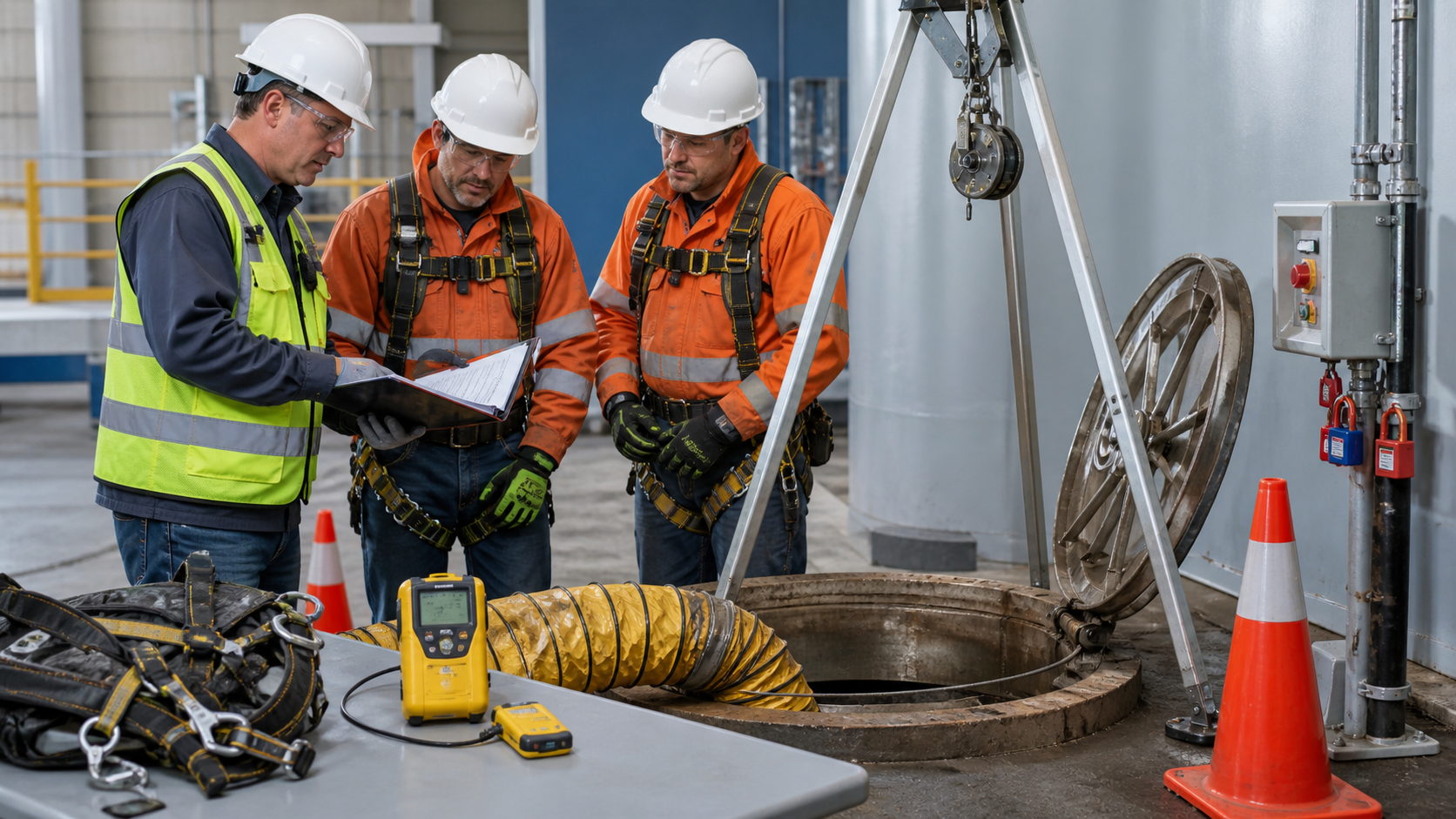
- Check equipment familiarity. Confirm that workers can inspect, wear, connect, and use the harness, retrieval line, tripod, davit, winch, blower, ducting, radio, intrinsically safe lighting when applicable, barriers, and personal protective equipment selected for the task.
- Confirm atmospheric testing practice. Training should explain why testing matters, but the employer must confirm the worker understands the specific monitor, sensors, calibration or bump-test process, sampling sequence, alarm response, continuous monitoring expectations, and limitations of the instrument being used.
- Validate rescue planning. Identify whether retrieval is feasible, whether entry rescue could be required, who will perform rescue, how quickly the rescue resource can respond, and whether the rescue plan fits the opening, depth, configuration, obstructions, and hazards of the actual space.
- Coordinate contractors. When multiple employers are involved, confirm that hazard information, prior-entry information, expected work, simultaneous operations, and post-entry results are communicated to the right parties.
- Keep records usable. Store training certificates with role assignments, site-specific briefings, practical evaluations, permits, monitor records where used, rescue evaluations, and refresher triggers. Records should answer what the worker was prepared to do, not merely that a course was completed.
- Set refresher triggers. Review training when duties change, procedures change, new hazards are introduced, equipment changes, an incident or near miss occurs, or an employee shows uncertainty about required procedures.
A simple decision framework helps. Ask four questions before assigning the worker:
1. What exact confined space duty will this person perform?
2. Does the completed course match that duty?
3. Has the employer covered site-specific procedures and equipment?
4. Has a supervisor or responsible person authorized the employee for this assignment?
If any answer is unclear, the next step is not to discard the training. The next step is to close the specific gap before entry.
Which Training Fits This Situation
Course selection should follow exposure and responsibility. Not every employee needs the same level of training, but every assigned duty needs enough training to support the employer's program.
Awareness training is generally the right starting point for employees who may encounter confined spaces but are not assigned to enter, supervise, attend, test, or rescue. It helps workers recognize spaces, understand why unauthorized entry is dangerous, respect signs and barriers, and know when to notify a supervisor. This can fit facility employees, helpers, office or warehouse personnel who pass through work areas, customer-facing staff near industrial operations, or crews that need general hazard recognition before a more specific assignment is made.
Permit-Required Confined Space Entry training fits employees who will participate in permit entries. Entrants need to understand hazards, acceptable entry conditions, communication, equipment use, signs and symptoms of exposure, evacuation triggers, and their duty to follow the permit and instructions. Attendants need to understand continuous monitoring of entrant status, communication, controlling access, recognizing hazardous conditions, ordering evacuation, and summoning rescue without abandoning the role unless relieved. Entry supervisors need to verify that the permit, hazard controls, testing, rescue arrangements, and assigned personnel are in place before authorizing entry.
Supervisor training is important when the person is responsible for the decision to authorize or stop entry. A supervisor who only has general awareness may understand that confined spaces exist but still lack the working knowledge needed to review permits, question incomplete controls, evaluate role coverage, or coordinate changes during the job. For buyers, this is often the missing course in a training plan. Entrants and attendants may be assigned training, while foremen and operations leaders are left to manage the work from habit.
Competent Person training is especially relevant for construction activities covered by 29 CFR 1926 Subpart AA. The competent person must be able to identify confined spaces and permit spaces and must have the authority connected to that evaluation. This role is not the same as entrant or attendant. A construction supervisor may need Competent Person training for the pre-entry evaluation and separate permit-entry training if that same person will also authorize or participate in a permit entry.
A multi-role plan is often the best fit for contractors, municipalities, utilities, and maintenance teams. The plan might assign Awareness training to employees who only need recognition, Permit-Required Entry training to entrants and attendants, Supervisor training to foremen who authorize permits, and Competent Person training to construction leads who evaluate work areas. For larger employers, group training, Spanish-language access, virtual sessions, in-person practical training, or SCORM delivery may help standardize records across locations. For smaller employers, the priority is a clear map from employee name to duty rather than buying the same course for everyone without a role decision.
No online course removes the need for hands-on practice where the job requires equipment proficiency. Workers still need to handle the monitor, blower, harness, retrieval system, communication device, and permit form they will actually use. Training should support that practice by explaining why each control exists and when it matters.
Common Mistakes to Avoid
The most common mistake is treating the certificate as the final authorization. A certificate of completion is valuable, but the employer still has to decide whether the employee may perform a specific role at a specific entry.
Another mistake is buying Awareness training for everyone because it sounds broad. Awareness is useful, but it is not the same as training for permit-required entrant, attendant, entry supervisor, rescue, atmospheric testing, or competent person duties. If a worker will enter a permit space, act as the attendant, or authorize entry, the course selection should reflect that duty.
Employers also create problems when records, job postings, or customer communications overstate OSHA's role in private training. A more accurate approach is to document OSHA-aligned training and a certificate of completion, then separately document employer authorization and any practical evaluations.
A fourth mistake is ignoring site-specific hazards after online training. A worker may understand oxygen deficiency, flammable atmospheres, toxic exposures, engulfment, mechanical hazards, and poor access in general. That worker still needs to know what is credible in the employer's tank, vault, pit, sewer, or vessel today.
Some teams also overlook language and comprehension. If workers receive training in a language or format they do not understand well enough to act on, the record may not support real readiness. Course access, briefings, permit review, and instructions should match the workforce.
Another mistake is assigning rescue as a line item without confirming capability. Naming a rescue provider is not the same as confirming that rescue can be performed for the space, opening, depth, internal layout, atmospheric condition, and PPE involved. Retrieval may be preferred when feasible, but employers still need to verify that the retrieval method will not create additional risk and that equipment is set up before entry.
Finally, many employers fail to update records when assignments change. A worker trained last year as an entrant may become a lead this year. A maintenance job may become construction. A non-permit space may change because of introduced hazards. A new monitor, ventilation method, or contractor activity may alter the briefing. Records should move with the work.
Next Step
After employees complete online confined space training, place the certificate in the record, then make one clear role decision for each worker. If the worker only needs to recognize spaces and avoid unauthorized entry, choose Awareness training and document that limit. If the worker will enter or support permit entry, choose Permit-Required Entry training and add site-specific equipment and procedure review. If the worker will authorize entry, choose Supervisor training. If the worker will evaluate confined spaces on construction work, choose Competent Person training, and add any additional role training needed for permit entry duties.
The practical course decision is simple: buy the training that matches the duty, then complete the employer follow-through before entry begins.
Ready to Get Your Crew Confined Space Certified?
Explore our OSHA-aligned online courses for Awareness, Permit-Required Entry, Supervisor, and Competent Person roles with instant certification.
Explore Courses & Pricing