
Search Intent
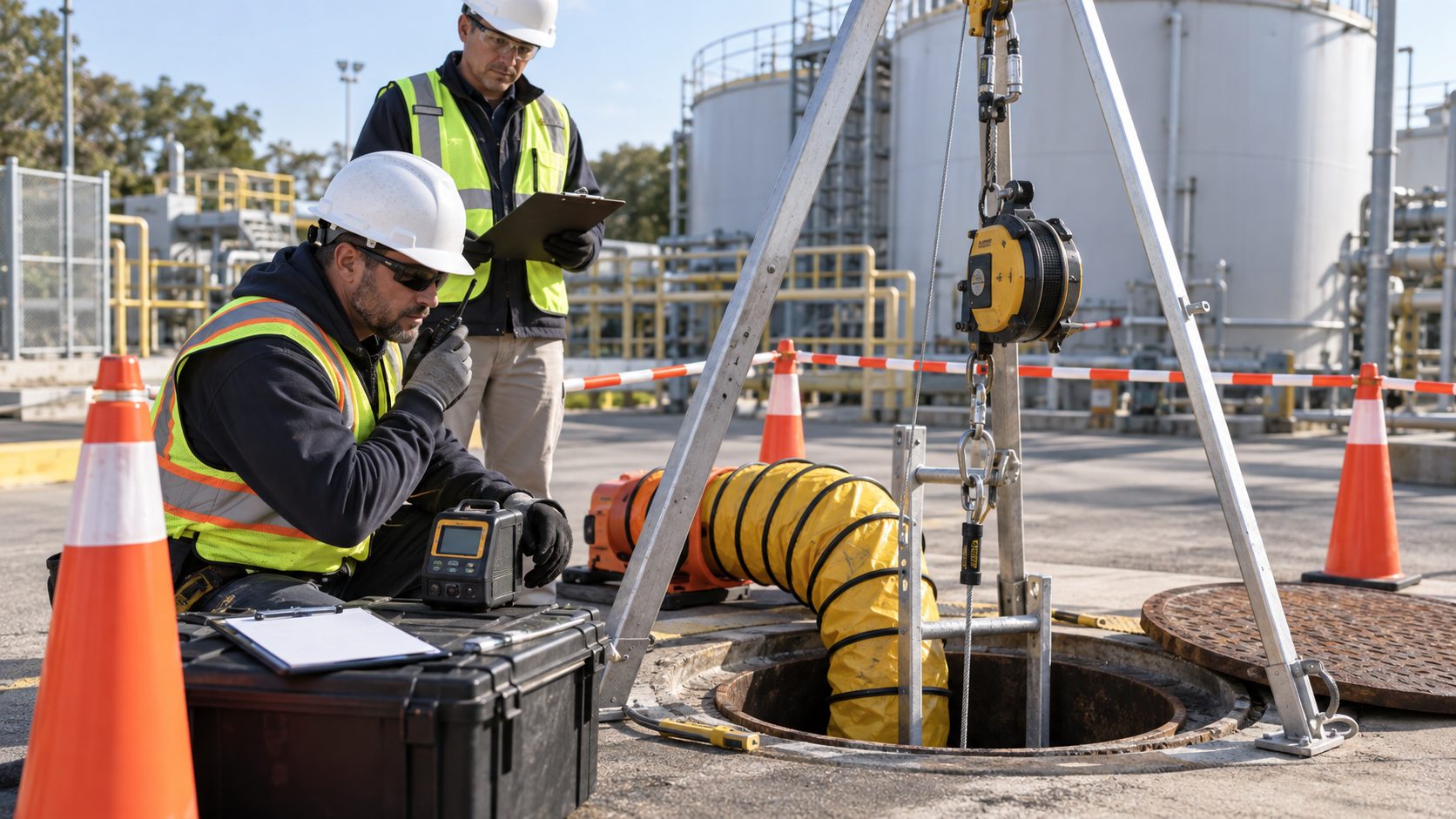
Employers often search for confined space training because they know entrants need instruction before going inside a tank, vault, pit, manhole, or process vessel. The practical question for this article is different: what training does the worker outside the opening need when that person is assigned as the attendant? It matters because the attendant is not a spare helper. The attendant is the worker expected to maintain communication, monitor conditions, recognize warning signs, keep unauthorized people away, and start the emergency response process without becoming a second victim.
Who This Affects
This affects employers that assign employees to support confined space work even when those employees do not enter the space. In many workplaces, the outside worker is a maintenance technician, utility crew member, laborer, foreman, plant operator, public works employee, contractor employee, or supervisor who has done the job many times before. That experience can be useful, but it does not automatically prepare the person for attendant duties.
The role shows up across general industry and construction. A manufacturing facility may assign an attendant while entrants clean a process tank or inspect a pit. A municipality may station an attendant at a manhole, lift station, meter vault, or stormwater structure. A contractor may assign an attendant while crews work in a crawl space, trench-connected vault, or newly installed utility structure. A facility manager may expect a contractor to provide the attendant, while the contractor assumes the host site will handle access control and emergency coordination.
The employers most likely to benefit from a clear attendant training decision include:
- EHS managers who maintain permit-required confined space programs
- Maintenance managers who schedule tank, vessel, pit, and vault work
- Construction supervisors working under 29 CFR 1926 Subpart AA
- Public works leaders responsible for sewer, water, stormwater, or utility crews
- General contractors coordinating several employers near one entry point
- Facility managers who hire outside service contractors for recurring confined space tasks
- Compliance coordinators who must document which employees are trained for which role
The key issue is that an attendant can be exposed to high-pressure decisions while physically remaining outside the confined space. The person may need to tell an entrant to evacuate, challenge a supervisor who wants work to continue, prevent an untrained employee from crossing the barricade, recognize an alarm on a monitor, or contact rescue services. If the attendant only received general awareness training, the employer should confirm whether that is enough for the assigned duty.
The Confined Space Compliance Issue
Confined space programs often focus first on the entrant because entry feels like the highest-risk act. That is understandable, but permit-required entry depends on more than the person going inside. OSHA standards identify duties for authorized entrants, attendants, and entry supervisors, and those duties are different. A worker stationed outside the opening is not simply watching the clock. The attendant role is a control point in the entry system.
Under the general industry permit-required confined space standard, an attendant is stationed outside one or more permit spaces and monitors authorized entrants while performing the duties assigned under the employer's permit space program. In construction, Subpart AA separately addresses duties of attendants and requires training so employees acquire the understanding, knowledge, and skills needed to safely perform their assigned duties.
For employers, the compliance issue is not only whether a course has been completed. The issue is whether the training matches the role the employee will actually perform. A person assigned as an attendant should understand the hazards that may be faced during entry, the symptoms and behavioral effects of exposure, the communication method, the procedure for ordering evacuation, the limits of non-entry rescue, the need to summon rescue and emergency services, and the rule that the attendant does not enter the space to attempt rescue unless properly relieved and authorized under the program.
That last point is especially important. Attendants can feel pressure to act physically when an entrant is in trouble. Without clear training, a well-intentioned employee may enter the space and become another casualty. Attendant training should reinforce that the role is active, but it is active from outside the space unless the employer's rescue plan specifically assigns and equips the person for rescue duties.
Employers should also avoid treating the attendant as a floating helper. If the attendant is asked to fetch tools, assist another crew, move materials, answer unrelated calls, or watch several separated openings at once, the role can break down. The training decision should be tied to a realistic work setup, not an ideal permit form that nobody follows in the field.
The issue is more complicated when contractors are involved. A host employer may know the space history, previous contents, isolation points, and site alarm procedures. The entry employer may train its own entrants and attendants. A controlling contractor may coordinate access, sequencing, and emergency communication at a construction site. If the attendant is not trained on the site-specific communication chain, the crew may have a certificate of completion but still lack the practical readiness needed for that entry.
What Employers Should Check
Before assigning a worker as a confined space attendant, employers should check both the formal training record and the planned work conditions. A practical review can prevent the common mistake of assuming the outside position is the easiest one to fill.
- Identify whether the space is a confined space, and whether it is permit-required.
- Confirm whether the job falls under general industry requirements, construction requirements, or a situation where both site and task context must be reviewed carefully.
- List the hazards that could affect the entrant and the attendant's decisions, including atmospheric hazards, engulfment, mechanical hazards, electrical hazards, heat, traffic, falls, and changing work conditions.
- Decide who will serve as authorized entrant, attendant, entry supervisor, competent person, rescue contact, and site contact.
- Confirm that the assigned attendant has training for attendant duties, not just general awareness.
- Verify that the attendant understands the permit, acceptable entry conditions, communication method, evacuation triggers, alarm responses, and emergency notification steps.
- Check whether the attendant is expected to monitor one opening or several spaces, and whether that setup is realistic.
- Confirm that the attendant will not be assigned unrelated work that interferes with monitoring entrants.
- Verify that unauthorized employees, visitors, subcontractors, and pedestrians can be kept away from the opening.
- Confirm how atmospheric monitoring readings will be communicated and who has authority to stop work.
- Review non-entry retrieval equipment, including tripod, winch, harness, lifeline, or other retrieval system when required and feasible.
- Confirm that the attendant knows not to enter for rescue unless the employer's rescue plan specifically allows that person to do so and all required conditions are met.
- Document the training date, course topic, employee name, role covered, and any site-specific briefing or hands-on practice.
The employer should also check whether the employee can explain the role in plain language. A good field test is simple: ask the attendant what would cause them to order evacuation, who they would call first, how they would keep a bystander away, what they would do if the gas monitor alarms, and whether they may enter the space during an emergency. If the answers are hesitant, inconsistent, or based on habit rather than procedure, the training plan needs attention before the entry starts.
For recurring work, employers should check whether conditions have changed since the last entry. A tank that was safe during one cleaning job may not have the same atmosphere, contents, isolation status, or contractor mix the next time. A utility vault that was treated as routine may become more complex after nearby construction, flooding, chemical discharge, traffic changes, or equipment failure. The attendant's training should prepare the worker to respect the current permit and current conditions, not just past experience.
Supervisors should also check language comprehension. If an attendant and entrant use different primary languages, the employer needs a communication method that works under field conditions. Hand signals, radios, verbal check-ins, and alarm instructions should be understood before entry. Training delivered in a language the worker does not understand well may leave the employer with a record but not real readiness.
Which Training Fits This Situation
The right training depends on what the worker will actually do. A worker who only needs to recognize confined space signs, understand basic hazards, and avoid unauthorized entry may need confined space awareness training. A worker assigned to stand outside a permit-required space and monitor entrants usually needs training that covers attendant duties in a much more specific way.
For an employee who will never enter, never authorize entry, and never supervise the permit, the employer may choose a role-focused attendant training plan as part of a permit-required confined space course. The course should explain how the attendant supports entry, how communication is maintained, what hazards and symptoms to watch for, when evacuation is required, how to summon rescue, and why the attendant must not abandon the post or enter for rescue outside the employer's plan.
For employees who may rotate between entrant and attendant duties, a permit-required confined space entry course is often a better fit than awareness alone. Rotation is common in small crews, municipal crews, and maintenance departments. One employee may enter during one job and serve as attendant during another. In that case, training should cover both authorized entrant duties and attendant duties, with clear boundaries for each role.
For supervisors, foremen, or lead workers who authorize entry, cancel permits, verify acceptable conditions, coordinate contractors, or decide when work stops, confined space supervisor training may be needed in addition to entrant or attendant instruction. The entry supervisor has different responsibilities from the attendant. Combining the two roles without training employees on both sets of duties can create confusion at the opening.
For construction activity, employers should consider whether a competent person must identify confined spaces, evaluate hazards, classify permit spaces, and coordinate protective measures before employees enter. Competent Person training is not the same as attendant training, but it may be part of a multi-role plan for contractors and construction supervisors. A competent person may help determine what conditions exist, while an attendant monitors entrants during the actual entry.
For larger employers, a multi-role plan may work best:
- Awareness training for employees who work near confined spaces but do not enter or support permit entry.
- Permit-Required Entry training for entrants and attendants who participate in permit spaces.
- Supervisor training for employees who authorize entry, verify permits, and coordinate work.
- Competent Person training for construction leaders who must evaluate confined spaces and related hazards on changing jobsites.
- Site-specific briefing and hands-on practice for the actual space, equipment, communication method, and emergency procedure.
Online training can help employers cover core concepts consistently, especially across multiple locations or shifts. It can also support documentation by creating a certificate of completion and a repeatable baseline. But employers should still provide site-specific instruction where needed. The attendant should know the actual rescue contact, alarm procedure, retrieval equipment, permit form, communication device, and stop-work authority for the job at hand.
The best question is not simply, "Did this person take confined space training?" A better question is, "Has this person been trained and briefed for the attendant duties we are assigning today?"
Common Mistakes to Avoid
One common mistake is assigning the newest or least experienced worker as the attendant because the person is not going inside. The role may look less technical from a distance, but it requires attention, authority, and confidence. An attendant who does not understand the hazards may miss early signs of trouble or hesitate when evacuation is needed.
Another mistake is treating awareness training as enough for every role. Awareness training is valuable for recognition and prevention, but it may not cover the detailed duties of an attendant during permit-required entry. If the employee is monitoring entrants, controlling access, communicating with the crew, and initiating emergency procedures, the training should match those duties.
A third mistake is letting the attendant perform side tasks. The attendant may be asked to retrieve parts, help with traffic control, move a hose, complete paperwork in a truck, or assist a second crew. If those tasks interfere with monitoring the entrants, the employer should assign another person or pause the entry. The attendant role should be protected from distractions.
Employers also make mistakes with communication. Radios may not work inside a tank. Verbal contact may fail near traffic, pumps, blowers, or production equipment. A hand signal may not be visible around a bend or through a manway. Before entry, the attendant and entrant should test the communication method and agree on check-in timing, alarm signals, and evacuation instructions.
Another frequent problem is unclear rescue planning. Attendants must know who to call and what information to provide. They should understand the difference between summoning rescue, using non-entry retrieval when appropriate, and entering the space. If the plan depends on outside emergency responders, the employer should confirm that the responders are able to respond in a manner suitable for the hazards and site conditions. If the plan depends on an in-house rescue team, the attendant should know how to activate that team immediately.
Contractor coordination can create another gap. A host site may have excellent information about the space, but the contractor's attendant may never receive it. Or the contractor may have trained attendants, but the host site may not explain site alarms, access routes, chemical history, or emergency contacts. The entry plan should close that gap before work starts.
Finally, employers should avoid stale records. A worker may have completed a course years ago, changed roles, moved departments, or begun supporting different types of entry. Refresher training may be needed when duties change, procedures change, hazards change, an incident or near miss occurs, or the employer has reason to believe the employee no longer has the required understanding or skill.
Next Step
Before the next confined space entry, identify every worker who may serve as an attendant and compare their training to the actual duty. If the worker will only recognize and avoid confined spaces, awareness training may fit. If the worker will monitor entrants outside a permit-required space, choose training that covers attendant duties as part of a Permit-Required Entry or role-specific confined space plan. If that same worker also enters, supervises, authorizes permits, or evaluates construction spaces, build a multi-role plan that includes the additional training needed for those responsibilities.
The practical goal is simple: the attendant should know the hazards, understand the permit, maintain communication, control access, recognize warning signs, order evacuation when needed, and activate rescue without improvising. That level of readiness supports employer compliance and gives the entry team a stronger margin of safety before anyone crosses the opening.
Sources
OSHA, Permit-required confined spaces, 29 CFR 1910.146
https://www.osha.gov/laws-regs/regulations/standardnumber/1910/1910.146
OSHA, Confined Spaces in Construction, 29 CFR 1926 Subpart AA
https://www.osha.gov/laws-regs/regulations/standardnumber/1926/1926subpartaa
OSHA, Confined Spaces Overview
https://www.osha.gov/confined-spaces
OSHA, Confined Spaces Hazards and Solutions