
Search Intent
What training should an entry supervisor complete before signing a confined space permit, and what should the employer verify before allowing the job to begin? This matters because the signature on a permit is not a ceremonial step. It is the employer's checkpoint that hazards, roles, controls, rescue arrangements, and site-specific procedures have been reviewed before workers enter a space where conditions can change quickly.
Who This Affects
This topic affects employers who assign supervisors, competent persons, foremen, lead technicians, maintenance managers, municipal crew leaders, construction superintendents, facility managers, safety coordinators, and contractor representatives to authorize confined space work. It also affects entrants and attendants because their work depends on the supervisor's ability to recognize whether the entry is ready or whether the team needs to stop and correct a gap.
In many workplaces, the person who signs the permit is not a full-time safety professional. The role may belong to a maintenance supervisor who knows the equipment, a public works lead who knows the site, a construction foreman coordinating several trades, or a facility manager who schedules recurring contractor work. That can work well when the employer gives the supervisor role-specific training and clear authority. It becomes risky when the signature is treated as paperwork instead of a decision.
A confined space entry supervisor needs more than general awareness. Awareness training helps workers recognize confined spaces, understand why hazards can be serious, and know when not to enter. The supervisor must go further. This person needs to understand the employer's permit system, the difference between permit and non-permit spaces, atmospheric testing expectations, ventilation and isolation controls, entrant and attendant duties, rescue arrangements, communication methods, and the conditions that require canceling, suspending, or reevaluating the entry.
This is especially important for employers with mixed crews or shared jobsites. A host employer may know the space history, a controlling contractor may coordinate the overall job, and an entry employer may direct the workers who enter. The supervisor who signs the permit needs enough training to ask practical questions across those lines. Who verified the space classification? Who tested the atmosphere? What hazards are expected from the work itself? Who is the attendant? How will rescue be summoned or performed? Is the rescue plan realistic for this space and this crew?
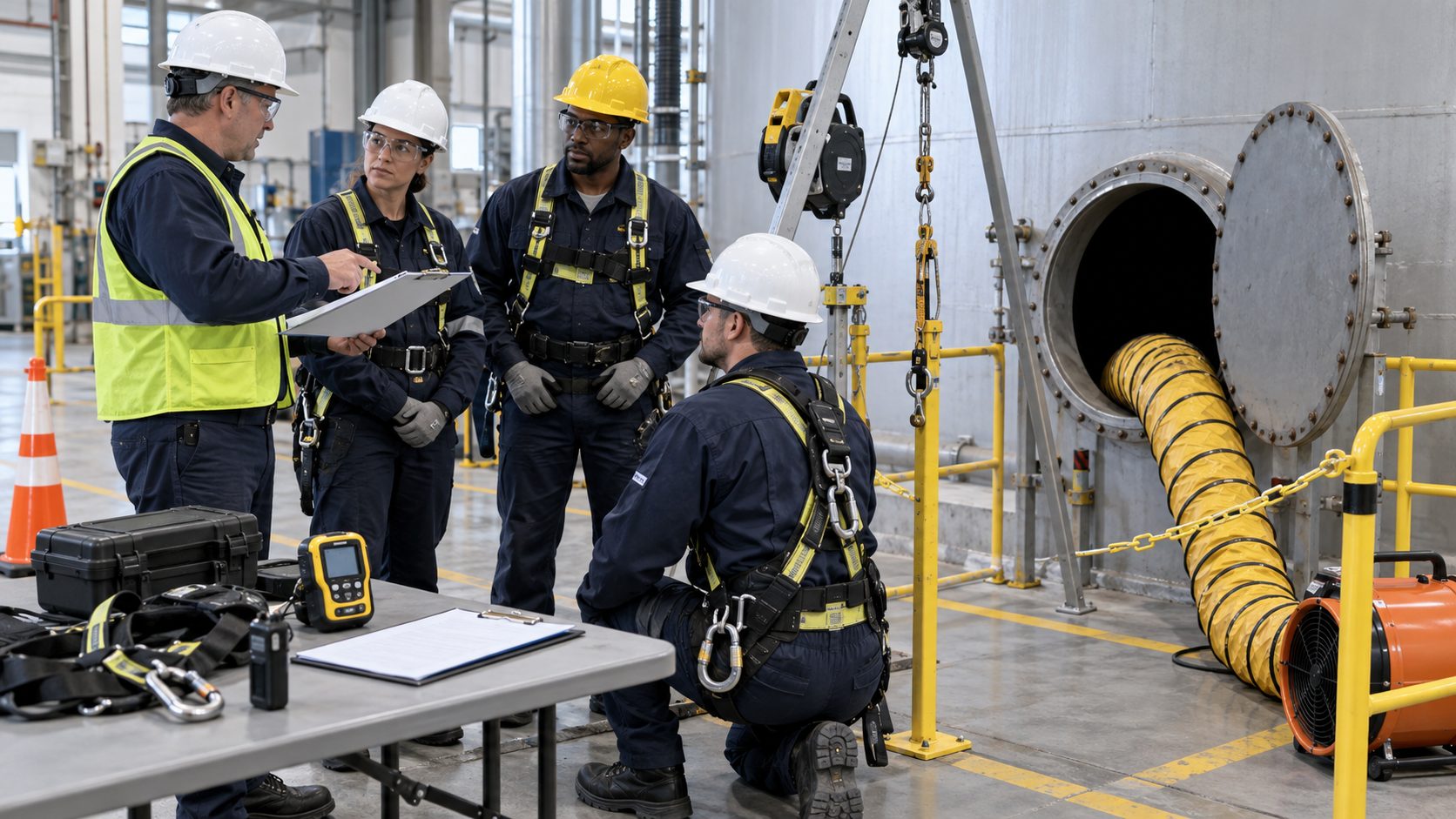
The ready-check concept is useful because it turns training into a worksite decision. The goal is not simply to produce a certificate of completion. The goal is to make sure the person authorizing entry can connect course learning to the actual tank, vault, pit, vessel, manhole, crawl space, sewer structure, utility chase, or process equipment in front of the crew.
The Confined Space Compliance Issue
OSHA's confined space rules place responsibility on employers to evaluate spaces, identify hazards, protect employees, and make sure affected workers understand the procedures that apply to their duties. In general industry, 29 CFR 1910.146 addresses permit-required confined spaces. In construction, 29 CFR 1926 Subpart AA addresses confined spaces in construction and includes duties for different employer roles on construction worksites. The exact standard that applies depends on the work, the employer, and the setting, but the practical issue is the same: workers should not enter until the employer has made a real determination that entry conditions are acceptable.
That is where entry supervisor training becomes important. A permit-required confined space may contain or have the potential to contain a hazardous atmosphere. It may contain material that could engulf an entrant. It may have an internal configuration that could trap or asphyxiate a worker. It may contain another serious safety or health hazard, such as mechanical energy, electrical hazards, heat, chemicals, biological hazards, traffic exposure, falls, or moving parts. The permit is the employer's controlled method for identifying those conditions and documenting the steps taken before and during entry.
The supervisor's signature should mean that required preparations have been completed, not merely that a form has been filled out. If testing is missing, if ventilation has not been set up, if lockout or isolation is incomplete, if entrants are unclear about communication, or if rescue arrangements are vague, the entry is not ready. A trained supervisor should have the confidence and authority to delay the job until the issue is corrected.
Employers sometimes assume that online training alone makes a supervisor ready to sign. Online training can be a strong part of the plan, especially when it is OSHA-aligned and role-specific. It can explain regulatory concepts, job roles, hazard recognition, permits, communication, and emergency planning in a consistent way. But the employer still has to connect that training to the workplace. The supervisor must know the employer's written procedures, the exact permit form, the types of spaces at the site, the testing equipment used by the crew, the rescue provider or retrieval system, and the stop-work expectations.
Another compliance issue is role confusion. On small crews, one person may be a competent person for construction evaluation, an entry supervisor for the permit, and a foreman for production scheduling. Those functions can overlap, but they are not the same decision. A competent person may identify hazards and corrective measures. An entry supervisor authorizes, oversees, and terminates entry according to the permit program. A foreman may manage labor and schedule. Training should help the employee understand which hat they are wearing at each step and where the employer requires another qualified person to review the work.
Confined space conditions can also change after the permit is signed. Welding, cleaning, coating, pumping, pressure washing, sludge disturbance, chemical use, adjacent processes, weather, traffic, and equipment operation can all affect the atmosphere or other hazards. A ready-check is therefore not a one-time formality. It is the starting point for continuous attention. If conditions change, the supervisor and attendant need to know what to do, including evacuating entrants, stopping work, retesting, revising controls, or canceling the permit.
What Employers Should Check
Before assigning someone to sign or authorize a confined space permit, employers should check the training, site knowledge, authority, and support behind that role. A practical readiness review can prevent a common problem: a supervisor who has responsibility on paper but does not have enough information to make the decision.
- Confirm the employee has completed role-specific confined space training, not only general awareness. Awareness is useful, but the supervisor needs training tied to authorization, permit review, hazard controls, rescue coordination, and stopping entry when conditions are not acceptable.
- Match the training to the standard and setting. General industry work should align with the employer's 29 CFR 1910.146 program. Construction work should account for 29 CFR 1926 Subpart AA, including employer communication and competent person responsibilities where applicable.
- Review the employer's actual permit form. The supervisor should know what each field means, who provides the information, what is required before signing, and when the permit must be canceled or closed.
- Verify space classification. The supervisor should understand why the space is being treated as permit-required, non-permit, alternate procedure, or reclassified where allowed by the employer's program and applicable standard.
- Confirm atmospheric testing expectations. The supervisor does not always perform the testing personally, but they should know who is qualified to test, what sequence is used, what acceptable entry conditions are, whether continuous monitoring is required, and what action levels trigger evacuation or review.
- Check ventilation and isolation controls. The supervisor should know whether the space has been ventilated, whether ventilation must continue, how energy sources have been controlled, and whether mechanical, hydraulic, pneumatic, electrical, chemical, or process hazards have been isolated.
- Confirm entrant and attendant assignments. The supervisor should verify that each person understands their role, that the attendant is not assigned conflicting duties, and that communication methods are available and understood.
- Review rescue and retrieval before entry. The supervisor should know whether non-entry retrieval is required or feasible, where the retrieval equipment is placed, who will respond, how they will be contacted, and whether the rescue plan fits the actual space.
- Check contractor coordination. If contractors are involved, the supervisor should know what information the host or controlling employer has provided, how hazards will be communicated, and who has authority to stop work.
- Confirm language and comprehension needs. If the crew includes workers who prefer Spanish or another language, the employer should make sure training, briefings, and permit instructions are understood in a language and format workers can use.
- Document completion and refreshers. Keep certificates of completion, course records, toolbox briefings, hands-on evaluations, equipment practice records, and site-specific instruction together so the employer can show how the supervisor was prepared for the duty.
- Give the supervisor real stop-work authority. Training is incomplete if the supervisor is expected to sign while production pressure overrides safety decisions. The employer should state clearly that entry can be delayed, suspended, or canceled when conditions are not acceptable.
These checks do not have to be complicated. A supervisor readiness file might include the course completion certificate, a copy of the employer's confined space program, a sample permit review, a list of spaces the supervisor may authorize, equipment familiarization notes, rescue contact details, and records of site-specific briefings. The point is to create a practical bridge between training and the jobsite.
Employers should also check whether the supervisor has practiced the decisions they will make under time pressure. Can they identify a missing attendant? Can they notice that the rescue plan is only a phone number with no realistic response plan? Can they explain why a blower running at the opening does not automatically prove the atmosphere is safe? Can they stop a job when a contractor wants to enter a pit that was classified for a different task? Those questions show whether training has become usable judgment.
Which Training Fits This Situation
For employees who only need to recognize confined spaces and avoid unauthorized entry, Confined Space Awareness training is usually the starting point. It helps workers understand what a confined space is, why some spaces require permits, and why no one should enter without authorization. It is appropriate for employees who may work near spaces, report hazards, support a crew from outside the entry program, or need a foundation before deeper role training.
For workers who enter permit-required confined spaces, Permit-Required Confined Space Entry training should address entrant duties, attendant duties, supervisor duties where included, hazard recognition, atmospheric testing concepts, communication, ventilation, rescue awareness, and permit procedures. If a worker may enter tanks, vaults, manholes, pits, vessels, sewers, crawl spaces, or similar spaces, the course should be paired with site-specific instruction on the employer's spaces and equipment.
For the person signing or authorizing the permit, Entry Supervisor training should be explicit. The supervisor needs to understand how to verify acceptable entry conditions, review the permit, confirm controls, coordinate roles, monitor conditions, remove unauthorized individuals, and terminate entry when required. If a general permit-required entry course includes supervisor duties, the employer should still verify that the course content is deep enough for the authority being assigned.
For construction crews, Competent Person training may also be needed. Construction confined space work often requires someone who can identify existing and predictable hazards and has authorization to take prompt corrective measures. This is especially relevant when work conditions change, multiple employers are present, or the crew is evaluating spaces created or affected by construction activity. Competent Person training should not be treated as a substitute for entry supervisor training unless the content and employer procedures clearly cover both duties.
For supervisors managing mixed teams, a multi-role plan is often best. One plan might include Awareness training for nearby employees, Permit-Required Entry training for entrants and attendants, Entry Supervisor training for the person authorizing the permit, Competent Person training for construction leads, and hands-on practice with the employer's monitor, blower, retrieval device, communication system, and permit form. This layered approach is more defensible than giving everyone the same basic course and assuming the job roles will sort themselves out later.
Refresher training should be considered when duties change, procedures change, equipment changes, a new type of space is added, an incident or near miss occurs, an audit finds gaps, or the employer has reason to believe an employee no longer understands the required procedures. Many employers also schedule periodic refreshers as part of a broader EHS calendar. The key is to make refreshers meaningful. A supervisor refresher should include permit review, role coordination, rescue planning, and examples of when to stop entry.
Online training is useful when employers need consistent baseline content across locations, shifts, or contractors. It can be especially helpful for documenting completion and making sure supervisors receive the same foundation. But the final fit depends on job duties. A supervisor who signs permits needs more than a broad overview. The course should help them make decisions, and the employer should follow it with site-specific instruction before the person is placed in charge of an actual entry.
Common Mistakes to Avoid
One mistake is letting the most senior person on the crew sign the permit without confirming confined space role training. Experience with the equipment is valuable, but experience alone does not prove the person understands permit-required confined space duties, atmospheric hazards, rescue expectations, or when to terminate entry.
Another mistake is confusing a certificate of completion with employer authorization. A certificate can show that a worker completed a course. It does not automatically prove the worker is ready to authorize entry at a specific facility or jobsite. Employers still need to review their own procedures, equipment, spaces, and rescue arrangements with the supervisor.
Employers also get into trouble when the permit is copied from a prior job without a fresh hazard review. A space may look familiar, but the task can change the risk. Cleaning, welding, pumping, coating, chemical use, grinding, pressure washing, and sludge disturbance can create different hazards from inspection or simple maintenance. A trained supervisor should ask whether today's work changes the controls.
A fourth mistake is assigning the attendant conflicting duties. If the attendant is also expected to fetch tools, operate equipment away from the opening, direct traffic, or perform unrelated maintenance, the entry may not be properly monitored. The supervisor should catch that before signing.
Rescue assumptions are another weak point. Calling 911 may be part of an emergency plan, but employers should not assume local emergency responders can perform timely confined space rescue for every space. The supervisor needs to know what the employer's rescue plan actually is, whether non-entry retrieval is set up when required and feasible, and how the team will respond if an entrant cannot self-rescue.
Some employers also overlook language access. If the supervisor completed training in English but the entrant or attendant relies on Spanish instruction, the briefing can become uneven. The supervisor needs to confirm that the crew understands the permit conditions, communication methods, evacuation triggers, and emergency steps.
Finally, avoid treating the entry supervisor as a paperwork role with no authority. If the supervisor cannot delay work, request more testing, require ventilation, stop a contractor, or cancel the permit, the employer has weakened the control that the role is supposed to provide. Training should be backed by management support.
Next Step
If your organization assigns anyone to sign confined space permits, start with a simple role map. List who may enter, who may serve as attendant, who may authorize the permit, who evaluates construction spaces as a competent person, and who coordinates contractors. Then match training to each duty.
For the permit signer, choose training that specifically covers entry supervisor responsibilities, permit review, acceptable entry conditions, testing and ventilation concepts, communication, rescue coordination, and the authority to stop or cancel entry. Pair the course with a site-specific walkthrough of your permit form, your known spaces, your monitoring equipment, your ventilation and retrieval setup, and your rescue plan.
The right question is not, "Did the supervisor take a confined space course?" The better question is, "Can this supervisor make a sound ready-for-entry decision for this space, this crew, and this task today?" When the answer is yes, the permit signature has real meaning. When the answer is uncertain, the next step is training, clarification, and site-specific practice before anyone enters.
Sources
OSHA, Permit-required confined spaces, 29 CFR 1910.146
https://www.osha.gov/laws-regs/regulations/standardnumber/1910/1910.146
OSHA, Confined Spaces in Construction, 29 CFR 1926 Subpart AA
https://www.osha.gov/laws-regs/regulations/standardnumber/1926/1926SubpartAA
OSHA, Confined Spaces overview