
Search Intent
Facility managers, maintenance leaders, and contractor coordinators often need to know which confined space training applies when the same building, plant, campus, or municipal facility has recurring cleaning, inspection, repair, or service callouts. The practical question is not only whether a space is confined. It is who will recognize the hazard, who will authorize work, who will enter, who will attend the entry, who will supervise contractors, and what the employer must still do after an online course or certificate of completion is finished.
Who This Affects
This topic affects employers that manage facilities where confined spaces are part of normal operations, even if entry is not a daily task. A facility may have tanks, pits, sumps, vaults, crawl spaces, ducts, hoppers, process vessels, clarifiers, lift stations, utility chases, trenches connected to structures, or below-grade mechanical rooms. Some of those spaces may be visited only during inspections, annual cleaning, pump repair, utility work, or emergency maintenance. That limited frequency can make the training decision feel less urgent, but it can also make the work harder to control because each callout feels unusual.
The audience is broad. It includes facility managers who schedule contractors, EHS managers who own the written program, maintenance supervisors who assign employees, purchasing teams that buy online training, construction managers who bring in trade partners, municipal leaders who manage water or wastewater assets, and property managers who coordinate vendors across multiple sites. It also includes contractors who may be asked to enter a tank, pit, manhole, crawl space, or vault on a customer's property.
For many employers, the confusing point is that confined space training is not a single universal course decision. A person who only needs to recognize a confined space and avoid unauthorized entry does not need the same preparation as an entrant who will work inside a permit-required confined space. A supervisor who signs or cancels entry permits needs different knowledge than a maintenance planner who only coordinates dates and contractor access. A competent person on a construction jobsite needs to be able to identify confined spaces and evaluate hazards in the context of 29 CFR 1926 Subpart AA. A general industry facility may need to align its program with 29 CFR 1910.146 when permit-required spaces are present.
Recurring callouts raise one more issue. Work can become routine in the calendar without becoming routine in the hazard profile. The same sump that was cleaned safely last quarter can have a different atmosphere after a process change, chemical spill, sludge buildup, ventilation failure, adjacent hot work, or weather event. The same contractor crew may not send the same employees every visit. The same entry supervisor may not be available. The same facility manager may assume the contractor is handling everything, while the contractor assumes the host employer will provide space information and site rules. Training helps close those gaps, but only when it is matched to the worker's role.
The Confined Space Compliance Issue
The compliance issue begins with classification and communication. A confined space is generally large enough for a person to enter, has limited or restricted entry or exit, and is not designed for continuous occupancy. A permit-required confined space has one or more serious hazards, such as a hazardous atmosphere, engulfment potential, inwardly converging walls, a floor that slopes downward and tapers, or another recognized serious safety or health hazard. Employers need a way to identify those spaces, prevent unauthorized entry, and control entry when work must be performed.
In general industry, OSHA's permit-required confined space rule at 29 CFR 1910.146 requires employers to evaluate the workplace, inform exposed employees about permit spaces, prevent unauthorized entry, and develop a permit space program when employees will enter permit-required spaces. The rule also defines duties for authorized entrants, attendants, and entry supervisors. Those duties are not interchangeable. Entrants need to know the hazards, signs and symptoms of exposure, communication procedures, equipment use, and when to evacuate. Attendants need to monitor entrants, maintain communication, keep unauthorized people away, and summon rescue. Entry supervisors need to verify permit conditions, confirm tests and procedures, authorize entry, terminate entry, and remove unauthorized individuals.
In construction, 29 CFR 1926 Subpart AA adds requirements for confined spaces in construction and includes coordination duties when more than one employer is involved. This matters when a facility owner, general contractor, subcontractor, utility contractor, cleaning contractor, or maintenance vendor is part of the same job. A facility manager may not be performing the entry, but the facility may still hold critical information about the space, including known hazards, prior testing data, isolation points, products previously stored, configuration, and previous incidents.
The training issue is therefore not limited to the person climbing through the opening. Training needs to support the full entry system. Someone has to recognize when a planned task involves a confined space. Someone has to know whether the work is general industry maintenance, construction activity, or a situation where both sets of obligations need careful review. Someone has to decide whether the facility will prohibit employee entry and rely on a qualified contractor, or whether its own personnel will participate as entrants, attendants, rescue support, testing personnel, or entry supervisors. Someone has to maintain records, permits, rescue arrangements, equipment readiness, and site-specific procedures.
Online confined space training can be a useful foundation because it helps standardize baseline knowledge across sites, shifts, and contractor coordination roles. But a certificate of completion does not, by itself, evaluate a particular tank, assign rescue services, calibrate a gas monitor, write a permit, verify lockout, or practice retrieval. Employers still need site-specific instruction, hands-on equipment orientation where needed, written procedures, and supervision appropriate to the task. That distinction is especially important for recurring callouts because people may treat the training purchase as the finish line when it is really one part of the readiness process.
What Employers Should Check
Before choosing a course or assigning a contractor, employers should check the work pattern, the space, the role, and the site controls. The goal is not to make the training decision complicated. The goal is to avoid buying one course for everyone and discovering later that the people making entry decisions were not trained for the decisions they made.
- List the spaces that may be entered during recurring work.
- Identify whether each space is a confined space and whether it may be permit-required.
- Note which spaces are owned, controlled, leased, maintained, or serviced by outside employers.
- Separate routine access from true entry. Reaching through an opening may create different issues than full body entry, but both should be reviewed carefully.
- Identify who can authorize work, who can stop work, and who can change the schedule.
- Decide whether employees will enter, contractors will enter, or both.
- Identify whether the work is maintenance, inspection, cleaning, repair, construction, demolition, installation, or utility service.
- Confirm which OSHA standard is most relevant to the task and industry setting.
- Review known hazards, including atmospheric hazards, mechanical energy, electrical hazards, engulfment, heat, noise, chemicals, biological hazards, traffic, water, sludge, moving parts, and poor access.
- Confirm whether atmospheric testing, ventilation, isolation, lockout, blanking or blinding, line breaking controls, fall protection, retrieval, or barricades are needed.
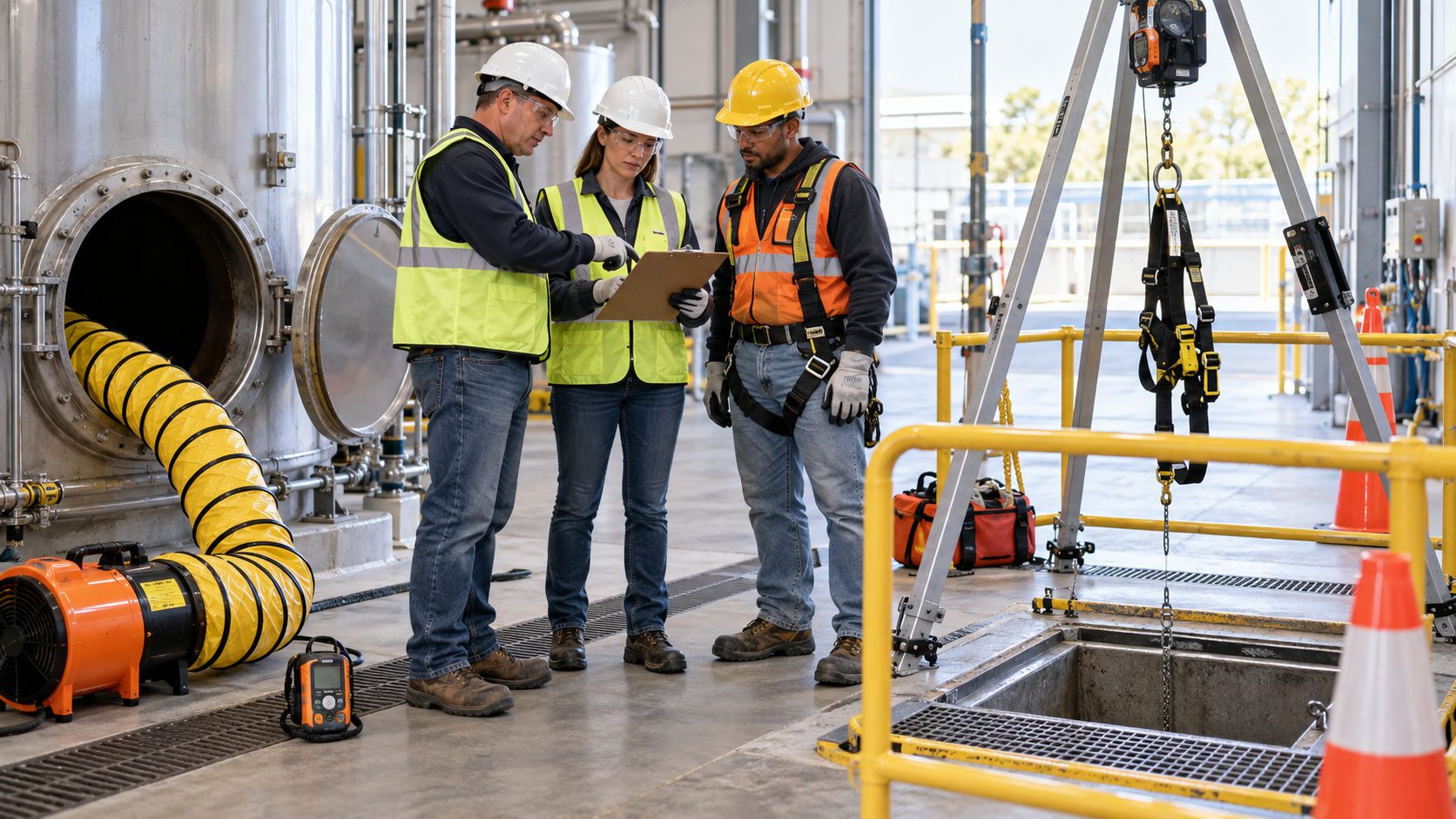
- Confirm who supplies, inspects, uses, and maintains equipment such as gas monitors, blowers, tripods, winches, harnesses, radios, ladders, lighting, and PPE.
- Confirm whether rescue is non-entry retrieval, entry rescue by an outside service, an internal rescue team, or another documented arrangement.
- Check whether the rescue arrangement is practical for the specific space, not just named on paper.
- Decide what records will be kept, including training completion, site-specific instruction, permits, equipment checks, atmospheric test results, contractor communications, and refresher triggers.
- Decide how temporary workers, substitute crew members, second-shift employees, and new contractor personnel will be handled.
Facility managers should pay special attention to communication with contractors. A contractor may have its own confined space program, but the host employer may still need to share known hazards and coordinate activities. Contractors should not be left to guess what a tank previously contained, where isolation valves are located, whether a sump receives chemical discharge, or whether another contractor will be performing nearby hot work. Likewise, the host employer should not assume that a vendor's general safety orientation proves that the specific workers on site are prepared for confined space entry.
Employers should also check how callouts are initiated. If a maintenance ticket simply says "clean pit" or "inspect tank," the person scheduling the job may not flag the confined space issue early enough. Better work orders identify the space, the expected task, the potential need for permit-required confined space procedures, the role of the contractor, and the internal contact responsible for coordination. The earlier this happens, the easier it is to choose the right training path.
Another useful check is the difference between awareness and authorization. Many employees need awareness-level training because they work near confined spaces or could discover one during normal duties. Awareness training can help them recognize the space, understand warning signs, avoid unauthorized entry, and contact the right supervisor. That does not mean they are authorized entrants. A person should not be assigned as an entrant, attendant, or entry supervisor just because they completed a broad overview course.
Finally, employers should check whether hands-on practice is needed. People who use atmospheric monitors need instruction on the actual device, including calibration or bump testing procedures established by the employer or manufacturer, sampling strategy, alarm response, and documentation. People who use ventilation need to understand placement, airflow, ducting, and limitations. People who wear retrieval harnesses need to know fit, connection points, and the rescue plan. Training should support those tasks, not replace the employer's site-specific equipment program.
Which Training Fits This Situation
For recurring facility callouts, the strongest training plan is usually role-based. It may include several course types rather than one catch-all assignment.
Awareness training fits employees who may encounter confined spaces but are not authorized to enter. This can include property managers, maintenance coordinators, facility office staff who dispatch vendors, custodial leads, mechanics who work near tanks or pits, and supervisors who need to recognize when a job should be escalated. Awareness training is useful when the main behavior is recognition, avoidance of unauthorized entry, and notification.
Permit-Required Confined Space Entry training fits employees who may serve as authorized entrants or attendants, or who need a more complete understanding of permit-required entry procedures. For facility callouts, this may apply to in-house maintenance teams that clean sumps, inspect tanks, enter process vessels, service pits, work in utility vaults, or assist contractors. It should cover hazards, permits, communication, atmospheric testing concepts, ventilation, PPE, evacuation, attendant duties, and the limits of each role.
Supervisor training fits people who authorize, coordinate, or oversee confined space work. A facility manager may not be the formal entry supervisor on every permit, but supervisors who plan work need enough knowledge to spot incomplete arrangements. Entry supervisors need deeper role-specific training because they verify conditions, confirm procedures, authorize entry, terminate entry when needed, and make sure unauthorized people stay out. This is a critical role for recurring callouts because the supervisor is often the person who prevents a routine service job from drifting into uncontrolled entry.
Competent Person training is often relevant for construction work under 29 CFR 1926 Subpart AA. If a contractor is installing equipment, modifying a structure, repairing a system as part of construction activity, or working on a multi-employer construction jobsite, the employer may need a competent person who can identify confined spaces, evaluate hazards, and take prompt corrective measures. Facility leaders should not assume that all confined space work at an existing site is automatically general industry. The nature of the task matters.
A multi-role plan is best when a facility has repeated entries, multiple buildings, mixed crews, or frequent contractor support. For example, awareness training may go to dispatchers and general maintenance staff, permit-required entry training may go to employees who enter or attend, supervisor training may go to maintenance leads and EHS staff, and competent person training may go to those overseeing construction-related confined space work. Contractors can be asked to document their own role training, while the host employer documents site-specific communication and coordination.
For employers buying online training, the practical question should be: what decision will this person make after the course? If the person only needs to recognize a confined space and route the job correctly, awareness may fit. If the person will enter or attend, a permit-required entry course is more appropriate. If the person will authorize or manage entries, supervisor training should be considered. If the person will evaluate confined spaces in construction, competent person training may be needed. If the person will use equipment, the employer should add hands-on and site-specific instruction.
Common Mistakes to Avoid
One common mistake is treating annual contractor work as if it is outside the facility's confined space responsibilities. Hiring a qualified contractor can be a sound decision, especially when internal employees are not trained or equipped to enter. But the facility may still need to identify known permit spaces, communicate hazards, coordinate operations, and control its own employees. "The contractor handles confined space" is not a complete plan unless the communication and coordination pieces are also handled.
Another mistake is assigning awareness-trained employees to entry roles. Awareness training is valuable, but it is not the same as authorized entrant, attendant, entry supervisor, or competent person preparation. The title of the course, the course objectives, and the worker's assigned duties should line up.
A third mistake is relying on a certificate of completion as proof that a specific entry is ready. A certificate can document course completion. It does not prove that the atmosphere is safe, that isolation is complete, that ventilation is adequate, that rescue can reach the space, or that the permit has been reviewed. Employers should keep completion records, but they should also maintain the job-level controls required for the work.
Another frequent problem is missing the handoff between general industry and construction. A facility may run under general industry rules most of the year, then bring in contractors for installation, demolition, renovation, or major repair work that changes the confined space compliance context. The training plan should allow managers to recognize that shift and involve the right competent person, contractor, or EHS resource before work begins.
Employers also make mistakes with rescue planning. Calling 911 may be part of an emergency plan, but employers should not assume that local emergency responders are automatically equipped, trained, available, and able to perform rescue from a specific tank, vault, pit, or vessel. Rescue arrangements need to fit the actual space and entry method. Non-entry retrieval may be required or preferred when feasible, but it must be set up before entry and used correctly.
Finally, recurring work can create overconfidence. When a pit has been cleaned ten times without incident, crews may skip testing, rush ventilation setup, or treat the permit as paperwork. Training should reinforce that each entry is evaluated on current conditions. A routine schedule does not make a confined space routine.
Next Step
For recurring facility and contractor callouts, start with a simple role map. Identify who recognizes confined spaces, who schedules the work, who enters, who attends, who supervises, who evaluates construction-related spaces, and who coordinates contractors. Assign awareness, permit-required entry, supervisor, and competent person training according to those duties. Then add the employer's site-specific instruction, equipment practice, rescue planning, and documentation before any entry is authorized.
The best course choice is the one that matches the worker's actual decision-making authority. If a person can stop, approve, enter, attend, test, ventilate, or coordinate confined space work, the training plan should say so clearly. That clarity helps employers use online training correctly, support compliance, and give supervisors a practical way to control recurring confined space work before the crew arrives.
Sources
OSHA, Permit-Required Confined Spaces, 29 CFR 1910.146
https://www.osha.gov/laws-regs/regulations/standardnumber/1910/1910.146
OSHA, Confined Spaces in Construction, 29 CFR 1926 Subpart AA
https://www.osha.gov/laws-regs/regulations/standardnumber/1926/1926SubpartAA
OSHA, Confined Spaces