
Search Intent
What confined space training should employers choose when tanks, bins, silos, hoppers, pits, vaults, and process vessels are scattered across a facility or jobsite, and why should the hazard inventory come before the course purchase?
That question matters because many employers do not start with one simple, labeled permit space. They start with a maintenance list, a production schedule, a contractor scope, or a supervisor request that says a crew needs to clean, inspect, repair, sample, unclog, coat, weld, or troubleshoot something inside equipment that was never designed for routine occupancy. The training decision can become rushed: send the workers to a confined space course, collect certificates of completion, and move on. That may create a record, but it does not answer the field question that controls the entire plan: what hazards are credible in each space, and who is expected to recognize, evaluate, enter, attend, supervise, or stop the work?
A practical confined space training plan starts with the inventory. Not just a list of space names, but a usable review of access points, dimensions, contents, residues, atmospheric concerns, engulfment potential, mechanical energy, electrical energy, heat, chemical exposure, isolation needs, communication limits, rescue realities, and tasks that may introduce new hazards. Once the employer knows what the spaces are and what work is expected, the training choices become more defensible and much easier to explain to supervisors, purchasing teams, contractors, and crews.
Who This Affects
This issue affects employers that manage more than one type of confined space or more than one type of crew. Manufacturing plants, food and beverage facilities, utilities, municipalities, grain and aggregate operations, construction contractors, wastewater teams, warehouses, refineries, fabrication shops, campuses, hospitals, commercial facilities, and maintenance contractors may all have spaces that look different but raise similar training questions.
The spaces may include tanks, vats, bins, silos, hoppers, mixers, process vessels, boilers, pits, vaults, manholes, pump stations, ductwork, trenches with restricted access, crawl spaces, storm structures, sewers, wet wells, and equipment housings. Some are entered on a routine schedule. Others are opened only during breakdowns, shutdowns, product changes, inspections, cleaning, construction, installation, demolition, or emergency maintenance.
EHS managers are affected because they often own the written program, training records, and audit trail. They need a way to show that training assignments were based on real duties and real hazards, not just a generic course list.
Operations leaders are affected because they schedule the work and may feel pressure to keep production moving. If they do not understand the inventory, they may send an employee into a space before the right evaluation, permit, isolation, monitoring, ventilation, or rescue plan is ready.
Maintenance supervisors and foremen are affected because they often make the first practical decision. They know which tank is plugged, which bin is bridged, which pit has standing water, or which vessel needs internal inspection. They need enough training to recognize when a normal task has become a confined space entry issue.
Contractors are affected because they may be asked to work inside spaces they do not control. A cleaning contractor, millwright crew, electrician, pump service company, coating crew, or construction subcontractor may bring its own training records, but still needs site-specific hazard information from the host or controlling employer.
Employees are affected because job titles do not always match confined space duties. A mechanic may only need awareness training for most work orders but may become an authorized entrant during a tank cleanout. A lead operator may normally support lockout but may also act as an entry supervisor. A helper may be near an opening but should not enter. A construction foreman may need competent person knowledge before deciding whether the work area contains a confined space or permit space.
The Confined Space Compliance Issue
The compliance issue is that training must match assigned duties, and duties cannot be assigned intelligently until the employer understands the spaces and hazards. OSHA's general industry permit-required confined space rule, 29 CFR 1910.146, addresses practices and procedures for protecting employees from permit space hazards in general industry. OSHA's construction confined spaces standard, 29 CFR 1926 Subpart AA, addresses confined spaces in construction and includes requirements for identifying confined spaces, evaluating hazards, coordinating among employers, training affected employees, and assigning roles such as authorized entrant, attendant, entry supervisor, and competent person.
Both frameworks point employers toward the same practical discipline: identify the space, evaluate the hazards, control the conditions, train people for the duties they perform, and prevent unauthorized entry. A training purchase made before the inventory may miss that sequence.
Consider a facility with three common space types. A stainless process tank may have chemical residues, low oxygen potential, cleaning agents, mechanical agitators, and a manway that makes rescue difficult. A storage bin may have engulfment potential, bridging material, dust, limited visibility, and lockout concerns for conveyors or augers. A below-grade valve vault may have atmospheric hazards, water intrusion, traffic exposure, ladder access, poor communication, and retrieval limitations. All three may be confined spaces. More than one may be permit-required. But the training plan for each worker depends on what role that worker performs and what conditions exist.
Awareness training may be appropriate for employees who need to recognize spaces and avoid unauthorized entry. Permit-Required Entry training may fit workers assigned to enter, attend, or supervise permit entries. Supervisor training may be needed for people who authorize work, verify permits, stop work, coordinate rescue planning, or review acceptable entry conditions. Competent Person training may be important for construction leaders who must identify confined spaces, evaluate hazards, and take prompt corrective action within the employer's program.
The inventory also helps avoid overclaiming. A certificate of completion can support employer compliance, but it does not replace the employer's obligation to evaluate spaces, assign roles, control hazards, provide site-specific information, and verify that workers can use the actual equipment and procedures required for the job. Employers should describe courses carefully as OSHA-aligned training that supports compliance, not as OSHA approval or endorsement of a person, course, or company.
Another issue is change. A space that was evaluated last year may need a new look when the task changes. Hot work, coating, solvent use, pressure washing, product changeover, inerting, temporary power, welding, cutting, blasting, pump removal, or adjacent operations can introduce hazards that were not part of the normal inventory. Training should prepare supervisors and crews to recognize when the inventory needs to be updated before entry proceeds.
What Employers Should Check
Before choosing confined space training for tanks, bins, silos, hoppers, vaults, pits, or vessels, employers should build a field-ready inventory that helps them decide who needs which level of training.
- List each space by a clear name, location, and equipment number when available. Avoid vague labels such as small tank, pit, or bin if workers use several similar spaces.
- Confirm whether the space is large enough for a worker to enter, has limited or restricted means of entry or exit, and is not designed for continuous occupancy.
- Identify whether the space has actual or potential hazardous atmosphere concerns, including oxygen deficiency, oxygen enrichment, flammable atmosphere, toxic substances, vapors, dusts, decomposition, welding fumes, or displacement by gases.
- Look for engulfment potential from grain, sand, aggregate, resin, sludge, water, wastewater, pellets, powders, or other flowing or shifting materials.
- Review configuration hazards, including inwardly converging walls, sloped floors, tapered bottoms, internal baffles, narrow manways, long crawl paths, ladders, obstructions, or areas where a worker could be trapped.
- Identify mechanical, hydraulic, pneumatic, thermal, electrical, chemical, radiation, steam, pressure, or stored energy hazards that require isolation before entry.
- Check whether the task itself creates hazards. Cleaning, coating, hot work, abrasive blasting, pressure washing, cutting, welding, product removal, scraping, or chemical treatment can change the space.
- Decide whether general industry, construction, or both may be relevant. Maintenance, repair, alteration, installation, demolition, and construction-like work can change the training and coordination questions.
- Assign the roles before buying the course. Identify who only needs awareness, who may enter, who may act as attendant, who may authorize entry, who evaluates spaces, who tests atmospheres, and who coordinates contractors.
- Confirm the atmospheric monitoring plan. Decide which instrument is used, who is trained on it, how calibration or bump testing is addressed, what order of testing is followed, and whether continuous monitoring is needed.
- Review ventilation needs and limits. A blower and ducting are not meaningful controls unless workers understand placement, air movement, contaminants, ignition sources, and when ventilation does not make entry acceptable by itself.
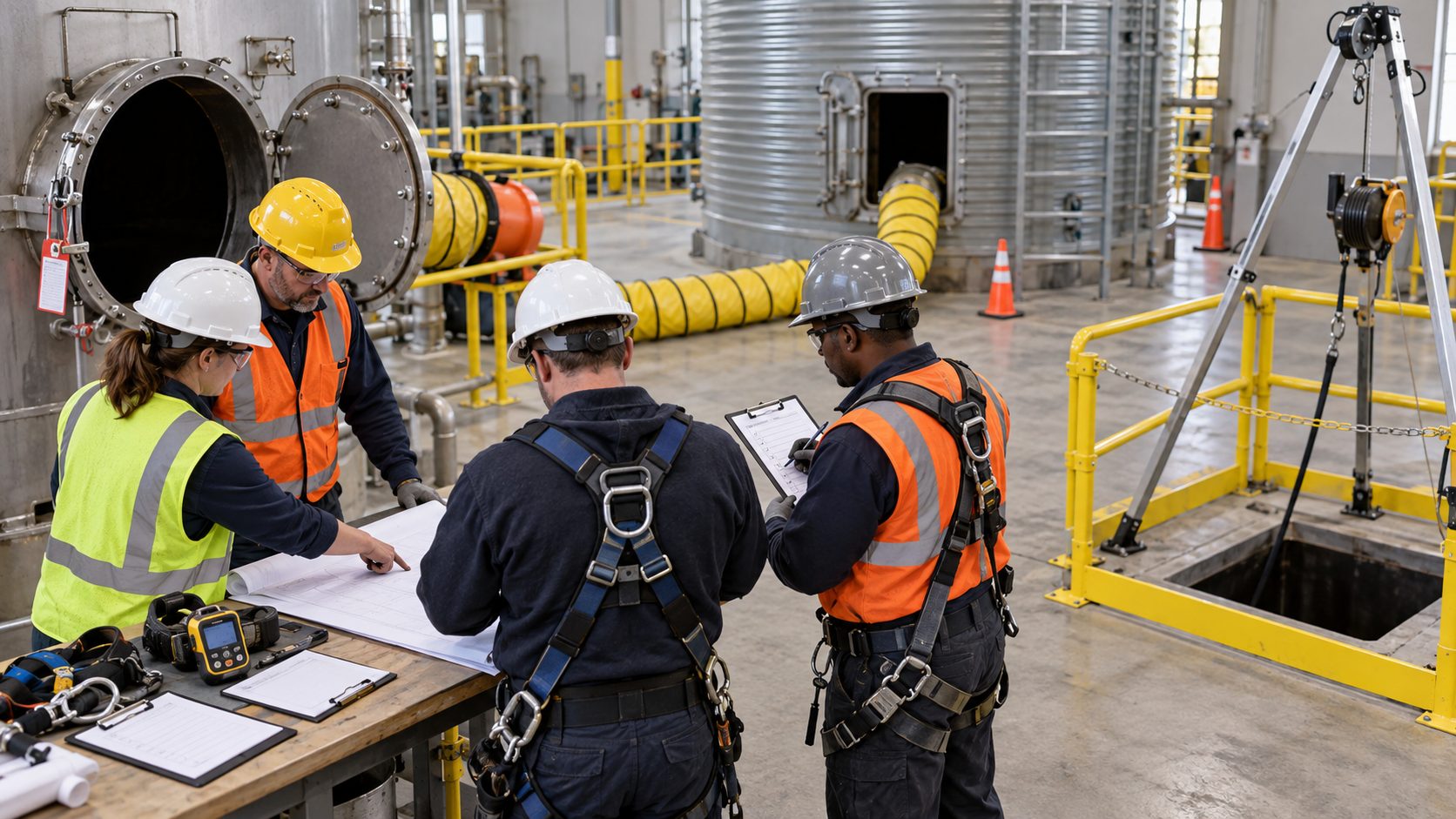
- Evaluate rescue and retrieval before entry day. Check opening size, depth, internal layout, retrieval line routing, obstructions, harness connection, tripod or davit placement, rescue service capability, and communication.
- Plan contractor information exchange. Host, controlling, and entry employers should communicate known hazards, prior-entry information, permit requirements, simultaneous operations, and post-entry results when multiple employers are involved.
- Store records in a way supervisors can use. Keep space inventory notes, training records, role assignments, permits, monitor records where used, rescue evaluations, and refresher triggers connected to the spaces and crews they support.
This checklist does not have to be complicated to be useful. A simple spreadsheet, site map, or controlled inventory form can improve decisions if it is accurate, current, and tied to training assignments. The key is to make the inventory operational. A list that sits in a binder but never reaches supervisors will not help a crew standing beside an open manway.
For buyers, the inventory can also reduce waste. Instead of buying the same course for everyone, the employer can assign Awareness training broadly, Permit-Required Entry training to workers with permit entry roles, Supervisor training to leaders who authorize and control entry, and Competent Person training to construction personnel who evaluate confined spaces and permit spaces. The result is usually a stronger record and a more practical training budget.
Which Training Fits This Situation
Awareness training fits employees who may encounter confined spaces but are not assigned to enter or support permit entry. This may include operators, maintenance helpers, warehouse employees, property staff, estimators, project managers, security personnel, sanitation support workers, or contractors who work near tanks, bins, pits, silos, or vaults without entering them. Awareness training should help them recognize a confined space, understand why entry can be dangerous, respect signage and barriers, and know when to stop and contact a supervisor.
Permit-Required Entry training fits workers who will participate in permit space operations. Authorized entrants need to understand known hazards, acceptable entry conditions, equipment use, communication, signs and symptoms of exposure, evacuation triggers, and the limits of their authorization. Attendants need to understand continuous monitoring of entrants, communication, access control, evacuation orders, rescue notification, and why they must not abandon their role unless properly relieved. Entry supervisors need to verify that the permit, controls, testing, rescue arrangements, and personnel are in place before authorizing entry.
Supervisor training fits the person responsible for turning the inventory into a controlled job. That may be a maintenance supervisor, plant foreman, operations leader, municipal crew chief, EHS coordinator, construction superintendent, or facility manager. This person needs to know how to question incomplete information, confirm that hazards are controlled, coordinate contractors, cancel entry when conditions change, and document the decision.
Competent Person training fits construction settings where someone must identify confined spaces and permit spaces, recognize hazards, and take prompt corrective measures. On construction or construction-like work, the competent person may need to review new access points, altered conditions, excavation-related spaces, renovation work, or spaces uncovered as the project progresses. If that same person also authorizes permit entry, additional permit-entry or supervisor training may be needed.
A multi-role plan is often the best fit for employers with several space types. For example, a food manufacturing facility may provide Awareness training to sanitation support and operations employees, Permit-Required Entry training to the trained tank-entry crew, Supervisor training to maintenance and production leaders who authorize the work, and Competent Person training to construction leads who oversee installation or alteration projects. A municipal utility may use Awareness training for general public works staff, Permit-Required Entry training for workers assigned to vault or wet well entries, Supervisor training for crew chiefs, and competent person preparation for construction activity around new structures.
Training should also include site-specific follow-through. Workers need to know the employer's permit form, communication method, atmospheric monitor, ventilation equipment, lockout procedure, rescue arrangement, retrieval equipment, barricade approach, stop-work authority, and reporting chain. Online training can establish the foundation, but the employer still has to connect that instruction to its own spaces and tasks.
Common Mistakes to Avoid
One common mistake is starting with the course catalog instead of the space inventory. Course titles are useful, but they cannot classify a space, identify residues, evaluate engulfment, check energy isolation, or decide whether the task introduces a new hazard. Inventory first, then match courses to roles.
Another mistake is assuming all confined spaces require the same training for every employee. A worker who only needs to recognize and avoid unauthorized entry has a different training need than a worker assigned as an authorized entrant. An attendant has different duties than an entrant. An entry supervisor has a different decision-making burden than a helper. A construction competent person has a distinct field-evaluation role.
A third mistake is treating a certificate of completion as the final authorization. The certificate is a useful record, but it does not prove that a worker knows the employer's actual tank, bin, vault, monitor, blower, retrieval setup, permit form, contractor coordination plan, or rescue procedure. Authorization should be tied to the employer's assigned duty and site-specific controls.
A fourth mistake is forgetting about non-atmospheric hazards. Many teams focus on gas monitors, oxygen levels, and ventilation, which are important. But permit-required conditions can also involve engulfment, inwardly converging walls, sloped floors, mechanical hazards, electrical hazards, heat, chemical contact, traffic, poor access, or other serious safety and health hazards.
A fifth mistake is letting space nicknames drive the decision. A bin, hopper, pit, sump, vault, duct, crawl area, or vessel may be discussed casually for years. The nickname does not determine whether it is a confined space or permit-required confined space. The configuration and hazards do.
A sixth mistake is ignoring contractors. If an outside company enters the space, cleans it, repairs it, coats it, or removes material from it, the host or controlling employer still needs to communicate known hazards and coordinate information. Contractor training records matter, but they are not a substitute for site-specific hazard exchange.
A seventh mistake is failing to refresh the inventory after changes. New chemicals, new products, new equipment, new entry points, altered ventilation, changed rescue access, new construction activity, and incident findings can all affect the training plan. A stale inventory can create a stale training assignment.
Next Step
Before assigning the next confined space course, choose five representative spaces and test the inventory. Pick one tank or vessel, one bin or silo, one pit or vault, one space used by contractors, and one space that supervisors consider routine. For each space, answer four questions: is it a confined space, could it be permit-required, who performs each role, and what training supports that role?
If employees only need to recognize and avoid unauthorized entry, start with Awareness training and document that limit. If workers will enter or attend permit spaces, assign Permit-Required Entry training and add site-specific equipment and procedure review. If leaders authorize entry or stop work, assign Supervisor training. If construction personnel evaluate spaces or permit spaces in the field, assign Competent Person training and add any needed permit-entry training for their actual duties.
That sequence gives employers a cleaner training plan: inventory, hazards, roles, training, site-specific practice, and records. It also gives supervisors a practical way to explain why one worker received Awareness training, another received Permit-Required Entry training, and a foreman or competent person received additional preparation. The point is not to buy more training than the job needs. The point is to make the training match the spaces, hazards, and duties that actually exist.
Sources
OSHA 29 CFR 1910.146, Permit-required confined spaces
https://www.osha.gov/laws-regs/regulations/standardnumber/1910/1910.146
OSHA 29 CFR 1926 Subpart AA, Confined Spaces in Construction
https://www.osha.gov/laws-regs/regulations/standardnumber/1926/1926SubpartAA
OSHA Confined Spaces Overview
https://www.osha.gov/confined-spaces
OSHA Confined Spaces, Hazards and Solutions