
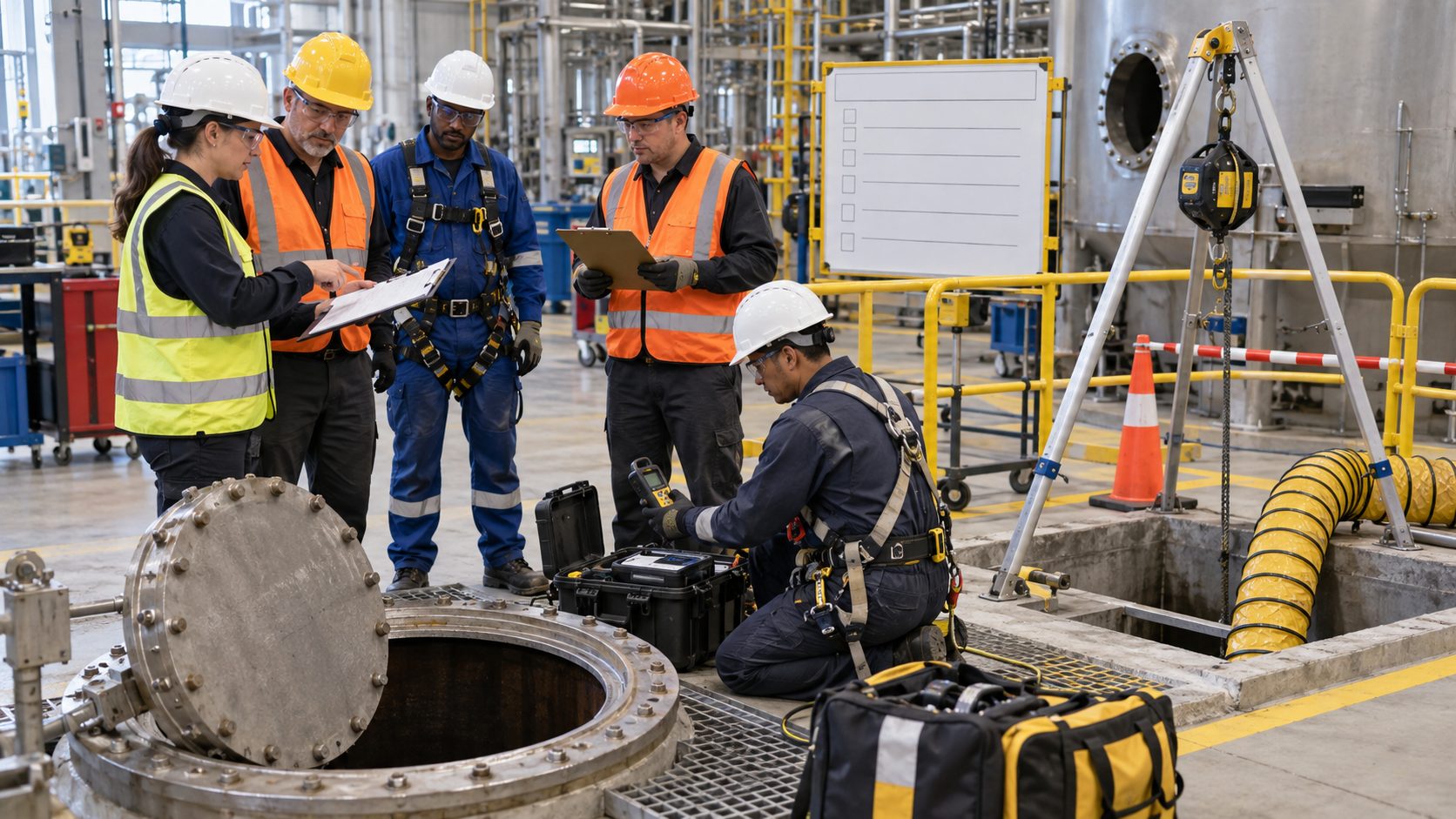
Search Intent
Employers planning a maintenance shutdown often ask which confined space training workers need before tanks, pits, sumps, process vessels, ductwork, vaults, or similar spaces are opened. The practical question is not only whether a worker can recognize a confined space. It is whether the employer has matched training to the actual duties employees will perform during the shutdown, the hazards that may be introduced by the work, and the controls that must be in place before anyone approaches the opening.
That question matters because shutdowns compress many high-risk decisions into a short work window. Production may be down, contractors may be onsite, equipment may be isolated, and several crews may be waiting for the same space. A facility can have capable maintenance employees and still be underprepared if entrants, attendants, entry supervisors, rescue coordinators, and competent decision makers have not been trained for their assigned roles. The right training plan helps the employer avoid confusion at the permit table, during atmospheric testing, when ventilation is adjusted, and when changing work conditions require a stop-work decision.
Who This Affects
Maintenance shutdown confined space planning affects a wide range of employers and crews. Manufacturing plants, food processing facilities, chemical operations, water and wastewater utilities, refineries, warehouses, institutional campuses, municipal shops, commercial buildings, and construction contractors all may open confined spaces during planned maintenance. The specific spaces vary, but the training problem is similar: people must understand their roles before the work day begins.
Facility managers and maintenance supervisors are usually closest to the schedule. They know which tanks need cleaning, which sumps need inspection, which hoppers need repair, which crawl spaces need access, and which process vessels cannot stay offline for long. Their challenge is turning a work order into a controlled entry plan. That includes identifying whether the space is a permit-required confined space, assigning trained personnel, coordinating lockout or isolation, confirming atmospheric testing, planning ventilation, and making sure a rescue or retrieval plan is realistic for the space.
EHS managers and compliance coordinators have a different but connected burden. They must help the employer prove that training was not a last-minute formality. Records should show who completed awareness training, who is trained as an authorized entrant, who can serve as an attendant, who can authorize or cancel entry as an entry supervisor, and who has the site-specific knowledge needed to evaluate construction-related confined space hazards when that standard applies. If contractors are involved, EHS staff also need to confirm how information is shared between host, controlling, and entry employers.
Contractors and specialty vendors are affected as well. Tank cleaners, millwrights, welders, electricians, HVAC technicians, utility contractors, industrial hygienists, inspection firms, and rescue service providers may all enter the same facility during a shutdown. Even when a contractor supplies trained personnel, the host employer still has information that outside crews need, such as prior contents, known residues, energy sources, configuration hazards, traffic patterns, drainage paths, and emergency access constraints. Training helps each party know which questions must be answered before work begins.
Employees also benefit from a clearer training match. A worker assigned only to help barricade an area may need awareness-level recognition and reporting knowledge. A worker assigned to enter a vessel needs much more. An attendant must understand monitoring, communication, entry tracking, evacuation triggers, and the limits of the attendant role. An entry supervisor must know how to verify conditions, authorize entry, terminate entry, and make sure the permit reflects current conditions. A competent person on a construction activity must be able to identify hazards and take prompt corrective action within the employer's program.
The Confined Space Compliance Issue
A shutdown can make a familiar space feel routine, and that is one reason training must be deliberate. A vessel that employees walk past every day may become a confined space entry once a manway is opened and a person can bodily enter. A pit that is normally guarded may become an active work area. A sump that seems shallow may still have limited means of entry or exit, atmospheric concerns, engulfment risks, mechanical hazards, or other serious hazards depending on the work and surrounding process.
Under OSHA's general industry confined space rule, a confined space is large enough for an employee to enter and perform work, has limited or restricted means for entry or exit, and is not designed for continuous employee occupancy. A permit-required confined space has one or more additional hazards, such as a hazardous atmosphere, engulfment potential, inwardly converging walls or sloping floors that could trap or asphyxiate an entrant, or another recognized serious safety or health hazard. Training must support the employer's ability to identify those conditions and control them before entry.
Construction work can bring additional coordination duties under OSHA's confined spaces in construction standard. During a shutdown, construction and maintenance may overlap. Installing new piping, replacing a tank section, modifying equipment, repairing structural components, or performing project-based upgrades may move the work from ordinary maintenance into construction activity. Employers should not wait until the day of entry to decide which standard and which coordination duties apply. Training should help supervisors and competent persons recognize when the job has crossed that line.
The compliance issue is not solved by handing everyone the same course and calling the crew trained. Training has to be understandable, role-specific, and connected to the hazards employees may face. An entrant must know the hazards of the space, the signs or symptoms of exposure, the equipment used for entry, and the conditions that require evacuation. An attendant must know how to monitor entrants, keep unauthorized people away, communicate with the entry team, and summon rescue without becoming an unplanned rescuer. An entry supervisor must know how to verify a complete permit, ensure hazards are controlled, confirm rescue arrangements, and cancel entry when conditions change.
Shutdowns also introduce changing conditions. Cleaning solvents, welding, cutting, coatings, steam, nitrogen purging, decomposition, residue disturbance, adjacent process releases, temporary ventilation, temporary lighting, and mobile equipment can change a space after initial testing. Training should make clear that atmospheric testing is not a one-time ritual. Employees need to know when continuous monitoring is required, when retesting is needed, how ventilation affects readings, and who has authority to stop work.
Another compliance issue is the gap between online training and site-specific implementation. Online confined space courses can support employer compliance by teaching core concepts, OSHA-aligned terms, role responsibilities, and decision frameworks. They do not replace the employer's obligation to evaluate the actual workplace, designate roles, provide necessary equipment, conduct site-specific instruction, and verify that employees can apply what they learned. A certificate of completion is useful evidence, but it is not a substitute for a complete confined space program.
What Employers Should Check
Before a planned shutdown begins, employers should treat confined space training as part of job planning, not as a paperwork item added after the schedule is set. The following checks help connect training to real work conditions.
- List every tank, pit, sump, vault, vessel, hopper, crawl space, duct, or other enclosed area that may be entered during the shutdown.
- Confirm whether each space meets the confined space definition, and whether it is permit-required based on atmosphere, engulfment, configuration, mechanical, electrical, thermal, chemical, biological, or other serious hazards.
- Separate workers by duty: awareness-only personnel, authorized entrants, attendants, entry supervisors, competent persons, rescue or retrieval support, and contractors.
- Decide whether the work is general industry maintenance, construction activity, or a mix that requires additional coordination.
- Confirm who has authority to authorize entry, cancel entry, revise permits, stop work, and restart after conditions change.
- Review energy isolation, blanking or blinding, lockout, line breaking, drainage, cleaning, and verification steps before entry.
- Identify atmospheric hazards related to prior contents, residues, decomposition, inerting, displacement of oxygen, welding, cutting, coatings, cleaning chemicals, or nearby processes.
- Confirm the testing sequence, testing equipment, calibration or bump check expectations, user training, sampling method, and continuous monitoring needs.
- Plan ventilation before entry, including duct placement, fresh air source, exhaust route, recirculation concerns, and how readings will be checked after changes.
- Match PPE, lighting, communication devices, retrieval equipment, ladders, barriers, and traffic controls to the actual space.
- Confirm whether non-entry rescue is feasible, whether retrieval lines may create hazards, and when a rescue service must be coordinated before entry.
- Make sure attendants know they are not assigned production tasks that distract from monitoring entrants.
- Review contractor information exchange, including known hazards, previous contents, permit procedures, emergency access, and post-entry debrief expectations.
- Verify training records before assigning roles, including refresher needs for employees whose duties changed since their last course.
- Build time into the schedule for a pre-entry briefing, questions, equipment checks, and hands-on site-specific instruction.
Employers should also check how the shutdown schedule affects fatigue and decision quality. Confined space work often gets scheduled during nights, weekends, holidays, or compressed outages. A trained entry supervisor may understand the permit system, but still need support if multiple spaces open at once. A trained attendant may know evacuation rules, but still be placed in a weak position if asked to watch two openings or manage unrelated maintenance tasks. Training should be paired with staffing levels that let people perform the duties they were assigned.
Documentation should be checked early. A training roster should identify course type, completion date, employee name, role, language of instruction where relevant, and any site-specific training completed by the employer. The confined space inventory, permits, atmospheric test records, rescue coordination notes, contractor handoff records, and post-entry debrief notes should align with those training records. When records and assignments disagree, the employer should fix the mismatch before entry.
Finally, employers should check communication. Shutdowns bring noise, temporary barriers, unfamiliar contractors, altered traffic routes, and changing access points. Workers need to know who to call, where the entry permit is posted or controlled, how entrants and attendants communicate, how alarms are handled, and how a stop-work decision is reported. The best training plan loses value if crews cannot apply it under actual shutdown conditions.
Which Training Fits This Situation
For many shutdowns, a layered training plan works better than a single course for everyone. The employer can start with confined space awareness training for employees who need to recognize spaces, understand basic hazards, respect barriers, avoid unauthorized entry, and know how to report concerns. This may include mechanics, production leads, sanitation staff, security, project coordinators, and temporary support personnel who work near openings but are not assigned as entrants or attendants.
Permit-required confined space entry training fits employees who may enter tanks, pits, process vessels, utility vaults, hoppers, or similar spaces where permit procedures are required. Entrants need to understand the hazards of the space, entry equipment, communication methods, atmospheric monitoring, PPE, evacuation conditions, and the importance of following the permit. In a shutdown, this training should be paired with site-specific instruction on the exact spaces they will enter, including prior contents, isolation status, rescue expectations, and any task-generated hazards.
Attendant training is essential when an employee is assigned to monitor an entry. The attendant is not a general helper stationed near the opening. The attendant must track entrants, maintain communication, watch for signs of trouble, keep unauthorized people away, order evacuation when required, and summon rescue according to the employer's procedure. Shutdown schedules often tempt employers to combine duties, so training should emphasize the attendant's focus and limits.
Entry supervisor training fits supervisors, lead mechanics, foremen, EHS personnel, and others who authorize permit entry. These employees need a stronger command of permit verification, hazard control, atmospheric test review, equipment checks, role assignment, rescue coordination, cancellation of permits, and reauthorization after interruptions. A shutdown may involve several entries in different departments, so the employer should decide whether one person can reasonably supervise each entry or whether additional trained entry supervisors are needed.
Competent Person training fits construction activities where the employer needs someone capable of identifying existing and predictable confined space hazards and taking prompt corrective measures. During shutdowns that include construction contractors, equipment modifications, replacement work, or installation projects, this training helps bridge the gap between the construction standard and real field decisions. It is especially useful when confined space conditions interact with excavation, hot work, demolition, mechanical installation, or multi-employer coordination.
Supervisor training may also be appropriate for managers who do not sign permits but must plan the work. Maintenance managers, project managers, plant engineers, facility managers, and contractor coordinators need enough confined space knowledge to staff jobs correctly, request the right documentation, schedule rescue coverage, recognize when a role assignment is weak, and avoid pressuring entry teams to work outside permit limits. Their decisions shape whether trained workers have the time and authority to do the job correctly.
Many employers use a multi-role plan. For example, a plant may assign awareness training to nearby production employees, permit-required entry training to maintenance employees who enter vessels, attendant training to designated support employees, entry supervisor training to lead mechanics and EHS staff, and Competent Person training to construction supervisors managing project-based work. That approach is more useful than treating confined space training as a single checkbox, because the training mirrors the way the shutdown actually operates.
Online training can be a strong starting point when employers need consistent course content, certificates of completion, English and Spanish access, group enrollment, refresher tracking, or a scalable way to prepare multiple crews before the outage. It should be followed by employer-led site-specific review, equipment practice, permit walkthroughs, atmospheric monitor instruction, and rescue coordination. The key is to use online training for structured knowledge, then connect it to the facility's actual spaces and assignments.
Common Mistakes to Avoid
One common mistake is waiting until the shutdown begins to decide who is trained for which role. By then, supervisors may already be under schedule pressure, contractors may be mobilized, and employees may be reassigned informally. Role assignments should be made before the outage, with training records checked against the planned work.
Another mistake is assuming a space is non-permit because employees have entered it before. Prior successful entries do not prove that current conditions are safe. A change in contents, residues, cleaning method, isolation status, ventilation, weather, adjacent operations, or task activity can change the hazard profile. Training should reinforce that classification is a current evaluation, not a memory of how the last job went.
Employers also get into trouble when they train entrants but overlook attendants and entry supervisors. A trained entrant cannot compensate for an attendant who does not understand evacuation triggers or an entry supervisor who signs an incomplete permit. Permit-required confined space entry is a team system. Each role has a separate purpose.
A fourth mistake is treating atmospheric monitoring as equipment ownership instead of user competence. Having a meter onsite is not enough. Workers must know what the instrument measures, how it is checked before use, how readings are taken, what alarm conditions mean, when continuous monitoring is needed, and how ventilation or work activity may change readings. Training should make atmospheric testing understandable, not mysterious.
Some employers rely on rescue assumptions that have not been tested against the actual space. Calling local emergency services may be part of a plan, but the employer still needs to evaluate whether rescue can be performed in time, whether responders are equipped and available, and whether non-entry retrieval is feasible. Training should help supervisors ask those questions before entry day.
Another frequent mistake is failing to coordinate contractor information. A contractor may bring strong confined space experience and still need facility-specific details. The host employer knows the space history, nearby process hazards, access limits, traffic patterns, and emergency procedures. Contractors know their methods, tools, staffing, and task hazards. Training should support a two-way handoff, not a one-way document exchange.
Finally, employers should avoid overstating what any course completion means. Confined space training supports employer compliance, but it does not make OSHA certify a worker, approve an employer's program, or endorse a provider. The employer remains responsible for evaluating the site, assigning competent personnel, controlling hazards, providing equipment, maintaining records, and verifying that employees can perform their assigned duties.
Next Step
Before the shutdown schedule is locked, list the confined spaces that may be opened and assign every affected person to a role. Use awareness training for workers who need recognition and reporting knowledge, permit-required entry training for entrants, attendant training for workers stationed outside the space, entry supervisor training for those who authorize or cancel entry, and Competent Person training when construction confined space duties apply. Then add the employer-specific pieces: the actual permit procedure, atmospheric monitor use, ventilation setup, rescue plan, equipment checks, contractor handoff, and records review.
That sequence gives managers a practical way to choose training without overcomplicating the process. Start with the work, identify the space and hazards, assign duties, train for those duties, and verify readiness before entry day.