
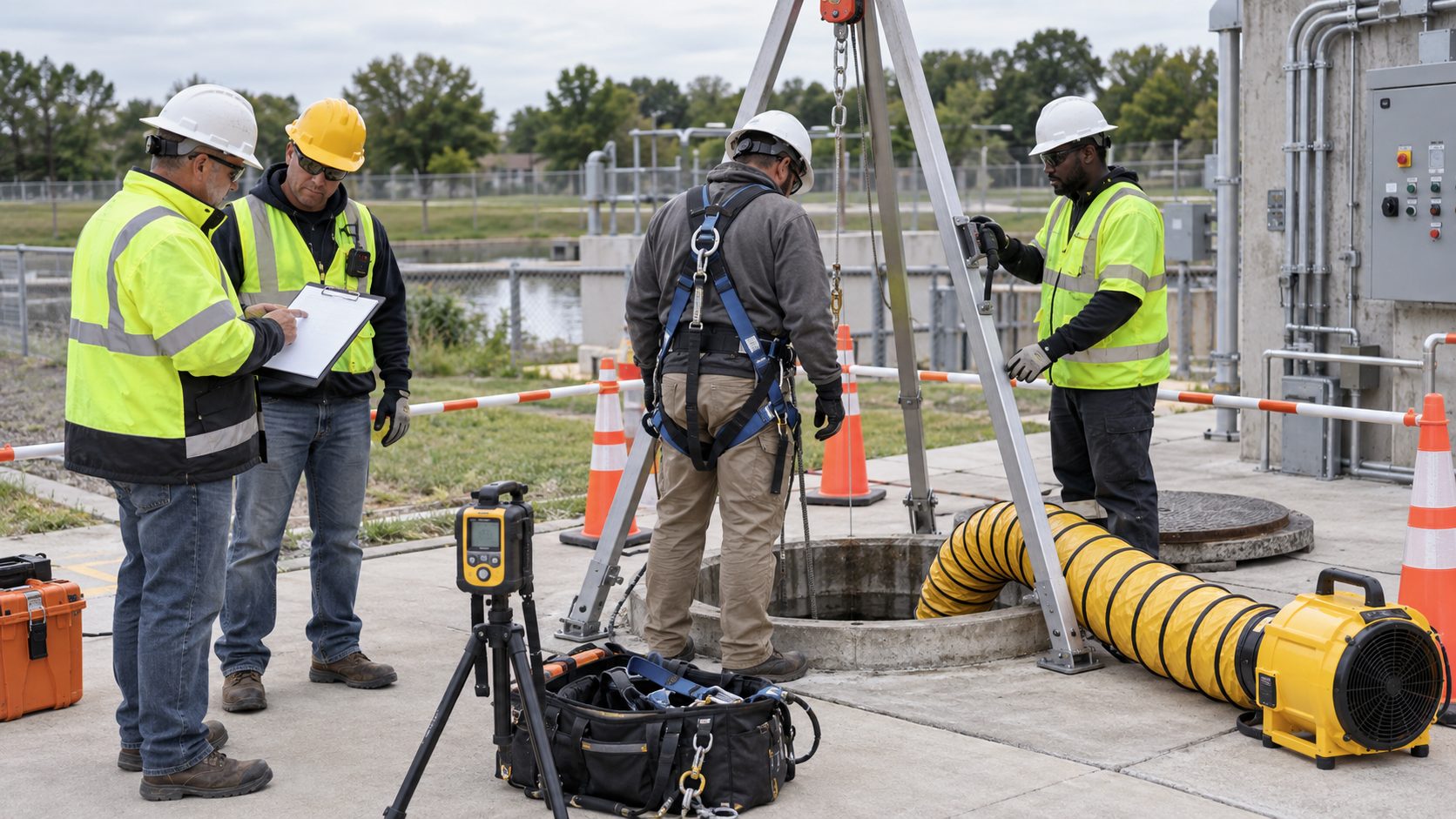
Search Intent
Public works directors, utility supervisors, wastewater operators, and safety managers often search for confined space training when crews are assigned to wet wells, lift stations, pump pits, valve vaults, meter pits, and related municipal utility spaces. The practical question is not just whether a worker needs a course. It is which roles need which training before routine inspections, pump maintenance, emergency callouts, contractor support, and permit-required entries create real exposure.
Who This Affects
Wet wells and lift stations sit in the middle of daily municipal service. They are ordinary infrastructure, but the spaces around them can create serious confined space exposure for public works employees, wastewater utility crews, maintenance mechanics, electrical contractors, pump vendors, inspectors, and supervisors who coordinate the work.
This affects small towns with a few operators, regional authorities with dedicated collections crews, private contractors working under municipal contracts, and facilities teams that maintain package lift stations on campuses or industrial sites. It also affects managers who rarely enter the space themselves but approve work orders, schedule contractors, assign standby personnel, or sign off on training records.
The training question usually becomes urgent when a crew has to do one of these jobs:
- Inspect a wet well, pump pit, valve vault, or meter vault.
- Pull or service a submersible pump.
- Clean accumulated debris, grease, grit, or sludge.
- Troubleshoot floats, rails, guide cables, controls, or level sensors.
- Support electrical or mechanical contractors during repairs.
- Respond to a pump failure, overflow risk, odor complaint, or alarm.
- Open hatches for observation, measurement, or ventilation setup.
- Enter a space after bypass pumping, cleaning, or isolation.
Even when the planned task seems brief, these spaces can involve limited entry and exit, poor natural ventilation, slippery surfaces, engulfment or drowning hazards, biological material, mechanical energy, electrical exposure, traffic or fall hazards around open hatches, and atmospheric hazards that change as conditions shift.
For employers, the training decision should be made before the callout, not while a pump is down and service pressure is rising. A worker who only needs to recognize hazards and stay out of a space may need awareness-level instruction. A worker assigned as an entrant, attendant, or entry supervisor needs training matched to those duties. A supervisor or competent person may need a deeper ability to classify spaces, recognize when construction or maintenance rules apply, coordinate with contractors, and confirm that the permit process is actually ready.
The Confined Space Compliance Issue
Wet wells and lift stations are often familiar, which can make them deceptively easy to under-control. Crews may visit the same station every month. They may know the access hatch, the pump rail, the odor pattern, and the normal alarm history. Familiarity does not remove the confined space analysis.
Under OSHA’s general confined space framework, a confined space is large enough for a worker to enter and perform assigned work, has limited or restricted means for entry or exit, and is not designed for continuous occupancy. Many wet wells, valve vaults, meter pits, pump pits, and underground utility structures can meet that basic definition. The next question is whether the space is permit-required because it contains, or has the potential to contain, a hazardous atmosphere, an engulfment hazard, an internal configuration hazard, or another recognized serious safety or health hazard.
For wastewater and lift station work, the permit-required analysis deserves special attention because the hazard profile can change quickly. A space that was tested last month may not have the same atmosphere today. Flow conditions, decomposition, upstream discharges, chemical use, pump operation, sludge accumulation, bypass setup, and weather can all change the exposure picture. The presence of hydrogen sulfide, oxygen deficiency or enrichment, flammable gases, or other atmospheric hazards cannot be evaluated by smell or habit. It requires a planned testing sequence and competent interpretation.
Construction work can introduce another layer. If a crew is building, replacing, upgrading, rehabilitating, or substantially altering a lift station, wet well, vault, or related structure, OSHA’s confined spaces in construction standard at 29 CFR 1926 Subpart AA may apply. Routine operation and maintenance may instead fall under the general industry permit-required confined spaces standard at 29 CFR 1910.146, depending on the work and employer. Many municipal projects involve both public employees and contractors, so the host employer, controlling contractor, and entry employer responsibilities have to be discussed before work begins.
The mistake is assuming that a certificate alone solves this. Online training can support employer compliance by teaching roles, terminology, hazard recognition, regulatory structure, and decision points. It does not replace the employer’s responsibility to evaluate actual spaces, create or maintain the written program when required, issue permits when applicable, select equipment, verify rescue capability, provide site-specific instruction, and make sure workers can perform assigned duties safely.
For lift station and wet well work, that means training has to connect to the real program:
- Which spaces are known or suspected confined spaces?
- Which are permit-required confined spaces?
- Which employees may only observe or support from outside?
- Which employees may enter?
- Who may act as attendant?
- Who may authorize entry as entry supervisor?
- Who understands atmospheric testing, ventilation, isolation, retrieval, and rescue planning?
- Who is responsible for contractor coordination?
- What conditions stop the job?
If those answers are unclear, the training plan is probably too generic.
What Employers Should Check
Use the training decision as a chance to review the work itself. A wet well or lift station entry plan should not start with the course catalog. It should start with the tasks, the spaces, and the roles.
- Identify the spaces.
List the wet wells, lift stations, pump pits, valve vaults, meter vaults, force main access structures, below-grade control areas, and related spaces employees may open, inspect, or enter. Include infrequent sites, older stations, and small packaged systems that are easy to overlook.
- Decide who may enter and who may not.
Some employees may need awareness training because they inspect, unlock, open, or work near confined spaces but are not authorized to enter. Others may be assigned as entrants, attendants, or entry supervisors. Do not let informal seniority decide this during a callout.
- Classify the work.
Separate routine observation, non-entry support, maintenance, cleaning, pump retrieval, electrical troubleshooting, construction upgrades, rehabilitation work, and emergency response support. Each task can affect the training level and the applicable standard.
- Evaluate atmospheric hazards.
Confirm that the program explains testing before entry, testing from outside the space when feasible, testing at appropriate levels, continuous monitoring when required by the plan, instrument calibration or bump test expectations, alarm response, and documentation. Workers need to understand what the meter result means and what action follows.
- Review ventilation practices.
Ventilation is not just placing a blower nearby. The crew needs to know how air will move, where the intake is located, whether ducts reach the needed area, how long ventilation is expected before and during work, how monitoring confirms effectiveness, and what conditions require the space to be evacuated or re-evaluated.
- Confirm isolation and control of energy.
Pump systems can involve electrical energy, mechanical movement, automatic starts, stored pressure, flow, valves, bypass systems, and upstream influences. Training should reinforce that entry cannot rely on hope that equipment stays quiet.
- Check fall and struck-by exposure around openings.
An open wet well hatch or vault lid creates hazards for entrants, attendants, and other workers nearby. Barricades, covers, traffic control, lighting, communication, and housekeeping may be part of the safe setup.
- Match retrieval and rescue planning to the space.
A tripod at the site does not automatically mean rescue is solved. The employer must know whether non-entry retrieval is feasible, whether the entrant can be connected to retrieval equipment, whether obstructions or configuration limit retrieval, and what rescue service is available for the actual hazards and location.
- Plan contractor coordination.
Municipal crews often support pump vendors, electricians, bypass contractors, sewer cleaning companies, and construction contractors. Clarify who controls the site, who evaluates the space, who issues permits, who supplies monitoring and ventilation, who provides attendants, and how information is exchanged before and after the work.
- Review records and refresher triggers.
Training records should show the worker, date, subject, role, and completion status. Refresher training may be needed when duties change, procedures change, conditions reveal a gap, a near miss occurs, or the employer has reason to believe the worker no longer has the needed understanding or skill.
This checklist helps employers choose training that matches actual job assignments rather than buying one course for everyone and hoping it covers every exposure.
Which Training Fits This Situation
For wet wells and lift stations, most employers need a role-based training plan, not a one-size-fits-all answer.
Awareness training fits employees who need to recognize confined spaces, understand why unauthorized entry is prohibited, and know when to stop and notify a supervisor. This may include utility office staff who dispatch work, field employees who open access points for observation, grounds or maintenance employees who work near lift stations, and new employees who need a foundation before receiving more advanced assignments.
Permit-Required Entry training fits workers who may enter a permit-required confined space or directly support an entry. Entrants need to understand hazards, communication, equipment, symptoms of exposure, conditions that require evacuation, and the limits of their authorization. Attendants need to understand monitoring of entrants, communication, access control, emergency response activation, and the duty to remain outside unless properly relieved. Entry supervisors need to understand how to verify that the permit, controls, equipment, rescue arrangements, and conditions are acceptable before authorizing entry.
Supervisor training fits lead workers, foremen, operators in charge, public works supervisors, wastewater managers, and safety coordinators who decide whether the job is ready. These employees may not always enter, but they often decide whether an alarm response becomes a controlled maintenance task, whether a contractor is properly coordinated, whether a permit is complete, and whether the crew has enough trained people on site.
Competent Person training may fit construction or construction-like work where someone must be able to identify existing and predictable hazards and has authority to take prompt corrective measures. For lift station upgrades, wet well rehabilitation, new utility installation, vault reconstruction, or other construction activity, employers should consider whether the person directing the work needs deeper training under the construction confined space framework.
A practical plan for a public works department might look like this:
- Awareness training for all employees who may encounter, open, dispatch, or work near wet wells, vaults, and lift station spaces.
- Permit-Required Entry training for employees assigned as authorized entrants or attendants.
- Entry supervisor or supervisor-level training for lead operators, foremen, wastewater supervisors, public works managers, and safety staff who authorize or oversee work.
- Competent Person training for those directing construction, rehabilitation, or contractor-heavy work where hazard identification and corrective authority are central.
- Site-specific practice for the actual lift stations, meters, monitors, blowers, retrieval systems, permits, rescue contacts, and communication methods used by the employer.
Online courses can be useful for the shared foundation. They help employees learn the vocabulary, roles, regulatory expectations, and decision points before the employer layers on field procedures. The field layer still matters. Workers should know which wet wells are off limits without a permit, how their department labels spaces, where the monitor is stored, how the permit is completed, how rescue is summoned, and who has authority to stop work.
For Spanish-speaking or mixed-language crews, training access also matters. A worker cannot reliably carry out entrant, attendant, or supervisor duties if the instruction, permit briefing, or emergency expectations are not understood. Employers should consider English and Spanish course access, translated job aids where appropriate, and bilingual site briefings when that reflects the workforce.
For larger organizations, bulk or group training can help standardize the foundation across multiple crews, departments, or facilities. For organizations with learning management systems, SCORM or record-friendly options may make tracking easier. For high-risk entries, unusual configurations, or new equipment, virtual or in-person follow-up can help connect the course material to the employer’s actual procedures.
Common Mistakes to Avoid
The first mistake is treating every lift station visit as routine. Routine work can still involve permit-required confined space hazards. A monthly inspection, a pump pull, or a wet well cleaning task should still be evaluated by the actual conditions present at the time of work.
The second mistake is training only the entrant. Confined space safety depends on the team. If the entrant is trained but the attendant does not understand the duty to remain outside, the supervisor does not verify rescue arrangements, or the dispatcher sends an untrained employee to open a hatch during an emergency, the program has a weak point.
The third mistake is relying on smell to evaluate atmosphere. Hydrogen sulfide and other hazards cannot be controlled by informal sensory checks. Workers need to understand that atmospheric testing, ventilation, and monitoring are program controls, not optional extras.
The fourth mistake is assuming ventilation makes a space safe by itself. Ventilation may reduce or control atmospheric hazards, but it has to be applied correctly and confirmed by monitoring. It does not eliminate engulfment, mechanical, electrical, fall, biological, or configuration hazards.
The fifth mistake is confusing a rescue plan with a phone number. Calling 911 may be part of the emergency plan, but the employer must evaluate whether the rescue service can respond in time, has the right equipment, understands the hazards, and can perform the type of rescue the space may require. Non-entry retrieval should be considered when feasible, but the setup has to fit the space and the entrant.
The sixth mistake is giving everyone the same course and calling the program complete. Awareness, entrant, attendant, entry supervisor, supervisor, and competent person responsibilities are different. Training should reflect assigned duties.
The seventh mistake is forgetting contractor coordination. Pump vendors, electricians, sewer cleaning contractors, bypass providers, and construction crews may bring their own procedures, but the municipality or facility still needs to exchange information and understand who is responsible for what. A job can fail because everyone assumes someone else handled the permit, monitor, ventilation, or rescue arrangement.
The eighth mistake is not refreshing training after change. A new gas monitor, new permit form, new rescue vendor, station upgrade, incident, near miss, or role change should trigger a review of whether employees still understand the program.
The ninth mistake is overclaiming what training means. OSHA does not certify, approve, endorse, or accredit a student or course provider for confined space work. Employers should look for OSHA-aligned training that supports compliance and provides a certificate of completion, then complete the site-specific and hands-on steps required for their own operations.
Next Step
Start with the wet well and lift station duty list. Decide who only needs to recognize and avoid unauthorized entry, who may enter, who may serve as attendant, who may authorize entry, and who directs construction or contractor-supported work. Then assign training by role: Awareness for employees who encounter the spaces, Permit-Required Entry for entrants and attendants, Supervisor or Entry Supervisor training for those authorizing work, and Competent Person training where construction-related confined space decisions require stronger hazard recognition and corrective authority.
After the course is complete, finish the employer side of the job. Review the actual spaces, permits, monitoring equipment, ventilation setup, retrieval equipment, rescue plan, contractor coordination process, and records. That is where training becomes a working confined space program instead of a file in the training folder.
Sources
OSHA Confined Spaces Overview
https://www.osha.gov/confined-spaces
OSHA 29 CFR 1910.146 Permit-Required Confined Spaces
https://www.osha.gov/laws-regs/regulations/standardnumber/1910/1910.146
OSHA 29 CFR 1926 Subpart AA Confined Spaces in Construction
https://www.osha.gov/laws-regs/regulations/standardnumber/1926/1926subpartaa
OSHA Confined Spaces in Construction Frequently Asked Questions