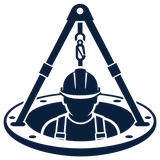
A retrieval system is the equipment used for non-entry rescue: a harness on the entrant, a retrieval line, and a mechanical device or fixed anchor outside the space. It's the reason an attendant can rescue someone without becoming a second victim.
What OSHA requires
Under 29 CFR 1910.146(k)(3):
- Retrieval systems or methods must be used whenever an authorized entrant enters a permit space, unless the equipment would increase the overall risk of entry or wouldn't contribute to the rescue.
- Each entrant uses a chest or full-body harness, with the retrieval line attached at the center of the back near shoulder level, above the head, or another point that gives a profile small enough for removal. Wristlets may be used only if a harness is infeasible or creates a greater hazard.
- The other end attaches to a mechanical device or fixed point outside the space so rescue can begin as soon as it's needed.
- A mechanical device must be available to retrieve personnel from vertical permit spaces more than 5 feet deep.
The construction standard (1926.1211) has parallel requirements.
Anchors: tripods, quad-pods and davit arms
| Anchor | How it works | Best for |
|---|---|---|
| Tripod | Three adjustable legs over the opening with a head that carries the winch or SRL | Manholes and round openings with room around them |
| Quad-pod | Four legs for larger openings or more stability | Larger hatches and vaults |
| Davit arm | An offset mast and arm mounted in a base (permanent, portable, counterweight or vehicle hitch) that reaches over the opening | Openings next to walls, tanks with side or top hatches, sites where a tripod won't fit |
| Fixed anchor | A structural point rated for the load | Some horizontal or permanent installations |
Mechanical devices: winches vs. 3-way SRLs
- Retrieval winch: a hand-cranked drum with a cable to raise and lower an entrant. It's a rescue and positioning device; on its own, a winch is generally not fall arrest.
- 3-way self-retracting lifeline (SRL): a fall-arrest SRL with a built-in retrieval winch. It arrests a fall and allows the attendant to switch to rescue mode and crank the entrant out.
- Personnel-rated winch for lowering workers: some systems use a winch for both lowering and retrieval with a separate fall-arrest device.
Choose equipment rated for personnel, follow the manufacturer's instructions, and meet the applicable ANSI/ASSP Z359 fall protection and rescue standards your program specifies.
Setup checklist
- Place the anchor on stable, level ground and center it over the opening.
- Extend legs evenly, lock the pins, and connect the leg chain or strap so legs can't spread.
- Mount the winch or SRL on the correct bracket, with the line running over the pulley and down the center of the opening.
- Connect the line to the entrant's dorsal D-ring or shoulder D-rings (with a yoke or spreader bar for an upright extraction profile).
- Test the winch and SRL before entry.
- The attendant stays at the winch and knows how to switch to rescue mode.
Inspection and practice
Inspect harnesses, connectors, cables, SRLs, winches and anchors before each use and on the manufacturer's schedule, and remove damaged gear from service. Practice rescues with the actual equipment: OSHA requires in-house rescue teams to practice at least once every 12 months. See confined space rescue.
Sources and official references
Last reviewed: October 25, 2026 · Free general education based on OSHA 29 CFR 1910.146 and 29 CFR 1926 Subpart AA. It does not replace the site-specific training, written program and hands-on evaluation your employer must provide, and it does not issue a certificate. Nothing you enter on this page is saved or sent.