Nitrogen can control fire or process hazards inside a vessel while creating an oxygen-deficient atmosphere that demands strict entry planning.
Inerting is common in process operations because a noncombustible gas can displace an atmosphere that might otherwise support combustion or affect product quality. That same displacement can remove the oxygen people need to survive. OSHA's general industry permit-required confined space standard notes that inerting produces an immediately dangerous to life or health oxygen-deficient atmosphere. A vessel that is safe for a process may therefore be unsafe for unprotected human entry.
The correct response is not simply to carry a gas monitor to the opening. Employers need to identify the space, understand the process, isolate every source, define acceptable entry conditions, select a ventilation or purging strategy, plan atmospheric testing, coordinate roles, and prepare rescue arrangements. The plan must match the applicable standard, site program, substance information, and actual work.
Who This Affects
Facility owners, host employers, entry employers, maintenance contractors, operations leaders, safety professionals, entry supervisors, attendants, authorized entrants, gas testers, and rescue services may all have responsibilities when inerting is used. Process engineers and control-room operators are also important because they understand nitrogen sources, valves, purge sequences, pressure conditions, and the steps required to return equipment to service.
The issue appears around tanks, reactors, mixers, kilns, vessels, silos, pipelines, and other enclosed process equipment. It may arise during shutdowns, cleaning, inspection, coating, welding preparation, catalyst work, product changeovers, or maintenance after a nitrogen blanket has been applied. Construction work can involve different confined-space requirements, so employers should identify which rules govern the activity instead of assuming one program fits every job.
Employees working near the opening also need awareness. An oxygen-deficient atmosphere can extend beyond the point a worker expects, particularly if nitrogen is flowing, the gas is released into a low area, or ventilation moves the atmosphere toward another work zone. Barricades, access control, ventilation discharge placement, and communication with nearby crews belong in the planning process.
The Confined Space Compliance Issue
Under OSHA's general industry standard, inerting means displacing a permit-space atmosphere with a noncombustible gas to the point that the atmosphere is noncombustible. The definition includes an important warning: the procedure produces an IDLH oxygen-deficient atmosphere. The standard identifies oxygen below 19.5 percent as a hazardous atmosphere, but a single number should not be treated as the whole evaluation.
The employer's written permit-space program must address how hazards are identified and evaluated, how unauthorized entry is prevented, and how entry is conducted safely. The entry permit must identify the space, purpose, duration, authorized entrants, attendants, entry supervisor, hazards, controls, acceptable entry conditions, testing results, rescue service, communication methods, and necessary equipment. Purging, inerting, ventilating, and flushing may be listed as control measures, but the employer must understand what each measure does and what new hazard it may introduce.
Inerting can reduce a fire hazard while increasing asphyxiation risk. Purging with air or ventilating may later restore oxygen, but it can also bring a previously controlled vapor through a flammable range. The sequence therefore requires process-specific analysis. Employers should consult knowledgeable personnel, safety data, equipment information, and applicable engineering controls rather than rely on a generic timing rule.
Isolation is another central issue. Closing a single valve may not prevent nitrogen, product, steam, cleaning chemicals, or other material from entering. The standard describes methods such as blanking or blinding, misaligning or removing line sections, double block and bleed, lockout or tagout, and blocking or disconnecting mechanical linkages. The correct isolation method depends on the system and must be verified before entry.
If a hazardous atmosphere exists, the employer must follow the entry requirements that apply to that condition. Reclassification or alternate procedures cannot be based on hope that ventilation will work. Employers must satisfy the specific criteria of the applicable standard and document the basis. An atmosphere created by inerting should be treated with the seriousness of an IDLH condition until testing and the full entry evaluation demonstrate otherwise.
What Employers Should Check
Start with the nitrogen inventory. Identify permanent lines, temporary hoses, cylinder manifolds, automatic valves, pressure-control loops, purge connections, vents, and adjacent equipment that could communicate with the space. Include backup or emergency systems. A line that is not obvious at the entry opening can still change the atmosphere after the permit is issued.
Verify the process status and isolation. The entry supervisor should not rely only on a control-screen indication or a valve handle position. The procedure should define how isolation is applied, locked or tagged, physically verified, and documented. It should also address who controls the isolation and how any change is communicated to the entry team.
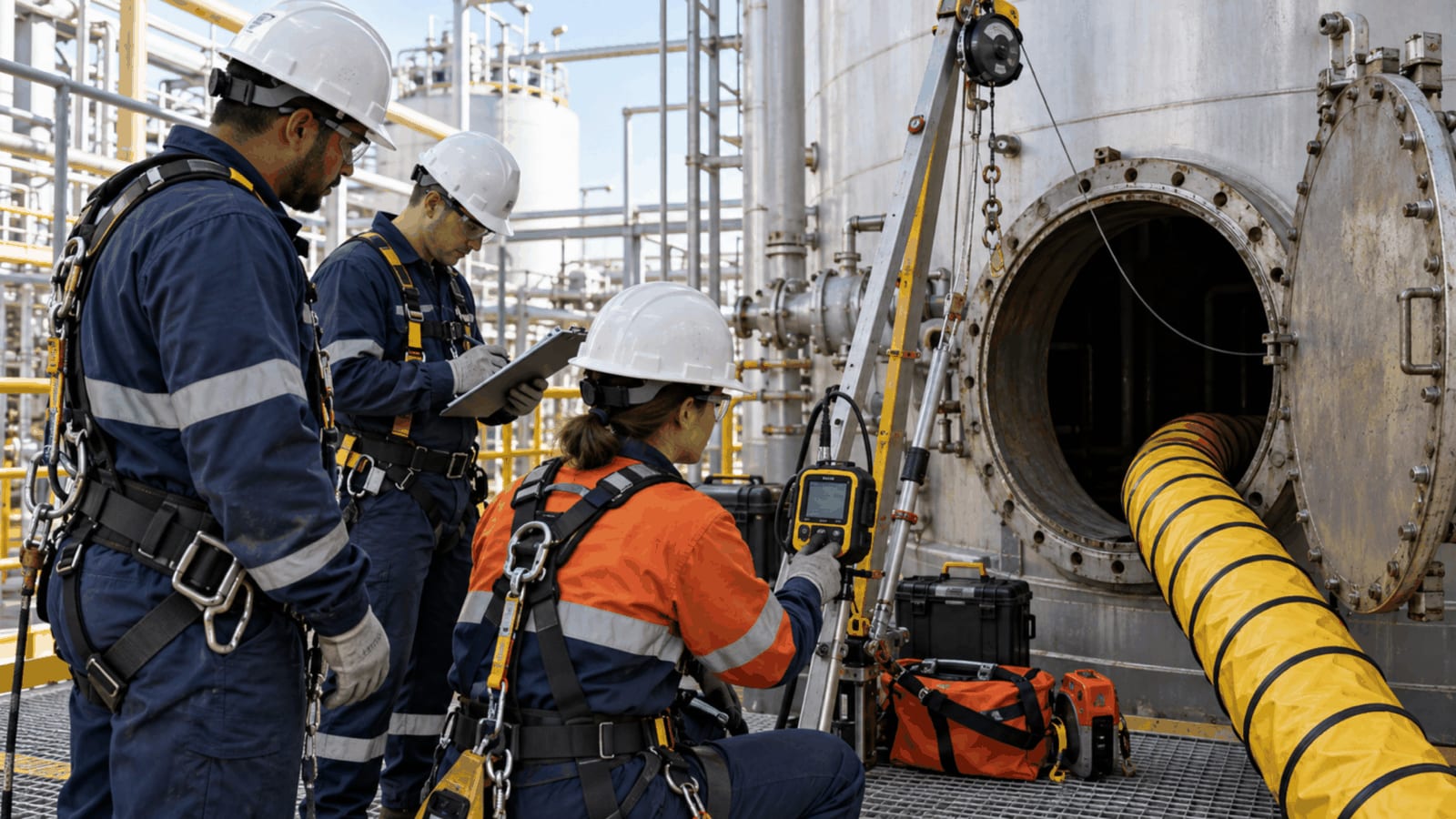
Plan atmospheric testing by location and time. Test before entry and as required during entry, using calibrated direct-reading instruments suitable for the expected hazards. Because gases can stratify or enter from a specific connection, sampling should represent the areas entrants will occupy and pass through. The testing sequence generally evaluates oxygen first, then combustible gases and vapors, then potential toxic contaminants, while following instrument instructions and the employer's procedure.
Understand the monitor. A standard four-gas meter does not detect every substance, and some sensors can behave differently in low-oxygen conditions. Sampling lines add response time. Filters, pumps, calibration status, alarm settings, cross-sensitivities, and environmental limits matter. The person testing should know what the instrument can and cannot establish.
Define acceptable entry conditions in writing. Conditions may include oxygen, flammable and toxic limits, temperature, pressure, energy isolation, ventilation performance, communications, lighting, work-generated contaminants, and any process-specific criteria. If hot work, solvents, coatings, cleaning, or other tasks can change the atmosphere, the permit and monitoring plan should address those changes.
Review ventilation and exhaust placement. Ventilation should use a suitable air source, reach the intended areas, and avoid recirculating contaminants or exhausting nitrogen toward people, building intakes, ignition sources, or another confined space. The plan should say what happens if the blower stops, a duct shifts, power fails, or test results trend toward an alarm condition.
Confirm rescue capability before entry. Calling emergency services without evaluating response, access, equipment, training, and availability is not a complete plan. The selected rescue service should receive the information it needs and be able to perform the type of rescue the space may require. Retrieval systems should be used where required and configured so they do not create additional hazards.
Finally, control the area around the space. Post or barricade the entry, route hoses and ducts to prevent damage, protect nitrogen connections from unauthorized operation, and monitor nearby low points or rooms when migration is plausible. Everyone who can affect the space should know that the entry permit controls the work.
Which Training Fits This Situation
Awareness training fits employees who may encounter a confined space or nitrogen system but will not enter. They need to recognize signs, understand that nitrogen is colorless and odorless, respect barriers, and report unintended releases. They should never use their senses as proof that an atmosphere is safe.
Authorized entrant training should cover space hazards, symptoms and consequences of exposure, equipment, communication, self-rescue, and the duty to exit when ordered, when an alarm activates, when a prohibited condition is detected, or when warning signs appear. Training should connect those duties to the site's inerting and ventilation sequence.
Attendant training should address monitoring entrants, maintaining communication, controlling unauthorized entry, recognizing behavioral or process changes, ordering evacuation, summoning rescue, and performing no conflicting duties. The attendant should understand that a normal-looking worker may become impaired rapidly in an oxygen-deficient atmosphere.
Entry supervisor training should emphasize verification. The supervisor authorizes entry only after checking that permit entries are complete, tests and controls are in place, rescue is available, and acceptable conditions exist. The supervisor must terminate entry and cancel the permit when work is complete or a prohibited condition arises.
Gas-testing personnel need hands-on instruction with the actual instruments, sampling accessories, bump-test and calibration procedures, limitations, alarm responses, and recordkeeping. Rescue teams require training and practice appropriate to the spaces and hazards they may face. Online confined-space courses can support role knowledge, but employers must add site-specific procedures, practical evaluation, equipment training, and authorization.
Common Mistakes to Avoid
One mistake is treating nitrogen as harmless because it is common in the air and is not flammable. Concentrated nitrogen displaces oxygen, and the person exposed may not receive a useful sensory warning. The control plan should focus on oxygen displacement and migration, not odor or irritation.
Another mistake is considering the job safe as soon as a meter at the opening reads normally. Conditions can differ deeper in the vessel, behind internal structures, near a nitrogen inlet, or after work begins. Sampling strategy and continuous or periodic monitoring should reflect the hazard evaluation.
Teams also make errors when ventilation begins before process hazards and ignition risks are reviewed. Introducing air can change the flammability of the atmosphere. The purge and ventilation sequence should be developed with process knowledge and appropriate technical support.
A fourth mistake is leaving a nitrogen source connected for convenience. A closed valve, disconnected control signal, or verbal promise may not equal effective isolation. Use the isolation methods established for the system and verify them before entry.
Some permits list rescue as 911 without evaluating whether responders can arrive, access the site, enter the specific space, and manage the atmosphere. Rescue planning must be completed before entry, and attendants or coworkers should not improvise an entry rescue.
Finally, employers sometimes reuse yesterday's permit or copy a similar vessel's limits without checking today's process. Contents, residues, work, isolation, weather, temperature, and connected systems can differ. Each permit should reflect the actual entry.
Next Step
Select one vessel or space that uses nitrogen and walk the entire sequence from process shutdown through permit cancellation. Mark every nitrogen source, isolation point, vent, sample location, ventilation path, entrant position, communication step, and rescue access point. Compare the field condition with the written program, piping information, permit form, and training records.
Then run a tabletop scenario in which the oxygen reading begins to fall after entry. Ask who sees the trend, who orders evacuation, how entrants respond, whether the nitrogen source can be isolated without delay, where the ventilation exhaust goes, and how rescue is summoned. Correct gaps before the next entry rather than during it.
The goal is not to prove that a vessel is generally safe. It is to establish and maintain acceptable entry conditions for a specific job while recognizing that inerting is itself a serious atmospheric hazard. Careful isolation, testing, ventilation planning, role-based training, and rescue readiness give the entry team a defensible basis for action.
Sources
OSHA, 29 CFR 1910.146 Permit-Required Confined Spaces | https://www.osha.gov/laws-regs/regulations/standardnumber/1910/1910.146
OSHA, 29 CFR 1910.146 Appendix B Procedures for Atmospheric Testing | https://www.osha.gov/laws-regs/regulations/standardnumber/1910/1910.146AppB
OSHA, 29 CFR 1910.146 Appendix D Confined Space Pre-Entry Check List | https://www.osha.gov/laws-regs/regulations/standardnumber/1910/1910.146AppD
OSHA, 29 CFR 1926 Subpart AA Confined Spaces in Construction | https://www.osha.gov/laws-regs/regulations/standardnumber/1926/1926SubpartAA