
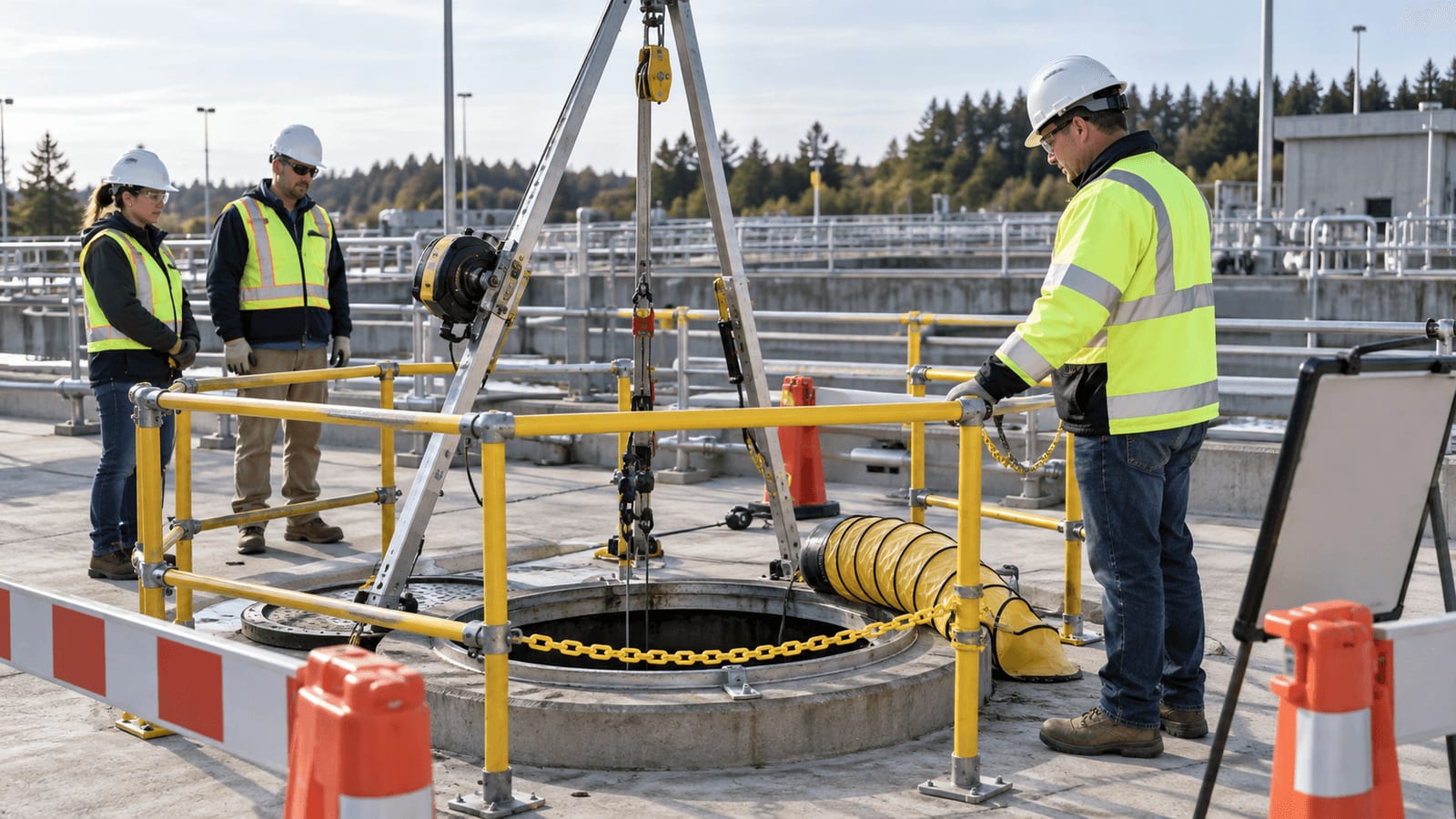
The opening to a confined space can expose entrants and nearby workers to traffic, falling objects, unauthorized access, and sudden changes outside.
Entry planning often concentrates on hazards inside a tank, vault, pit, manhole, or vessel. That is necessary, but the area around the opening is part of the entry system too. A missing guardrail, moving vehicle, suspended load, unsecured hatch, blocked retrieval line, or curious passerby can endanger an entrant even when atmospheric testing and isolation are correct.
Opening controls should be selected for the location, work, and duration of entry. A cone beside a hatch may communicate that work is happening, but it may not protect against a vehicle, falling material, or a person crossing the boundary. A sturdy barrier can still fail if it blocks rescue equipment or forces the attendant to stand where the attendant cannot monitor entrants. The employer needs a planned arrangement, not a pile of equipment placed around the portal.
Who This Affects
This issue affects employers with permit-required confined spaces, construction employers working in or near confined spaces, facility owners, controlling contractors, entry employers, and public works departments. It is especially relevant where entries occur in roadways, process areas, loading zones, rooftops, mechanical rooms, pedestrian corridors, wastewater plants, and other locations that stay active during the job.
Authorized entrants depend on the opening remaining usable for entry, exit, communication, ventilation, monitoring, and rescue. Attendants need a position from which they can track entrants, prevent unauthorized access, recognize outside hazards, and summon help without taking on distracting duties. Entry supervisors need to verify that barriers, shields, equipment, and procedures are in place before authorizing entry and remain effective while conditions change.
Employees who are not part of the entry team also matter. Operators, drivers, cleaners, delivery workers, contractors, and visitors may approach the area without understanding the hazard. Awareness training and site communication should help them recognize the boundary and follow the route around it. The entry team should not have to improvise crowd control while monitoring a permit space.
The host employer or facility representative may hold information that the entry employer needs, such as traffic patterns, automatic equipment, overhead work, drainage changes, product transfers, scheduled deliveries, or public access. Coordination should bring that information into the opening-control plan before the permit is signed.
The Confined Space Compliance Issue
OSHA's general industry permit-required confined-space standard requires employers to evaluate the workplace, prevent unauthorized entry, and protect entrants from external hazards. It specifically addresses barriers and shields needed to protect entrants from pedestrian, vehicle, or falling-object hazards. It also defines duties for attendants and entry supervisors when unauthorized persons approach or enter the space.
For construction, OSHA's confined-spaces requirements similarly require employers to identify permit spaces, protect employees through a permit program when entry occurs, and guard openings from accidental falls and objects entering the space. The exact duties depend on the work and industry setting, so employers should identify the applicable standard rather than assume that a familiar facility procedure covers every construction activity.
Entry begins when any part of a person's body breaks the plane of an opening. That definition matters during setup and troubleshooting. A worker leaning through a hatch to move a hose, retrieve a dropped tool, or take a reading may already be entering. Opening controls and authorization should be in place before work encourages someone to reach past the boundary.
The external hazard assessment should include more than unauthorized entry. Vehicles can strike equipment or push exhaust toward a space. Pedestrians can trip on lines or dislodge a cover. Work above can drop tools or material. Rain can enter a vault. A process release outside the space can change its atmosphere. A hatch can swing or fall. Noise can interfere with communication. These conditions belong on the permit or supporting plan when they can affect entry.
Barrier selection should reflect the hazard. Cones and warning tape may provide visual notice in a controlled indoor area, but they do not resist impact or prevent a fall. Guardrails, barricades, traffic-control devices, covers, shields, and spotters serve different purposes. The employer should determine which combination provides real protection without creating new hazards.
The opening must remain functional. Retrieval equipment needs a clear path and stable setup. Ventilation ducting should deliver air where intended without becoming crushed or pulling contaminants from the wrong location. Sampling lines, communications cables, lighting, and power leads should be routed to avoid entanglement. The access ladder or steps should remain unobstructed. The attendant needs room to monitor and order evacuation.
What Employers Should Check
Begin with the location. Identify nearby vehicle routes, forklifts, cranes, overhead work, doors, stairs, pedestrian traffic, weather exposure, drainage, process equipment, and public access. Note what will remain active during entry and what can be shut down, isolated, rerouted, or scheduled at another time. A sketch or annotated photo can help the team agree on the boundary.
Check the opening itself. Confirm the cover, hatch, grating, hinges, lifting points, fasteners, and support surfaces are in usable condition. Plan how the cover will be opened and secured. Heavy or spring-loaded covers can create caught-between and manual-handling hazards. Removed covers should be stored where they cannot roll, slide, fall, or block access.
Define the controlled area before equipment arrives. Place the boundary far enough from the opening to protect workers and equipment, while allowing the attendant to maintain effective oversight. Consider whether people could enter from more than one direction. In a roadway or loading area, coordinate traffic control with the applicable work-zone plan and qualified personnel.
Verify that the barrier matches the exposure. Where a person could fall, use protection designed for fall exposure. Where a vehicle could enter, use controls appropriate to vehicle movement and speed. Where overhead work can continue, provide a shield or exclusion zone that protects the opening. Warning tape should not be treated as physical protection when physical protection is needed.
Review equipment layout as a system. Position the tripod, davit, winch, ventilation, monitor, communications, lighting, and permit display so each can work without interfering with the others. Keep the entrant's path clear. Protect hoses and cables at crossing points. Make sure the retrieval line can travel without rubbing against sharp edges, wrapping around the barrier, or catching on the hatch.
Check the attendant's location and duties. The attendant should be able to communicate with entrants, track their status, observe relevant conditions, warn unauthorized persons away, and summon rescue. The assigned location should not expose the attendant to traffic or place the person behind equipment that blocks the view. Additional duties must not interfere with monitoring and protecting entrants.
Plan how unauthorized approach will be handled. Employees working nearby should receive notice before entry begins. Access doors may need temporary control. A spotter or additional attendant may be needed where one person cannot see multiple approach routes. The procedure should tell the attendant whom to contact if a person ignores the boundary and what happens to entry operations while the issue is resolved.
Identify stop-work triggers. Entry should be reassessed if a barrier is moved, a vehicle enters the zone, overhead work begins, a storm develops, the hatch shifts, the attendant loses visibility, retrieval equipment is disturbed, ventilation ducting is displaced, or an unauthorized person enters. The team should know whether entrants evacuate immediately or whether another defined action applies to a specific condition.
Document the arrangement. The permit or supporting record can note the type and location of barriers, traffic controls, external hazards, equipment layout, attendant position, and any coordination with the host employer. Photos may help for recurring entries, but they should be dated and reviewed because the work area can change.
Which Training Fits This Situation
Confined Space Awareness training fits employees who work near spaces but are not assigned to enter or support permit entry. They should be able to recognize common spaces, respect signs and barriers, avoid reaching past openings, and notify the right supervisor. Awareness training supports prevention of unauthorized entry, but it does not qualify someone to act as an entrant, attendant, or entry supervisor.
Permit-Required Confined Space Entry training fits employees assigned as authorized entrants or attendants. Entrants need to understand the permit, external hazards, communication, equipment, evacuation triggers, and the requirement to follow attendant directions. Attendants need deeper practice in access control, entrant tracking, communication, hazard recognition, rescue notification, and responding to unauthorized persons without leaving the post.
Confined Space Supervisor training fits people who authorize entry, verify permit conditions, coordinate outside activities, confirm rescue availability, and cancel entry when conditions no longer match the permit. Opening controls are a practical test of supervisor readiness because they require the supervisor to connect site conditions, equipment layout, roles, and stop-work decisions.
Confined Space Competent Person training may fit construction leaders responsible for identifying confined spaces and permit spaces, evaluating hazards, and taking corrective action under the employer's construction program. The employer should match training to actual assigned duties and add site-specific instruction for traffic control, fall protection, equipment, rescue, and facility procedures.
Online courses can support knowledge and provide course completion records. Employers may still need hands-on demonstrations, practical evaluation, equipment familiarization, drills, and site-specific briefings. A certificate of completion does not prove that a worker can set a tripod, manage a roadway boundary, or perform a role under the conditions of a particular entry.
Common Mistakes to Avoid
Do not assume that a warning sign or cone is enough everywhere. Visual warnings are useful, but the physical control has to match the fall, traffic, falling-object, or public-access hazard. If the boundary can be easily crossed or moved, the employer should decide whether stronger protection or active control is needed.
Do not build a barrier that blocks rescue. A crowded opening can trap hoses, prevent a stretcher from approaching, limit the winch path, or force rescuers to dismantle the setup during an emergency. Rescue access should be evaluated during setup, not after an entrant needs help.
Do not place the attendant in a traffic lane or give the attendant traffic-control duties that interfere with entry monitoring. If traffic requires active direction, assign qualified support and coordinate the roles. The attendant's primary duty remains monitoring and protecting entrants.
Do not overlook the cover and hatch. Workers can strain while lifting a cover, be struck by a closing hatch, or fall when a cover is removed before the boundary is ready. Plan the sequence from the first movement of the cover through final replacement and verification.
Do not allow the work area to expand without a new review. Tools, spoil, cleaning equipment, delivery vehicles, or another contractor may gradually occupy the controlled zone. Entry supervisors and attendants should have a defined way to restore the boundary or stop entry.
Do not copy yesterday's photo or permit without confirming today's conditions. A recurring vault may have a new traffic pattern, damaged guardrail, different retrieval setup, construction nearby, or weather exposure. Repeat entries benefit from standard layouts only when the layout is verified each time.
Next Step
Choose one recurring space and review the entire opening area from the viewpoint of an entrant, attendant, supervisor, nearby worker, and rescuer. Mark approach routes, external hazards, barrier locations, equipment footprints, and the rescue path. Compare that layout with the permit and the training assigned to each role.
Correct obvious gaps before the next entry. Update the site-specific briefing, equipment list, or permit prompts so the solution becomes repeatable. If employees only need to recognize and avoid the space, assign Awareness training. If they will enter or attend, use Permit-Required Entry training plus practical site instruction. If they authorize and control the operation, add Supervisor training. For construction evaluation duties, determine whether Competent Person training also fits.
The objective is not a perfect-looking perimeter. It is a controlled opening that keeps entrants protected, keeps other people out, supports the attendant, and preserves the routes needed for normal exit and rescue as work changes.
Sources
Occupational Safety and Health Administration, 29 CFR 1910.146 Permit-Required Confined Spaces: https://www.osha.gov/laws-regs/regulations/standardnumber/1910/1910.146
Occupational Safety and Health Administration, 29 CFR 1926 Subpart AA Confined Spaces in Construction: https://www.osha.gov/laws-regs/regulations/standardnumber/1926/1926SubpartAA
Occupational Safety and Health Administration, Confined Spaces Safety and Health Topics: https://www.osha.gov/confined-spaces