
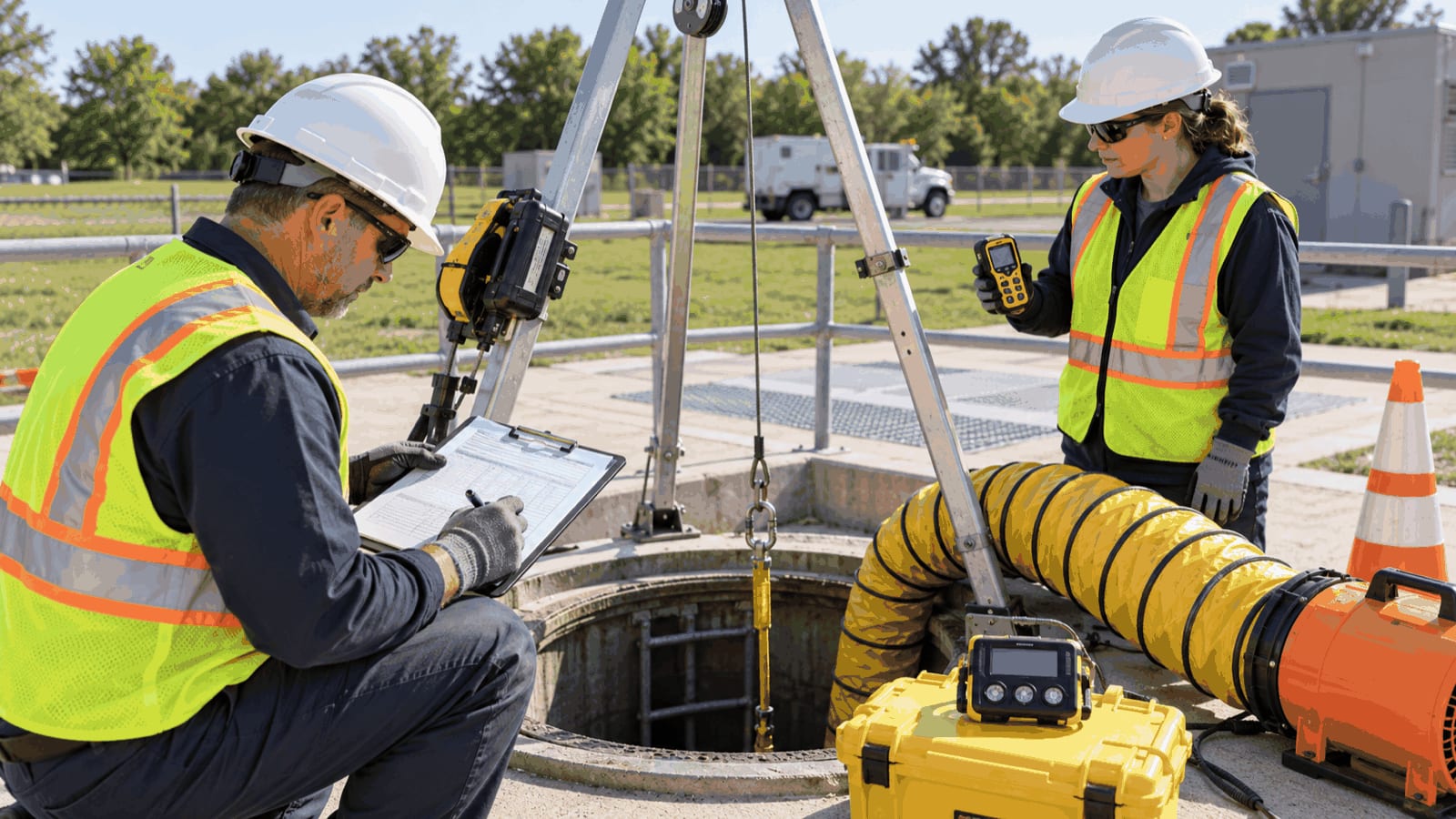
Confined-space atmospheric testing logs help employers verify that pre-entry tests, continuous monitoring, alarms, and responses match the actual entry plan.
A gas monitor reading is useful only when the employer knows where, when, how, and by whom it was taken. A number written on a permit does not explain whether the instrument was bump-tested, whether the sample reached remote areas, whether ventilation was running, or whether conditions changed after the reading. Reviewing the testing log before entry gives the entry supervisor and attendant a practical way to connect data to decisions.
This matters in tanks, vaults, manholes, pits, vessels, crawl spaces, and construction spaces where conditions can change because of line breaking, cleaning chemicals, biological activity, welding, nearby traffic, pumping, or a loss of ventilation. The log should support the permit-space program and the work plan. It should not be used to create a false sense of precision or to replace rescue preparation.
Who This Affects
Employers with maintenance, utility, municipal, manufacturing, wastewater, construction, or facility work may have more than one team involved in atmospheric testing. An entry supervisor may review the permit, an attendant may watch the monitor, an authorized entrant may carry a personal monitor, and a competent person or qualified tester may set the sampling method. Contractors may bring instruments while the host employer controls the space.
The people who make decisions need a shared understanding of the record. A maintenance manager may care about recurring trends. A supervisor may need to know whether acceptable entry conditions exist now. An attendant needs to recognize an alarm and communicate with entrants. A rescue provider needs enough information to understand likely hazards and access constraints.
The issue also affects employees who do not enter. A worker staging hoses, starting a fan, opening a line, or moving a vehicle near the opening can change the atmosphere or interfere with the monitoring method. Training should make the boundary around the space visible to the whole crew.
The Confined Space Compliance Issue
The applicable requirements depend on the employment context and the hazards. General industry permit-required confined space work is addressed by 29 CFR 1910.146. Construction work has additional requirements under 29 CFR 1926 Subpart AA. Employers should determine which rules and local procedures apply rather than assuming that one permit form fits every job.
Testing generally helps employers determine whether acceptable entry conditions exist and whether controls remain effective. A sound log identifies the space, date, time, tester, instrument, calibration or function-check information required by the employer's program, sampling locations, readings, ventilation status, and actions taken when conditions change. It should be legible and tied to the permit or electronic record.
Sampling location matters. A top reading may not represent the bottom of a deep vault. A single reading near the opening may miss a pocket, dead leg, sump, or area behind an obstruction. The sampling plan should reflect the space's configuration, expected contaminants, work activity, and the limitations of the instrument. Workers should not treat a clean opening as proof that the entire space is safe.
The order of testing can matter because gases have different characteristics and instruments have different limitations. Employers should follow the manufacturer's instructions and their written program. The person doing the testing needs to understand the instrument, the sampling tubing, response time, alarm settings, and what the readings mean for the planned work.
Continuous monitoring is not simply leaving a device on. The team should know who watches the display, where the monitor is located, whether the alarm can be heard or seen, how readings are communicated, and what action follows an alarm. If the monitor is moved, covered by equipment, exposed to water, or separated from the entrant, the control may not work as intended.
What Employers Should Check
Before entry, an employer can use a short review that tests the quality of the record rather than merely checking whether a blank is filled.
- Is the correct space identified, including the entry point and connected lines or compartments?
- Does the permit identify the hazards that drove the testing plan?
- Is the instrument appropriate for the expected atmosphere and work activity?
- Has the employer's required inspection, function check, calibration, or maintenance been addressed?
- Are sampling points and depths documented where the space requires them?
- Were readings taken before entry and after ventilation or isolation controls were applied?
- Does the record show who performed the test and who is responsible for monitoring during entry?
- Are alarm limits, evacuation triggers, and communication methods understood?
- Is there a plan for testing after breaks, shift changes, process changes, or interruptions?
- Is rescue equipment ready and compatible with the space and entrant arrangement?
The reviewer should compare the log to the work sequence. If a crew will use solvents, weld, cut, wash, pump, or open a line, the pre-entry reading may not represent the atmosphere later. If a fan stops, a storm raises a wet-well level, or another crew starts work nearby, the permit and monitoring plan may need review.
Employers should decide in advance where the record lives and who closes it out. A paper permit can be lost in a truck or become unreadable after a wet-well job. An electronic record can be incomplete if the device is offline or if the worker cannot enter a reading at the point of work. The method matters less than the result: the final record should remain available to the people who review permits, investigate alarms, train crews, and evaluate the program.
The review should include near misses and alarms that did not lead to an injury. A monitor that alarmed during a short task, a fan that failed for five minutes, or a reading that required an unexpected evacuation can reveal a weakness in planning. Employers can ask whether the hazard was identified, whether the response was timely, whether the instrument was placed correctly, and whether the crew understood the trigger. That conversation is more valuable than simply storing the permit as complete.
Records should support learning. Repeated oxygen changes, recurring alarm events, unexpected hydrogen sulfide readings, or frequent ventilation failures may reveal a program problem. Employers can use those patterns to improve isolation, equipment selection, maintenance, training, and job planning. A log that is filed without review loses much of its value.
Which Training Fits This Situation
Awareness training fits employees who may encounter confined spaces or support the work without entering. It can cover recognition, warning signs, prohibited entry, reporting, and the difference between observing a space and being authorized to enter.
Permit-Required Entry training fits entrants, attendants, and supervisors who participate in a permit process. The emphasis should include hazards, testing, ventilation, communication, personal protective equipment, evacuation, and rescue arrangements. Entrants need to understand their own monitor and the conditions that require them to exit.
Supervisor training is useful for people who authorize entry, review permits, coordinate contractors, or decide whether controls are adequate. They need to read the testing record critically and connect it to the work plan. Competent Person training may be relevant when the construction role includes identifying hazards, evaluating conditions, or coordinating the entry work, but employers should match the course to the actual duties and applicable requirements.
A multi-role plan is often best for recurring work. Employers can assign awareness to the broader workforce, entry training to the entry team, and supervisor or Competent Person training to the people who make decisions. Online training can provide a consistent foundation and certificates of completion. Site-specific procedures, equipment practice, drills, and hands-on evaluation may still be needed.
Common Mistakes to Avoid
One mistake is copying yesterday's readings into today's permit. Another is recording only a single number without documenting sampling locations or control changes. Teams may also assume that a new battery means the instrument is ready, ignore alarms because the work is almost finished, or let the attendant focus on paperwork instead of the entrant and monitor.
Employers should avoid treating a monitor as a rescue plan. A monitor detects certain conditions, but it does not isolate energy, remove an entrant, provide ventilation, or make an untrained person capable of rescue. Rescue and retrieval must be planned for the specific space.
The next common mistake is failing to test the communication path. A display alarm heard by an entrant may not be heard by the attendant. A radio may not work through steel or below grade. The team should test the actual arrangement before entry and after equipment is positioned.
Next Step
Review one recent permit and its atmospheric testing log against the actual space, work sequence, and monitoring responsibilities. If the record cannot answer where testing occurred, who watched the monitor, or what happens after an alarm, update the procedure and train the roles before the next entry. Confined-space.com can support a role-based awareness, entry, supervisor, Competent Person, or group training plan, but employers remain responsible for site-specific controls and decisions.