
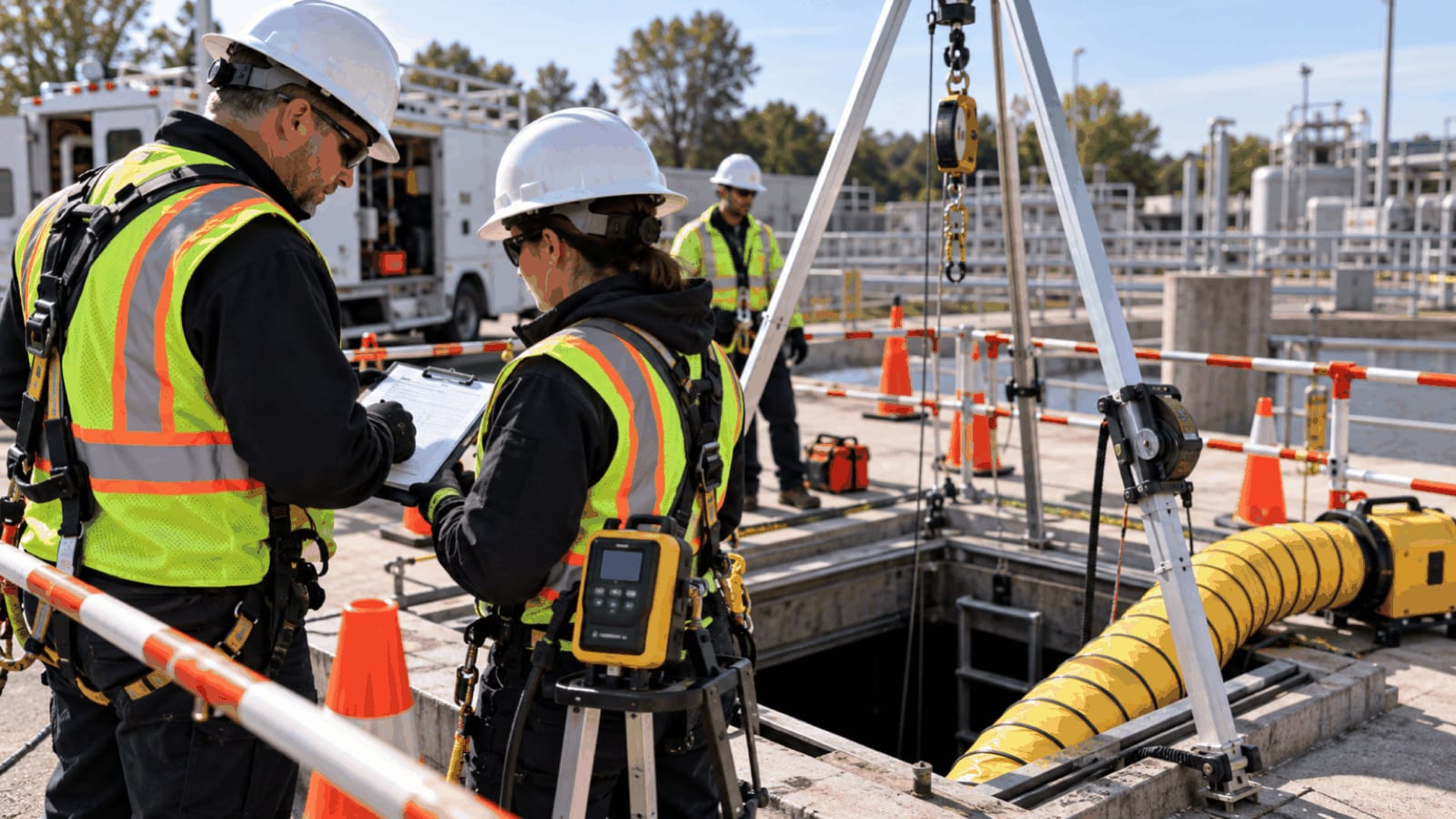
Multi-employer confined space work requires employers to coordinate roles, hazards, permits, communications, and rescue before entry begins.
Confined space work becomes harder to control when an owner, host employer, entry employer, contractor, subcontractor, and rescue provider share the same jobsite. One company may control the facility, another may perform cleaning, and a third may provide atmospheric testing or rescue. Each may bring a different permit, procedure, training record, and assumption about who is in charge. The space does not become safer because the paperwork is divided among employers. Coordination must connect the pieces before an entrant crosses the opening.
The practical question is not simply whether each worker completed a course. It is whether the employers have agreed on the space classification, hazards, isolation, roles, communications, equipment, and response if conditions change. A training plan should make those handoffs understandable to entrants, attendants, entry supervisors, host representatives, and anyone who can introduce a hazard from outside the space.
Who This Affects
This issue affects general contractors managing construction work, facility owners hiring specialty contractors, municipalities using utility crews, manufacturers scheduling shutdown work, and maintenance departments bringing vendors into tanks, pits, vaults, or vessels. It also affects employers that believe their role is limited to sending one worker to assist. A worker who opens a valve, starts a pump, operates a process, controls traffic, or enters to inspect can influence the permit space even without being the entry employer.
Host employers often know the facility history, process hazards, isolation points, and previous entries. Entry employers may know the task, tools, staffing, and work method. Contractors may bring the permit, monitor, ventilation, retrieval equipment, and rescue arrangement. A controlling contractor may manage schedule and access without having technical ownership of the space. These differences can be useful when they are deliberately coordinated, but dangerous when each employer assumes another party is handling the missing detail.
Before the pre-entry meeting, identify every employer with a role in or near the space. Include employees who remain outside, subcontractors working nearby, delivery or traffic personnel, and operations staff who can affect energy or atmosphere. Record who has authority to stop work and who must be notified when an entry is suspended. A clear contact list is especially important during nights, weekends, and shift changes when the person who approved the original plan may not be present.
The Confined Space Compliance Issue
OSHA requirements differ between construction and general industry, and a project can involve both contexts. Construction work is addressed in 29 CFR 1926 Subpart AA, while general industry permit-required confined space work is addressed in 29 CFR 1910.146. Employers should determine which requirements apply to their work and how host, controlling, and entry-employer duties are assigned. Training content should support the applicable program, not blur construction and general-industry concepts into a generic checklist.
The space classification must be based on the actual conditions and intended work. A space may be large enough to enter and not designed for continuous occupancy, yet still present a permit-required hazard because of an atmospheric hazard, engulfment risk, configuration, or another serious danger. A change in product, residue, ventilation, welding, cleaning chemical, weather, or process status can change the risk. One employer's past classification is not a substitute for the current evaluation.
Coordination begins with hazard information. The host should share known contents, previous service, connected lines, energy sources, oxygen-deficient areas, toxic materials, and process changes. The entry employer should explain the task and the hazards introduced by tools, coatings, solvents, hot work, or cleaning. Each employer should confirm how hazards will be eliminated or controlled, how isolation will be verified, and who will test the atmosphere. If information is missing, the entry should wait until the gap is resolved.
Atmospheric testing requires more than handing a monitor to the attendant. The team should know which instrument is appropriate, whether it is calibrated and bump-tested as required, where and when readings will be taken, and what action follows an alarm or unexpected trend. Ventilation must be positioned so it does not move contaminants into the breathing zone or create a false sense of security. Continuous monitoring may be necessary when hazards can develop during work. Test results should be communicated to every employer whose work could change the atmosphere.
What Employers Should Check
Use a coordination matrix or meeting record that assigns each issue to a named employer and person. The matrix should be reviewed when the work method, shift, space, crew, or surrounding operation changes.
- Who classified the space, and what facts support that classification?
- Who controls isolation, lockout, blanking, line breaking, and process shutdown?
- Who issues the permit, who signs it, and who can cancel it?
- Who serves as entrant, attendant, entry supervisor, and competent person where required?
- Who provides testing, ventilation, retrieval, communications, and rescue?
- How are readings, alarms, permit changes, and stop-work decisions communicated?
- What nearby work can add heat, fumes, traffic, water, or moving energy?
- How will the host and contractors hand off the space between shifts?
- Where are the exit routes, rescue access points, and emergency contacts?
The group should walk the controls in the order workers will use them. Verify isolation at the equipment, inspect the entry point, test from outside as required, position ventilation and retrieval, establish communications, and review the permit before entry. A document can be complete while a valve is still open or a rescue tripod is blocked by a truck. Field verification is part of coordination, not a separate administrative exercise.
Training records should be matched to duties rather than collected as a stack of certificates. Awareness may be appropriate for workers who recognize and report spaces but do not enter. Permit-Required Entry training supports entrants and attendants who perform controlled entry tasks. Entry Supervisor training supports the person who verifies readiness, authorizes entry, and terminates it. Competent Person training may be necessary for construction roles involving recognition of hazards and authority to take prompt corrective action. The employer remains responsible for assessing experience, site conditions, and task-specific needs.
Language and communication access are operational controls. If an attendant speaks with the entrant by radio, signals, or line, both need to understand the same alarm words and stop commands. A mixed-language crew may need English and Spanish materials, qualified interpretation, or a documented communication method that does not depend on guesswork. Online training can provide consistent concepts, but the employer must still confirm that each worker understands the site plan and can perform the assigned role.
Which Training Fits This Situation
An Awareness course can help general workers, project managers, and host personnel recognize confined spaces, avoid unauthorized entry, and understand why coordination matters. It is not a substitute for the training required of someone who enters, attends, supervises, tests, or performs rescue. Permit-Required Entry training fits workers who will enter or support controlled entries and need to understand hazards, permits, testing, ventilation, communications, and exit decisions.
Entry Supervisor training fits the person who confirms that the permit is complete, controls are in place, conditions are acceptable, and the entry is terminated when required. The supervisor also needs to coordinate with host operations and contractors when responsibility changes. Competent Person training may fit construction personnel who identify hazards and have authority to take prompt corrective action. A multi-role plan may assign different courses to different people instead of placing every duty on one broad course.
Online training can establish consistent knowledge, create completion records, and support group or multilingual delivery. Employers should pair it with site-specific orientation, hands-on practice with the actual monitor and retrieval equipment, drills or demonstrations appropriate to the role, and evaluation of competence. A certificate of completion shows that assigned training was completed. It does not prove that a worker can manage every space, instrument, rescue arrangement, or employer handoff without practical preparation.
Common Mistakes to Avoid
One common mistake is letting the host employer's permit serve as the contractor's entire program. A permit may describe the space, but the entry employer still needs to understand its own workers, tools, procedures, and rescue arrangements. Another mistake is assuming that a rescue service listed on a form has accepted the assignment. The employer should confirm availability, access, capabilities, communications, and response expectations before entry.
Teams also make mistakes when they change a task without revisiting the permit. Welding, coating, pressure washing, chemical use, or work on a connected line can introduce hazards that were not present during the initial test. A shift change can create a similar problem if the new crew does not receive the briefing. Training should teach workers to treat a changed condition as a reason to stop, communicate, and reassess, not as a small inconvenience.
Finally, do not reduce the attendant to a person who watches the opening. The attendant may need to maintain communication, track entrants, recognize prohibited conditions, summon help, order evacuation, and remain outside until relieved. If the attendant is assigned traffic control, material handling, or another competing task, the employer should address the conflict before entry.
Next Step
Before the next multi-employer entry, schedule a coordination meeting at the space, identify every employer and role, verify the controls in the field, and match training to duties. Confined-space Awareness, Permit-Required Entry, Supervisor, and Competent Person training can support a clear role-based plan, but the host and entry employers must still coordinate site-specific hazards, equipment, permits, and rescue. The best next step is a written matrix that answers who does what, who can stop the work, and who must be contacted when conditions change.