
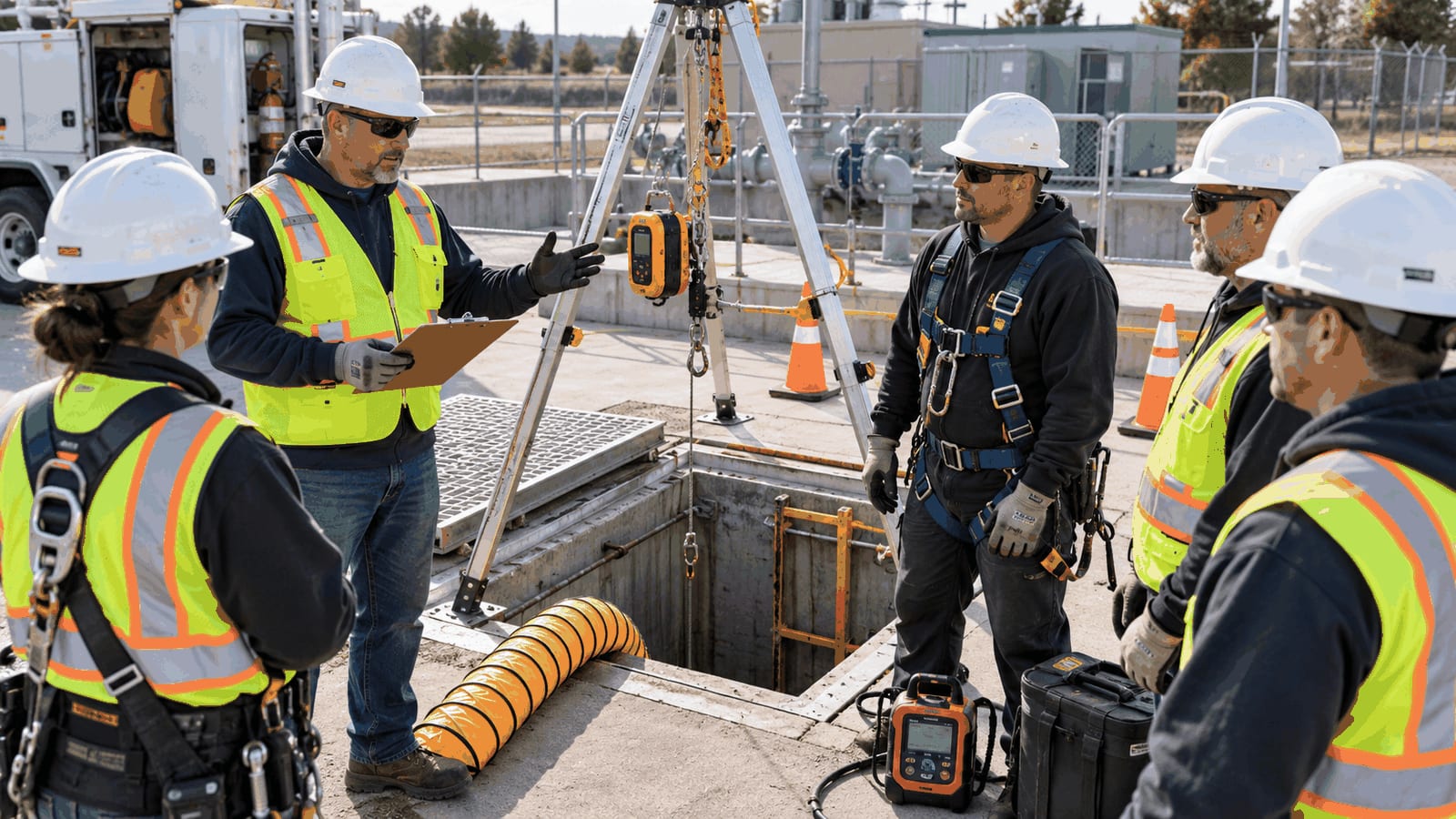
Every confined-space shift change should confirm hazards, permit status, roles, controls, and rescue readiness before the next worker crosses the opening.
A permit can be complete at the start of a job and still be incomplete for the next shift. Atmospheric conditions can change, ventilation can move, isolation can be disturbed, a new subcontractor can arrive, or a rescue team can become unavailable. A handoff that consists of passing a clipboard does not show that the incoming team understands the conditions or that the entry supervisor has reauthorized the work.
Employers need a repeatable process for stopping, reviewing, and restarting work. That process should match the applicable construction or general industry requirements, the employer's written program, and the hazards of the specific space. It should also make room for a conservative decision: if the team cannot explain the current conditions and controls, entry waits until the uncertainty is resolved.
Who This Affects
Shift handoffs affect authorized entrants, attendants, entry supervisors, rescue personnel, contractors, facility representatives, and managers who authorize the work. They matter in tanks, vaults, manholes, pits, sewers, crawl spaces, vessels, and other spaces where access is limited and conditions may change during the task.
The incoming entrant may have the right training but no knowledge of a new alarm, a change in ventilation, or a tool that introduced a hazard. The attendant may know the roster but not the revised communication method. A supervisor may inherit a permit without understanding why a control was selected. A rescue team may be on another call or lack the equipment required for the space. Handoffs connect those roles before work resumes.
Multi-employer work requires additional coordination. The host employer may control the facility, the controlling contractor may coordinate the project, and an entry employer may direct the entrants. The handoff should identify who has authority for the space, who supplies the permit, who controls energy and process hazards, and how each employer will share changes.
The Confined Space Compliance Issue
Permit-required entry programs depend on current information. An entry permit identifies the space, purpose, duration, authorized entrants, attendants, entry supervisor, hazards, measures used to isolate or control hazards, acceptable conditions, testing results, communication methods, rescue arrangements, and other required information. The exact requirements depend on the standard that applies and the employer's program, but the principle is consistent: the permit controls the entry, and the entry supervisor must know whether it still describes reality.
The handoff should address the time between crews. Was the space left open, covered, guarded, or isolated? Did anyone perform hot work, cleaning, chemical transfer, excavation, or line breaking nearby? Did ventilation stop? Was an alarm acknowledged? Was the monitor removed for charging or calibration? Did rain, temperature, process flow, or traffic change the environment? Each answer can affect whether the permit remains usable.
Testing is not a one-time ritual. Pre-entry testing establishes a starting point, but the monitoring plan must reflect the hazards and the work. Continuous monitoring may be appropriate, and periodic tests may be needed when conditions or tasks change. The team should know the instrument's alarm settings, bump-test or calibration status, sampling locations, response to an alarm, and who records results. No one should interpret an alarm as a nuisance that can be silenced without evaluating the space.
Ventilation and isolation need similar attention. A fan can create a safe condition in one location while leaving another area untested. A valve that was closed may not be locked, tagged, or otherwise secured according to the employer's procedure. A new process can reintroduce a hazard. The handoff should identify the physical control, its verification, and the person responsible for checking it before entry resumes.
Rescue readiness can expire during a shift. The designated team may leave, the retrieval path may be blocked, weather may affect access, or the entrant configuration may change. A written name on a permit is not enough if the rescuers do not know the space, cannot reach it, or do not have the required equipment. Confirm the method, communication route, access path, and activation decision every time the work changes hands.
What Employers Should Check
Use a short face-to-face or radio-confirmed handoff with a written record. The incoming supervisor or authorized person should be able to repeat the critical controls, not just acknowledge receipt.
- Identify the space, task, current permit, start time, expiration or review point, and reason work is continuing.
- Reconcile the entrant and attendant roster. Confirm who is inside, who has exited, and how the roster is tracked.
- Review the latest atmospheric readings, trends, alarm events, instrument identification, and next required test.
- Confirm isolation, lockout or tagout, blanking, blocking, line clearance, and control of connected processes.
- Verify ventilation placement, power, airflow, backup arrangements, and what happens if ventilation fails.
- Confirm communication between entrant and attendant, attendant and supervisor, and the worksite and rescue service.
- Walk the rescue route and check tripod, winch, harness, retrieval line, breathing equipment, or other equipment required by the plan.
- Review changes in tools, coatings, welding, cleaning agents, sludge, water level, weather, traffic, or nearby work.
- State the stop-work triggers and the person authorized to cancel the permit or evacuate the space.
- Record questions, deficiencies, corrective actions, and the time the incoming supervisor accepts control.
The incoming team should inspect the opening and surrounding area. Look for unauthorized access, damaged barricades, new liquids, displaced hoses, changed lighting, blocked egress, or equipment that could interfere with rescue. If the space was unattended, assume conditions may have changed until testing and isolation checks show otherwise.
The handoff should not encourage production pressure. A supervisor who inherits a late shift may feel pressure to keep workers moving, but a short delay to retest and confirm controls is part of the entry process. If a permit cannot be updated accurately, cancel it and prepare a new permit when the conditions are understood.
A useful handoff also records what did not happen. If a planned task was postponed, a control was not needed, or a reading was unavailable because work stopped, state that plainly. Future crews should not infer that an unchecked item was acceptable. The record should distinguish “not applicable,” “not completed,” and “completed after correction.” Those small distinctions make the permit review more useful and help employers identify recurring program weaknesses.
Managers can audit a sample of handoffs after the job. Compare the permit, monitor log, roster, work orders, and incident or near-miss notes. Look for unexplained gaps between readings, names that do not match the roster, rescue equipment that was listed but not checked, or cancellations that lack a reason. The purpose is learning and program improvement, not creating paperwork that crews cannot use.
Which Training Fits This Situation
Awareness training fits workers who may encounter confined spaces but do not perform entry. It helps them recognize openings, warning signs, prohibited entry, and the need to report changes. It supports safe coordination around the space without assigning them an entrant, attendant, or supervisor duty they do not perform.
Permit-Required Entry training fits authorized entrants and attendants who must understand hazards, testing, communication, evacuation, and their role during an entry. Attendant training should emphasize that the person outside the space maintains the roster, communicates with entrants, watches conditions, summons help, and does not abandon the post for an unrelated task.
Supervisor training fits the person who authorizes entry, confirms acceptable conditions, coordinates the handoff, and terminates or cancels the permit when conditions are not allowed. Competent Person training may be relevant in construction when the role includes identifying hazards and taking prompt corrective measures under the construction program.
A multi-role plan is often the best fit for recurring municipal, utility, maintenance, or contractor work. The employer can map each duty to the correct course, then add site-specific practice for the actual monitor, retrieval system, isolation points, rescue route, and communication equipment. Online training can provide foundational knowledge and a certificate of completion, but it does not replace employer authorization, hands-on equipment practice, site orientation, or rescue capability.
Common Mistakes to Avoid
One mistake is treating a permit as a static document. A permit is a control document tied to conditions, people, and time. Another is using the outgoing supervisor's memory instead of records. Memory may omit an alarm, a near miss, or a temporary control. A third is confusing a new employee's course certificate with authorization to enter a particular space.
Employers also overlook the attendant's workload. If the attendant must operate a radio, watch a camera, log readings, control traffic, and perform another job, the program may not give the person enough capacity to perform the attendant duties. The handoff should expose that conflict before entry begins.
Finally, avoid vague rescue language. “Call for help” is not a rescue plan. The team needs a known method, equipment, communications, trained responders, access, and a decision process. If those elements are not ready, the entry should not proceed.
Next Step
Add a shift-handoff line item to the confined-space entry procedure and test it on the next planned entry. Train each role for its actual duty, practice the handoff with the monitor and permit in hand, and require the incoming supervisor to verify conditions before authorizing work.