
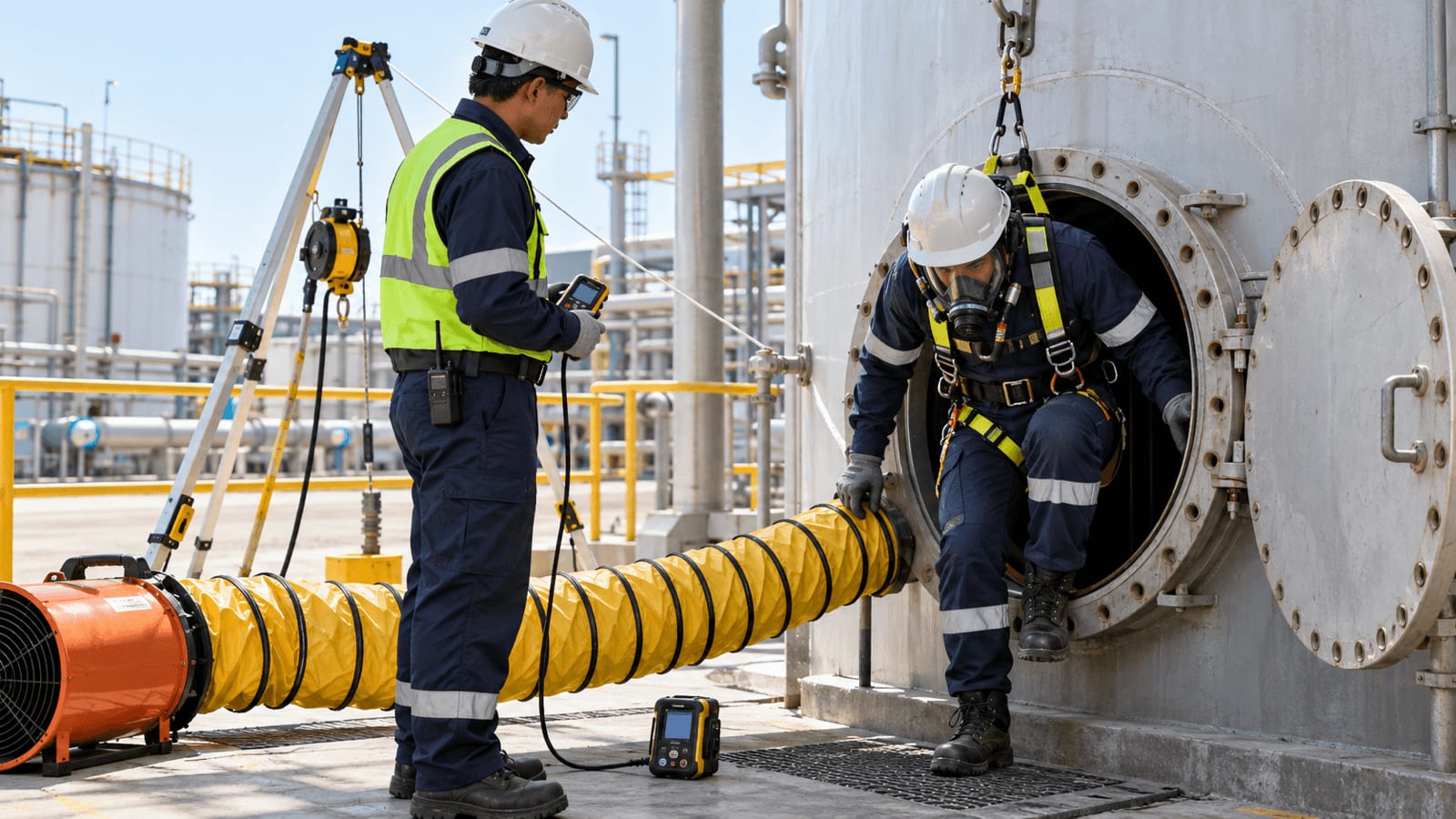
Confined space entrants need clear exit triggers because a delayed evacuation can turn a changing atmosphere, failed control, or warning sign into an emergency.
A permit, gas test, ventilation system, and attendant do not make entry conditions permanent. Work can release contaminants, isolation can fail, weather can affect a sewer or vault, equipment can stop, and an entrant can develop symptoms before an instrument provides an obvious explanation. The entry team should agree before entry on the events that require entrants to leave and the signals that communicate that decision.
This planning is not a substitute for the employer's permit-required confined space program. The applicable standard depends on the industry and work. OSHA 29 CFR 1910.146 covers general industry permit spaces, while 29 CFR Part 1926 Subpart AA covers confined spaces in construction. Employers should use the rule that applies to their operations and address site-specific hazards through their program, permit, training, equipment, and rescue arrangements.
Who This Affects
Authorized entrants are directly affected because they must recognize hazards, communicate with the attendant, and exit when required. They need to know more than a list of alarm numbers. They should understand the acceptable entry conditions on the permit, how their work could change those conditions, what warning signs matter, and which route they will use if the normal exit becomes difficult.
Attendants need the same shared language. The attendant monitors entrants and conditions outside the space, maintains an accurate count or identity of entrants, communicates as necessary, orders evacuation under required circumstances, and summons rescue or emergency services. An attendant who sees a hazard developing should not have to debate whether a phrase on the permit applies.
Entry supervisors authorize and oversee the entry within the employer's program. They verify that permit conditions and procedures are in place, that hazards are addressed, and that rescue services are available as required. They also need authority to cancel entry and keep people out while a condition is evaluated.
Rescue services, equipment operators, process owners, contractors, and host employers may also be affected. A process change outside the space can create an exit trigger inside it. A maintenance worker may stop ventilation to service a fan. A control-room operator may see a rising level. A contractor may introduce a chemical. Coordination should ensure that these changes reach the entry team immediately.
The Confined Space Compliance Issue
Under OSHA 1910.146(h), an authorized entrant must be trained to alert the attendant whenever the entrant recognizes a warning sign or symptom of exposure to a dangerous situation or detects a prohibited condition. The entrant must exit as quickly as possible when ordered by the attendant or entry supervisor, when the entrant recognizes a warning sign or symptom, when the entrant detects a prohibited condition, or when an evacuation alarm is activated.
The construction standard at 1926.1208 includes closely related entrant duties. Employers should not merge provisions casually or use the general industry rule for construction work without checking applicability. The common operational lesson is that exit decisions must be connected to defined conditions, trained roles, reliable communication, and a route that workers can use promptly.
Acceptable entry conditions are the conditions that must exist to allow safe entry and work. A prohibited condition is a condition in a permit space that is not allowed by the permit during authorized entry. The permit should translate the employer's hazard evaluation into values, states, limits, and controls that the team can recognize. Vague language such as evacuate if unsafe leaves too much interpretation for a time-critical moment.
Atmospheric alarms are important but not the only triggers. An alarm may indicate oxygen, combustible gas, or toxic gas conditions outside the employer's acceptable range. Exit may also be required by ventilation failure, loss of communication, unexpected liquid or material flow, isolation concern, electrical hazard, structural movement, fire, changing weather, external traffic, entrant symptoms, or a work activity that creates an unassessed hazard.
Exit is not rescue. Entrants who can leave under their own power should do so according to the procedure. If an entrant cannot self-rescue, the team follows the planned rescue process. Unplanned entry by the attendant or coworkers can expose additional people and make the emergency worse. Training must keep evacuation, non-entry retrieval, and entry rescue roles distinct.
What Employers Should Check
Start with the hazard evaluation and permit. Each trigger should link to a recognizable condition and a specific team response. For atmospheric hazards, identify the monitored substances, acceptable ranges, alarm settings, sampling locations, monitoring frequency, and action for instrument faults. Verify that those choices reflect the hazards, work, instruments, and employer program rather than a copied permit.
Review warning signs and symptoms associated with identified hazards, while avoiding the suggestion that workers should wait for symptoms. Dizziness, headache, irritation, confusion, unusual fatigue, breathing difficulty, or loss of coordination can be serious warning signs, but some atmospheres provide little sensory warning. Monitoring and controls remain essential. Any symptom or sign identified by the procedure should trigger communication and prompt exit.
Check communications under actual site conditions. Radios may not work through concrete or metal. Voice contact may be impossible around equipment. Hand signals may not be visible through a vertical opening. Hardwired systems can be damaged. The team should have a primary method, a backup where needed, and an understood evacuation signal that cannot be confused with ordinary work messages.
Verify the exit path. Ladders, tripods, davit arms, hoses, cords, tools, scaffolds, and work materials should not block or narrow the route. Entrants need enough space and time to stop work and move out. The employer should consider how protective clothing, fall arrest, respirators, body size, vertical travel, heat, and fatigue affect self-rescue.
Test what happens when one control fails. If ventilation stops, does the monitor remain on? If the monitor faults, is loss of data itself an exit trigger? If the attendant loses contact, how long does the team wait before ordering evacuation? If a process alarm occurs outside, who tells the attendant? These decisions belong in the plan before entry, not in an improvised discussion after a failure.
Confirm accountability. The attendant should know exactly who is inside, their approximate work locations when relevant, and whether each person has exited. A crowded portal can create false confidence if one entrant remains behind. The permit and communication process should support a positive headcount after evacuation.
Finally, define restart authority. After an evacuation, nobody should reenter merely because an alarm clears or ventilation resumes. The employer should identify who evaluates the event, retests conditions, corrects controls, revises or issues the permit, confirms rescue readiness, and reauthorizes entry. A restart is a new decision based on verified conditions.
Which Training Fits This Situation
Confined space awareness training fits workers who may encounter spaces but are not assigned permit-entry duties. It should help them recognize space markings, avoid unauthorized entry, and know how to report a concern. Awareness does not prepare someone to serve as an entrant, attendant, entry supervisor, or rescuer.
Authorized entrant training should cover the hazards of the space, signs and symptoms, equipment, communication, protective measures, and the four categories of exit triggers. Entrants should practice stopping the task, alerting the attendant, moving without delay, and reporting what they observed after exit. Training should address the real posture, PPE, travel distance, and opening configuration.
Attendant training should emphasize monitoring, communication, ordering evacuation, summoning rescue, controlling unauthorized persons, and avoiding duties that interfere with monitoring. Scenarios should require the attendant to act on incomplete but concerning information, such as lost contact or a ventilation alarm, without entering the space.
Entry supervisor training should include permit review, hazard and control verification, rescue-service confirmation, cancellation, and restart decisions. Supervisors should be able to explain why each trigger exists and how they will preserve records for program review.
Rescue training must match assigned rescue duties and the employer's rescue plan. A general entry course does not by itself establish rescue proficiency. Employers should evaluate rescue services, practice as required, and ensure that equipment and response time fit the identified hazards.
A useful drill uses a short sequence. Begin with stable readings and normal work. Then introduce a radio failure, a worker report of irritation, or a monitor fault. Observe whether entrants stop, notify, and exit; whether the attendant orders evacuation and counts everyone; whether rescue is summoned only when needed; and whether anyone tries to reenter before reauthorization. Debrief the decisions, not just the time.
Common Mistakes to Avoid
Do not define evacuation only by one gas-monitor alarm. Permit spaces can contain physical, mechanical, electrical, engulfment, temperature, traffic, configuration, and process hazards. The exit plan should cover the hazards identified for the specific space and task.
Do not tell entrants to investigate an alarm from inside. An entrant may be tempted to finish a bolt, reposition the monitor, silence an alarm, or wait for a second reading. Unless the employer's evaluated procedure clearly provides otherwise, the trained response to an exit trigger is to leave as quickly as possible and evaluate from outside.
Do not depend on smell or visible vapor. Some hazards have poor warning properties, and sensory fatigue can reduce perception. Use the required testing, monitoring, ventilation, isolation, and other controls.
Do not assume that every entrant interprets phrases the same way. Mixed-language crews, contractors, noisy locations, and unfamiliar equipment increase the need for plain terms and practiced signals. Training should be understandable to each employee and should verify comprehension.
Do not confuse retrieval equipment with permission to continue under unacceptable conditions. A harness and retrieval line support emergency planning but do not replace hazard control, monitoring, communication, or evacuation.
Do not restart automatically. Clearing an alarm, restoring a fan, or finding a broken sensor may explain part of the event, but the employer still needs to verify acceptable conditions and follow its permit and program procedures before entry resumes.
Next Step
Select one frequently entered permit space and place its permit beside the actual equipment. Ask each entrant and attendant to point to every exit trigger, state the evacuation signal, identify the route, and explain the post-exit headcount. If answers differ, revise the permit language and conduct a drill before the next entry.
Then review a recent canceled permit or evacuation. Check whether the record identifies the trigger, readings or observations, entrant accountability, control failure, corrective action, permit decision, and restart authorization. Use the findings to improve training and the written program without turning the review into blame.
Sources
Occupational Safety and Health Administration, 29 CFR 1910.146 Permit-Required Confined Spaces | https://www.osha.gov/laws-regs/regulations/standardnumber/1910/1910.146
Occupational Safety and Health Administration, 29 CFR 1926 Subpart AA Confined Spaces in Construction | https://www.osha.gov/laws-regs/regulations/standardnumber/1926/1926SubpartAA
Electronic Code of Federal Regulations, 29 CFR 1910.146 Permit-Required Confined Spaces | https://www.ecfr.gov/current/title-29/subtitle-B/chapter-XVII/part-1910/subpart-J/section-1910.146