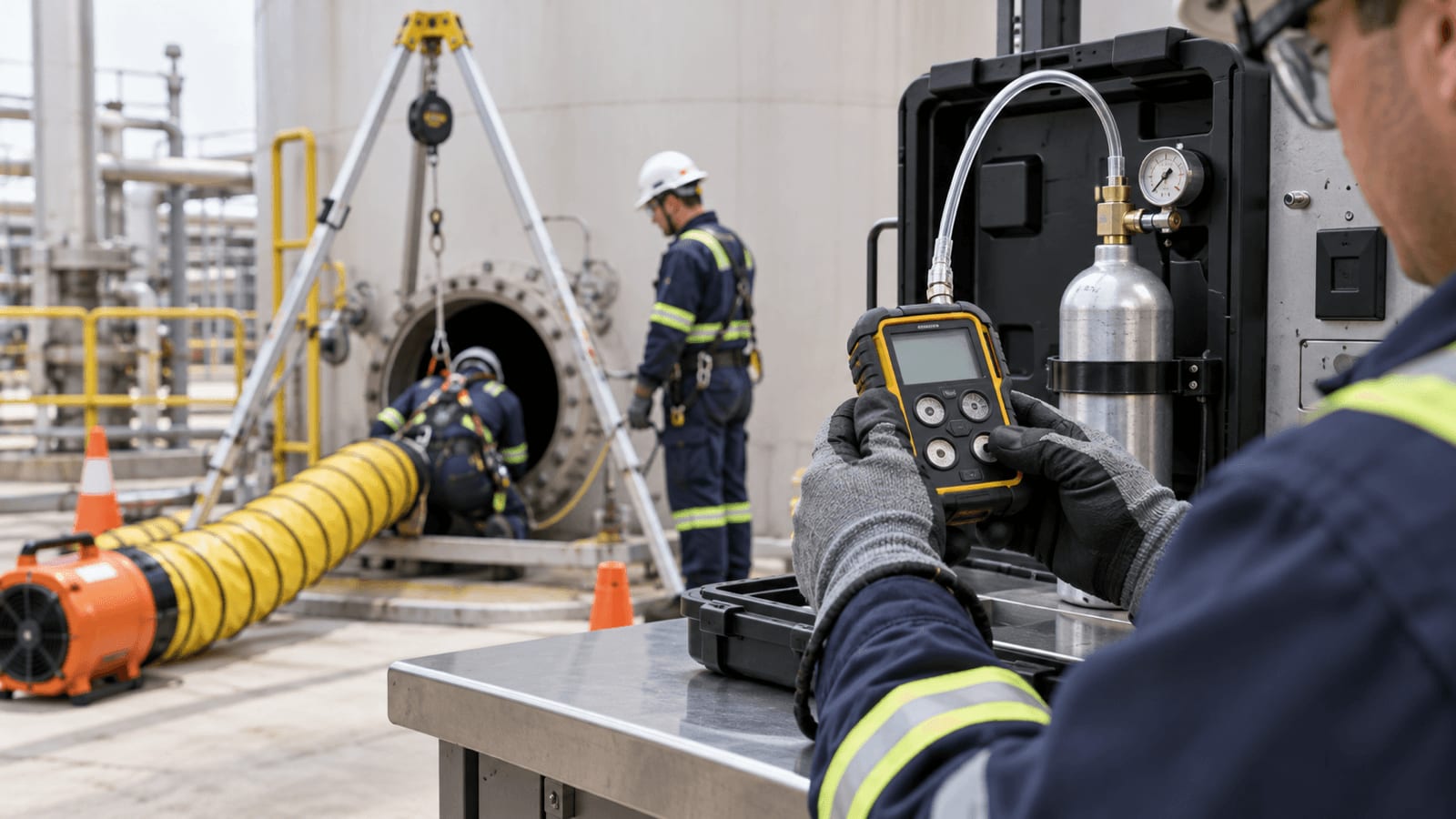
A gas monitor that powers on is not automatically ready for confined-space entry, so crews need a documented function check before relying on its alarms.
Portable gas monitors help entry teams detect hazards that cannot be seen or smelled reliably. Their value depends on correct selection, sensor condition, calibration status, alarm operation, sampling method, and the user's ability to interpret the results. A charged screen and familiar startup sequence do not prove that gas can reach every sensor or that audible, visual, and vibrating alarms will activate.
A bump test gives the crew a practical readiness check by exposing the instrument to a known challenge gas and confirming sensor response and alarm function. It is different from a full calibration and does not replace the atmospheric testing required for the space. Employers should build the check into equipment control, entry planning, permits, and role-based training so monitor readiness is verified before the instrument becomes a life-safety dependency.
Who This Affects
This issue affects employers whose workers enter tanks, pits, vaults, manholes, vessels, process equipment, sewers, utility spaces, or other locations that may have atmospheric hazards. It also affects host employers, contractors, equipment coordinators, entry supervisors, attendants, authorized entrants, safety staff, and rescue teams that rely on monitor readings when making entry or evacuation decisions.
The equipment may be company owned, rented, assigned to an individual, or stored in a shared charging station. Each arrangement creates different control points. A shared instrument might have been used on a different shift, exposed to a high gas concentration, dropped, left with a blocked filter, or returned without its test record. A rented instrument may arrive with documentation but still require the user checks specified by the manufacturer and employer.
Construction employers should also consider the confined-space requirements that apply to their work, including 29 CFR 1926 Subpart AA. The general-industry permit-space standard in 29 CFR 1910.146 has its own scope. The employer should identify the applicable standard and program rather than assuming one procedure fits every workplace. The central equipment principle remains consistent: test and monitoring instruments must be suitable, maintained, and used correctly.
The Confined Space Compliance Issue
OSHA's general-industry permit-required confined-space standard requires atmospheric testing with a calibrated direct-reading instrument in specified circumstances and requires employers to provide, maintain, and ensure proper use of testing and monitoring equipment. Entry conditions must be evaluated before authorization and monitored as necessary during the operation. A monitor that cannot respond properly to gas undermines those decisions.
OSHA's guidance on direct-reading portable gas monitors distinguishes a bump test from a calibration check and full calibration. A bump test is a qualitative function check. Challenge gas is applied long enough and at a sufficient concentration to activate the sensors and alarms. It confirms that gas reaches the sensors and that alarms work, but it does not establish measurement accuracy.
A calibration check compares the instrument's response with the concentration stated for a known test gas and the manufacturer's acceptable limits. A full calibration adjusts the instrument so its reading corresponds to a known gas concentration. Employers should follow the instrument manufacturer's instructions for frequency, gas mixture, flow, setup, tolerances, maintenance, and actions after a failed test.
OSHA's safety bulletin cites industry guidance recommending a bump test or calibration check before each day's use in accordance with manufacturer instructions. Site conditions or instrument history may call for additional checks. Exposure to an over-range concentration, a failed response, a dropped instrument, contamination, sensor replacement, prolonged storage, or questionable readings should trigger the response specified by the manufacturer and the employer's program.
The bump test is only one link in atmospheric evaluation. The employer must identify potential contaminants, select sensors capable of detecting them, define acceptable entry conditions, test in the required sequence, account for stratification and remote sampling, observe instrument response time, and continue monitoring when conditions may change. A successful function check cannot make an incorrectly selected monitor suitable for the hazard.
What Employers Should Check
Start with a written equipment-control process. Identify every monitor by a unique asset or serial number, its assigned sensors, service status, calibration due date, compatible test gas, accessories, and storage location. The process should prevent an instrument with an expired calibration, failed test, maintenance hold, or unsupported sensor from being placed into service.
Verify the challenge-gas cylinder before testing. Check that the mixture matches the monitor and procedure, the cylinder is within its stated expiration period, the regulator and tubing are compatible, and the concentration is sufficient to activate the alarm setpoints. Store cylinders under the conditions the supplier specifies. An empty cylinder, leaking connection, wrong regulator, or degraded gas can produce a misleading failure or pass.
Inspect the monitor physically. Look for cracked housings, damaged displays, blocked sensor ports, dirty filters, missing clips, loose battery connections, and contamination from mud, paint, silicone, solvents, or other substances. Confirm that pumps, probes, tubing, water traps, and remote-sampling accessories are clean, intact, and appropriate for the instrument. A pump check and tubing leak check may be part of the manufacturer's procedure.
Perform the bump test in clean air and in the sequence specified by the manufacturer. Confirm that each installed sensor responds and that audible, visual, and vibration alarms function. Do not accept a partial pass. If the instrument fails, remove it from service, identify it clearly, and follow the required calibration, troubleshooting, sensor replacement, or repair process. Repeating a test until the device barely passes is not a substitute for resolving the cause.
Review alarm setpoints and configuration. A monitor can respond to gas yet still be configured for the wrong limits, disabled alarms, an incorrect language or unit, or a datalogging setup that does not support the program. Access to configuration changes should be controlled. The entry supervisor should know what setpoints apply and what worker action each alarm requires.
Connect the test record to the actual entry. A useful record identifies the instrument, date and time, person conducting the check, gas cylinder or station used, result for each sensor, alarm result, and any corrective action. Electronic docking stations can simplify records, but the employer should confirm that data are transmitted, associated with the correct device, retained, and available to the entry supervisor.
Before entry, verify that the monitor used on the permit or certification is the same instrument that passed its readiness check. Confirm battery life for the planned duration, including delays and rescue standby. Review sampling locations, order, instrument response time, tubing delay, continuous-monitor placement, and communication of results. Entrants or their representatives must receive the opportunities and results required by the applicable standard.
During entry, treat alarms, unexpected readings, loss of flow, sensor errors, low battery warnings, and communication failures as defined action triggers. A worker should not silence an alarm and continue because the reading later returns to normal. The team should follow the permit-space procedure, including immediate exit when a prohibited condition exists, and investigate before any subsequent entry.
Which Training Fits This Situation
Confined-space awareness training fits employees who need to recognize spaces and entry hazards but will not perform permit entry duties. Authorized entrant, attendant, and entry supervisor training should address the responsibilities of each role, including atmospheric testing communication, alarm response, evacuation, permit review, and prohibited conditions. Rescue personnel need training and practice that match their assigned service and expected hazards.
Workers who operate monitors need instrument-specific hands-on instruction. They should be able to inspect the device, conduct the bump test, recognize a failed sensor or alarm, use pumps and probes, account for response time, sample at relevant levels, and interpret readings within the employer's program. A generic video about four-gas monitors cannot cover the controls and limitations of every model.
Supervisors and equipment coordinators should understand calibration intervals, service holds, cylinder control, docking-station records, sensor limitations, and configuration management. They also need to recognize when the expected contaminant is outside the installed sensor set or when an environmental condition can affect performance. Technical support from the manufacturer or a qualified safety professional may be necessary.
Online confined-space courses can support awareness, permit-required entry, entrant, attendant, and entry-supervisor knowledge. The employer must still provide site-specific and equipment-specific training and evaluate whether employees can perform their duties. Course completion does not by itself authorize entry or demonstrate proficiency with a particular monitor.
Common Mistakes to Avoid
Do not confuse a startup self-check with a bump test. A self-check may examine internal electronics, but it generally does not prove that challenge gas can reach the sensors and activate every alarm. Do not confuse a bump test with calibration either. Each process answers a different question.
Avoid using yesterday's pass for a device with a changed condition. If the monitor was dropped, exposed to an over-range event, contaminated, repaired, or stored improperly, the employer should follow the manufacturer's response even if the normal interval has not elapsed. The test process should be tied to instrument history, not only the calendar.
Do not let records become detached from equipment. A printed pass without an instrument identifier, a docking record that never synchronized, or a shared clipboard with no time creates uncertainty at the entry point. The supervisor needs evidence that the exact instrument in service is ready.
Avoid relying on one monitor for contaminants it cannot detect. A standard four-gas configuration may not address every solvent, process gas, or toxic material in a space. Hazard evaluation comes before sensor selection. Review safety data, process knowledge, previous entries, and potential work-generated contaminants.
Do not perform atmospheric testing without accounting for location and time. Different gases may stratify, remote tubing adds response delay, ventilation changes distribution, and work can generate new hazards. Pre-entry readings at the opening cannot always represent conditions throughout a large or complex space.
Next Step
Audit one complete monitor workflow from storage to entry. Choose an instrument, trace its calibration and bump-test record, inspect its cylinder and accessories, observe a worker perform the check, and compare the result with the permit-space procedure. Correct any gap before the next entry rather than waiting for an alarm that may not occur.
Then align training with the equipment and roles actually used. A reliable program lets the crew answer five questions before entry: Is this the right instrument, did it pass the required check, is its calibration current, does the user know how to sample correctly, and does everyone know what each alarm requires?
Sources
OSHA, Calibrating and Testing Direct-Reading Portable Gas Monitors: https://www.osha.gov/publications/shib093013
OSHA, 29 CFR 1910.146 Permit-Required Confined Spaces: https://www.osha.gov/laws-regs/regulations/standardnumber/1910/1910.146
OSHA, 29 CFR 1910.146 Appendix B Procedures for Atmospheric Testing: https://www.osha.gov/laws-regs/regulations/standardnumber/1910/1910.146AppB