
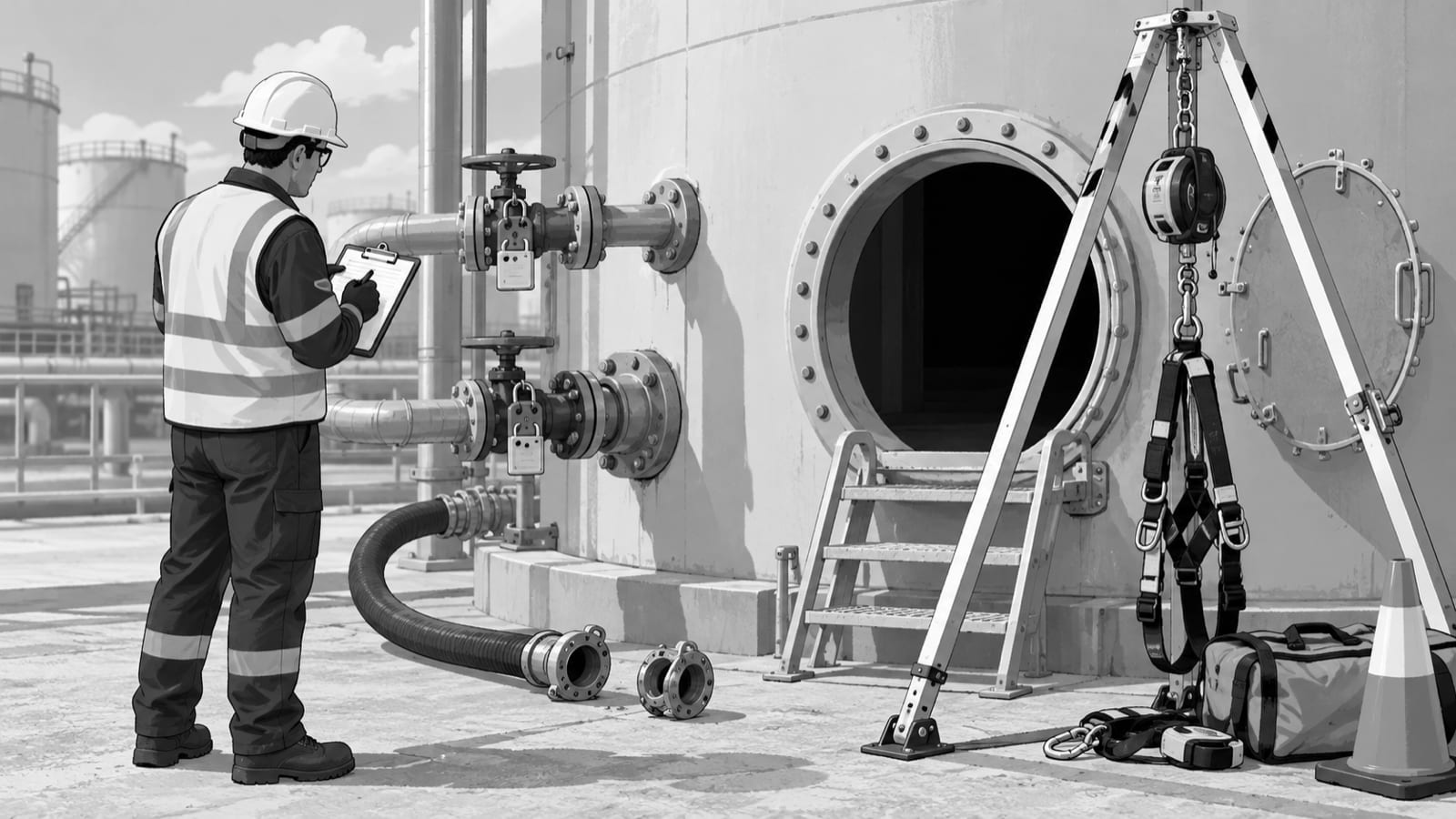
Before a tank, vessel, or vault is opened, employers should verify every energy and material source that could reintroduce danger during entry.
Who This Affects
Isolation verification affects employers, entry supervisors, authorized entrants, attendants, maintenance planners, contractors, and operations staff who control connected systems. A tank may be physically quiet while pumps, valves, process lines, steam, chemicals, electrical equipment, or gravity-fed materials remain connected to it. The entry team needs a reliable method for confirming that those sources are controlled before the opening is treated as an entry point.
The issue is common in maintenance shutdowns, wastewater work, manufacturing, utility service, and facility repair. It also appears in pits, silos, wet wells, vessels, ducts, and sections of continuous systems. A plan that works for one space may not work for another, even when the openings look similar. Each space deserves a hazard review based on its actual connections and operating history.
Employers should ensure that the people assigned to isolation verification understand their role. The person who places a lock may not be the person who authorizes entry. The entry supervisor needs enough information to verify permit conditions, while operations may need to document system status. In a multi-employer job, the handoff between these roles should be explicit.
Isolation is not the same as atmospheric testing. A monitor can show acceptable conditions at one moment, but testing does not prove that a pump cannot start, a line cannot drain, or a product cannot flow into the space. Physical isolation and control of energy sources reduce the chance that a safe atmosphere or condition will change during entry.
The Confined Space Compliance Issue
OSHA's permit-required confined-space rule requires employers to evaluate hazards, specify acceptable entry conditions, and prevent unauthorized entry. The rule also addresses isolation, testing, ventilation, communication, rescue, and the duties of attendants and entry supervisors. The exact method of isolation depends on the equipment and process, so employers should use the applicable procedure, energy-control program, and qualified technical support.
A useful isolation review starts with a system map. Trace every pipe, duct, drain, conveyor, agitator, electrical feed, hydraulic line, pneumatic line, and chemical connection that can affect the space. Include sources that are not obvious from the opening, such as a high point that can release vapor, a low point that can collect liquid, or an interconnected vessel that can equalize pressure. Review normal operation, startup, shutdown, automatic controls, and failures.
The plan should identify the isolation method for each source. Depending on the system, that may involve disconnecting, blinding, blocking, double-block-and-bleed arrangements, locking out equipment, securing valves, draining, purging, or another method that prevents hazardous material or energy from reaching the space. A closed valve without verification may be insufficient where leakage, mislabeling, bypasses, or valve-passing hazards are possible.
Verification should be more than a verbal assurance. The responsible person should compare the field condition with the system map, inspect locks or tags, confirm valve and breaker identities, check zero-energy indicators where appropriate, and document the result. Pressure or flow readings may support the review but should not be treated as the only proof when the equipment configuration requires physical separation.
The team should consider stored energy. A vessel can retain pressure, heat, vacuum, chemicals, mechanical movement, or liquid head after a source is shut down. Drains may be plugged, vents may be closed, and residues may release vapors when disturbed. The isolation plan should explain how stored energy is relieved or controlled and who confirms that the step is complete.
Atmospheric testing comes after the hazard evaluation and isolation plan, not instead of them. OSHA's atmospheric testing guidance describes testing for oxygen first, then combustible gases and vapors, and then toxic gases and vapors. Employers should select instruments and sampling locations that match the hazards, allow entrants to observe testing, and determine how often conditions will be tested or monitored.
If a hazardous atmosphere or unexpected flow is detected, entrants should leave immediately and the entry should be stopped. The space should be reevaluated before anyone returns. A permit change, new isolation, additional ventilation, or technical review may be needed. The entry supervisor should not treat a new reading as a minor adjustment when it may show that the original isolation assumptions were wrong.
What Employers Should Check
Employers should start with the entry permit and ask whether the listed hazards match the actual equipment. The permit should identify the space, purpose, entrants, attendant, entry supervisor, acceptable conditions, test results, communications, rescue arrangements, and measures used to isolate hazards. If a permit has a generic line for isolation but no equipment-specific detail, the team may need a better pre-entry review.
The isolation boundary should be visible in the field. Labels, lock numbers, valve positions, breaker identities, blind locations, and drain points should match the written plan. Where several systems look alike, the crew should use positive identification rather than memory. A photograph or marked-up diagram can support the record, but it should not replace the field check.
The employer should verify that every affected department understands the entry schedule. Production staff, utilities, contractors, and maintenance teams need to know which controls cannot be changed. The entry supervisor should know how to respond if another worker wants to restore equipment, clear a lock, open a valve, or start a process. Communication should include the planned end of entry and the conditions for restoring service.
Rescue planning should account for isolation. A rescue team may be exposed to the same energy or material if the system is not controlled. The plan should address non-entry retrieval where feasible, access, harness and line compatibility, communications, and the time needed to reach the entrant. Employers using their own rescuers should ensure they are trained and practiced for the spaces involved.
Records should connect the permit to isolation evidence. Keep the system map, lockout documentation, test results, entry log, shift handoff, and closeout notes together when practical. A record should make it possible to reconstruct who verified the boundary, when it was checked, what conditions were observed, and what changed during the work.
Which Training Fits This Situation
Authorized entrants need to understand hazards, acceptable entry conditions, alarm responses, communication, and the instruction to exit when conditions change. Attendants need to recognize unauthorized changes, track entrants, maintain communication, summon rescue, and prevent an unplanned rescue entry. Entry supervisors need deeper practice in evaluating permits, confirming isolation, reviewing test results, and stopping the operation.
Maintenance and operations personnel may need role-based training on energy control, system maps, valve identification, and the difference between shutdown and isolation. Contractors should receive a site-specific briefing before work begins, especially when the host facility controls the systems. Rescue personnel need training and practice appropriate to the space, equipment, access, and hazards.
Good training uses a realistic scenario. Give the team a tank drawing with two process lines, a drain, an agitator, a steam connection, and a remote pump. Ask who controls each source, what must be isolated, how verification will occur, what the monitor can and cannot prove, and what happens when the shift changes. The exercise should end with a documented go or no-go decision.
Training records should identify the topic and role, but competence is demonstrated in the field. Supervisors can ask workers to trace a line, identify an isolation point, explain an alarm response, or describe the exit trigger. Short refreshers after a near miss, process change, equipment change, or audit finding can be more useful than repeating a generic lecture.
Common Mistakes to Avoid
One mistake is treating a closed valve as complete isolation without checking the system design or the possibility of passing flow. Another is relying on the first gas test while a connected process remains capable of changing conditions. A third is leaving the isolation map with operations while the entry team works from memory.
Employers should avoid assigning isolation verification to someone without authority or knowledge to confirm the boundary. A worker may be able to read a gauge but not understand a bypass. A supervisor may sign a permit without seeing the lock points. Clear responsibilities and a field verification step close that gap.
Shift changes create another risk. The incoming supervisor should review the permit, conditions, test history, isolation status, entrant list, and changes before work continues. If the entry stops for an extended period or conditions change, the team should reassess rather than assume the original authorization remains valid.
Next Step
Before the next tank or vessel entry, create a one-page isolation verification checklist tied to the actual system. Include source identification, control method, zero-energy or zero-flow verification, atmospheric testing, communications, rescue readiness, and restoration authority. Use the checklist as a prompt for qualified review, not as a substitute for judgment.
Training can help employers build role-specific habits around permits, monitoring, isolation, and rescue. A short scenario-based review before the next entry can reveal whether the team understands who controls each source and what evidence is required before the supervisor authorizes work.
Sources
Occupational Safety and Health Administration, 29 CFR 1910.146 Permit-Required Confined Spaces - https://www.osha.gov/laws-regs/regulations/standardnumber/1910/1910.146
Occupational Safety and Health Administration, Appendix B Procedures for Atmospheric Testing - https://www.osha.gov/laws-regs/regulations/standardnumber/1910/1910.146AppB