
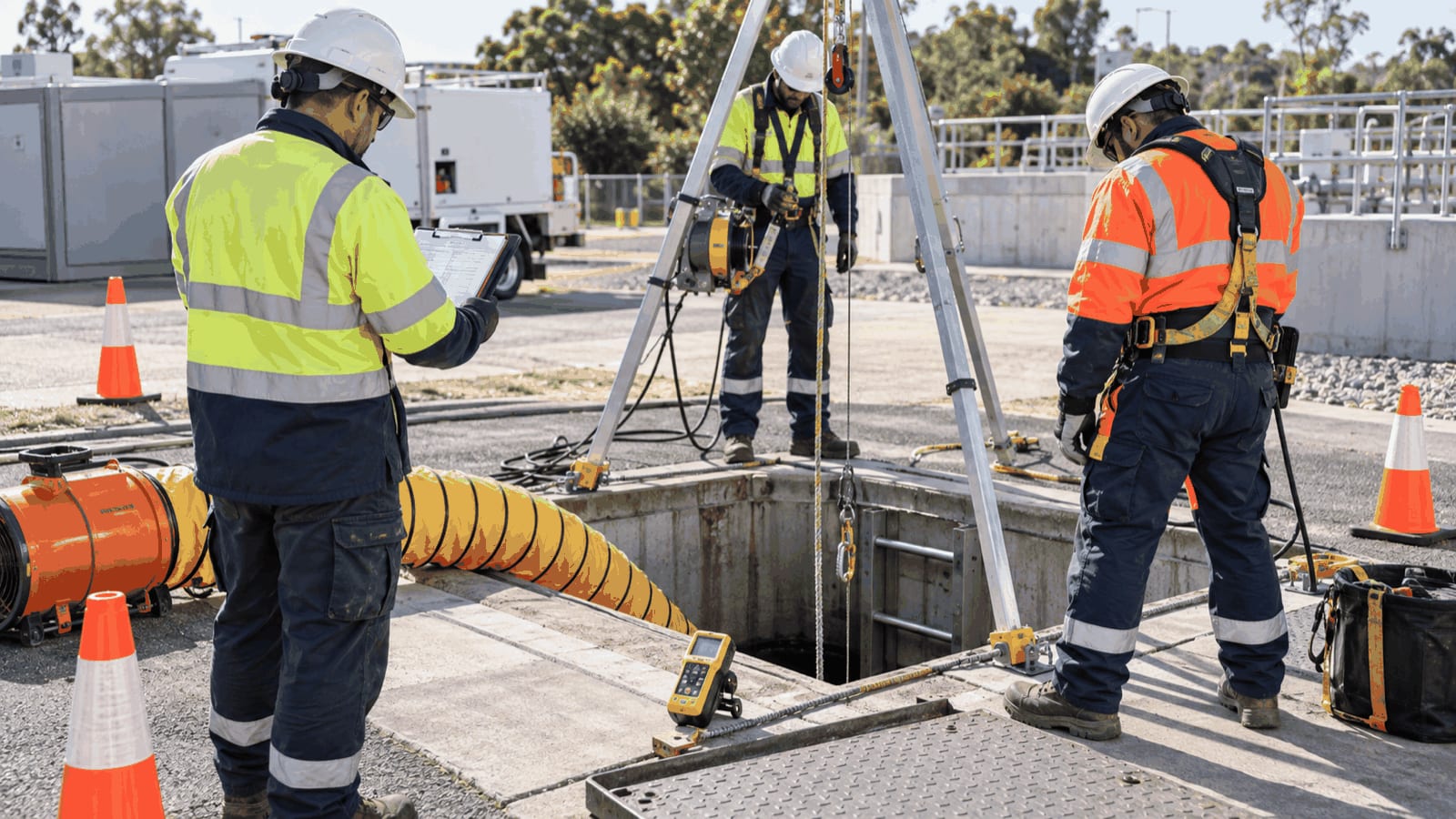
Before a confined-space crew arrives, supervisors should verify that testing, ventilation, retrieval, communication, and rescue equipment fit the planned entry.
Equipment staging is often the moment when a confined-space plan becomes real. A permit may identify hazards and roles, but the entry team still needs the right monitor, calibration information, ventilation arrangement, retrieval system, lighting, communication method, and emergency resources at the opening. If those items are missing, incompatible, or placed where they cannot be used, the crew may feel pressure to improvise.
This article supports planning and training discussions for employers, supervisors, attendants, entrants, and rescue teams. It does not replace the employer's hazard evaluation, written program, permit process, equipment instructions, or applicable OSHA requirements. The entry supervisor must determine whether the space and conditions are acceptable before entry.
Who This Affects
Maintenance departments, utilities, industrial facilities, construction contractors, and specialty service companies may all stage equipment for confined-space work. The space might be a tank, vault, pit, vessel, wet well, sewer, crawlspace, or process enclosure. The work may be cleaning, inspection, repair, coating, sampling, or shutdown support. Each task changes the hazards and the equipment decision.
The entry supervisor needs a complete picture of the job, including the space configuration, openings, internal obstructions, isolation points, work method, expected duration, atmospheric hazards, and rescue route. The attendant needs equipment that supports continuous awareness of the entrant and reliable communication. Entrants need equipment they can use without defeating their respiratory protection, harness, lighting, or other controls.
Host employers, controlling contractors, entry employers, subcontractors, and rescue providers may share responsibilities. A staging check is an opportunity to clarify who supplied the monitor, who verified calibration, who controls the permit, who operates ventilation, and who calls for help. The names and roles should be understood before the opening is treated as ready.
The Confined Space Compliance Issue
The central issue is not whether equipment is present. It is whether the equipment is appropriate, inspected, available at the point of work, and connected to the hazard controls in the permit. A four-gas monitor that has not been checked according to the manufacturer's instructions does not become reliable because it is clipped to a worker's belt. A tripod that cannot be positioned over the opening does not provide a complete retrieval plan.
Atmospheric testing should be planned around the space and the work. The employer may need to test from outside, sample different elevations, account for stratification, and continue monitoring during entry. The monitor's sensors must match the hazards identified by the evaluation. If the work introduces a new contaminant, changes oxygen conditions, or disrupts a deposit, the plan may need to be reassessed.
Ventilation requires the same discipline. A blower can move air, but the duct must deliver it to the correct area without drawing contaminants from an exhaust source or creating a trip hazard. The team should know what happens if ventilation stops, the monitor alarms, or the space cannot be maintained within the acceptable limits identified by the employer.
Retrieval and rescue equipment must match the entrant's location and the opening geometry. A harness, lifeline, winch, tripod, davit, or alternative system may be appropriate in one space and unsuitable in another. The equipment should not interfere with movement, create a snag, or encourage a non-entry rescue assumption that has not been evaluated. Rescue providers should know the space and have access to the equipment they are expected to use.
Equipment Is Part of the Procedure
The staging list should be linked to the entry sequence. Before opening, isolate energy and product sources. Before testing, confirm the instrument status and sampling method. Before entry, verify the permit, communication, ventilation, retrieval, lighting, and rescue arrangements. During entry, keep the attendant in position and maintain the monitoring and communication process. After a change, pause and reassess rather than silently crossing an old control off a list.
This sequence helps reveal gaps that a simple inventory misses. For example, a monitor may be present but the sampling hose may not reach the far end of a vault. A radio may be charged but not work below grade. A blower may run but its intake may be beside a truck exhaust. A retrieval line may be attached but not provide a clear path through an offset opening.
What Employers Should Check
Start with the space drawing or field sketch. Mark the opening, internal levels, ladders, pipes, baffles, valves, sumps, dead ends, and points where a worker could become trapped. Identify where the attendant will stand and where the rescue team will approach. Then place the equipment on the sketch and ask whether each item can be used without moving the attendant into an unsafe position.
Verify the atmospheric monitor's model, sensors, bump-test or calibration status as required by the employer and manufacturer, battery, alarms, sampling line, filters, and maintenance record. The team should know who is authorized to use it and how readings will be recorded. A monitor should be tested in a safe manner before entry, and the permit should reflect the employer's testing process.
Check ventilation direction, duct placement, power supply, backup arrangements, and the response to failure. Keep hoses and cords organized so they do not block egress or create a new hazard. If the space contains a hazardous atmosphere or a potential for one, confirm that the ventilation plan is consistent with the hazard assessment and that the crew knows when to stop.
Inspect retrieval components for condition, compatibility, anchorage, capacity, and access. Verify that the harness fits the entrant and that the line will not snag on internal equipment. If non-entry retrieval is not feasible, document the reason and confirm the alternative rescue method. Do not let the presence of a tripod substitute for a real rescue plan.
Confirm communication with a practical test. A radio check at the surface does not prove that the signal will work inside a steel tank or below a concrete vault. Use the planned words, signals, or system. Make sure the attendant can summon help without abandoning the opening or losing contact with the entrant.
Use a Staging Walkthrough
A supervisor can conduct a walkthrough in the same order that the team will perform the entry. Point to each piece of equipment, identify its owner, and demonstrate the first response to an alarm, loss of ventilation, failed communication, or entrant distress. Keep the permit and instructions readable, but do not depend on paperwork to reveal a physical mismatch.
Ask the entrant to explain how the harness, monitor, lighting, and tools will be carried. Ask the attendant to explain what will be watched and recorded. Ask the rescue team how it will reach the opening. These role-based answers are more useful than asking whether everyone is ready.
Which Training Fits This Situation
Entrants need training that covers hazards, equipment use, communication, exit decisions, and the conditions that require them to leave. Attendants need to understand the space, recognize prohibited conditions, maintain the count, communicate with entrants, summon help, and avoid entering during a rescue response. Entry supervisors need to evaluate readiness, verify permits, authorize entry, stop work, and cancel or close the entry as required by the employer's program.
Equipment users may need additional instruction on gas monitors, ventilation systems, retrieval devices, respiratory protection, or lockout and isolation. Rescue personnel need training and practice appropriate to the hazards and the space. A general awareness course may support recognition, but it should not be presented as the complete preparation for a role that requires specialized skills or site-specific practice.
Employers should compare the course scope with the work assignment. A utility vault crew may need different scenarios from a tank-cleaning contractor. A supervisor coordinating multiple employers may need training that emphasizes communication and responsibility transfer. Records should show the person, role, course, date, and any hands-on or drill requirement the employer has established.
Common Mistakes to Avoid
One mistake is staging equipment only after the crew arrives. That turns missing items into schedule pressure and can make a shortcut feel like the practical choice. Stage early enough to correct a mismatch.
Another mistake is choosing a monitor by habit instead of by the hazard evaluation. Sensor selection, sampling method, alarm settings, and maintenance status all matter. Do not assume that every four-gas meter covers every contaminant.
Do not place the blower, cords, or retrieval line where they obstruct the opening. Do not assume a radio works because it works at the truck. Do not treat a permit as proof that the equipment can be installed as planned.
Finally, avoid treating rescue as an outside topic. The rescue team, equipment, access route, and call process should be confirmed before entry. A rescue plan that cannot reach the entrant is not a usable control.
Next Step
Before the next entry, set up the equipment at the actual space and conduct a role-based staging walkthrough. Record the monitor check, ventilation arrangement, retrieval path, communication test, permit owner, and rescue contact. Use the results to update the entry briefing and assign any missing equipment before workers are asked to enter.
Sources U.S. Department of Labor, OSHA, Permit-Required Confined Spaces, https://www.osha.gov/confined-spaces; U.S. Department of Labor, OSHA, 29 CFR 1910.146, https://www.osha.gov/laws-regs/regulations/standardnumber/1910/1910.146; U.S. Department of Labor, OSHA, Confined Spaces in Construction, https://www.osha.gov/confined-spaces/construction