
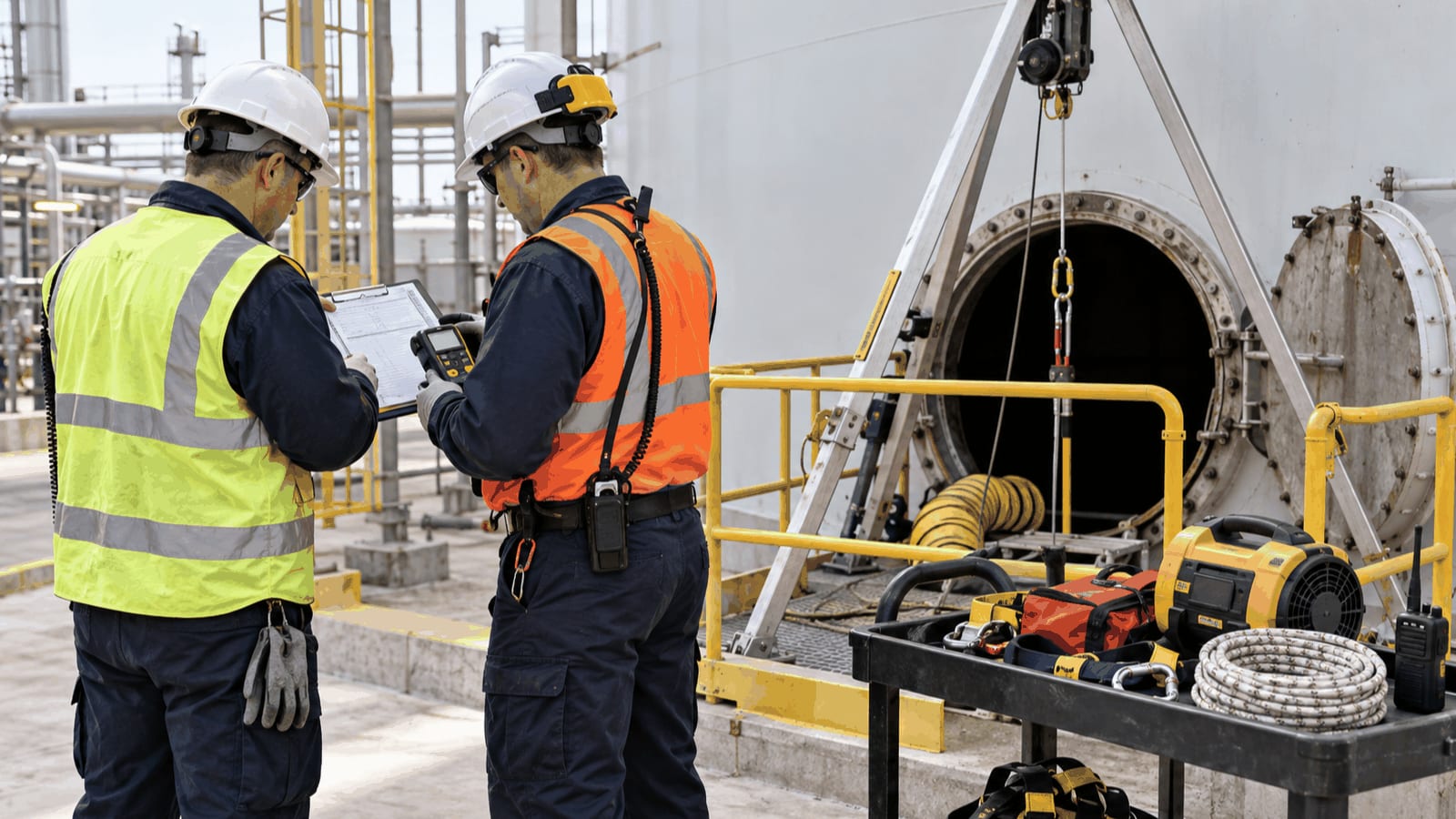
Before a confined-space shift changes, the next supervisor should confirm current hazards, permit status, readings, equipment, and rescue readiness.
Confined-space work often continues across shifts, breaks, contractors, or maintenance windows. The entry may look routine to the arriving crew, but conditions can change when ventilation stops, a process line is reconnected, a monitor alarm occurs, a worker leaves, or a rescue team changes. A verbal “everything is fine” does not give the next supervisor enough information to decide whether entry can continue.
This article focuses on the records and conversations that make a shift handoff useful. It is not a substitute for the employer's written permit-space program, the requirements that apply to the work, a qualified evaluation, or site-specific rescue procedures.
Who This Affects
The entry supervisor owns a key part of the handoff, but the transfer affects every role. Authorized entrants need to know the current hazards, communication method, alarms, exit triggers, and any changes in the work. Attendants need an accurate roster, reliable communications, current readings, and clear authority to order evacuation. Rescue personnel need access information, hazard details, equipment status, and a realistic understanding of the space.
Host employers, controlling contractors, entry employers, and contractors may each hold different pieces of the plan. A maintenance contractor may know the work method while the host knows process hazards, isolation points, and nearby operations. The handoff should identify who supplied each control and who must be contacted when the condition changes. That is especially important when a permit remains open but responsibility moves to another supervisor.
The arriving worker should not have to reconstruct the entry from scattered messages. A concise handoff packet can point to the permit, isolation record, atmospheric log, rescue plan, equipment check, and incident or near-miss notes. The packet should remain readable and current at the worksite or in the employer's approved system.
The Confined Space Compliance Issue
OSHA's permit-required confined-space standard, 29 CFR 1910.146, requires employers to evaluate hazards, specify acceptable entry conditions, test and monitor as necessary, provide equipment, and establish procedures for attendants, entry supervisors, and rescue. A handoff supports those duties by showing what conditions existed and what the next supervisor accepted. It does not make an entry safe simply because a form is complete.
Atmospheric information is especially time-sensitive. OSHA describes testing for oxygen, combustible gases and vapors, and toxic gases and vapors in that order, and requires testing or monitoring as necessary to determine whether acceptable conditions are maintained. A handoff should therefore include the time and location of readings, instrument identification, calibration or bump-test status as required by the program, alarm events, ventilation status, and any reason the pattern may not represent the entrant's breathing zone.
The permit should show the conditions for which entry was authorized, not just a signature. If a hazardous atmosphere was detected, an alarm occurred, a line was opened, ventilation changed, or the work introduced a new hazard, the arriving supervisor should know whether the permit was suspended, canceled, or required to be reissued. Continuing on an old permit because the job is behind schedule can hide a significant change.
The handoff should also identify the last point at which the space was fully checked and whether anyone entered, exited, or changed the work after that check. A useful record makes uncertainty visible. If a sensor was moved, a fan was repositioned, or a cover was opened, document the change and the resulting verification rather than assuming the earlier readings still describe the space.
What the Outgoing Supervisor Should Say
Start with the space and the work status. State which opening is active, who is inside, how long the entry has been underway, what task is in progress, and whether any entrant is injured, fatigued, or working under a modified plan. Identify tools, coatings, welding, cleaning chemicals, pumps, lines, agitators, or other activities that could change the atmosphere or create mechanical hazards.
Review the permit line by line with the incoming supervisor. Confirm isolation, lockout, blanking, disconnects, ventilation, lighting, barriers, communications, retrieval equipment, and attendant position. Mark anything that is incomplete, temporary, out of service, or different from the written plan. A handoff is an opportunity to close a gap before the next person assumes it.
Discuss every alarm, evacuation, near miss, communication failure, lost reading, or unexpected odor. The purpose is not blame. The purpose is to explain what happened, what was done, what remains uncertain, and whether the entry conditions were reevaluated. If the cause has not been determined, say so plainly and keep the space under the more protective decision until the employer resolves it.
What Employers Should Check
Employers should decide in advance what a handoff record must contain. At a minimum, it should identify the space, date and shift, entry supervisor, attendant, authorized entrants, task, permit number, isolation status, ventilation method, monitor and calibration information, readings and times, communications method, retrieval setup, rescue contact, and conditions that require evacuation or permit cancellation.
The record should also capture what changed since the permit was issued. Examples include process status, weather affecting an outdoor vault, nearby vehicle movement, work by another contractor, water level, sludge or engulfment potential, lighting, access, or equipment replacement. If the work is in a sewer, tank, pit, or vessel connected to another system, the handoff should state how the connected system was controlled and who can confirm that control.
Include the next decision point in the record. State when the next atmospheric check is due, who will review the reading, what event requires immediate exit, and who can authorize a restart. This turns a handoff from a history of the previous shift into an active control for the shift that follows.
Supervisors should physically verify the space and equipment when practical, rather than relying only on the outgoing supervisor's notes. Check the monitor display, sample tubing, ventilation placement, retrieval line, tripod or davit, radio, barriers, ladder, and rescue access. The incoming supervisor should observe or confirm the current atmospheric test according to the program and should know who is authorized to interpret an unexpected result.
Training records are not the whole handoff, but they matter. Employers should confirm that the arriving personnel are trained for their assigned roles and understand the equipment they will use. A worker who is trained as an entrant may not be prepared to act as an attendant or entry supervisor without role-specific instruction. The same applies to rescue personnel who need proficiency with the actual equipment and space configuration.
Which Training Fits This Situation
Role-based confined-space training can use shift handoffs as a realistic exercise. An entrant can practice asking what changed, where the exit route is, and what alarm means leave now. An attendant can practice maintaining a roster, communicating with the entrant, recognizing a prohibited condition, and summoning rescue without entering. A supervisor can practice deciding whether to continue, pause, cancel, or reissue the permit.
Atmospheric-testing instruction should connect readings to decisions. Learners should understand the sequence of testing, limitations of sampling, monitor alarms, sensor placement, ventilation effects, and the need to communicate results. Rescue training should use the actual space or a representative configuration where appropriate, including access restrictions, retrieval paths, communications, and the hazards rescuers may encounter.
Employers can add a short handoff drill to periodic audits. The outgoing team receives a realistic event, such as a ventilation interruption and a new contractor arriving. The incoming team must review the records, ask questions, inspect the equipment, and decide whether entry can continue. The debrief should identify missing information, unclear authority, and records that were technically complete but operationally unhelpful.
Common Mistakes to Avoid
One mistake is treating the permit as a static document. A permit describes an entry decision at a point in time. When conditions or roles change, the supervisor must follow the employer's procedures for reevaluation, suspension, cancellation, or reauthorization.
Another mistake is copying atmospheric readings forward without confirming when, where, and how they were taken. A clean reading from the top of a vertical space may not explain conditions at the entrant's location. The handoff should preserve the pattern and the context, not only the number.
It is also risky to transfer responsibility by text message alone. Digital tools can support records, but the incoming supervisor needs a direct opportunity to ask questions and inspect the space and controls. A rushed signature can be evidence that a transfer occurred, but it is not evidence that the arriving team understood the hazards.
Finally, do not make the attendant responsible for solving an unclear permit. The attendant can monitor, communicate, order evacuation, and summon help within the program. Supervisors and employers must provide the planning, equipment, authority, and rescue arrangements that make those actions possible.
Next Step
Review one recent confined-space handoff with the people who performed it. Ask what information the next shift needed but did not receive, which reading or equipment status was hard to verify, and what would have triggered a stop. Convert the answers into a one-page handoff prompt tied to the written program, then test it during the next planned entry.
Sources OSHA, 29 CFR 1910.146 Permit-Required Confined Spaces, https://www.osha.gov/laws-regs/regulations/standardnumber/1910/1910.146; OSHA, Appendix B Procedures for Atmospheric Testing, https://www.osha.gov/laws-regs/regulations/standardnumber/1910/1910.146AppB; OSHA, Appendix F Rescue Team or Rescue Service Evaluation Criteria, https://www.osha.gov/laws-regs/regulations/standardnumber/1910/1910.146appf