
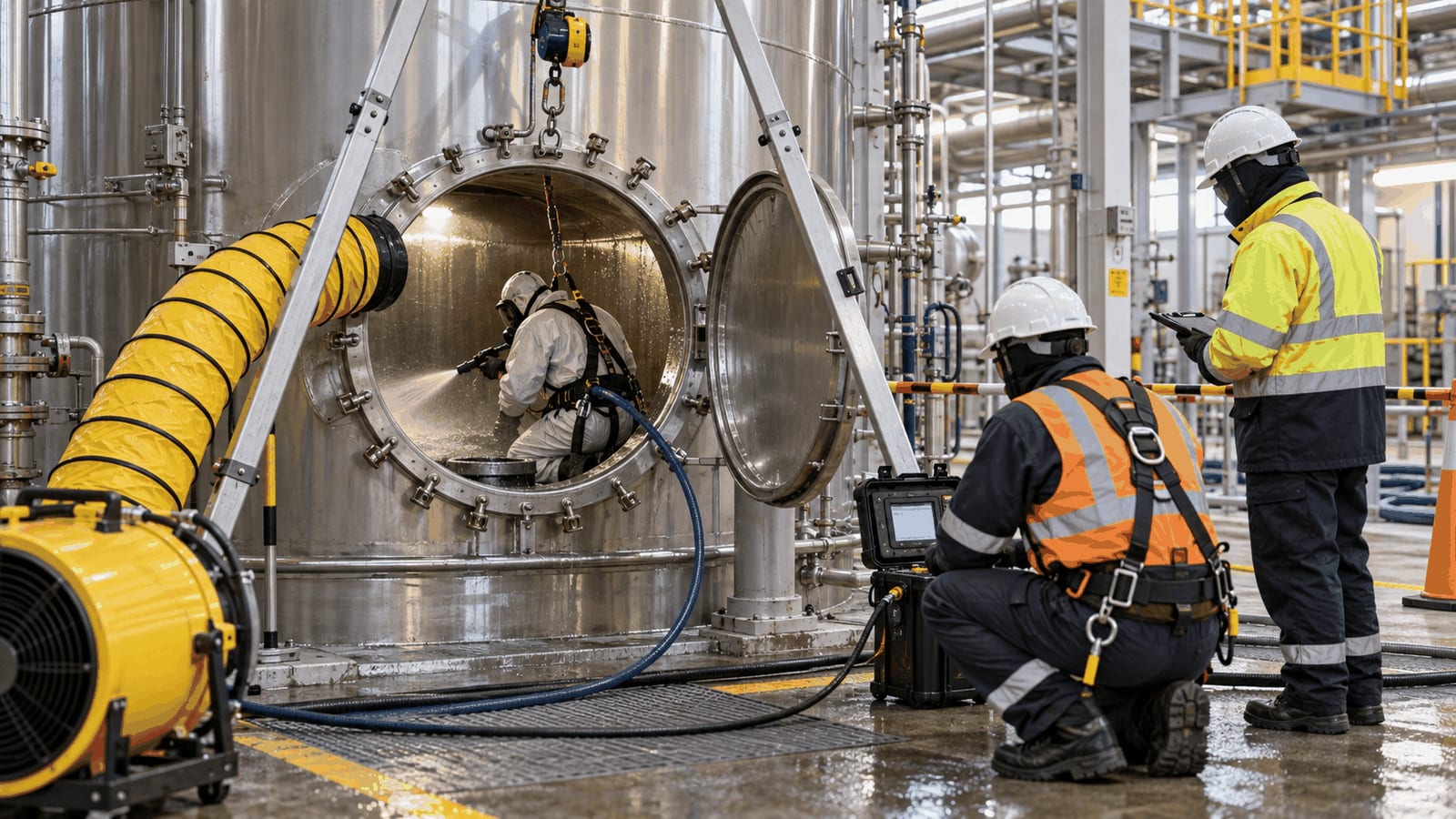
Cleaning inside a confined space can create new atmospheric, chemical, visibility, and movement hazards even after acceptable entry conditions are confirmed.
A tank, vessel, pit, or process space may be isolated and tested before entry, yet the work performed inside can change those conditions quickly. Water jets can disturb residues. Solvents and cleaners can release vapors. Agitation can expose trapped material. Sludge removal can uncover decomposition products. Heat and humidity can rise while visibility falls. A permit that accurately described the space at the start may become incomplete once cleaning begins.
Employers need an entry plan that treats cleaning as a changing process rather than a single task label. The plan should connect each cleaning method and product to monitoring, ventilation, personal protective equipment, communication, rescue, and stop-work criteria. Entry teams also need the authority and practical training to reassess the space whenever the work deviates from the planned sequence.
Who This Affects
This issue affects employees and contractors who clean tanks, process vessels, wet wells, vaults, bins, pits, digesters, mixers, and similar spaces. It also affects host employers that own the space, supervisors who authorize entry, attendants who track conditions, maintenance teams that perform isolation, and rescue services expected to respond.
Facilities may schedule cleaning during shutdowns, product changes, inspections, repairs, or emergency maintenance. Some entries are routine and repeated; others involve an unfamiliar residue or a one-time process upset. Familiarity should not reduce the level of review. A team that has cleaned the same vessel many times may face different conditions because the last product, cleaning chemical, temperature, or isolation status changed.
Multi-employer work deserves special attention. A cleaning contractor may understand its equipment and chemical products but not the host facility's process history. The host may understand the space but not how high-pressure washing, abrasive blasting, disinfecting, or coating removal changes the atmosphere. Effective coordination joins those two knowledge sets before entry begins.
The Confined Space Compliance Issue
OSHA's permit-required confined space standard requires employers to identify and evaluate permit space hazards before employees enter. The permit program must establish measures to prevent unauthorized entry, identify and evaluate hazards, specify acceptable entry conditions, isolate the space, provide necessary equipment, and verify that conditions remain acceptable during entry.
Pre-entry testing is essential, but it is not the end of atmospheric evaluation. OSHA requires testing or monitoring as necessary to determine whether acceptable entry conditions are maintained during operations. When atmospheric hazards are tested, the sequence is oxygen first, then combustible gases and vapors, then toxic gases and vapors. The instruments and sensors must match the substances that may be present; a standard four-gas meter does not detect every cleaning vapor or process contaminant.
Cleaning can introduce hazards from several directions. The cleaning agent itself may have inhalation, flammability, reactivity, or skin-contact hazards. Mixing products, even unintentionally through residues or shared equipment, can create a dangerous reaction. Hot water or steam may increase temperature and humidity. High-pressure equipment can create injection, laceration, noise, and recoil hazards. Hoses can restrict movement or entangle entrants. Removed residue can change walking surfaces and expose sumps or internal equipment.
The original contents also matter. Used tanks and trailers may contain residues that generate hazards through chemical or bacterial action. OSHA's example permit programs discuss cleaning and purging used tanks before authorized entry while also recognizing that work such as welding introduces additional requirements. Employers should use the actual process history, safety data, and site knowledge rather than assuming that an empty space is hazard-free.
Ventilation must be planned around the work. Air movement that maintained conditions during observation may not be enough once spraying or agitation begins. Ventilation can also move contaminants toward an entrant, interfere with sampling, or create a false impression if the monitor is placed only near the supply air. The plan should define air source, duct placement, exhaust path, monitoring locations, and how the team will recognize loss of ventilation.
What Employers Should Check
Begin with a task breakdown. List each stage, such as opening, draining, initial rinse, detergent application, manual scraping, residue removal, final rinse, inspection, and closeout. For each stage, identify what changes: products introduced, residues disturbed, equipment energized, workers repositioned, and atmosphere affected. The permit and briefing should reflect the sequence rather than using the single word cleaning.
Confirm isolation at every connection. Blanking or blinding, line breaking, double block and bleed, lockout or tagout, and mechanical blocking may be needed depending on the system. Pay attention to recirculation lines, drain lines, steam, compressed air, chemical dosing, agitators, augers, and remote automatic controls. A small line that is overlooked can introduce material or energy into the space.
Review chemical information before products enter the space. Compare safety data with expected residues and with other products used during the job. Determine whether the planned atmospheric instruments can detect relevant contaminants and whether exposure evaluation requires additional sampling. Check ignition sources and electrical classification where flammable vapor could be present. Do not rely on odor as a warning.
Establish monitoring locations and frequency. Test the space from outside before entry to the extent feasible, then monitor where entrants are working and where contaminants may accumulate. Because gases and vapors may stratify or collect in dead areas, one reading at the opening is not a complete picture. If work moves between compartments or around baffles, sampling strategy should move with it.
Verify ventilation effectiveness during the actual cleaning step. Ducts should deliver or remove air from the intended area without blocking access or retrieval. Exhaust should discharge where it will not be drawn back into the space or expose other workers. The team should know what happens if a fan loses power, a duct collapses, or an exhaust route becomes obstructed.
Inspect access and housekeeping. Hoses, cords, air lines, tools, and removed material can obstruct the opening and interfere with non-entry retrieval. Slippery residue can make climbing difficult. The attendant must be able to maintain communication and an accurate entrant count even as equipment and waste containers move. Rescue access should not be sacrificed for production convenience.
Check the rescue plan against the cleaning configuration. Respiratory hazards, internal obstructions, small openings, hose entanglement, and wet surfaces can change how rescue would work. If entrants use supplied-air respirators or bulky protective clothing, the team should consider how those systems affect removal. The rescue service should receive enough information to evaluate its capability for the actual hazards and space.
Which Training Fits This Situation
Authorized entrant training should cover the hazards associated with both the space and the cleaning process. Entrants need to understand monitor alarms, ventilation limits, chemical warnings, communication procedures, and the signs and symptoms that require immediate exit. They should know that continuing until the tank looks clean is not more important than leaving when a prohibited condition appears.
Attendant training should emphasize active observation. The attendant tracks who is inside, communicates with entrants, monitors activities inside and outside, orders evacuation when required, and summons rescue. During cleaning, the attendant should recognize changes such as stronger vapor, loss of airflow, unusual equipment sound, entrant confusion, heat strain, or blocked access.
Entry supervisor training should focus on verification and decision-making. The supervisor confirms that tests, procedures, and equipment are in place before authorizing entry and terminates entry when required. For staged cleaning, the supervisor may need to verify that controls remain suitable before a new chemical or method is introduced.
Role-based confined space courses can establish the foundation, but task-specific instruction is still necessary. Training should use the facility's permits, monitors, ventilation equipment, communication methods, and rescue arrangements. A practical drill can reveal whether workers can read instruments while wearing gloves, hear communications over pumps, route hoses without blocking retrieval, and evacuate promptly.
Retraining is appropriate when duties change, when the permit-space operation changes, or when an employee's performance shows a deficiency. A new cleaning method, different chemical, revised monitor, or changed rescue system may create a training need even if the worker's job title remains the same.
Common Mistakes to Avoid
Treating the pre-entry reading as a guarantee is a common mistake. It describes conditions at a time and place. It does not prove that agitation, cleaning chemistry, or residue removal will leave the atmosphere unchanged. The monitoring plan should respond to the work being performed.
Assuming a four-gas meter detects every hazard is another mistake. Oxygen, combustible gas, carbon monoxide, and hydrogen sulfide sensors are useful for many entries, but they do not cover all solvents, disinfectants, process chemicals, or reaction products. Instrument selection should follow the hazard evaluation.
Using ventilation without verifying its effect can create false confidence. Air may short-circuit from the supply to the opening, leaving a remote compartment poorly ventilated. A fan may be running while a duct is damaged. Monitoring and observation should confirm that acceptable conditions are maintained where people actually work.
Changing products or methods without updating the permit is risky. A substitute degreaser, added heat, or an unplanned coating-removal step can alter hazards. Entry should pause while the team evaluates the change, updates controls, and communicates the decision.
Allowing hoses and waste to take over the opening undermines access and rescue. The route should be managed throughout the job, not cleaned up only at the end. Entrants and attendants should know where equipment belongs and how removal can occur without delay.
Relying on generic rescue language is also inadequate. Calling emergency services is not itself a complete rescue plan. The employer must evaluate rescue capability, response time, equipment, and access for the specific space and hazards. The cleaning setup should be included in that evaluation.
Next Step
Before the next cleaning entry, select one representative space and map the work in stages. Compare each stage with the hazard assessment, permit fields, instrument capabilities, ventilation arrangement, chemical review, and rescue plan. Any stage that changes conditions without a corresponding control is a gap worth correcting.
Then brief the entry team using the actual sequence. Ask what would cause a pause, an evacuation, or a new authorization. Confirm who can introduce a product, who verifies monitoring, and how the attendant will know that the process has moved to the next stage.
Confined space training should help workers apply the written program to changing conditions. When cleaning is treated as a dynamic operation, the team is better prepared to recognize when the original assumptions no longer fit and to stop before a changing hazard becomes an emergency.
Sources
Occupational Safety and Health Administration, 29 CFR 1910.146, Permit-Required Confined Spaces: https://www.osha.gov/laws-regs/regulations/standardnumber/1910/1910.146
Occupational Safety and Health Administration, Appendix C to 29 CFR 1910.146, Examples of Permit-Required Confined Space Programs: https://www.osha.gov/laws-regs/regulations/standardnumber/1910/1910.146AppC