
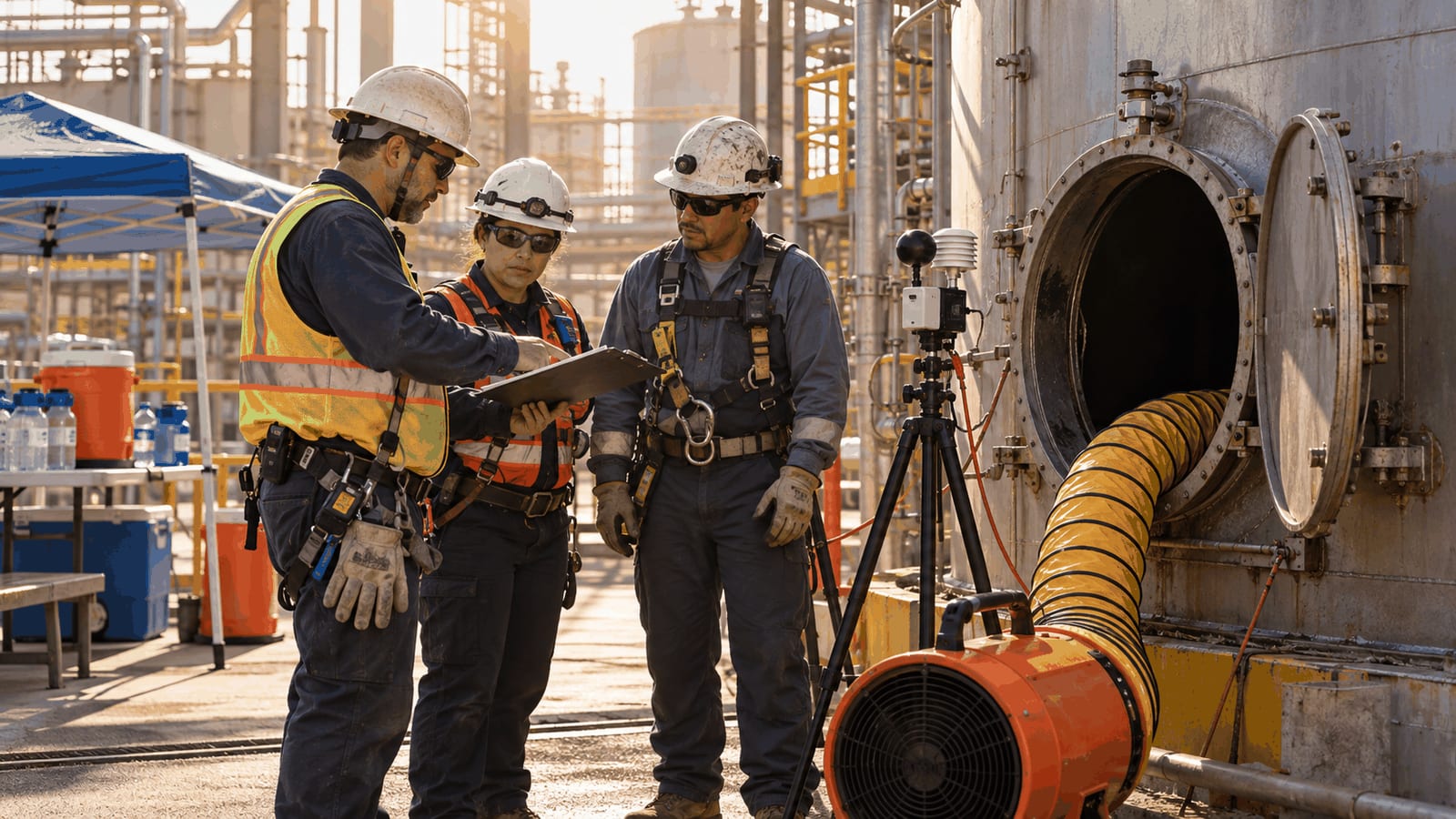
Heat can become a confined space hazard when restricted airflow, strenuous work, protective clothing, and delayed exit combine during an entry. A tank, vault, vessel, boiler, pit, or similar space can hold heat from the surrounding process, hot surfaces, steam, sunlight, or the work itself. The entrant also produces metabolic heat while climbing, lifting, scraping, cleaning, or handling tools. When the body cannot release that heat effectively, judgment, coordination, and physical capacity can decline at the same time that a prompt exit becomes more difficult.
Confined space planning often gives close attention to oxygen, flammable atmospheres, toxic contaminants, engulfment, and mechanical energy. Those hazards deserve careful controls, but they should not cause the entry team to overlook heat. A normal outdoor temperature does not prove that conditions inside a space are acceptable. Humidity, radiant heat, limited air movement, protective clothing, and heavy work can create a substantial heat burden even when a weather report does not appear alarming.
Employers should evaluate heat as part of the actual space, task, worker, equipment, and entry duration. That evaluation should connect to the permit-space program, the entry permit, communication procedures, stop-work criteria, and emergency plan. Heat guidance can support those decisions, but no single temperature, app reading, or generic schedule replaces a site-specific assessment by people who understand the work and the applicable requirements.
Who This Affects
This issue affects employers whose workers enter spaces that retain heat or limit the body's ability to cool. Industrial maintenance teams may enter process vessels after production stops but before metal surfaces have cooled. Public works employees may descend into steam vaults, wet wells, or below-grade structures where warm pipes, humid air, and limited airflow increase the burden. Construction crews may work in tanks, shafts, crawl spaces, or enclosed equipment while wearing protective clothing and carrying tools through restricted openings.
Authorized entrants are directly affected because they experience the combined load of the environment, clothing, and physical work. Attendants are affected because early heat illness can appear as unusual behavior, slowed responses, irritability, poor coordination, or a failure to follow instructions. Entry supervisors are affected because they must decide whether the identified controls, acceptable entry conditions, staffing, communications, and rescue arrangements still fit the conditions throughout the entry.
Contractors, host employers, and controlling contractors also need a shared understanding of the heat plan. The host may know that a vessel wall remains hot after shutdown, while the entry employer knows the workload and protective clothing required for the repair. Another contractor may restore steam, move ventilation, or begin nearby hot work. If that information remains separated by company boundaries, a permit can look complete while the entry team is missing a major part of the hazard picture.
Entries That Deserve a Closer Heat Review
Heat deserves particular attention when employees perform heavy work, wear vapor-resistant or multilayer clothing, use respirators, enter soon after a hot process stops, work near steam or heated lines, or remain far from the opening. New workers, returning workers, and employees moved from cooler duties may not be acclimatized to the same conditions as an experienced crew. The plan should address the job without asking employees to disclose private medical details to coworkers or treating individual differences as a substitute for effective workplace controls.
The Confined Space Compliance Issue
OSHA's general industry permit-required confined space standard defines a permit space to include a confined space that contains another recognized serious safety or health hazard. Heat does not make every confined space permit-required, but credible heat exposure should be evaluated with the other hazards presented by the space and the planned work. A space classification or permit copied from a cool inspection task may not fit a strenuous repair performed later in hot, humid conditions.
For permit entry, the employer's program should identify and evaluate hazards, specify acceptable entry conditions, provide necessary equipment, and establish procedures for safe operations. Construction requirements likewise call for the entry employer to identify and evaluate permit-space hazards and verify that conditions remain acceptable throughout authorized entry. The practical question is not whether a permit contains a box labeled heat. It is whether the program and permit address the conditions that could impair or injure the entrant.
Heat assessment also has to be coordinated with other confined space controls. Ventilation selected to control a toxic vapor may affect temperature and humidity, but air movement alone does not prove that heat exposure is controlled. Cooling air must come from a clean source and should not disrupt contaminant capture or introduce exhaust. Isolating a hot line may address both process energy and radiant heat, while a line that is locked out but still hot can remain a thermal hazard.
Employers should use current federal, state, and local requirements that apply to their workplace. Some state plans have heat-specific rules, and contracts or facility procedures may add controls. OSHA and NIOSH heat resources provide technical guidance on environmental conditions, workload, clothing, acclimatization, controls, and training. Those resources should be applied carefully alongside the employer's evaluation and applicable workplace requirements.
Conditions Can Change During Entry
An acceptable start does not guarantee an acceptable finish. Sunlight can heat an exterior vessel, a cooling cycle can end, temporary ventilation can move, and a worker's metabolic load can rise when the task changes from inspection to material handling. Humidity can increase during washing, and protective clothing can trap more heat than ordinary workwear. The permit and briefing should make clear who monitors change, what information is recorded, and which conditions require entrants to exit for reassessment.
What Employers Should Check
Evaluate the Space and Heat Sources
Start with the space itself. Identify hot walls, piping, steam, heated residue, warm process material, sunlight on metal surfaces, nearby engines, and any operation that adds heat or moisture. Determine whether shutdown and isolation allow enough cooling time before entry. Measure conditions near the actual work area when feasible, because a reading at the opening or from a distant weather station may not represent a deep vessel, lower vault, or area beside a radiant heat source.
OSHA heat guidance explains that temperature is only one part of environmental heat. Humidity, radiant heat, and air movement also matter. Wet bulb globe temperature can provide a more useful workplace assessment than heat index when used correctly, but the instrument must be placed and operated for the conditions being evaluated. A qualified safety or health professional can help when the employer lacks the knowledge to interpret measurements, account for clothing, or develop controls for a complex entry.
Account for Workload and Clothing
Estimate what entrants will actually do, not merely how long the permit remains open. Climbing a vertical ladder, crawling with tools, lifting sludge, grinding, and performing repeated overhead work can generate considerable metabolic heat. Break the task into stages and identify the most demanding portion. A short period of very heavy work can require more protection than a longer visual inspection, especially when exit is slow or the entrant cannot easily reach a cool recovery area.
Review the full clothing and equipment ensemble. Chemical protective garments, impermeable coveralls, welding clothing, respirators, harnesses, and layered garments can reduce heat loss or add effort. The team should not remove necessary protection simply to cool a worker. Instead, it should consider eliminating or reducing the heat source, cooling the space, changing the work method, providing suitable cooling equipment, limiting exposure, adding recovery time, or rescheduling the entry.
Build Controls Into the Entry Sequence
Use a hierarchy of controls rather than depending on endurance. Cooling or isolating hot equipment, shielding radiant sources, improving safe ventilation, mechanizing heavy work, and moving part of the task outside the space can reduce exposure at its source. Administrative measures may include scheduling during cooler conditions, shortening work periods, providing cool recovery areas, rotating demanding tasks without transferring risk to unprepared workers, and supplying adequate drinking water according to the employer's heat plan.
Acclimatization should be considered for new employees and workers returning after time away from hot conditions. It is a gradual adaptation, not a declaration that an experienced worker is immune to heat illness. Supervisors should review recent conditions, job changes, staffing, and work intensity rather than assuming yesterday's schedule remains suitable. Recovery periods should occur in a place that actually allows cooling and should not interfere with required attendant coverage or create unauthorized role changes.
Define Monitoring and Exit Triggers
The plan should state how conditions will be observed during entry and who has authority to stop the work. Environmental readings may need to be repeated when the task, ventilation, weather, or process changes. Atmospheric gas monitors generally do not measure a worker's total heat burden, so a normal oxygen or toxic-gas reading does not close the heat question. Conversely, heat monitoring does not replace required atmospheric testing for oxygen, flammability, or toxic contaminants.
Entrants and attendants should know the signs and symptoms identified in the employer's training and emergency procedures. Headache, nausea, dizziness, weakness, confusion, poor coordination, fainting, or unusual behavior can require immediate action. The response should not depend on the affected person diagnosing a specific illness. If an entrant reports symptoms, shows concerning changes, receives an evacuation order, or encounters a prohibited condition, the team should follow the established exit and emergency procedures without pressuring the person to finish the task.
Coordinate Communication and Rescue
Heat can affect thinking and communication before a worker recognizes the severity of the problem. The attendant should use planned check-ins that require meaningful responses rather than a simple signal that may hide confusion. Communication equipment should be tested in the space, and backup methods should be available. The entry supervisor should confirm how an entrant wearing gloves, hearing protection, respiratory equipment, or protective clothing will communicate symptoms and receive an evacuation order.
Rescue planning should consider a worker who is weak, confused, or unable to climb. Restricted openings, vertical travel, hot surfaces, and bulky clothing can complicate non-entry retrieval and emergency care. Rescue personnel need accurate information about the space, heat sources, isolation, atmosphere, clothing, and work location. Entry teams should never rely on unplanned coworker entry, and they should not assume that calling emergency services is a complete rescue evaluation.
Record Decisions on the Permit
The entry record should make the heat controls understandable to the crew. Useful information can include identified heat sources, measurement location and time, workload, clothing, ventilation or cooling arrangement, recovery plan, communication intervals, exit triggers, and the person responsible for reassessment. The level of detail should match the hazard and the employer's program. A copied note such as take breaks is not enough when it leaves workers guessing about timing, location, coverage, or authority.
Which Training Fits This Situation
Authorized entrant training should explain the heat hazards associated with the assigned space and task, the controls employees must use, the limits of monitoring equipment, and the required response to symptoms or changed conditions. Entrants should practice reporting how they feel and exiting when directed. Training should reinforce that continuing through dizziness, confusion, or weakness is not evidence of commitment and can make both self-exit and rescue more difficult.
Attendant training should address behavioral and communication clues, scheduled check-ins, changing conditions outside the space, and the duty to order evacuation when required by the program. An attendant should understand that heat can affect more than comfort. Slowed answers, mistakes, stumbling, or an unexplained loss of communication can signal a developing emergency. The attendant must remain focused on assigned duties rather than leaving the post to bring water or personally enter the space.
Entry supervisor training should cover hazard evaluation, permit limits, control verification, staffing, acclimatization considerations, and authority to delay or cancel entry. Scenario practice can require the supervisor to respond when protective clothing changes, a hot line remains warm, the planned task becomes more strenuous, or an entrant reports symptoms. The goal is to connect heat decisions to the same disciplined permit process used for atmospheric, mechanical, and configuration hazards.
Construction employers may also need competent-person capability for identifying confined spaces and permit spaces before work begins. Permit-Required Confined Space Entry Training can support entrants and attendants whose duties include permits, monitoring, communication, and evacuation, while Entry Supervisor Training can support the people who authorize or terminate entry. Heat-illness prevention training, equipment instruction, and site-specific briefing serve different purposes. A course can build knowledge, but the employer still needs to apply that knowledge to its spaces, procedures, instruments, protective equipment, rescue arrangements, and assigned duties.
Practice the Handoff Between Roles
A short tabletop exercise can reveal gaps before entry day. Give the team a scenario involving a warm steam vault, heavy valve work, protective clothing, and a rising on-site heat measurement. Ask the entrant what must be reported, the attendant when evacuation is ordered, and the supervisor how the permit and controls are reassessed. Include the rescue contact so the exercise tests whether everyone shares the same information and understands the limits of their role.
Common Mistakes to Avoid
One mistake is relying on the outdoor heat index as proof of conditions inside a confined space. Weather information can support planning, but it may not represent radiant heat, humidity, blocked airflow, hot equipment, or the work location. The error becomes more serious when a reading is taken at the opening while the entrant works deeper inside near a hot surface. Site measurements should be selected and interpreted for the actual exposure.
Another mistake is assuming that a fan controls every heat problem. Ventilation can improve air movement and may support cooling, yet its effectiveness depends on air source, duct placement, space geometry, humidity, heat sources, and the worker's location. It also has to remain compatible with atmospheric hazard controls. A running fan is equipment status, not proof that acceptable entry conditions continue to exist.
Employers also create risk when they consider only air temperature and ignore workload or clothing. A moderate environment can become hazardous during heavy labor or when impermeable garments limit evaporation. A schedule developed for light inspection should not be reused automatically for grinding, cleaning, lifting, or repair. Changing the task, crew, clothing, or access route should trigger a fresh review of the heat plan.
Water and breaks are important, but they should not be the entire control strategy. Hydration does not eliminate radiant heat, cool hot surfaces, reduce workload, or guarantee that a worker will recognize symptoms. Breaks do little if the recovery area remains hot or if staffing pressures cause workers to skip them. Controls should work together and should be feasible within the attendant, permit, and rescue arrangements.
A final mistake is treating symptoms as a personal weakness or waiting for collapse before acting. Heat illness can affect judgment, and a confused worker may not make a reliable decision about continuing. Training, communication, and supervision should support early reporting and prompt exit. Employers should follow their emergency procedures and obtain appropriate medical assistance rather than attempting to classify a serious condition through informal observation.
Next Step
Review one upcoming entry where heat could reasonably develop. Walk through the space, task, clothing, workload, ventilation, cooling, recovery area, communication method, exit route, and rescue plan. Compare the result with the written program and permit form. If the form does not prompt the crew to evaluate heat, add a practical decision point that captures the controls and reassessment triggers required by the employer's procedure.
Then brief the people who will perform each role. Confirm that entrants can recognize and report warning signs, attendants know the communication and evacuation process, and supervisors know when to delay, suspend, or cancel entry. Verify that measurements are taken where they represent the work and that the person interpreting them understands workload and clothing effects. A role-based confined space course can support this preparation when it is combined with hands-on equipment familiarization and site-specific instruction.
Heat planning is strongest when it is integrated into normal entry control rather than added after a worker feels ill. A clear evaluation, effective controls, trained roles, meaningful monitoring, and an executable exit and rescue plan help the crew respond before heat turns a difficult entry into an emergency.
Sources
OSHA, Permit-required confined spaces, 29 CFR 1910.146: https://www.osha.gov/laws-regs/regulations/standardnumber/1910/1910.146
OSHA, Permit-required confined space program for construction, 29 CFR 1926.1204: https://www.osha.gov/laws-regs/regulations/standardnumber/1926/1926.1204
OSHA, Heat Hazard Recognition: https://www.osha.gov/heat-exposure/hazards
OSHA, Technical Manual Section III Chapter 4, Heat Stress: https://www.osha.gov/otm/section-3-health-hazards/chapter-4
NIOSH, Criteria for a Recommended Standard, Occupational Exposure to Heat and Hot Environments: https://www.cdc.gov/niosh/docs/2016-106/