
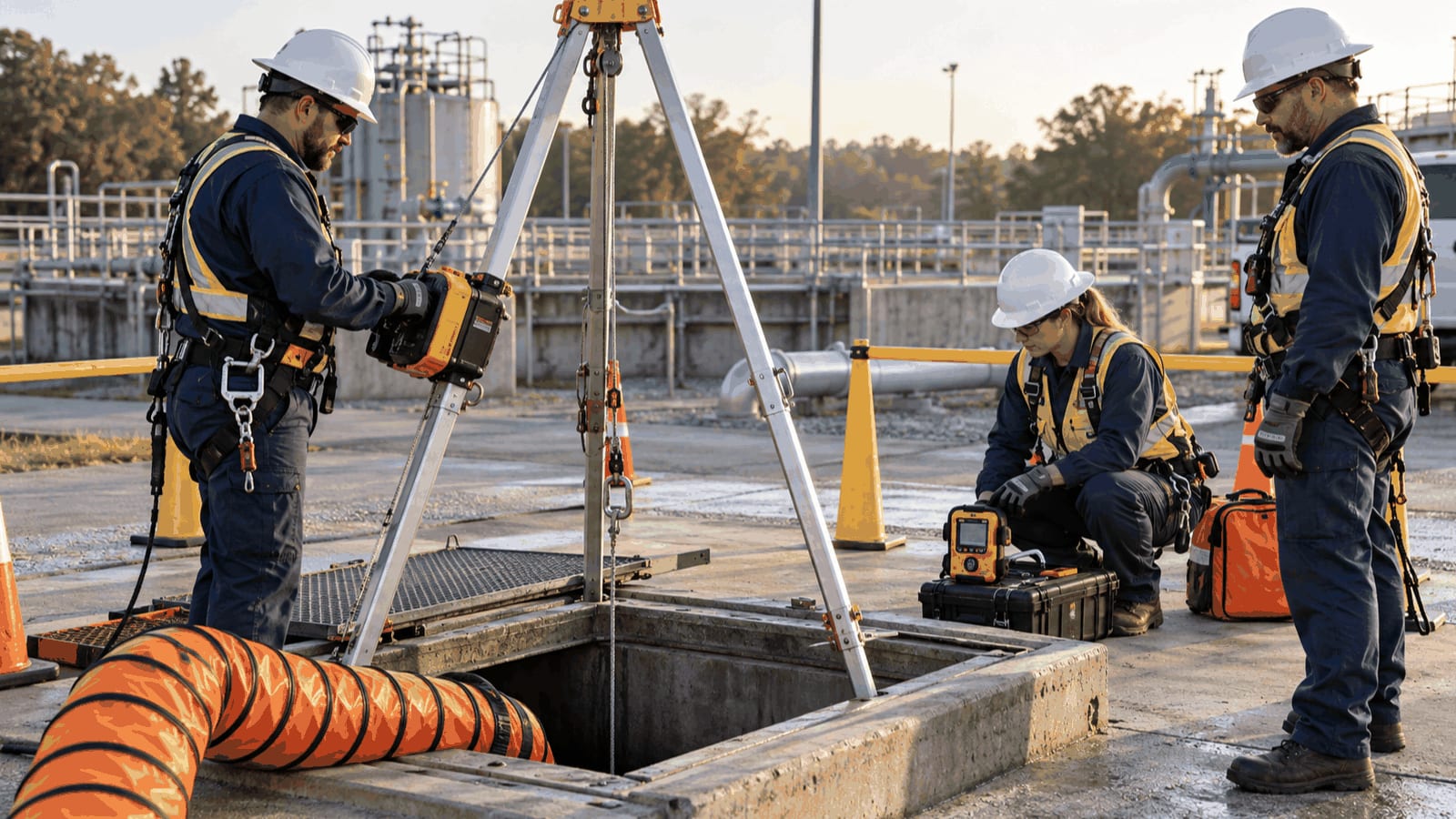
An atmospheric testing log connects every confined space entry to readings, equipment checks, and supervisor decisions before the next crew returns.
Supervisors should also compare the log with the actual duration and movement of the entry. If the entrant worked behind a tank baffle, moved below a ladder landing, or opened a cover that changed airflow, the record should show how monitoring addressed that activity. The review should ask whether the team had a reliable way to recognize an instrument fault, a depleted sensor, a blocked sampling line, or an alarm caused by the equipment rather than the space. The answer should come from the employer's procedure and equipment instructions, not from guesswork at the opening.
When a contractor performs the entry, the host and contractor should agree on who keeps the original permit, who receives alarm notifications, and who reviews the completed record. A clear handoff prevents a critical observation from staying in one company's file while the next shift relies on an incomplete summary.
Supervisors should also compare the log with the actual duration and movement of the entry. If the entrant worked behind a tank baffle, moved below a ladder landing, or opened a cover that changed airflow, the record should show how monitoring addressed that activity. The review should ask whether the team had a reliable way to recognize an instrument fault, a depleted sensor, a blocked sampling line, or an alarm caused by the equipment rather than the space. The answer should come from the employer's procedure and equipment instructions, not from guesswork at the opening.
When a contractor performs the entry, the host and contractor should agree on who keeps the original permit, who receives alarm notifications, and who reviews the completed record. A clear handoff prevents a critical observation from staying in one company's file while the next shift relies on an incomplete summary.
Who This Affects
Atmospheric testing affects every employer that sends workers into a space where air conditions can change or where a hazardous atmosphere could be present. That includes maintenance departments working in tanks, utility vaults, manholes, lift stations, crawl spaces, pits, process vessels, and similar areas. It also affects attendants, entry supervisors, contractors, host employers, rescue teams, and managers who must decide whether an entry program is working as intended.
The person holding the monitor is not the only person responsible for using the information. The entrant needs to understand the readings and alarms. The attendant needs to track the entrant, maintain communication, and order evacuation when conditions require it. The entry supervisor needs to verify that testing, ventilation, isolation, communications, retrieval, and emergency arrangements match the permit and the actual space. A log that only lists numbers without showing who interpreted them is a weak record.
Conditions may differ between a tank that has been cleaned, a vault exposed to groundwater, and a process space connected to another line. Even the same space can change after ventilation stops, a valve is opened, a nearby vehicle operates, or material begins to decompose. Supervisors should therefore treat atmospheric testing as an ongoing part of entry control rather than a one-time reading taken at the hatch.
Good records also help employers coordinate with contractors. If a host employer knows that a vault has a history of low oxygen or a tank has connected piping, that information should be available before a contractor selects equipment or assigns workers. The record should support a conversation about hazards and roles, not create the impression that a past normal reading guarantees a future normal reading.
The Confined Space Compliance Issue
The central issue is whether the employer can show that testing was performed with appropriate equipment, at appropriate locations and times, by people who understood the results and acted on them. OSHA's permit-required confined-space rule addresses atmospheric testing, acceptable entry conditions, monitoring, evacuation, and permit documentation. A record should make those steps visible enough for the supervisor to evaluate the entry.
Start with equipment identity. Record the monitor or instrument identifier, sensor configuration, calibration or bump-test status, battery condition, sampling tubing if used, and the person who performed the check. The exact information depends on the employer's program and instrument, but the purpose is consistent: the team should be able to connect a reading to the equipment that produced it. A handwritten statement that the monitor was good is less useful than a documented pre-use check and a clear equipment assignment.
Record where samples were taken. Air can stratify, and hazards may collect near the top, middle, or bottom of a space. Note the opening, the sample depth, the direction of movement, and any areas that could not be sampled. If the space is divided by baffles, shelving, process equipment, or connected chambers, explain how the sampling plan addressed those features. A single reading at the opening may not represent the atmosphere where an entrant will work.
Record readings for oxygen, flammable conditions, and toxic contaminants included in the employer's evaluation. Use the instrument's units and document the time. If an alarm occurs, retain the alarm event and the response. The log should show whether workers evacuated, whether ventilation was adjusted, whether the source was investigated, whether the permit was suspended, and who authorized any later re-entry. Avoid rewriting an alarm as a normal result simply because the final reading improved.
The log should also capture ventilation and isolation conditions. Note the fan or blower used, its placement, power status, duct routing, and any interruption. Record whether lines, agitators, electrical equipment, or other energy sources were isolated as required by the entry plan. Atmospheric testing cannot compensate for an uncontrolled source. Similarly, ventilation should not be treated as a guarantee when the hazard source has not been understood.
What Employers Should Check
Employers should review whether the monitoring plan follows the work rather than merely opening the permit. Before entry, ask what could make the atmosphere different at the bottom, behind a partition, near a residue, or inside a connected section. During entry, confirm the frequency or continuous-monitoring approach, alarm settings, communication method, and conditions that require evacuation. After entry, compare the records with the permit, work activity, and any deviations.
A useful review looks for patterns. Are readings consistently taken at the same location even though workers move? Do logs show unexplained gaps during breaks? Are alarms being silenced without an evacuation record? Do multiple instruments produce different results without a documented reason? Do workers enter before the monitor check is complete? These questions are more valuable than a simple search for a signature because they examine the process behind the paper.
Supervisors should review the space after any change. A cleaning chemical, welding operation, coating, sludge disturbance, pump shutdown, weather change, or nearby exhaust can affect the air. If a worker reports dizziness, irritation, unusual odor, alarm activity, or breathing difficulty, the entry should stop and the event should be evaluated. Odor is not a reliable substitute for testing, and the absence of odor does not establish a safe atmosphere.
Employers should make sure the team knows the action associated with each alarm or limit. The plan should explain evacuation, accounting for entrants, notification, ventilation, rescue activation, and re-entry authorization. Workers should not have to negotiate the response while a reading is changing. Training, drills, and pre-entry briefings can make those steps familiar.
Records should be retained according to the employer's program and applicable requirements. Store the permit, test results, calibration information, rescue documentation, incident notes, and corrective actions together when practical. A complete file helps the employer identify recurring equipment issues, locations that need a different sampling plan, and training topics that should be refreshed.
Which Training Fits This Situation
Entrants need training on the space hazards, monitor displays and alarms, communication, evacuation, and the limits of their assignment. Attendants need training on continuous awareness, time and identity tracking, communication, unauthorized entry, emergency notification, and the authority to order evacuation. Entry supervisors need training on permit review, testing, ventilation, isolation, acceptable conditions, coordination, and termination of the entry.
A role-based course can provide a common foundation, but it does not replace the employer's site-specific procedures, equipment practice, rescue arrangements, or evaluation of employee performance. The right course depends on the work, the classification of the space, the employer's duties, and the role each worker will perform. A monitor user should practice with the same type of instrument used at the job, including sampling tubing and alarm responses.
Training records should show who completed which topic and when. The employer should pair those records with hands-on demonstrations, pre-entry briefings, and drills. If an audit finds that workers can read a number but do not know what action follows an alarm, the improvement needed is practical response training, not just another slide presentation.
Common Mistakes to Avoid
One mistake is treating a pre-entry reading as proof that conditions will remain acceptable. Another is sampling only at the opening. A third is failing to record the time, location, and instrument used. Employers also create confusion when they use one form for every space without a field for unusual conditions, alarms, interruptions, or corrective actions.
Do not let ventilation become a ritual with no verification. Do not rely on a worker's sense of smell. Do not allow a monitor alarm to be treated as an equipment nuisance until someone has checked the space and the instrument. Do not send an entrant back in because a later reading looks normal if the source of the change is still unknown.
Finally, avoid separating records from decisions. A complete log should tell the story of what the team observed and what it did. When the record and the response are connected, supervisors can improve the entry plan before the next shift.
Next Step
Take one recent confined-space permit and compare its atmospheric log with the work sequence, ventilation plan, alarm response, and training records. If the record cannot show where readings were taken, what changed, or why entry continued, revise the form and briefing before the next entry.
Sources
OSHA, Permit-Required Confined Spaces https://www.osha.gov/laws-regs/regulations/standardnumber/1910/1910.146
OSHA, Confined Spaces in Construction https://www.osha.gov/confined-spaces
NIOSH, Criteria for a Recommended Standard: Working in Confined Spaces https://www.cdc.gov/niosh/docs/80-106/