
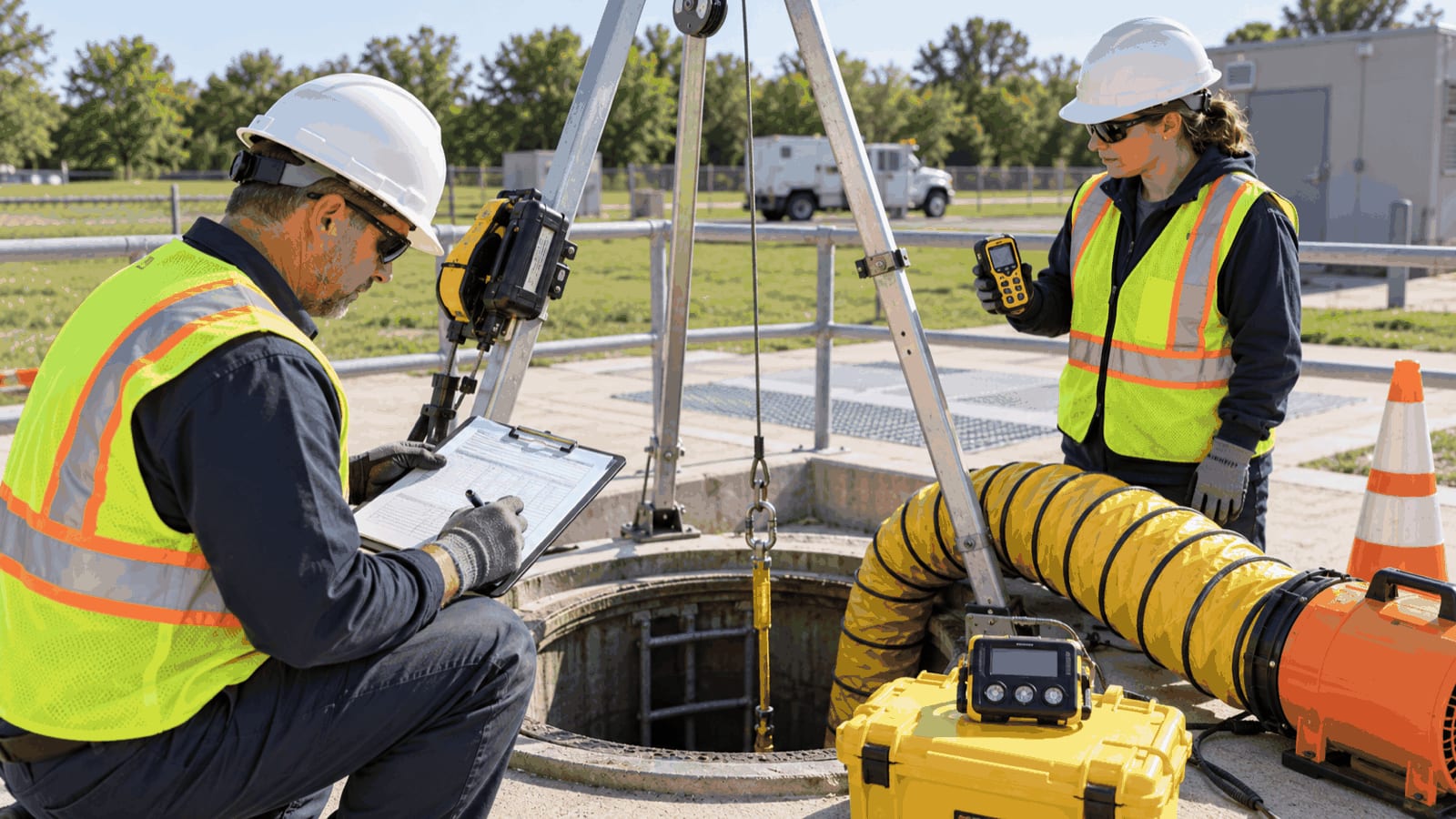
Before ventilation starts, employers should verify the hazard source, airflow path, monitoring plan, communications, and response if the atmosphere changes.
Ventilation is often described as turning on a fan, but a fan does not automatically make a confined space safe. Air movement can dilute or remove a contaminant, introduce fresh air, disturb settled material, or move a hazardous atmosphere toward another worker. The result depends on the space, the source, the duct placement, the work, and the monitoring that confirms whether the control is working.
The entry supervisor should connect the ventilation plan to the permit, atmospheric testing, isolation, personal protective equipment, rescue arrangements, and work sequence. A ventilation plan should also explain what happens when the fan stops, a duct moves, a generator fails, or a reading reaches an alarm level. Training helps workers understand that airflow is a control requiring verification, not a promise that conditions will remain acceptable.
Who This Affects
Ventilation planning affects employers and crews entering tanks, vaults, manholes, pits, vessels, crawl spaces, sewers, utility structures, and other spaces with limited openings or restricted natural airflow. It affects authorized entrants, attendants, entry supervisors, atmospheric testers, maintenance workers, contractors, and rescue personnel.
Host employers and contractors should agree on who supplies fans, ducting, monitors, power, and emergency equipment. One employer may control the space while another performs hot work, cleaning, coating, welding, or inspection. Each activity can change the atmosphere or airflow. The entry team needs a shared plan rather than separate assumptions.
People who never enter may still be affected. A worker setting a fan, opening a connected line, moving a vehicle, or using a chemical near the intake can change what reaches the space. A discharge can expose an attendant or nearby public area. The boundary around the space should include the ventilation equipment and exhaust path.
The Confined Space Compliance Issue
General industry permit-required confined space work is addressed by 29 CFR 1910.146, while construction work has requirements under 29 CFR 1926 Subpart AA. Employers should identify the applicable context, written program, and site procedures before choosing controls. A fan and duct arrangement should be evaluated as part of that program, not treated as a generic solution.
Ventilation must address the actual hazard. Fresh air may be appropriate for a known dilution task, but it may not control a source that continues to release a toxic, flammable, or oxygen-displacing substance. If a line is not isolated, a product continues to evaporate, or a coating operation creates vapors faster than the fan can remove them, the atmosphere can become hazardous despite visible airflow.
Duct placement matters. A duct aimed only at the opening may leave a low point, side compartment, sump, or area behind a baffle untouched. The plan should account for the space geometry, expected contaminant behavior, entry position, work location, and the time needed for air exchange. Employers should follow equipment instructions and avoid assuming that one fan setting produces the same result in every space.
Atmospheric testing verifies conditions before entry and during work. The tester should know where samples are taken, how the instrument is used, what alarm settings apply, and what readings require evacuation. Continuous monitoring is meaningful only when someone can see or hear the alarm and knows what action follows it. A fan should never be used to justify skipping testing.
What Employers Should Check
Before entry, an employer can review the ventilation plan with questions that test the control:
- What contaminant, oxygen change, or process hazard is the ventilation intended to address?
- Has the source been eliminated, isolated, or reduced where possible?
- Where does clean air enter, and where does contaminated air leave?
- Can the discharge reach workers, building intakes, traffic, or the public?
- Does the duct reach the areas where the entrant will work?
- Is the fan rated for the atmosphere and task, including flammable or corrosive conditions?
- Is the power source protected, grounded, and separated from water or traffic?
- How will the attendant know that airflow has stopped or moved?
- What readings will be taken before entry, after ventilation starts, and during work?
- What is the evacuation and rescue response if readings change?
The plan should identify who starts and monitors the fan. If a worker can disconnect a duct without telling the attendant, the control is not fully managed. The team should mark duct routes, protect them from vehicles, and keep the opening and retrieval path clear.
Ventilation, Testing, and Entry Sequence
The sequence should be deliberate. Employers may first isolate lines and energy sources, inspect the space, set up ventilation, test the atmosphere, and confirm communications before authorizing entry. The actual order depends on the hazard assessment and written program. Workers should understand why each step occurs and what condition allows the next step.
Sampling should reflect the space rather than only the opening. A deep vault may require testing at multiple elevations. A tank may have compartments or dead legs. A vertical duct can create a path that leaves another area stagnant. The tester should document locations, times, readings, ventilation status, and responses to alarms or changes.
Work activities can defeat an earlier plan. Solvents, welding, cleaning agents, sludge disturbance, compressed gas, and equipment exhaust can add hazards. A change in weather or building pressure can also affect the exhaust path. The entry supervisor should require reevaluation when the process, equipment, ventilation, or atmosphere changes.
If ventilation is interrupted, entrants may need to leave immediately depending on the permit and hazard assessment. The team should not improvise by opening another cover, moving a fan, or sending someone in to investigate. The written plan should make the first action clear, and drills should test whether the team can execute it.
Which Training Fits This Situation
Entrants need to understand the hazards, controls, alarms, communications, and exit requirements for their role. Attendants need to recognize changes, maintain an accurate count, prevent unauthorized entry, and summon help. Supervisors need to verify the permit, controls, testing, and emergency arrangements. Workers setting up ventilation need equipment-specific instruction and a clear boundary around the opening.
Training is most useful when it uses the employer's actual space diagrams, equipment, permit, and alarm response. A general course can support awareness and role preparation, but it cannot replace a job-specific evaluation or the employer's procedures. Rescue personnel need information about the space, access, ventilation, isolation, retrieval, and likely hazards.
Employers should document course completion, practical briefings, equipment instruction, drills, and corrective actions. The records should make role assignments visible without suggesting that a training certificate alone authorizes entry. Supervisors should confirm current competency through observation and practice.
Common Mistakes to Avoid
One mistake is placing the fan at the opening and assuming the entire space is ventilated. Another is exhausting contaminated air into an occupied area. Crews also forget that a flexible duct can collapse, a fan can lose power, or an intake can draw exhaust from a vehicle.
Another mistake is treating a good initial reading as permanent evidence. Conditions can change when the work starts or when a connected line opens. A monitor left outside may not represent the entrant's breathing zone. An alarm that cannot be heard over equipment is not an effective warning.
Employers should also avoid using oxygen enrichment as a ventilation strategy, bypassing isolation because a fan is running, or allowing an entrant to remain while the team diagnoses a ventilation problem. A pause is a control when the plan no longer matches the condition.
Next Step
Review one upcoming entry and draw the airflow path on the permit or job briefing. Identify the source, intake, exhaust, sampling points, alarm response, and person responsible for monitoring. If any part is uncertain, pause the entry plan until the employer can evaluate it.
Sources https://www.osha.gov/laws-regs/regulations/standardnumber/1910/1910.146 https://www.osha.gov/laws-regs/regulations/standardnumber/1926/1926SubpartAA