
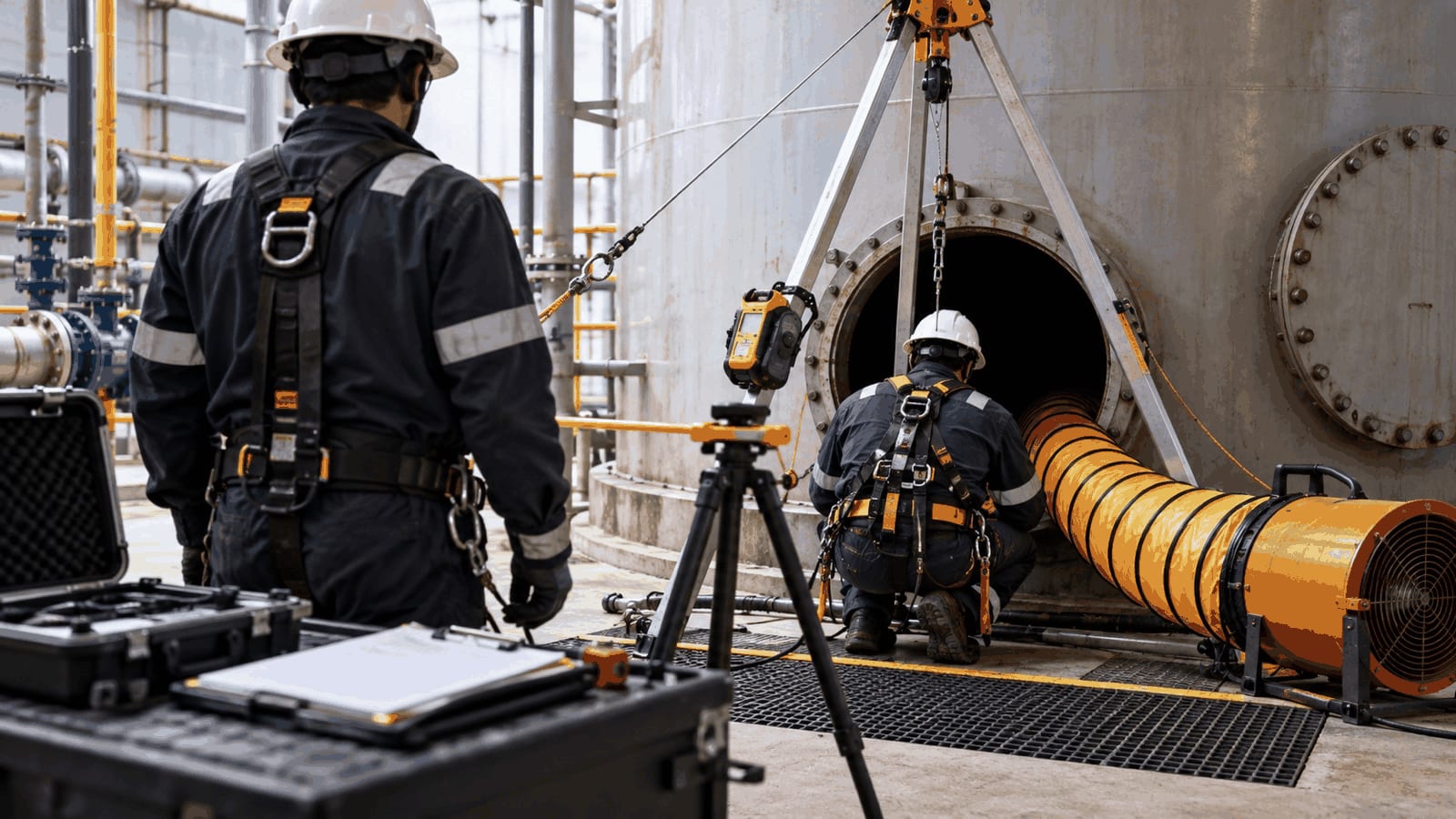
When radios or visual contact fail during entry, employers need a tested communication plan that protects entrants, attendants, supervisors, and rescuers.
Who This Affects
Communication is part of the entry system for employees working in tanks, vaults, pits, silos, sewers, and other confined spaces. It affects authorized entrants who need to report conditions, attendants who must monitor the space, entry supervisors who authorize or stop work, and rescue personnel who may need information quickly. Contractors and host employers can also depend on the same communication method during a coordinated job.
The plan must fit the space. A radio that works beside a manhole may fail below a concrete vault. A hardwired system may create a snag or become unavailable when ventilation equipment is repositioned. Hand signals may be useful in a quiet tank but unreliable when fans, pumps, or tools are running. The point is not to select the most sophisticated device. It is to verify that the chosen method works for the actual entry, including foreseeable changes.
The Confined Space Compliance Issue
OSHA's permit-required confined-space standard, 29 CFR 1910.146, requires employers to establish practices and procedures for safe permit-space entry. Communication supports the attendant's ability to monitor entrants and summon help, but it does not replace atmospheric testing, isolation, ventilation, retrieval, or a written permit. The standard also expects employers to review operations and revise the program when experience shows that procedures are not adequate.
A communication failure can be an early warning. The entrant may be unable to report dizziness, a change in ventilation, a new odor, a blocked route, or a rising alarm. The attendant may not hear a withdrawal signal. A supervisor may assume work is continuing because no alarm is visible. These gaps can turn a manageable condition into a delayed response.
Employers should define what happens when communication is lost. Depending on the entry plan, the instruction may be to stop work, withdraw immediately, activate a backup signal, or use retrieval equipment under the approved rescue procedure. The instruction should be clear before entry starts, and the team should practice it without creating a rescue attempt by an unprotected worker.
What Employers Should Check
Test the primary method in the space
Perform a functional test from the locations where entrants will work, not only at the opening. Test the worst expected depth, corners, obstructions, background noise, ventilation, and equipment operating at the same time. Ask the entrant to send and receive the exact signals that will be used for routine status, emergency withdrawal, and loss of communication.
Record whether the message was understood, not merely whether a light illuminated. If a radio has a push-to-talk delay, dead zone, interference, or battery problem, the team should address it before authorization. If a line-of-sight signal is chosen, identify the positions from which the attendant can maintain visual contact and the conditions that would break it.
Establish a backup that is actually available
A backup cannot be a device locked in a truck or a person who is not assigned to the entry. Keep the backup method where the team can reach it without entering an unsafe area. Confirm batteries, spare parts, charging, compatibility, and the person responsible for switching methods. The attendant should know the first action after a failure, and the supervisor should know who can stop the job.
Consider how a backup affects other controls. A tether may support communication but can interfere with retrieval or movement. A messenger line may work in one vertical space but not through a bend. A second radio may be useless if both units share the same dead zone. Testing the backup under real conditions reveals these issues before an emergency.
Link communication to alarms and readings
The entrant and attendant should agree on how to respond to monitor alarms, ventilation interruptions, changing readings, and symptoms. The communication plan should not require an entrant to explain a long story before leaving. Short, known phrases or signals make the first action faster. The attendant should keep the entry log and permit information available so that a supervisor or rescue team can understand who is inside, where they are, and what changed.
Coordinate contractors and rescue
At a multi-employer site, identify which employer provides the attendant, supervisor, monitoring equipment, rescue service, and communication system. Share the failure signal during the pre-entry briefing. A contractor should not assume that the host's radio channel, emergency number, or rescue procedure is available without testing it.
Rescuers also need a reliable way to receive updates. The plan should identify the opening, access route, hazards, isolation status, monitor readings, number of entrants, and any equipment already in use. Communication is not a replacement for a non-entry rescue plan or a trained rescue team, but it helps those controls work together.
Which Training Fits This Situation
Awareness training can help workers recognize that silence, a missing signal, or a monitor alarm is a condition to report. Authorized entrant training should cover status checks, withdrawal signals, and the instruction to leave when communication cannot be maintained. Attendant training should emphasize continuous attention, accurate logs, immediate action, and the prohibition on entering to rescue unless authorized and protected.
Entry supervisor training should include a pre-entry communication test and a decision point for stopping work. Rescue training should rehearse how information is transferred without exposing an unprotected responder. For supervisors who coordinate contractors, a role-based module can focus on channel assignment, handoff records, and confirming that every employer understands the same emergency signals.
Training is strongest when it uses the actual device and space. A classroom explanation of radio range cannot prove that a radio works inside a steel tank. A written permit cannot show whether a fan masks a withdrawal call. A short drill with the equipment in place can reveal a dead zone, a confusing signal, or an attendant who cannot see the entrant.
Common Mistakes to Avoid
One mistake is treating a working radio as a working communication system. The team must test the space, the noise, the task, the batteries, and the people using it. Another is relying on cell phones where reception is uncertain or where workers cannot safely handle the device. A third is giving an entrant a device without explaining the emergency phrase or the action that follows it.
Do not let production pressure turn a failed test into an informal workaround. Do not ask an attendant to watch two openings without evaluating whether the attendant can monitor all entrants and conditions. Do not let a shift change occur without transferring the communication method, current readings, entrant count, and any equipment problems. Do not put a rescuer into the space because the attendant lost contact.
Next Step
Before the next entry, write the primary and backup communication methods on the entry plan, test them from the work locations, and document the result. Brief every role on the failure signal and the immediate action. If the method fails, stop the entry until the employer restores a reliable system or changes the plan through the appropriate review.
Review the plan after every near miss
A near miss involving a missed call, a dead battery, a fan that drowned out a signal, or a confusing handoff deserves more than a replacement device. Ask what the team expected to happen, what actually happened, and what change will be tested before the next entry. Record the lesson in the program review so the next crew does not have to rediscover it.
Shift changes deserve the same discipline. The incoming attendant should test the device, confirm the entrant count, review current readings, and repeat the withdrawal signal. The outgoing attendant should not assume that a working system remains reliable after equipment, depth, weather, or work location changes.
Include communication in the permit review
The entry supervisor can add a short communication confirmation to the permit process: primary method tested, backup available, emergency signal understood, and rescue contact confirmed. This creates a visible decision point before entry. It also gives the next shift a record to review rather than relying on memory or a casual verbal handoff.
If the work changes from inspection to cleaning, welding, pumping, or repair, repeat the test. New tools can increase noise, new hoses can obstruct a line, and a worker can move beyond the range that was tested. A communication plan should follow the task and the space, not remain fixed because the permit number stayed the same.
Supervisors can use a short drill to test the response without entering danger. Have the entrant send a routine status, report a simulated condition, and stop transmitting. The attendant should demonstrate the required action and the supervisor should confirm that the rescue or emergency contact path works. The drill should end with a debrief and any needed correction.
Keep the result with the entry record so recurring failures can be seen across shifts and contractors.
The review should also account for ordinary changes that can make a successful test obsolete. A storm can increase pump noise, a new liner can block a signal path, and a different entrant can use equipment differently. Before the shift begins, the supervisor should compare the planned work with the conditions that were actually tested. If the team changes the entry location, adds a tool, moves a fan, or changes the number of people involved, pause long enough to repeat the relevant communication check. This is a practical program-control step, not paperwork for its own sake. It helps the crew identify when the communication method is part of the changed condition and gives the attendant a clear reason to stop work when the method is no longer dependable.
Employers can make the review easier by keeping a small communication checklist with the permit materials. The checklist can identify the primary channel, backup method, emergency signal, test locations, battery or power check, and the person responsible for calling rescue. A short record also makes it easier to compare failures across projects. If several entries show the same dead zone or handoff problem, the employer has a useful basis for changing equipment, improving the layout, or revising role-based training before the next crew enters.
Sources OSHA, Permit-required Confined Spaces, 29 CFR 1910.146, https://www.osha.gov/laws-regs/regulations/standardnumber/1910/1910.146; OSHA, Appendix B to 1910.146, Procedures for Atmospheric Testing, https://www.osha.gov/laws-regs/regulations/standardnumber/1910/1910.146AppB