
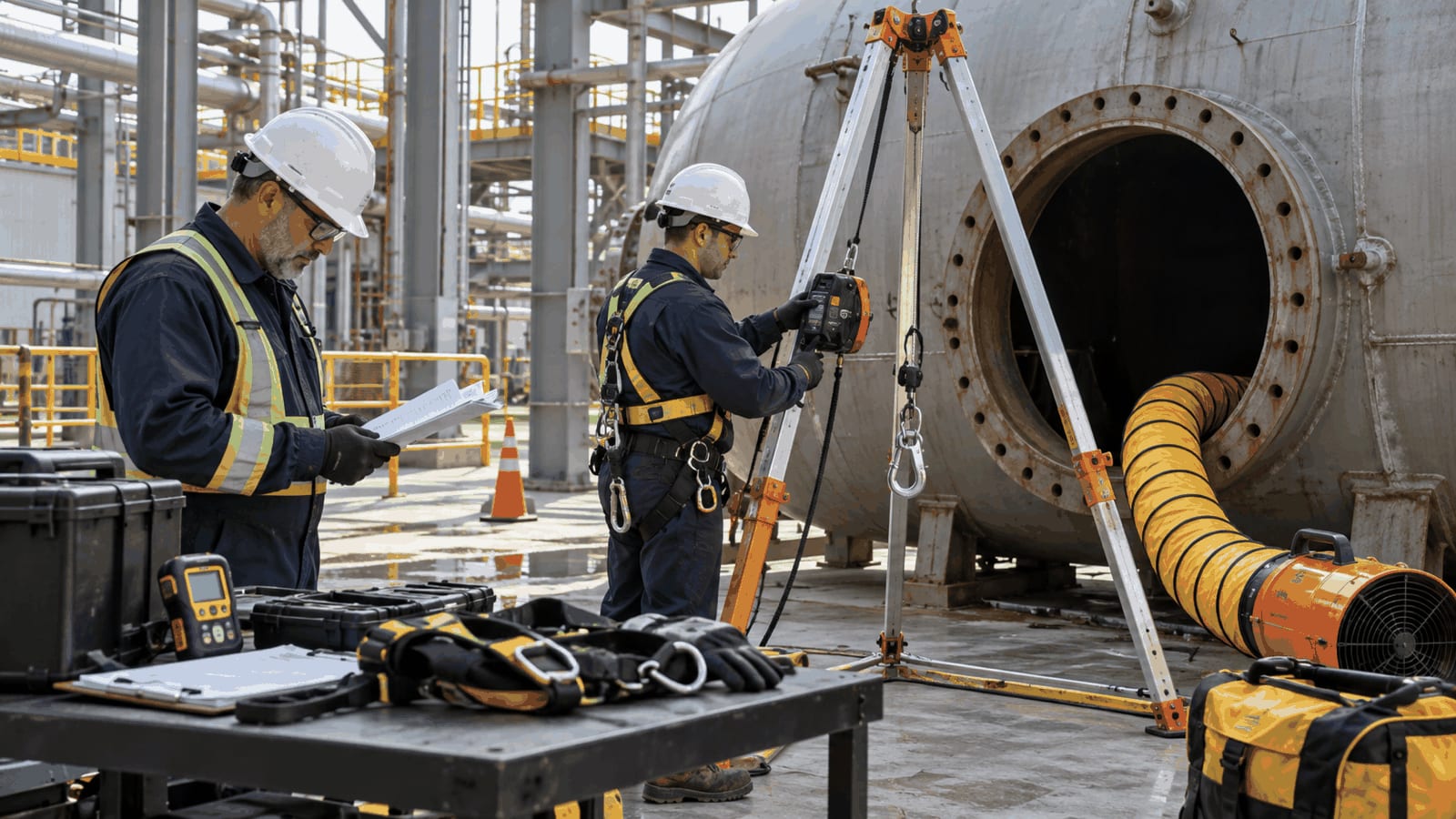
Confined space work continues after the last entrant exits, because permit closeout preserves changes and improves the next entry decision.
Permit-required confined space programs are built around preparation, authorization, monitoring, communication, rescue planning, and review. The closing step is often treated as paperwork after the real work is done, but it can reveal whether the permit matched the space, whether conditions changed, and whether the employer's procedures worked as intended.
This article is a practical training and program-review discussion for employers, entry supervisors, attendants, authorized entrants, contractors, and program managers. It does not replace 29 CFR 1910.146 where applicable, construction requirements, a site-specific permit-space program, or the judgment of qualified personnel.
Who This Affects
Permit closeout affects any employer that authorizes entry into a permit-required confined space, including facilities teams working in tanks, vessels, pits, wet wells, vaults, silos, sewers, and process areas. It also affects host employers, contractors, controlling contractors, rescue services, and managers who need reliable records across recurring work.
The person who cancels the permit may not be the person who prepared it. A shift may end, a contractor may leave, or an entry supervisor may hand the work to another team. The closeout process gives the organization a common record of who entered, when work occurred, what conditions were encountered, and why the permit was terminated or canceled.
Attendants and entrants contribute important information. The attendant may have observed communication interruptions, changes in ventilation, alarms, unauthorized approach, or a change in the surrounding operation. Entrants may have noticed heat, odors, water, residue, restricted movement, or task conditions that were not obvious from the opening. A good closeout invites those observations without treating the form as a blame exercise.
Contractors need a clear handoff rule. The host may own the space and the site hazards, while the contractor controls its employees and equipment. The closeout should identify which records each party retains and who receives the canceled permit, monitoring log, rescue notes, and corrective actions.
The Confined Space Compliance Issue
OSHA's general-industry permit-space standard requires procedures for concluding entry, including closing off the space and canceling the permit when entry operations are complete. It also calls for review of entry operations when the employer has reason to believe the program may not protect employees, and it identifies events such as unauthorized entry, an uncovered hazard, a prohibited condition, an injury or near miss, a change in space use, or employee complaints as reasons to examine the program.
Closeout is therefore more than a signature. The employer should be able to tell whether the entry ended normally, whether the permit was canceled because a condition changed, whether the space was secured, and whether any follow-up is required. If a permit is simply filed with no review of its observations, the organization may miss a pattern across spaces or shifts.
The record should distinguish between a completed entry and an interrupted entry. A completed entry may have reached the task objective with acceptable conditions. An interrupted entry may have ended because of an alarm, ventilation failure, communication problem, weather, process change, or rescue concern. Both outcomes matter, but they should not be described as equivalent.
Closeout should also compare the planned task with the work actually performed. If the crew changed tools, opened a second access point, added a chemical, extended the entry, or discovered a different obstruction, capture that difference. A small deviation can reveal that the hazard analysis or briefing needs revision before the next permit is issued.
Atmospheric data needs context. A meter reading without the location, time, instrument identification, calibration or bump-test status, sampling method, and response is hard to interpret. Closeout should connect readings to the work period and explain what happened when values changed. It should also identify whether the space was reclassified, re-permitted, ventilated, isolated, or left unavailable for additional review.
What Employers Should Check
Start with personnel accountability. Confirm the names or identifiers of authorized entrants, attendants, entry supervisors, contractors, and rescue resources involved. Reconcile the entry log with the permit and the site access record when appropriate. If someone left early, changed roles, or was replaced, record the handoff rather than relying on a later memory.
Confirm the permit status. Record the start and end time, the task completed, the reason for termination, and whether the permit was canceled normally or because a prohibited condition arose. If the entry supervisor terminated the entry, identify the observed condition and the immediate action. The purpose is to preserve the decision, not to make the form look complete.
Review isolation and control measures. Ask whether lockout, blanking, line breaking, blocking, de-energizing, traffic control, process shutdown, and ventilation controls remained effective. If a control was removed or changed before the work ended, the record should identify who authorized it and what condition followed. A space should not be represented as safe because an isolation checklist was signed at the beginning if the process changed later.
Check communication and retrieval. Note whether radios, hard lines, visual signals, retrieval lines, harnesses, tripods, winches, and entry equipment remained available and functional. If the retrieval method was not used because it would increase risk or was not feasible for the specific task, the program should retain the reasoning and alternative arrangement required by the applicable procedure.
Review the ventilation and atmospheric-monitoring log. Look for gaps, alarms, unusual readings, sensor placement changes, and periods when monitoring was interrupted. A gap should be explained, not hidden by copying the previous value. The closeout may recommend calibration, sensor replacement, a different sampling plan, or a revised ventilation method before the next entry.
The physical space also needs a post-entry condition check. Confirm that tools, hoses, waste, temporary barriers, and equipment were removed or left under a controlled plan. Close the opening, restore guards, and prevent unauthorized access. If the space remains hazardous or unavailable, mark it clearly through the site's established process.
Which Training Fits This Situation
Authorized entrants need training on how to describe conditions they experienced and why that information matters after exit. They should know how to report alarms, symptoms, communication failures, changing hazards, and task deviations. Training should reinforce that leaving the space does not end the responsibility to communicate what happened.
Attendant training should include a closeout conversation. The attendant can confirm when entrants exited, identify any communication interruptions, and state whether an alarm or emergency procedure was considered. A short debrief is valuable when it is structured and recorded rather than treated as an informal chat.
Entry supervisors need role-based practice in canceling permits and deciding what requires program review. Exercises can use a normal closeout, a ventilation failure, a new process hazard, a near miss, an unauthorized approach, and a rescue activation. The supervisor should identify whether the space is secured, whether the permit is canceled, who must be notified, and what prevents the next entry until the issue is resolved.
Program managers and contractors need training on records and handoffs. They should know where permits, monitoring logs, equipment checks, rescue documentation, and corrective actions are stored. They should also know how to preserve records when a contractor's form and the host's form use different space names or time formats.
Training support can include a sample permit audit. Select a small group of closed permits and compare the entry log, atmospheric record, isolation record, equipment check, incident or near-miss log, and follow-up. The exercise should identify missing links and unclear responsibilities, not just count signatures.
Common Mistakes to Avoid
One mistake is treating every permit as a success because it contains all the required fields. A filled field may still be vague, copied, or inconsistent with the monitoring log. Review the quality of the explanation, not only the presence of ink or a digital mark.
Another mistake is failing to distinguish the reason for ending the entry. Completed work, a shift change, a canceled job, an alarm, a prohibited condition, and a rescue event create different follow-up needs. Use plain language and preserve the timeline.
Avoid closing the permit before the space is secured. A canceled entry should not leave an open hatch, an unattended ladder, a running ventilation setup, or an unmarked hazard that invites another worker to enter. Assign the physical closeout and verify it.
Do not erase awkward information. A failed bump test, a short communication outage, a late alarm response, or a missing reading may show where the program needs improvement. Correct the record transparently, document the reason, and evaluate whether the event triggers a broader review.
Avoid assuming that annual training certificates prove readiness for every space. Role knowledge, space-specific hazards, equipment condition, supervision, rescue coordination, and recent practice all matter. Training supports the program; it does not replace the employer's duty to evaluate the actual entry.
Next Step
Choose five recently closed permits and trace each one from pre-entry authorization through exit, space security, record storage, and follow-up. Ask whether a new supervisor could understand the entry without calling the original crew. Use the gaps to revise the permit, briefing, monitoring log, or handoff process before the next entry.
Sources
Occupational Safety and Health Administration, 1910.146 Permit-required confined spaces https://www.osha.gov/laws-regs/regulations/standardnumber/1910/1910.146
Occupational Safety and Health Administration, 1910.146 Appendix D Sample Permit Space Pre-Entry Checklist https://www.osha.gov/laws-regs/regulations/standardnumber/1910/1910.146AppD