Hot work inside a confined space can change the atmosphere, ignite residues, and complicate rescue, so entry and welding controls must operate as one plan. A confined-space permit and a hot-work permit serve different purposes, but neither should be managed in isolation when welding, cutting, brazing, grinding, or another spark-producing task will occur inside or near a permit space.
The work can introduce fumes, gases, heat, sparks, ultraviolet radiation, noise, and ignition sources into an area with restricted movement and limited natural ventilation. Shielding gas can displace oxygen. Heat can affect coatings or residues. Cables, hoses, ventilation ducts, retrieval lines, and communication equipment can compete for the same small opening. A fire watch outside the immediate work area may not be able to see every surface inside the space.
Good coordination starts before anyone enters. The employer should identify the space, the exact hot-work task, the materials and coatings involved, the energy and product connections, the ventilation method, the monitoring strategy, the entry roles, and the rescue approach. If those pieces are owned by different departments or contractors, the pre-entry review must connect them into one operating plan.
Who This Affects
This issue affects authorized entrants who will perform hot work, attendants who monitor the entry, entry supervisors who authorize the work, competent persons or program managers who evaluate spaces, fire watches, maintenance planners, industrial hygienists, rescue teams, and contractors who supply welding or ventilation equipment. It also affects host and controlling employers when contractor personnel enter spaces at an operating facility or construction site.
The authorized entrant needs more than welding skill. The entrant must understand the space hazards, permit conditions, monitoring arrangement, communication method, ventilation limits, prohibited equipment locations, and exit triggers. A technically excellent welder can still be unprepared for confined-space entry if those responsibilities are not clear.
The attendant must remain focused on entrant status and conditions inside and outside the space. The attendant should not be assigned a fire-watch task that prevents performance of required attendant duties. In some arrangements, a separate fire watch may be needed so both functions receive continuous attention. The employer should decide this through the hazard assessment rather than assuming one person can cover every outside role.
The entry supervisor verifies that acceptable entry conditions exist, required tests and equipment are in place, rescue services are available, and the permit accurately describes the work. Hot work adds conditions that can change during entry, so the supervisor must understand how the welding or cutting process affects ventilation, monitoring, isolation, and emergency planning.
The Confined Space Compliance Issue
General industry permit-required confined-space requirements call for employers to evaluate hazards, establish acceptable entry conditions, isolate the space, control hazards, test or monitor as needed, provide communication, arrange rescue, and use an entry permit. Construction work has a separate confined-space standard, and welding and cutting requirements may also apply. Employers should determine which standards and site rules govern the actual work rather than using a generic permit from another operation.
OSHA's hot-work guidance notes that when hot work is conducted in a permit-required confined space, the confined-space permit should be used together with the hot-work permit. The permits should agree on the task, location, timing, isolation, atmospheric limits, ventilation, fire prevention, responsible people, and stop-work conditions. If one permit says the space is free of ignition hazards while the other authorizes a torch, the documents are not describing the same job.
Atmospheric evaluation is central because hot work can create hazards after entry begins. Welding fumes, cutting gases, shielding gases, combustion products, and vapors released from heated coatings can alter conditions. Testing should address oxygen content, flammability, and potential toxic contaminants in an order and at locations appropriate to the hazard. The plan should account for stratification, dead spaces, and the entrant's breathing zone rather than relying only on a measurement at the manway.
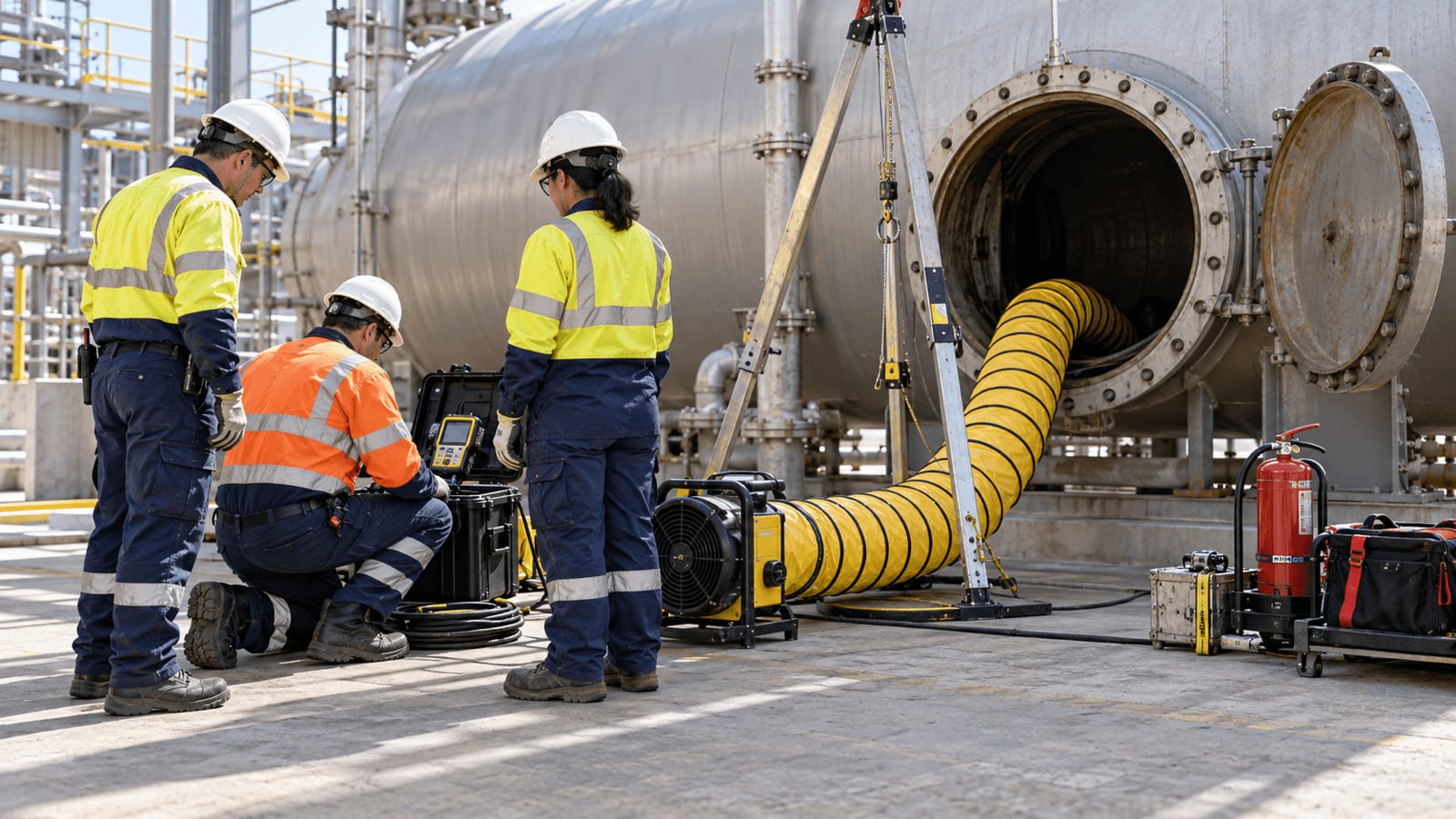
Ventilation has to be designed around the work. The air supply should come from a clean source, reach the area where the entrant works, and remove contaminants without spreading sparks or fumes to another occupied area. Ventilation equipment and duct placement must not block access, interfere with retrieval, or pull contaminants past the entrant. If work location or process changes, the team should reassess airflow and monitoring.
Isolation also goes beyond switching off a machine. Piping, ducts, mechanical movement, electrical energy, stored pressure, product residues, and adjacent operations can affect the space. The employer should apply the isolation methods required for the system and verify them before entry. Hot-work leads, torch hoses, and gas supplies add another energy-control layer. Cylinders should remain outside confined spaces, and equipment condition and hose routing should be checked before use.
Fire prevention requires knowledge of the space and its contents. Combustible materials, residues, liners, insulation, dust, coatings, and materials on the opposite side of a surface may ignite or release harmful products when heated. Cleaning, purging, removal, shielding, or other controls should be selected for the specific conditions. A surface that looks clean is not proof that hidden spaces, double walls, or connected piping are safe for hot work.
Rescue planning must reflect the additional hazards. Cables, hoses, ducting, and welding screens can obstruct non-entry retrieval. A worker wearing welding PPE may have limited movement or visibility. Fire, smoke, or a rapidly changing atmosphere can make the planned access route unusable. The rescue service needs accurate information about the space, task, hazards, entry configuration, and equipment before work begins, not after an alarm.
What Employers Should Check
Confirm that the confined-space evaluation and hot-work authorization identify the same physical space and exact task. The description should specify where the weld, cut, grind, or heating will occur, what base metal and coating are involved, and whether the work can affect connected areas. If the task moves or expands, the permits should be reviewed before the new work starts.
Review isolation line by line. Verify process lines, valves, electrical sources, mechanical components, pneumatic or hydraulic energy, and material flow are controlled under the site's procedure. Check whether heating could pressurize trapped material or transmit heat through a wall. Record who verified each isolation point and how continued control will be maintained.
Inspect and prepare the work surfaces. Identify paint, galvanizing, plating, residue, insulation, sealants, oils, and other materials that may burn or release contaminants. Determine whether cleaning or coating removal is necessary and how that work changes the hazard profile. Confirm combustible material is removed or protected and that the fire watch can observe the areas that matter.
Define atmospheric test locations, instruments, alarm settings, and monitoring frequency. Verify the monitor is ready for use in accordance with the manufacturer's instructions. Place sensors so they represent the entrant's work area and likely contaminant paths. If continuous monitoring is used, decide who watches the readings, how alarms are communicated, and what actions follow an alarm or loss of the instrument.
Check the ventilation setup under expected conditions. Confirm the blower is located in clean air, ducting is secured, airflow reaches the hot-work zone, and exhaust does not expose other workers or reenter the space. The plan should address blower failure, loss of power, or a displaced duct. Ventilation should not be treated as proof that monitoring or other controls are unnecessary.
Organize the opening. Separate welding leads, torch hoses, ventilation ducts, communication lines, and retrieval equipment so they do not tangle or block exit. Protect lines from sharp edges, heat, traffic, and falling objects. Keep compressed-gas cylinders outside the space and secure them appropriately. Verify lighting and electrical equipment are suitable for the conditions.
Assign entry supervisor, attendant, entrant, fire watch, and rescue contacts by name or clear role. Confirm that no individual has conflicting duties. Review communication signals, evacuation commands, fire response, gas-monitor alarms, ventilation failure, and loss of contact. The entry supervisor should know when the hot-work permit or entry permit must be suspended or canceled.
Finally, conduct a short pre-entry briefing at the space. The team should see the actual isolation points, monitor, ventilation route, equipment layout, and rescue path. Paperwork completed in an office cannot reveal a hose that crosses the ladder, a duct that blocks retrieval, or an exhaust outlet next to the blower intake.
Which Training Fits This Situation
Workers who recognize confined spaces but do not enter may need confined-space awareness training suited to their exposure. Authorized entrants and attendants need permit-required entry training plus employer instruction and practice for the site's equipment and procedures. Entry supervisors need role-specific training on permit authorization, hazard verification, coordination, cancellation, and emergency decisions.
Personnel who manage the overall confined-space program may need competent-person or program-level training appropriate to the applicable industry and their assigned duties. Hot-work performers also need welding, cutting, fire-prevention, PPE, and equipment training for the process they use. A confined-space course does not replace trade qualification, and welding training does not replace entry-role preparation.
The entry team should practice with the actual monitor, ventilation equipment, communications, harness, retrieval setup, and permit forms. Fire-watch instruction should cover the hazards, extinguishing equipment, alarm method, coverage area, and post-work monitoring required by the site's procedure. Rescue personnel need task-specific information and practice appropriate to the space and expected emergency.
Online training can build regulatory knowledge and role awareness. The employer must still provide site-specific information, hands-on practice, evaluation, equipment, and authorization. Course completion does not by itself make a person an authorized entrant, attendant, entry supervisor, competent person, fire watch, or rescuer.
Common Mistakes to Avoid
One common mistake is treating a favorable pre-entry gas test as proof the space will remain safe. Hot work can create contaminants and consume or displace oxygen after the test. Monitoring and ventilation decisions should account for the work as it occurs.
Another mistake is using the same person as attendant and fire watch without checking whether the duties conflict. Watching sparks inside a vessel, inspecting surrounding surfaces, and monitoring an entrant can demand attention in different places. The employer should assign enough qualified people to perform every duty continuously.
Crews also place equipment wherever it fits. Cylinders, leads, hoses, ducting, and retrieval lines then compete for the opening. Layout should be planned and tested before entry, with cylinders outside and exit and retrieval paths kept clear.
Some teams issue two permits that never meet. Different times, tasks, limits, or responsible people create confusion. The entry and hot-work permits should be reviewed together and updated when conditions change.
Another error is assuming cleaning eliminates all hazards. Residues may remain in seams, connected lines, or porous material, and coatings may release fumes when heated. Verification must match the actual space and materials.
Finally, rescue is sometimes reduced to a phone number. The employer should evaluate the rescue service, provide access and information, and ensure the plan works with the hot-work equipment and entry configuration. Unplanned entry by coworkers can turn one emergency into several.
Next Step
Before the next confined-space hot-work job, place the entry permit, hot-work permit, isolation record, atmospheric plan, ventilation layout, and rescue plan side by side. Walk the opening with the people who will perform each role. Resolve every conflict in task description, equipment placement, monitoring, communication, and stop-work authority before authorizing entry.
Choose training by role, then add the site's hazards and hands-on equipment practice. The Confined Space Supervisor course can support people who authorize and cancel entries, while Permit-Required Confined Space Entry training can support entrants and attendants. The employer should confirm the course selection against the applicable standard, the worker's duties, and the site's written program.
Sources
OSHA, 29 CFR 1910.146 Permit-Required Confined Spaces - https://www.osha.gov/laws-regs/regulations/standardnumber/1910/1910.146
OSHA, 29 CFR 1910.146 Appendix C Example Permit-Required Confined Space Programs - https://www.osha.gov/laws-regs/regulations/standardnumber/1910/1910.146AppC
OSHA, Confined Spaces in Construction - https://www.osha.gov/confined-spaces-construction
OSHA, Hot Work, Welding, Cutting, Brazing, and Grinding - https://www.osha.gov/etools/oil-and-gas/general-safety/hot-work-welding