
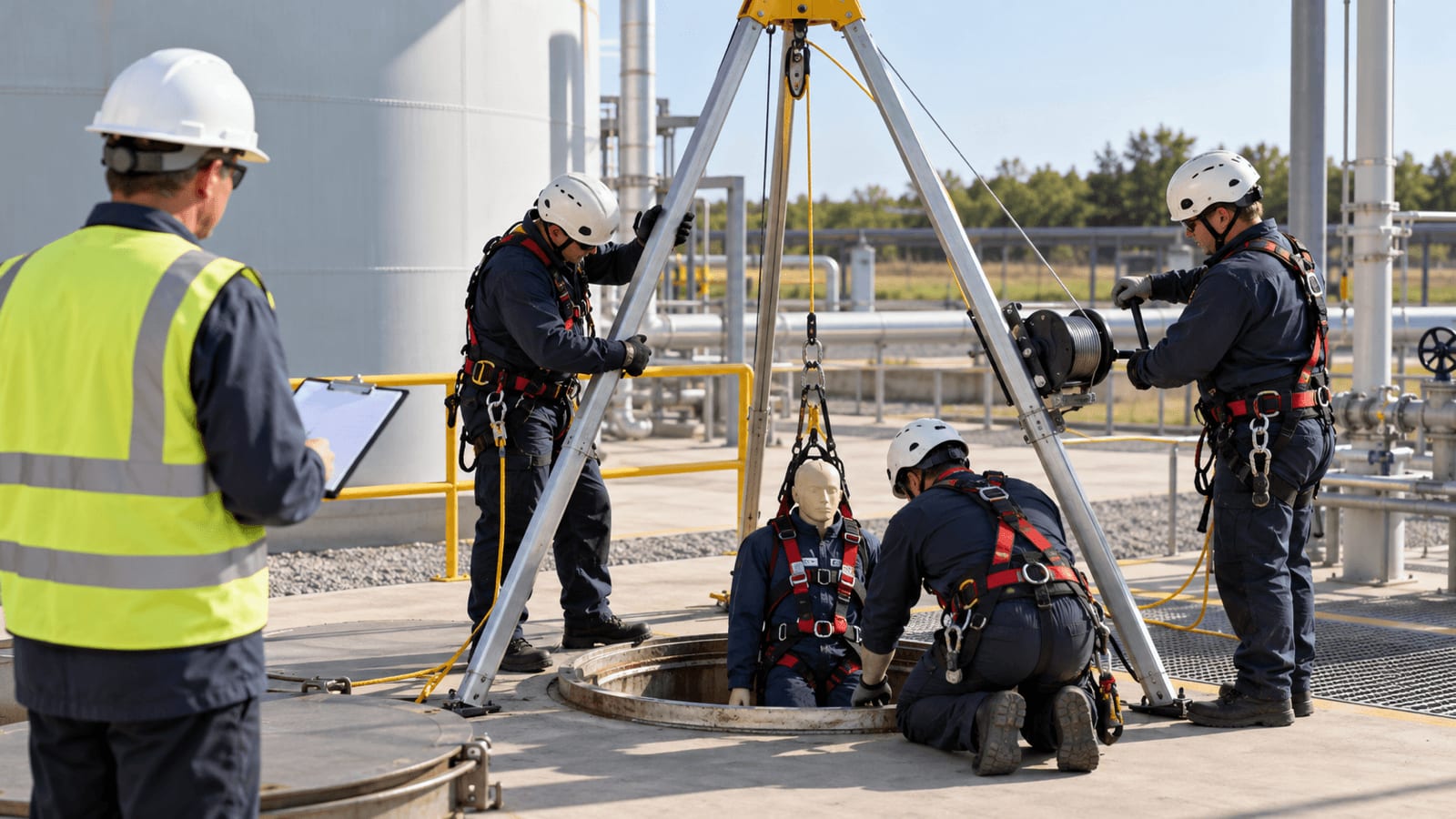
An outside rescue provider is only a workable confined space safeguard when the employer verifies its response, equipment, access, and practice performance.
Writing a fire department, contractor, or rescue company name on an entry permit does not establish that the service can rescue an entrant from the actual space. The employer must connect the rescue arrangement to the hazards, configuration, entry method, work schedule, and time needed to reach a victim. That evaluation belongs in planning before entry, not in the first phone call after an entrant becomes unresponsive.
General industry employers commonly address rescue under 29 CFR 1910.146. Construction employers need to apply the rescue requirements in 29 CFR 1926 Subpart AA and coordinate with the controlling contractor and other entry employers as applicable. The details differ, so the employer should identify which standard governs the work and use its written program, permit system, and site procedures together.
OSHA's non-mandatory Appendix F to 1910.146 provides useful evaluation criteria for prospective and current rescue teams. It describes an initial evaluation and a performance evaluation. That framework helps an employer move beyond a provider's general assurance and ask whether the team is trained, equipped, available, and proficient for the spaces where employees will enter.
Who This Affects
This issue affects facility owners, plant managers, municipalities, utilities, manufacturers, warehouses, campuses, maintenance contractors, construction firms, and any employer whose employees enter permit-required confined spaces while relying on an outside rescue service. Typical spaces include tanks, pits, vaults, manholes, wet wells, silos, vessels, sewers, digesters, and process equipment.
Entry supervisors are directly affected because they authorize entry and need to know that rescue services are available and that the communication method works. Attendants need a clear activation procedure and must understand when entrants must exit if the rescue service becomes unavailable. Authorized entrants need to understand the rescue approach, retrieval equipment, and limitations before they enter.
Host employers and controlling contractors also have coordination duties. One company may own the space, another may control the project, and a third may perform the entry. Rescue assumptions can become fragmented across contracts unless someone verifies the complete arrangement. A statement that rescue is by others is not a practical plan when the other party has not accepted the role or evaluated the space.
The outside service is affected as well. It needs accurate information about hazards, dimensions, access, internal obstructions, isolation, ventilation, atmospheric conditions, potential patient condition, and equipment available at the site. A capable technical rescue team can still be a poor match if it has never seen the space, cannot arrive within an appropriate time, or lacks the equipment for the portal and internal geometry.
The Confined Space Compliance Issue
Under 1910.146(k), an employer that designates a rescue service must evaluate the service's ability to respond in a timely manner considering the identified hazards, evaluate its proficiency with rescue tasks and equipment, select a service capable of reaching victims within an appropriate time, and provide access to the permit spaces so the service can develop and practice rescue plans. The employer also must inform the service about the hazards it may confront.
Timely response is tied to the hazard, not a universal number. A space with an atmosphere that is or could quickly become immediately dangerous to life or health may require a rescue team positioned to respond without travel delay. A different space with controlled mechanical hazards may support a different response arrangement. The employer should document the basis for the expected response, including notification, dispatch, travel, access, setup, entry, patient packaging, and retrieval.
Appendix F warns that merely posting a service's telephone number or relying on a 911 call at the time of the emergency does not meet the evaluation requirement. A public emergency service may have capable personnel but may not provide permit-space rescue, may not be available during the planned shift, or may prioritize other emergencies. Direct coordination is necessary to learn what the service will actually do.
Space configuration changes the rescue problem. A top-entry vault more than five feet deep may require vertical rescue capability. A narrow portal can limit the size of breathing apparatus and patient packaging. Baffles, piping, mixers, ladders, scaffolds, sloped floors, and long horizontal travel can interfere with retrieval. A team that practices in open training towers may need different skills and equipment for an obstructed process vessel.
Atmospheric hazards also shape the evaluation. The rescue service may need atmospheric monitoring, supplied air or self-contained breathing apparatus, backup air, ventilation knowledge, intrinsically safe communications, and decontamination planning. The employer should not assume the service carries everything needed. The written arrangement should identify which equipment comes from the service and which equipment the employer provides.
Non-entry rescue should be used when it is feasible and does not increase the overall risk. Retrieval systems can reduce the need to expose rescuers, but they are not automatically suitable for every space. Internal obstructions, entanglement, sharp edges, horizontal entries, worker position, and the work task can make retrieval ineffective or harmful. The employer should evaluate the actual path, not simply place a tripod near the opening.
Construction entries require equivalent discipline. Section 1926.1211 addresses rescue and emergency services for permit-required confined spaces in construction. Employers should evaluate the rescue team's ability to respond and perform the needed rescue, provide access for planning and practice, and ensure appropriate retrieval systems where required. Coordination across the controlling contractor and entry employers should prevent conflicting or missing arrangements.
What Employers Should Check
Start with a current confined-space inventory and hazard evaluation. Identify which spaces may require rescue, the work performed, the entry portal, depth, internal layout, isolation points, potential atmospheric hazards, engulfment, mechanical hazards, electrical hazards, heat, chemicals, and changes the work can introduce. Rescue planning cannot be more accurate than the information given to the service.
Meet directly with the prospective rescue provider. Confirm that it is willing to serve the location and the specific types of spaces. Review entry schedules, after-hours work, holidays, simultaneous calls, staffing, travel routes, gate access, escorts, security controls, and how the service will notify the employer if it becomes unavailable. The plan should state what happens to an active entry when availability is lost.
Evaluate response time by breaking it into parts. How long does it take the attendant to recognize the emergency and send the alarm? How quickly can the service dispatch? What is the travel time under realistic traffic and weather? How long are site access, hazard briefing, equipment setup, atmospheric evaluation, rescuer entry, patient packaging, and extraction expected to take? A simple station-to-site driving estimate omits much of the response.
Compare the service's equipment and skills with the space. Ask about vertical and horizontal rescue, rope systems, confined portal access, patient packaging, respiratory protection, monitoring, ventilation, medical care, communications, fall protection, backup personnel, and equipment inspection. Identify any equipment the employer must stage. Verify compatibility among anchors, tripods, davits, winches, lifelines, harnesses, connectors, and the space opening.
Give the provider access to representative spaces for planning and practice. Representative should mean similar in internal configuration, elevation, portal size, and access orientation. An open vertical tank does not fully represent a horizontal vessel with baffles. A shallow vault may not represent a deep wet well. Appendix F offers characteristics employers can use when deciding whether a practice space matches the actual rescue challenge.
Observe performance, not just credentials. During a practice rescue, note arrival and setup times, hazard briefing, command, atmospheric testing, equipment assembly, entrant protection, backup readiness, communications, patient care, packaging, retrieval, and team accountability. The team should critique the exercise and correct deficiencies. The employer should decide whether the observed performance meets the needs identified for its spaces.
Review training and practice frequency. Under 1910.146, rescue team members must be trained to perform assigned rescue duties, and at least one member must hold current first-aid and CPR certification. Rescue practice is required at least once every 12 months by simulated operations in representative spaces unless the team has performed an actual permit-space rescue in that period. Other standards, employer policies, or hazard conditions may justify more frequent practice.
Confirm the activation method with the attendant. The attendant should know which number or radio channel to use, what information to provide, how to direct responders to the space, and how to initiate non-entry rescue when authorized and feasible. The attendant must not leave the post to search for help or improvise an entry rescue. Backup communication should exist if the primary method fails.
Keep rescue information with the permit process. Useful records include the service contact, availability confirmation, response evaluation, space information shared, equipment responsibilities, site-access instructions, practice dates, observed deficiencies, corrections, and the date the arrangement was last reviewed. Records should be accessible to the entry supervisor and updated when hazards, spaces, providers, or schedules change.
Reevaluate after change. New chemicals, changed ventilation, a narrower opening, internal scaffolding, different work, extended travel inside the space, altered access roads, staffing changes, or a delayed drill can change the rescue plan. A provider that was appropriate last year is not automatically appropriate for today's entry.
Which Training Fits This Situation
Confined Space Awareness Training fits employees who may encounter spaces or support site controls without serving on the entry team. It can help security staff, dispatchers, managers, and nearby workers recognize why unauthorized entry is dangerous and why they must direct responders without entering the space.
Permit-Required Confined Space Entry Training fits authorized entrants, attendants, and entry supervisors who need role-based knowledge. Entrants need to understand hazards, communication, exit conditions, and equipment. Attendants need to monitor entrants, protect the space, order evacuation, summon rescue, and avoid duties that interfere. Entry supervisors need to verify the permit, conditions, roles, equipment, and rescue arrangement before authorization.
Supervisor-focused training should include how to evaluate outside rescue arrangements. The entry supervisor does not need to become a technical rescuer to ask whether the service is available, whether the activation method works, whether equipment is ready, and whether conditions still match the plan. Site-specific training should show where evaluation records and emergency information are kept.
Construction employers may also need competent-person training aligned with Subpart AA. The competent person's evaluation of spaces and permit-space classification supports planning, but that role is not identical to an entry supervisor or rescue team member. Employers should map each course to actual duties instead of using one generic confined-space trained designation.
Technical rescue training is a separate, hands-on discipline. An online awareness or entry course does not qualify someone to perform entry rescue with rope systems, respiratory protection, or patient packaging. Employers establishing an internal rescue team need the personnel, equipment, practice, medical capability, and performance verification required by the applicable standard.
Course completion records can document baseline instruction, but the employer must add site-specific information, equipment practice, language support, role authorization, and performance evaluation. A certificate does not prove that a worker can use the site's monitor, retrieval system, or communications under emergency conditions.
Common Mistakes to Avoid
Do not list 911 as the entire rescue plan. Public responders may be valuable partners, but the employer must determine whether a service is willing, available, timely, equipped, and proficient for the spaces involved.
Do not judge readiness only by driving time. Dispatch, access, setup, hazard control, entry, packaging, and retrieval all affect how long it takes to reach and remove a victim.
Do not assume a rescue company that can handle one tank can handle every vault, silo, wet well, or obstructed vessel. Compare the provider's capability with each type of configuration and hazard.
Do not treat a tripod as a complete rescue plan. Confirm the anchor, equipment compatibility, lifeline path, worker harness, opening, obstructions, and whether non-entry retrieval can work without causing additional harm.
Do not schedule entry while the designated service is unavailable. If availability changes during entry, the permit process should require evacuation unless another evaluated rescue arrangement is active.
Do not keep the evaluation only in a contract file. The entry supervisor and attendant need practical activation information at the work area.
Do not confuse entry training with technical rescue qualification. Rescue proficiency requires task-specific instruction, equipment practice, medical capability, and drills.
Do not skip the post-drill critique. A practice rescue is valuable when the team and employer identify delays, equipment conflicts, communication failures, or staffing gaps and verify that corrections are completed.
Next Step
Choose one permit space scheduled for entry and review the rescue arrangement against the actual configuration and hazard. Confirm direct contact with the service, response expectations, access, equipment responsibilities, communications, availability, and the last representative practice. If any answer is based on assumption, pause authorization until the employer and provider resolve it.
Use the review to assign training by role. Awareness training, permit-entry training, supervisor instruction, competent-person education, and technical rescue practice serve different purposes. The most useful program connects each course to the written plan, the actual space, the employer's equipment, and demonstrated performance.
Sources
Occupational Safety and Health Administration, 29 CFR 1910.146 Permit-Required Confined Spaces: https://www.osha.gov/laws-regs/regulations/standardnumber/1910/1910.146
Occupational Safety and Health Administration, Appendix F Rescue Team or Rescue Service Evaluation Criteria: https://www.osha.gov/laws-regs/regulations/standardnumber/1910/1910.146appf
Occupational Safety and Health Administration, 29 CFR 1926.1211 Rescue and Emergency Services: https://www.osha.gov/laws-regs/regulations/standardnumber/1926/1926.1211