
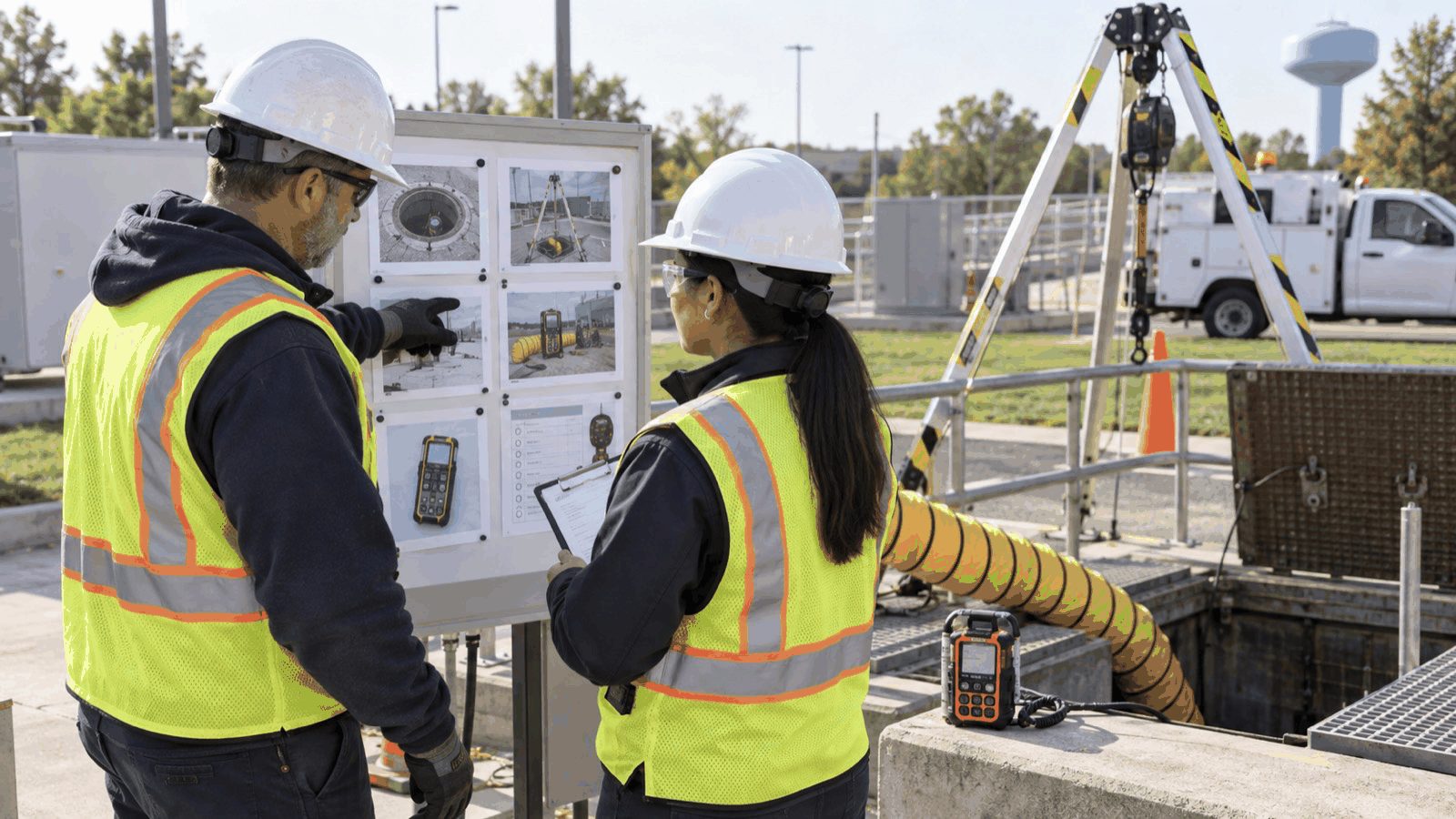
A confined space program audit should test permits, atmospheric records, rescue readiness, role performance, and corrective actions, not just confirm that workers completed training.
Training certificates are useful evidence that an employer assigned learning to the right people, but they do not show whether an entry program works at the actual tank, vault, pit, manhole, crawl space, or vessel. A program can have complete certificates and still produce incomplete permits, weak communication, poorly placed ventilation, or a rescue plan that does not fit the space. Employers need an audit method that looks at decisions and field behavior as well as records.
An audit is not necessarily a punishment exercise. It is a structured opportunity to compare written procedures with what supervisors, entrants, attendants, contractors, and rescue providers actually do. The best time to review is before a major shutdown, after a near miss, when the space or process changes, or on a planned cycle that does not depend on an incident.
Who This Affects
Construction employers working under 29 CFR 1926 Subpart AA need to consider the roles and responsibilities associated with confined spaces in construction. General industry employers commonly work under 29 CFR 1910.146. A company may also coordinate with host employers, controlling contractors, entry employers, subcontractors, facility owners, public works departments, or outside rescue services. The applicable standard and division of responsibility depend on the work and the employer relationship.
The audit should include more than the person who owns the safety manual. Ask an entry supervisor to explain how a permit is authorized. Ask an attendant what would cause an evacuation. Ask an entrant where the communication device, retrieval line, and exit route are. Ask a maintenance planner how hazards from a process are isolated. Ask a contractor coordinator what information is exchanged before a crew arrives.
Municipal and utility teams often face recurring spaces with changing conditions, such as wet wells, lift stations, storm structures, sewer manholes, and vaults. Maintenance groups may enter tanks, pits, chases, and vessels during short shutdown windows. General contractors may coordinate multiple employers at a construction site. Each group benefits from a sample-based audit because the same written procedure can be applied differently by different crews.
The Confined Space Compliance Issue
The core audit question is whether the employer can show how it identifies the space, evaluates hazards, authorizes entry, monitors conditions, and responds when conditions change. A certificate alone does not answer those questions. A program should connect the space inventory to hazard assessments, permits, equipment, training assignments, and rescue arrangements.
Sample several completed permits rather than reviewing only the newest one. Look for the space name, task, date, authorized entrants, attendant, entry supervisor, hazards, acceptable entry conditions, isolation steps, test results, testing times, ventilation, communications, rescue method, and termination information. A permit may be neatly filled out yet fail to explain how a process line was isolated or how an atmospheric change would be recognized. The audit should follow the logic of the entry, not simply count blank fields.
For construction work, Subpart AA includes requirements for the permit-required confined space program, permitting process, training, role duties, rescue, and employee participation. For general industry, 1910.146 includes permit-program elements, entry permits, training, rescue, and review of the program. Employers should use the standard that applies to the work and account for state-plan or local requirements where relevant.
Atmospheric testing deserves special attention. Check whether the instrument was appropriate, maintained, calibrated or bump-tested according to the employer's procedure, and operated by a person who understood the readings. Review the order and location of tests, the timing of retests, and the response to an alarm. If continuous monitoring was required, confirm that the record or device history shows the monitoring actually occurred. Do not assume that a normal pre-entry test proves conditions stayed acceptable during welding, cleaning, pumping, coating, or a process change.
Rescue records should be practical. Review whether the designated service understood the particular space, access route, hazards, equipment, and time constraints. Check whether a non-entry retrieval method was feasible for the configuration and task. If the plan relied on a public emergency service, verify what the employer had communicated and what response capability had been confirmed. A named phone number is not the same as a rescue arrangement that has been evaluated.
What Employers Should Check
Use a sample that includes routine and unusual entries, different supervisors, different spaces, and at least one entry performed by a contractor. For each sample, trace the work from planning to closeout.
- Was the space identified and classified before the crew arrived?
- Did the hazard assessment reflect the actual contents, process, configuration, and nearby work?
- Were lines, mechanical equipment, electrical sources, and other hazards isolated as required?
- Were test instruments suitable, functional, and used according to the procedure?
- Were test results recorded with enough context to show when and where they were taken?
- Did the permit name the correct roles and explain how communication would work?
- Did entrants know the hazards, controls, symptoms, alarms, and exit triggers?
- Did the attendant remain able to monitor the entrants and summon help?
- Did the entry supervisor verify conditions before authorization and after a change?
- Was ventilation placed and operated to control the identified hazard rather than simply move air?
- Did retrieval equipment fit the space and task, with an anchor and harness arrangement that could work?
- Was the canceled permit retained and reviewed for lessons or required program changes?
Interview people separately from the document review. A supervisor may say the permit requires continuous monitoring, while an attendant may say the monitor was used only at the opening. An entrant may not know whether a change in fan location requires a new test. Those differences are useful findings because they identify where the written program did not reach the field.
Classify findings by risk and by system cause. A missing signature can be a documentation problem, while an unrecognized alarm or unavailable rescue service can be an immediate entry-program concern. Repeated minor errors may show a poor form, confusing instructions, or weak supervision. Assign an owner and due date for each corrective action, then verify completion instead of closing the item when someone promises to fix it.
The audit should also evaluate training assignments. Awareness training may be appropriate for workers who recognize spaces but do not enter. Permit-Required Entry training belongs with authorized entrants and attendants who perform the duties. Entry Supervisor training should cover authorization, verification, termination, and response to changing conditions. A Competent Person or advanced role may be appropriate where the employer assigns hazard evaluation or program leadership. Mixed-role crews need a matrix that avoids assuming one broad course covers every duty.
Which Training Fits This Situation
Confined Space Awareness Training can establish recognition, restricted-entry behavior, alarm response, and reporting expectations for employees who work around spaces. It is a useful foundation for facilities, construction support teams, leasing or operations staff, and workers who may encounter a space without being authorized to enter.
Permit-Required Entry Training should be matched to entrants and attendants. Entrants need to understand acceptable entry conditions, hazards, communications, equipment, symptoms, evacuation, and their right to stop or exit. Attendants need to track entrants, stay outside, communicate, recognize prohibited conditions, order evacuation, summon rescue, and avoid taking on distracting duties.
Supervisor training should focus on the permit decision and the employer's process. Supervisors need to verify controls, authorize entry, suspend or cancel a permit, recognize when conditions change, and coordinate with contractors. Competent Person training may be appropriate when the role includes evaluating spaces, hazards, controls, or the work program beyond a single entry.
Online, self-paced learning can provide a consistent baseline and a certificate of completion. The employer should add space-specific procedures, equipment practice, communication drills, isolation steps, and rescue coordination. OSHA-aligned training supports employer compliance planning, but neither a certificate nor a course by itself proves that an entry was safe or that the employer's program is complete.
Common Mistakes to Avoid
One common mistake is treating training records as the whole audit. A second is reviewing only perfect permits from a single supervisor. Another is asking whether rescue is available without examining whether the rescuer can reach the space, manage the hazards, and perform the needed task in time.
Avoid copying a permit from one space to another without reviewing configuration and process hazards. Avoid assuming that an attendant can also drive equipment, perform unrelated maintenance, or leave the opening. Avoid treating a gas monitor as a control by itself. It measures conditions, but the program must define testing, ventilation, alarms, evacuation, and response.
Do not write findings that say only “retrain the crew.” Training may be part of the fix, but the underlying cause could be an unclear procedure, unavailable equipment, poor contractor handoff, or a permit that does not match the work. Correct the system and then confirm that people understand the change.
Next Step
Choose a small, representative sample of recent entries and trace each one from space identification through permit closeout. Use the findings to assign role-based training, repair weak procedures, verify rescue capability, and schedule a follow-up review. The goal is a program that works at the opening, not a file that merely contains certificates.