
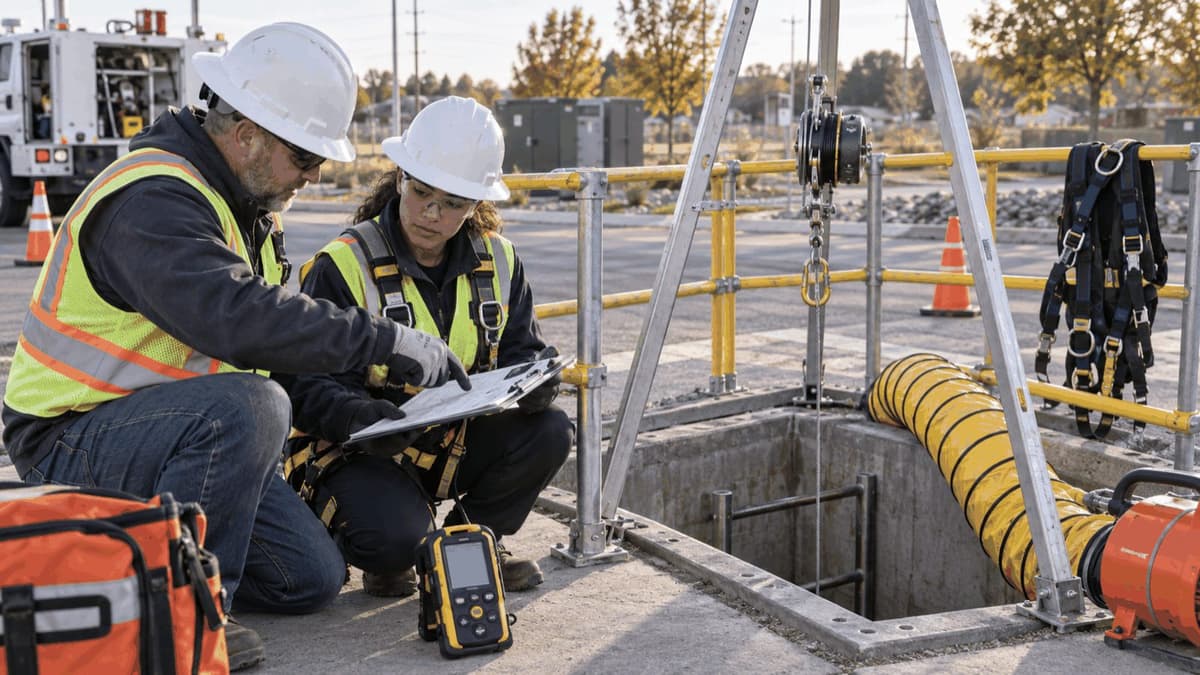
Post-entry confined space reviews help employers turn permit notes, worker feedback, and near misses into safer procedures and better training before the next entry.
An entry can finish without an injury and still reveal a weak control. A monitor alarm, a blocked retrieval line, an unclear radio call, a late permit change, or a worker who was unsure when to evacuate can show where the program needs attention. A short review soon after the work preserves details that disappear when the crew moves to the next task.
Employers should evaluate the entry plan and the actual work together. Construction employers may need to apply 29 CFR 1926 Subpart AA, while general industry operations may use 29 CFR 1910.146. The applicable rule and the employer’s procedures should guide the review, and state or local requirements may add expectations. Training supports improvement, but it does not replace a documented hazard assessment or a site-specific procedure.
The decision should also account for the worker’s exposure during setup and exit. A person may be outside the space while connecting a blower, opening a hatch, isolating a line, or positioning retrieval equipment, but those tasks can still involve stored energy, traffic, chemicals, or a fall hazard. Training and procedures should cover the complete job sequence, not only the minutes spent inside.
Who This Affects
Hazard classification affects employers, facility managers, EHS professionals, contractors, supervisors, attendants, entrants, rescue teams, and workers who may encounter a space unexpectedly. A maintenance department may own the building while a contractor performs the entry. A municipality may dispatch crews to lift stations or manholes with conditions that vary after storms. A general contractor may coordinate several employers around a construction space.
Workers outside the entry team are affected too. Dispatchers, security staff, operators, and nearby crews need to know when an opening is controlled and who may authorize entry. They should not remove a cover, enter to help a coworker, or bypass a permit process because the task appears short. Awareness training can be appropriate for people who recognize and avoid spaces, while entry personnel need more detailed preparation.
The classification decision matters for smaller employers that combine roles. One person may be the entry supervisor on one shift and an attendant on another. That person needs training for each duty, and the employer should verify that the role can be performed without distractions or conflicts. Wearing two hats does not eliminate the responsibilities of either role.
The Post-Entry Review Issue
A post-entry review should ask whether the permit described the work that actually occurred. Compare the planned task, hazards, isolation, atmospheric testing, ventilation, communication, retrieval, and rescue arrangements with field experience. If the crew changed the sequence, added a chemical, moved a fan, or used a different access point, record why and whether the change was authorized.
The review should be proportionate but deliberate. A routine entry may need a five-minute crew debrief and a supervisor note. An alarm, evacuation, unexpected condition, equipment failure, or near miss deserves a more detailed review involving the employer, affected workers, safety staff, and contractors as appropriate. The objective is to understand the condition and improve controls, not to blame the person who reported it.
A confined space is generally large enough for a worker to enter, has limited or restricted means for entry or exit, and is not designed for continuous occupancy. A permit-required confined space has additional hazards, such as a hazardous atmosphere, engulfment potential, internal configuration that could trap or asphyxiate a worker, or another recognized serious safety or health hazard.
The classification should be based on the actual space and reasonably foreseeable conditions. Managers should ask what is stored nearby, what can flow into the space, what energy sources connect to it, what the task will release, and how workers will leave if conditions change. Atmospheric testing should be planned around the hazards, with appropriate instruments, calibration and bump-test practices, sampling locations, ventilation controls, and monitoring frequency.
A non-permit classification is not a permanent promise. A process change, chemical use, weather event, equipment failure, or maintenance activity can introduce a hazard. If the employer relies on ventilation to control a hazard, the employer should understand what happens when the fan stops. If a space is reclassified under a particular procedure, the documentation should explain the conditions supporting that decision and the conditions that would invalidate it.
Construction work brings another layer of planning. Excavation, demolition, coating, welding, temporary ventilation, and utility connections can change the space during the shift. The controlling contractor and subcontractors should coordinate who evaluates the space, who controls the permit, and how changes are communicated. General industry employers should likewise coordinate host, contractor, and entry-employer responsibilities when work crosses company boundaries.
Rescue planning is part of classification. A space requiring retrieval, non-entry rescue, or a trained rescue service should be evaluated before a worker goes in. A cellular phone and a promise to call emergency services do not by themselves make a rescue plan. The employer should consider access, response time, equipment, victim geometry, communication, and the hazards rescuers may encounter.
What Employers Should Check
Managers can use a repeatable decision framework before selecting a course or authorizing work:
- Identify every space that workers may enter, including tanks, pits, vaults, manholes, crawl spaces, bins, silos, sewers, and utility chases.
- Describe the normal purpose of each space and the entry tasks that are actually planned.
- Determine whether the space meets the confined-space definition and whether additional permit-space hazards are present.
- Review connected lines, valves, stored energy, process materials, electrical sources, vehicles, and equipment that can introduce hazards.
- Identify atmospheric hazards and specify how testing, ventilation, continuous monitoring, alarms, and instrument checks will be handled.
- Decide whether the space can be entered without a permit under the employer’s documented procedure, or whether a permit-required process is needed.
- Assign entrant, attendant, entry supervisor, and rescue responsibilities before the shift.
- Verify that workers understand communication, evacuation triggers, retrieval equipment, and emergency actions.
- Coordinate contractor and host responsibilities, including who supplies the permit, equipment, training records, and rescue arrangements.
- Reassess the space when the task, contents, ventilation, weather, access, or nearby operations change.
The checklist should be specific enough to guide action. “Atmosphere safe” is not a useful record without the date, time, location, instrument, tester, readings, and acceptance criteria used by the employer. “Rescue available” should identify who responds, what equipment is ready, and whether the response has been evaluated for the actual space.
Employers should distinguish training from qualification. A certificate of completion can document that a learner finished an online course, but it does not prove that the learner has site-specific knowledge, hands-on equipment practice, medical clearance where required by the employer, or the ability to perform a rescue. Those elements may need separate evaluation.
Which Training Fits This Situation
Awareness training fits workers who need to recognize confined spaces, understand warning signs, stay out unless authorized, and report changes. It is useful for general employees, delivery staff, property teams, and contractors who work near spaces but do not perform entries.
Permit-Required Entry training fits entrants, attendants, and workers involved in the permit process. It should cover hazards, atmospheric testing, ventilation, communication, personal protective equipment, retrieval, alarm response, and the conditions that require evacuation. The course should be paired with the employer’s procedures and site-specific equipment practice.
Supervisor training fits people who authorize, coordinate, or oversee entry. These supervisors need to understand the hazard evaluation, permit contents, isolation and control measures, testing results, communications, contractor coordination, and cancellation or suspension of a permit. They also need to know when the planned entry is not ready.
Competent Person training may be appropriate for construction roles responsible for recognizing hazards and taking prompt corrective action under the employer’s program. The employer should verify the person’s knowledge and experience for the work being performed, rather than assuming a course alone creates the designation.
A multi-role plan is often the most practical choice. A municipality may need awareness for the wider public works team, permit-required training for entry crews, supervisor training for foremen, and rescue coordination for a designated service. English and Spanish access, group delivery, SCORM, virtual, or in-person options can help an employer reach different audiences, but the delivery format should not obscure the need for hands-on and site-specific preparation.
Common Mistakes to Avoid
One common mistake is classifying a space by its name instead of its conditions. Calling a vault “routine” does not remove atmospheric, electrical, engulfment, or traffic hazards. Another is selecting awareness training for a worker who will actually enter, test, attend, supervise, or rescue.
Employers also make mistakes when a permit is treated as paperwork completed after the work starts. The permit should reflect the planned conditions and controls before entry. Testing only at the opening can miss stratified or remote hazards. Ventilation without monitoring can create false confidence. A harness or tripod that has never been fitted or used can delay response.
A final mistake is assuming the classification never changes. A storm, process release, shutdown, coating job, or change in crew can require a new evaluation. Refresher training and audits can help employers find gaps before a worker is dispatched.
Next Step
Start with the spaces and tasks your organization actually performs, then map each role to the training and field practice it requires. Use an OSHA-aligned course to establish shared knowledge, and complete the site-specific evaluation, equipment practice, procedures, and rescue coordination before entry.
For teams that need a repeatable foundation, confined-space.com can support an awareness, permit-required entry, supervisor, Competent Person, or multi-role training plan. The useful decision is not simply which course is shortest. It is whether the selected training matches the hazards and duties workers will face.
Sources
- OSHA 29 CFR 1910.146, Permit-Required Confined Spaces
- OSHA 29 CFR 1926 Subpart AA, Confined Spaces in Construction
- OSHA Safety and Health Topics, Confined Spaces
The review should be repeated when a space changes owners, processes, or access arrangements. A tank used for storage may later be opened for cleaning, a vault may receive new electrical equipment, or a contractor may bring chemicals and temporary ventilation. Each change can affect the hazards and the role training required for the next entry.