
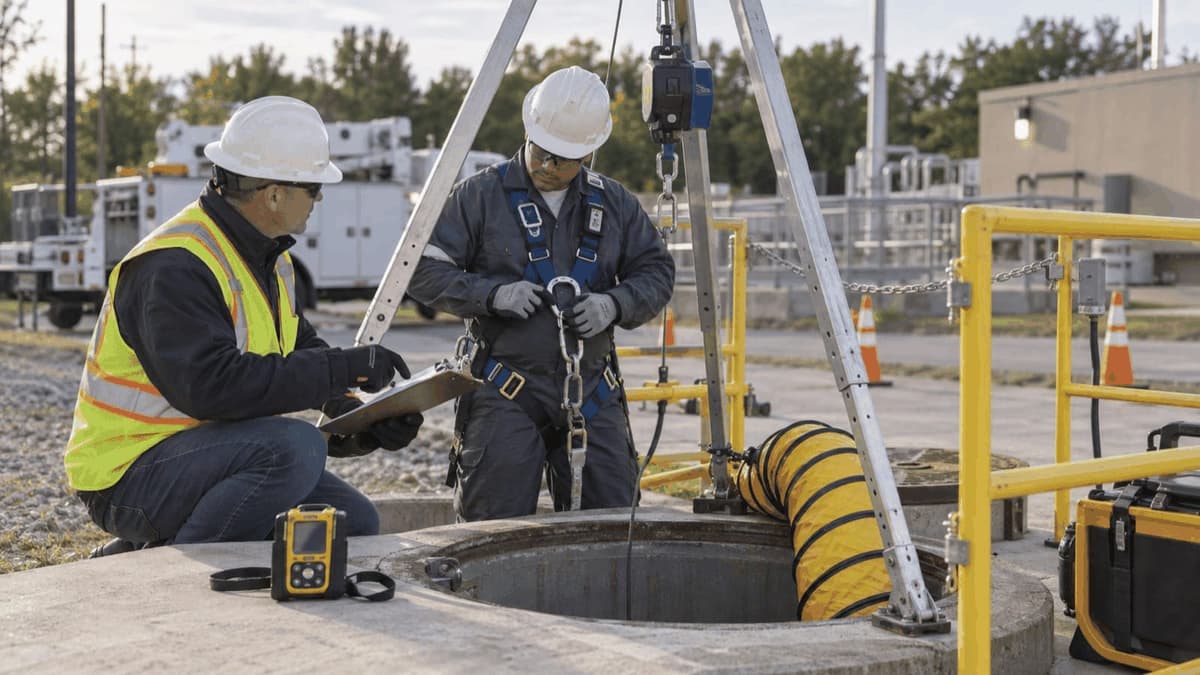
Attendant training helps employers prepare the person outside a confined space to monitor entrants, recognize changing conditions, communicate clearly, and start the planned response before a routine entry becomes an emergency.
The attendant is sometimes treated as the least technical role because the person does not enter. That assumption creates a training gap. An attendant may be the only person positioned to see the entry point, track who is inside, notice a ventilation failure, hear an entrant's warning, control unauthorized access, or summon rescue. In a permit-required entry, the attendant's decisions are part of the entry system, not an extra pair of eyes.
The right training depends on the space, the employer's program, and the attendant's assigned duties. Construction work may be covered by 29 CFR 1926 Subpart AA, while general industry work may involve 29 CFR 1910.146. A certificate of completion can document learning, but it does not replace site-specific procedures, equipment practice, communication plans, or a rescue arrangement that fits the actual space.
Who This Affects
Attendants are common in municipal manholes, utility vaults, lift stations, tanks, pits, vessels, crawl spaces, silos, and maintenance shutdowns. They may be full-time safety staff, members of a public works crew, a contractor's foreman, or a worker who has another duty when no entry is underway. Their title varies, but the outside-the-space responsibilities remain important.
Employers should also consider multi-employer projects. A host employer may control the facility, an entry employer may provide the crew, and a contractor may supply rescue or specialized equipment. The attendant needs to know who controls the permit, who receives the check-in, who can order an evacuation, and how to contact rescue. If those answers are unclear, the training problem is really a coordination problem.
Small crews deserve special attention. One worker may be qualified for more than one role on different jobs, but no one should be expected to perform incompatible duties during an active entry. An attendant who leaves the opening to fetch a tool, operate equipment, or solve a nearby problem may no longer be able to monitor entrants. Training should make that limitation visible before the permit is signed.
The Confined Space Compliance Issue
An attendant's central duty is continuous awareness of the entry. That includes knowing which entrants are inside, maintaining reliable communication, observing conditions from outside when possible, and ordering an evacuation when a prohibited condition appears, an entrant shows warning signs, an outside hazard threatens the space, or the attendant can no longer perform the role safely.
The attendant is not expected to improvise a rescue. Unplanned entry by an unprotected attendant is a common way a single emergency becomes multiple casualties. A sound program gives the attendant a clear instruction: summon the rescue service or follow the non-entry rescue procedure, while preserving the opening and communicating with the entrant when doing so does not create additional risk.
Atmospheric testing is another area where role confusion causes trouble. The person who operates a monitor needs training on the instrument, bump tests or other employer-required checks, sampling locations, alarm limits, sensor limitations, and what to do when the reading changes. An attendant who sees a value on a screen but does not understand stratification, ventilation effects, or the response plan may not recognize that entry conditions have changed.
Ventilation needs active observation too. A fan can stop, a duct can move away from the work area, or a process can introduce a contaminant. The attendant should know what the ventilation is intended to accomplish, where the air is moving, how to recognize a failure, and when to order entrants out. “Fan running” is not the same as “the atmosphere is controlled.”
The permit is a coordination tool. The attendant should be able to locate the space, review the hazards and controls, confirm the entry roster, understand the communication method, and find the emergency contact. The permit should not become a script that overrides field observations. If the space, task, weather, process, or equipment changes, the entry supervisor may need to suspend or reevaluate the entry.
What Employers Should Check
Before assigning an attendant, employers should match the training to the actual job. A practical review includes:
- Whether the employee understands the difference between a confined space, a permit-required confined space, and the employer's entry categories.
- Which standard and written program govern the work, including construction or general industry requirements.
- The hazards of the specific space, such as oxygen deficiency, toxic gases, engulfment, mechanical energy, temperature, flooding, or lines that can introduce material.
- How atmospheric testing will be completed, where the instrument will be placed, how often readings are taken, and what each alarm means.
- The communication method with entrants and the backup method if radios fail or the space becomes noisy.
- How the attendant tracks entrants, visitors, and unauthorized people near the opening.
- The exact conditions that require evacuation and who has authority to stop the entry.
- The rescue provider, contact method, non-entry retrieval equipment, and limits of the rescue plan.
- What records document training, equipment checks, permit review, drills, and corrective actions.
Employers should observe the attendant in a practice scenario. The exercise can be simple: a monitor alarms, a fan stops, an entrant misses a check-in, or a delivery truck blocks the rescue route. The attendant should state the immediate action, communicate with the entrant, notify the entry supervisor or rescue service, and maintain control of the opening. A course that explains the duty is useful; a rehearsal that tests the duty is better.
The employer should also decide what the attendant is not allowed to do. If the person must operate a hoist, answer a gate, direct traffic, or fetch supplies, assign someone else or pause the entry. A written job briefing can make this explicit. Clear boundaries reduce the temptation to leave the post for a task that feels minor.
Which Training Fits This Situation
Awareness training may fit employees who identify confined spaces, recognize warning signs, and report work that could require a formal entry program but do not perform entry duties. It is useful for general staff, project managers, and workers who may encounter a vault, pit, tank, or crawl space during ordinary work.
Permit-Required Entry training is more appropriate for entrants and attendants who participate in a permit system. The course should cover hazards, testing, ventilation, communication, permits, evacuation, and the employer's procedures. The attendant portion should be explicit rather than implied by a general overview.
Supervisor training fits the person who authorizes the entry, verifies conditions, confirms that the permit is complete, and terminates the entry when required. Competent Person training may be needed for construction roles that identify hazards and take prompt corrective action. Some employers need a multi-role plan so the entrant, attendant, entry supervisor, and competent person understand how their decisions connect.
Online training can establish knowledge and provide a certificate of completion, including for English- and Spanish-speaking crews when the employer chooses accessible material. It should be followed by site-specific orientation, equipment instruction, communication practice, and rescue coordination. Employers should keep completion records and refresh training when duties change, deficiencies appear, or the written program changes.
Common Mistakes to Avoid
One mistake is assigning an attendant because the person is available, without confirming that the person understands the role or can remain at the opening. Another is treating the attendant as a passive observer who only calls for help after an entrant stops responding. Early warnings, changing readings, lost communication, and outside hazards all require attention before the situation becomes an obvious emergency.
Another mistake is relying on one initial gas test. The attendant should understand when continuous monitoring or repeated testing is necessary and how ventilation, work activity, or connected systems can change the atmosphere. A permit signed at the start of a shift does not make later readings irrelevant.
Employers should avoid promising that a course alone makes a worker ready for every space. Training is one part of an employer's program. The employer still needs an inventory, hazard evaluation, isolation or control procedures, appropriate equipment, a rescue plan, and a process for reviewing permits and incidents.
Finally, do not let a certificate replace role verification. Ask the employee to explain the evacuation triggers, demonstrate communication, locate the rescue contact, and describe what happens if the entrant does not respond. Those checks reveal whether the training transferred to the job.
Refresher discussions should follow real work. After a shutdown, near miss, alarm, or difficult entry, ask what the attendant saw, what information arrived late, and which part of the plan was hard to follow. That review can improve radio channels, equipment placement, staffing, access control, and rescue contacts. It also gives managers a practical way to notice when a worker needs additional instruction before the next assignment.
Next Step
List every employee who may serve as an attendant, then compare each person's training with the spaces and duties they will actually support. Choose awareness, permit-entry, supervisor, Competent Person, or a combined plan based on that responsibility. Use an OSHA-aligned course to establish a foundation, then add site-specific practice and rescue coordination before the next entry.