
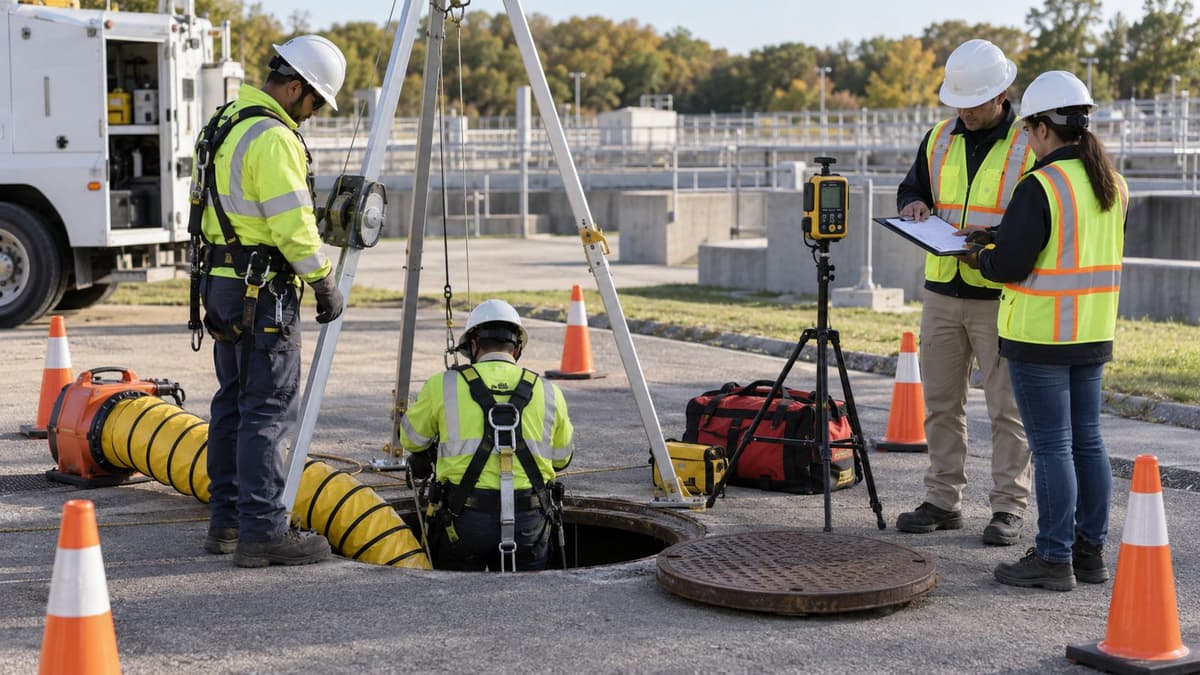
Employers often search for confined space training after realizing that a permit form does not answer the hardest entry question: what happens if something goes wrong inside the space? Rescue planning is not a paperwork detail to fill in at the end of the permit. It is a practical decision that affects whether entry should begin, who may enter, what equipment must be present, and whether the crew understands its limits.
This matters for construction crews, municipalities, utilities, maintenance teams, and facility contractors because confined space hazards can change quickly. Atmospheric conditions, engulfment hazards, mechanical energy, heat, poor visibility, restricted openings, and communication problems can all affect both entry and rescue. OSHA-aligned confined space training should help supervisors and crews understand that rescue planning must be realistic before anyone crosses the opening.
Who This Affects
Rescue planning affects every role connected to confined space entry. Authorized entrants need to know how to recognize symptoms, communicate, use retrieval equipment when required, and evacuate when ordered. Attendants need to know their monitoring and communication duties, when to summon rescue, and why they must not abandon their post or enter the space unless they are trained and relieved. Entry supervisors need to verify that conditions, equipment, rescue arrangements, permits, and personnel are ready before authorizing work.
Employers, EHS managers, project managers, and facility owners also have a role because rescue capability is not created by writing a name on a permit. Someone has to evaluate whether non-entry rescue is feasible, whether a retrieval system can be used without creating a new hazard, whether local emergency services can actually perform the needed rescue, and whether in-house personnel need additional training. Contractors working inside active facilities should also coordinate with host and controlling employers so rescue expectations are not assumed incorrectly.
Municipal and utility crews face this issue in manholes, vaults, wet wells, lift stations, meter pits, and underground utility structures. Construction crews face it in tanks, pits, crawl spaces, shafts, and other spaces that may fall under construction confined space requirements. Maintenance teams face it during shutdowns, cleaning, repairs, and inspections. The details differ, but the core question is the same: can the planned rescue response match the hazards of the space?
The Confined Space Compliance Issue
Confined space rules require employers to evaluate hazards, control entry conditions, assign trained roles, and address rescue. Under permit-required confined space programs, rescue and emergency services must be available and appropriate for the entry. In construction, employers must also coordinate on multi-employer sites and make sure confined space duties are assigned clearly. A generic statement that employees will call 911 may not be enough if the responding service lacks the equipment, training, timing, or site information needed for the specific space.
The compliance issue is practical as much as regulatory. A rescue plan that looks acceptable on paper can fail in the field if the retrieval line cannot pass through the opening, if the entrant must move around obstructions, if the attendant cannot maintain communication, or if the rescue team has never seen the space. Supervisors need training that helps them test the plan against the actual entry conditions. They should ask how an entrant would be removed, who will make the call, how long help may take, and what conditions would cancel entry.
Rescue planning also connects to atmospheric testing and continuous monitoring. If oxygen, flammable gas, hydrogen sulfide, carbon monoxide, vapors, or other hazards are possible, the plan has to account for how conditions will be monitored and what actions are required when readings change.
Ventilation, lockout, isolation, blanking, draining, cleaning, and other controls may reduce the chance of rescue being needed, but they do not eliminate the need to prepare.
What Employers Should Check
Before authorizing entry, employers and supervisors should review the rescue plan with the same seriousness as the permit itself. The review should be specific to the space, the task, and the crew assigned that day. A practical checklist includes the following items.
- Has the space been classified correctly as permit-required or non-permit based on actual hazards?
- Are retrieval systems required, feasible, inspected, and set up before entry?
- Can non-entry rescue be used, or would obstructions, vertical travel, or equipment make it ineffective?
- If outside rescue services are part of the plan, have they been evaluated, contacted, and informed about the space?
- Are entrants, attendants, and entry supervisors trained for their assigned roles?
- Are atmospheric testing, ventilation, communication, and evacuation triggers clearly understood?
- Are barriers, traffic controls, lockout steps, and isolation methods in place?
- Does the permit identify who will stop work if conditions change?
Documentation should support the decision, but it should not replace field verification. Supervisors should physically look at the opening, tripod location, anchor points, harness connection, monitor placement, ventilation ducting, and communication method. They should confirm that equipment does not block egress and that the attendant can remain outside the space with a clear role. If the rescue plan depends on people or equipment that are not present, entry should wait.
Employers should also confirm how rescue planning is communicated between shifts and employers. A contractor may assume the facility has a rescue arrangement, while the facility may assume the contractor brought its own retrieval equipment. A public works crew may rely on a rescue service that is farther away during certain hours. These assumptions should be resolved before entry, not during an alarm. Clear training helps supervisors ask those questions without turning the permit meeting into a formality.
Which Training Fits This Situation
Confined Space Awareness Training is useful for workers who may recognize spaces, understand basic hazards, and know not to enter unless authorized. It helps general crews, maintenance staff, and supervisors identify when a confined space question needs escalation. Permit-Required Confined Space Entry Training is more appropriate for entrants and attendants who need to understand permits, atmospheric testing, ventilation, communication, evacuation, and assigned duties.
Entry Supervisor Training should address the decision-making role in detail. Supervisors must know what they are authorizing, what must be verified, and when conditions require cancellation or termination of entry. Competent Person training in construction contexts can help with identifying confined spaces, evaluating hazards, coordinating duties, and connecting training to site-specific controls.
A multi-role training plan often works best. A facility or contractor may need awareness training for employees who encounter spaces, permit-entry training for entrants and attendants, supervisor training for those signing or authorizing permits, and additional rescue or retrieval training for employees assigned to those functions. Online OSHA-aligned training can support the knowledge portion, while employers still need to provide site-specific procedures, equipment practice, and hands-on instruction where required by the assigned task.
Rescue preparation may also call for drills, equipment checks, and coordination meetings that go beyond online coursework. Training gives workers the vocabulary and baseline expectations, while the employer decides how those expectations apply to the site. That combination is what makes the permit meaningful: people know their role, the equipment is present, the space has been evaluated, and the rescue approach fits the actual hazard.
Common Mistakes to Avoid
One common mistake is treating rescue as a line on the permit instead of a capability. Another is assuming that emergency responders can handle any confined space rescue without prior evaluation. A third is assigning retrieval equipment without checking whether it can actually remove an entrant through the space geometry. Employers also run into problems when attendants are trained only to watch the opening but not to understand communication, evacuation triggers, or the boundary between monitoring and rescue.
Another mistake is separating training from the actual spaces employees encounter. A generic course can explain the standard and core duties, but the employer must connect that knowledge to local procedures, hazards, equipment, and rescue arrangements. Teams should not discover during an emergency that radios do not work below grade, the tripod cannot be centered over the opening, or the rescue service does not have immediate access to the facility.
Finally, supervisors should avoid letting schedule pressure convert a questionable rescue plan into an accepted risk. If the plan is incomplete, the right answer may be to delay entry, bring in qualified rescue resources, change the work method, or improve controls. Training should reinforce that stopping entry is a valid supervisory action when rescue readiness is not in place.
Next Step
Employers planning permit-required confined space work should review the roles assigned to each worker and choose training that matches those duties. Entrants and attendants need role-specific permit-entry knowledge. Supervisors need training that supports authorization decisions. Crews that only need to recognize hazards may start with awareness training. For construction and utility work, a Competent Person or supervisor-focused course can help connect confined space requirements to the actual jobsite.
The best next step is to compare the spaces your team enters, the hazards they may face, and the rescue approach listed on your permit. If the plan depends on assumptions, update the procedure and get the right people trained before entry day.