
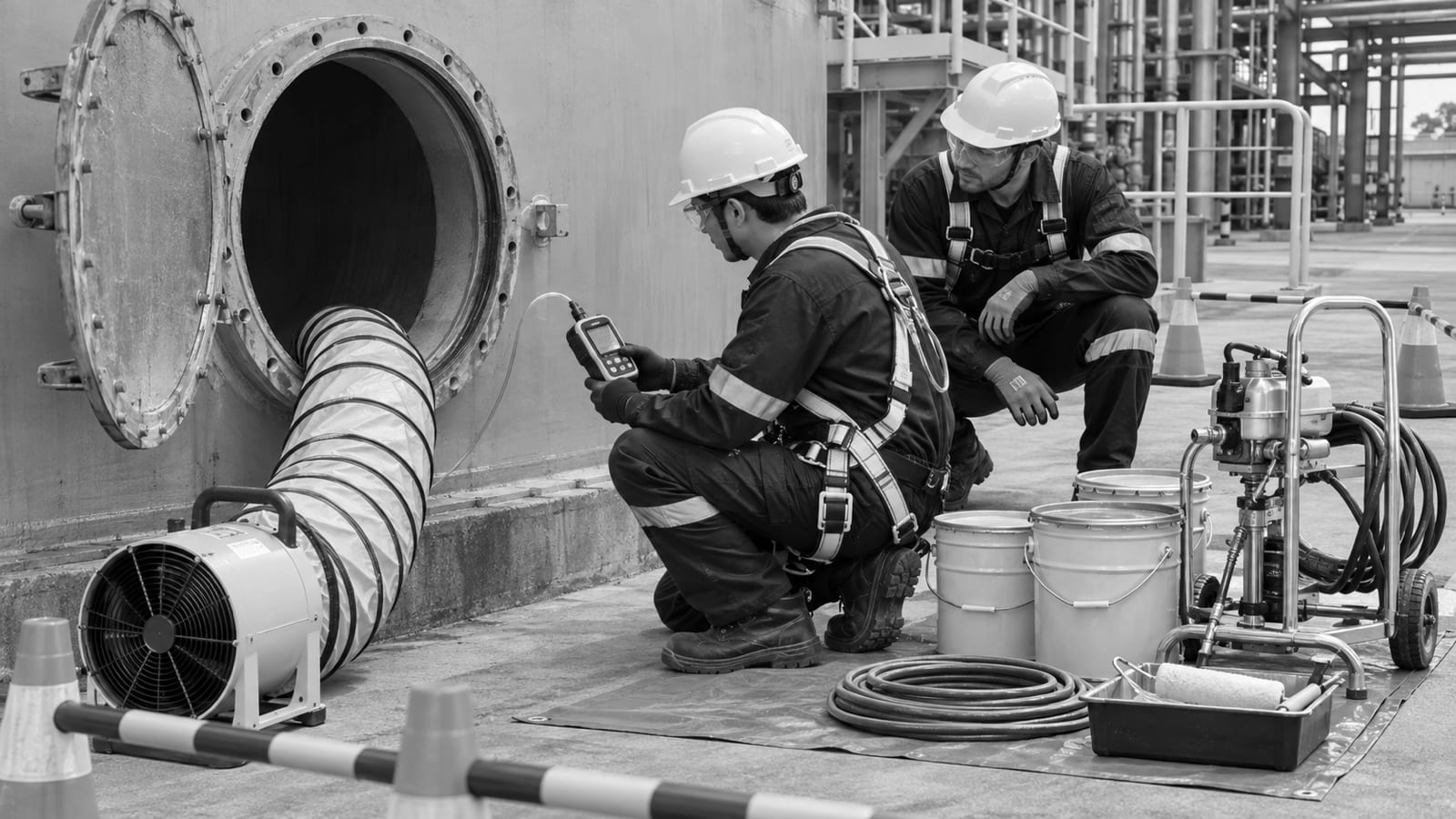
Coating work can change a confined space atmosphere quickly as solvents, spray mist, curing reactions, and equipment add hazards during entry. A tank or vault that tested acceptably before work began can become hazardous after surface preparation, mixing, application, or cleanup starts. Employers need an entry plan that treats the work itself as a source of change and links product review, ventilation, monitoring, ignition control, personal protective equipment, and rescue.
Who This Affects
This issue affects employers whose employees or contractors apply coatings, linings, sealants, adhesives, cleaners, or corrosion-control products inside tanks, vessels, pits, vaults, process equipment, and other confined spaces. It also affects host employers, facility owners, entry employers, coating contractors, industrial hygienists, maintenance supervisors, entry supervisors, attendants, authorized entrants, and rescue providers who must coordinate information and decisions.
The job may be part of a shutdown, rehabilitation project, water or wastewater maintenance task, food-processing repair, industrial cleaning operation, or corrosion-control program. Some spaces are entered repeatedly and may feel familiar. Familiarity does not keep a product, application method, temperature, or work sequence from changing the atmosphere. Each planned entry needs a current evaluation.
The Confined Space Compliance Issue
The permit-space program must address hazards that exist before entry and hazards introduced by the work. Coating products can release vapors. Spraying can create airborne droplets. Surface preparation can generate dust. Curing can consume or displace oxygen in some circumstances. Pumps, mixers, lights, and extension equipment can introduce electrical, mechanical, heat, and ignition hazards. Cleaning solvents and waste containers can continue releasing vapor after application stops.
Safety data sheets are useful inputs, but they do not by themselves establish that entry is safe. The employer should review product ingredients, exposure limits, flammability information, required ventilation, incompatible materials, application restrictions, and protective equipment. That information must be connected to the space volume, openings, internal geometry, temperature, amount used, application rate, and other work occurring nearby.
Atmospheric testing should be performed with a suitable, calibrated instrument and in an order that recognizes oxygen, flammable gases and vapors, and potential toxic contaminants. A common multi-gas meter may not detect every solvent or coating component at the concentrations that matter. Employers should select sensors and sampling methods based on the actual products and anticipated contaminants, obtain competent industrial-hygiene support when needed, and understand instrument limitations before relying on a reading.
Ventilation has to move contaminated air out and provide clean replacement air without creating a new problem. A duct pointed through the opening does not prove that corners, baffles, sumps, or the far end of a vessel are being swept. Exhaust placement, supply location, short-circuiting, vapor density, and the position of workers all matter. Discharged air should not expose attendants, other workers, occupied areas, air intakes, or ignition sources.
Flammable vapor control requires coordination. The entry team should identify ignition sources, review the electrical classification and equipment suitability, control static where applicable, and define alarm and evacuation levels. A respirator does not make a flammable atmosphere acceptable. Ventilation and monitoring should maintain the conditions required by the entry plan, and employees should exit when an alarm, ventilation failure, spill, unusual odor, symptom, or other prohibited condition occurs.
Temperature and cure time can change the work profile. A product applied in a warm vessel may release vapor differently than it did during an outdoor trial, and a second coat can add material before the first has fully cured. The hazard review should address pauses, shift changes, overnight ventilation, reentry after breaks, and conditions for removing respiratory or ventilation equipment. Work is not automatically finished from an atmospheric standpoint when spraying stops.
What Employers Should Check
Begin with a task-specific hazard review. Identify each product, quantity, mixing step, application method, cure period, cleaning method, and waste stream. Confirm whether other operations can send material or energy into the space. Isolate lines and mechanical equipment using the facility's verified procedures. Consider whether nearby welding, vehicle exhaust, process releases, or ventilation changes could affect the entry.
Define the atmospheric monitoring strategy before the permit is issued. Specify what will be measured, where samples will be taken, how often readings will be obtained, what instrument will be used, and what limits trigger evacuation. Test from outside before entry and evaluate different levels and remote areas where contaminants may collect. During coating work, use continuous or sufficiently frequent monitoring based on the hazard evaluation, not merely a single pre-entry reading.
Verify ventilation performance under the actual work arrangement. Confirm clean-air source, duct condition, fan capacity, inlet and exhaust placement, and what happens if power is interrupted. A smoke visualization or other appropriate method may help evaluate airflow when it can be used safely. Keep intakes away from exhausts and contaminated sources. Secure ducts so they do not block entry, damage retrieval lines, or collapse during work.
Review personal protective equipment as a system. Chemical-resistant clothing, gloves, eye protection, hearing protection, and respiratory protection must match the products and tasks. Respirator use requires a compliant respiratory-protection program, medical evaluation, fit testing when tight-fitting respirators are used, training, cartridge or canister selection, and change schedules where applicable. Supplied-air systems add hose routing, breathing-air quality, backup, and escape considerations.
Plan material handling and housekeeping. Limit the amount of coating and solvent inside the space to what the plan allows. Keep containers closed when not in use, control spills, remove waste, and manage contaminated rags or absorbents. Hoses and cords should not create entanglement or obstruct egress. The attendant should be able to track entrants and recognize changing conditions without taking on duties that interfere with monitoring and response.
Confirm rescue capability for the actual configuration. Coating suits, respirators, hoses, narrow openings, internal obstructions, and slippery surfaces can complicate retrieval. Evaluate whether non-entry retrieval is feasible and whether the selected harness, line, and anchor will work with the space geometry. Rescue personnel should know the products and exposures, have suitable protective equipment, and be able to perform the planned rescue in time.
Which Training Fits This Situation
Authorized entrants need permit-required confined space training that covers the hazards they may face, the signs and symptoms of exposure, proper equipment use, communication, and evacuation. They also need task-specific instruction on coating products, application equipment, respiratory protection, and spill response. General awareness training alone is not enough for employees who will enter and perform the work.
Attendants need role-based training focused on entrant status, communications, changing atmospheric conditions, prohibited conditions, unauthorized entry, and emergency actions. Entry supervisors need training that supports hazard review, permit verification, equipment checks, rescue confirmation, and cancellation or suspension of entry when conditions change. Host and contractor representatives need coordination training so product information, facility hazards, and lessons from the entry are exchanged.
The Confined Space Entry Training for General Industry course on confined-space.com can support the foundational knowledge needed for permit-space roles and program decisions. Employers should pair course completion with site-specific instruction, hands-on equipment practice, product training, respiratory-protection requirements, and documented rescue drills appropriate to the spaces employees enter.
Training should include a realistic setup exercise. The crew can position ventilation, route hoses and retrieval lines, sample at multiple locations, respond to an alarm, and practice an orderly exit without entering a hazardous atmosphere. Supervisors can then compare the drill with the written permit and correct conflicts involving equipment placement, communications, or rescue access before production work begins.
Common Mistakes to Avoid
A common mistake is treating acceptable pre-entry readings as proof that the atmosphere will stay acceptable. Coating work can create the contaminant, so monitoring must continue in a way that can detect change. Another mistake is assuming a standard four-gas meter detects all solvent vapors. Instrument selection should follow the hazard review and product information.
Employers should not use ventilation as an unverified box on a permit. Air has to reach the work area, contaminants have to leave the space, and failure needs a defined response. Do not place a fan where it recirculates exhaust, draws vehicle emissions, or sends vapor toward the attendant. Do not let ducting, air hoses, spray lines, or retrieval equipment compete for the same narrow opening without a routing plan.
Another error is separating coating safety from confined-space safety. The same entry plan should address product hazards, respirators, flammability, atmospheric testing, ventilation, isolation, communications, housekeeping, and rescue. If these subjects live in different binders and no one reconciles them at the jobsite, critical assumptions can conflict.
Finally, do not allow schedule pressure to extend a permit beyond the task and conditions it authorized. A different product, additional coat, ventilation interruption, spill, alarm, worker symptom, or change in nearby operations should trigger reassessment. Canceled permits and monitoring records should be reviewed after the job so the next entry benefits from what actually happened.
Next Step
Before the next confined-space coating job, bring the entry supervisor, coating lead, safety representative, facility contact, and rescue contact together for a task walkdown. Compare the product information with the space, equipment, airflow, monitoring capability, and rescue plan. Resolve gaps before materials are mixed or the permit is signed.
Use a short field verification at the opening to confirm that the written plan matches the actual setup. Test the atmosphere, start and verify ventilation, inspect equipment, check communications, confirm evacuation triggers, and document the entry conditions. If the work changes, stop, reassess, and issue a revised authorization rather than stretching the original permit beyond its basis.
Sources
Electronic Code of Federal Regulations, 29 CFR 1910.146, Permit-Required Confined Spaces: https://www.ecfr.gov/current/title-29/subtitle-B/chapter-XVII/part-1910/subpart-J/section-1910.146
Electronic Code of Federal Regulations, 29 CFR 1910.134, Respiratory Protection: https://www.ecfr.gov/current/title-29/subtitle-B/chapter-XVII/part-1910/subpart-I/section-1910.134
NIOSH Pocket Guide to Chemical Hazards: https://www.cdc.gov/niosh/npg/