
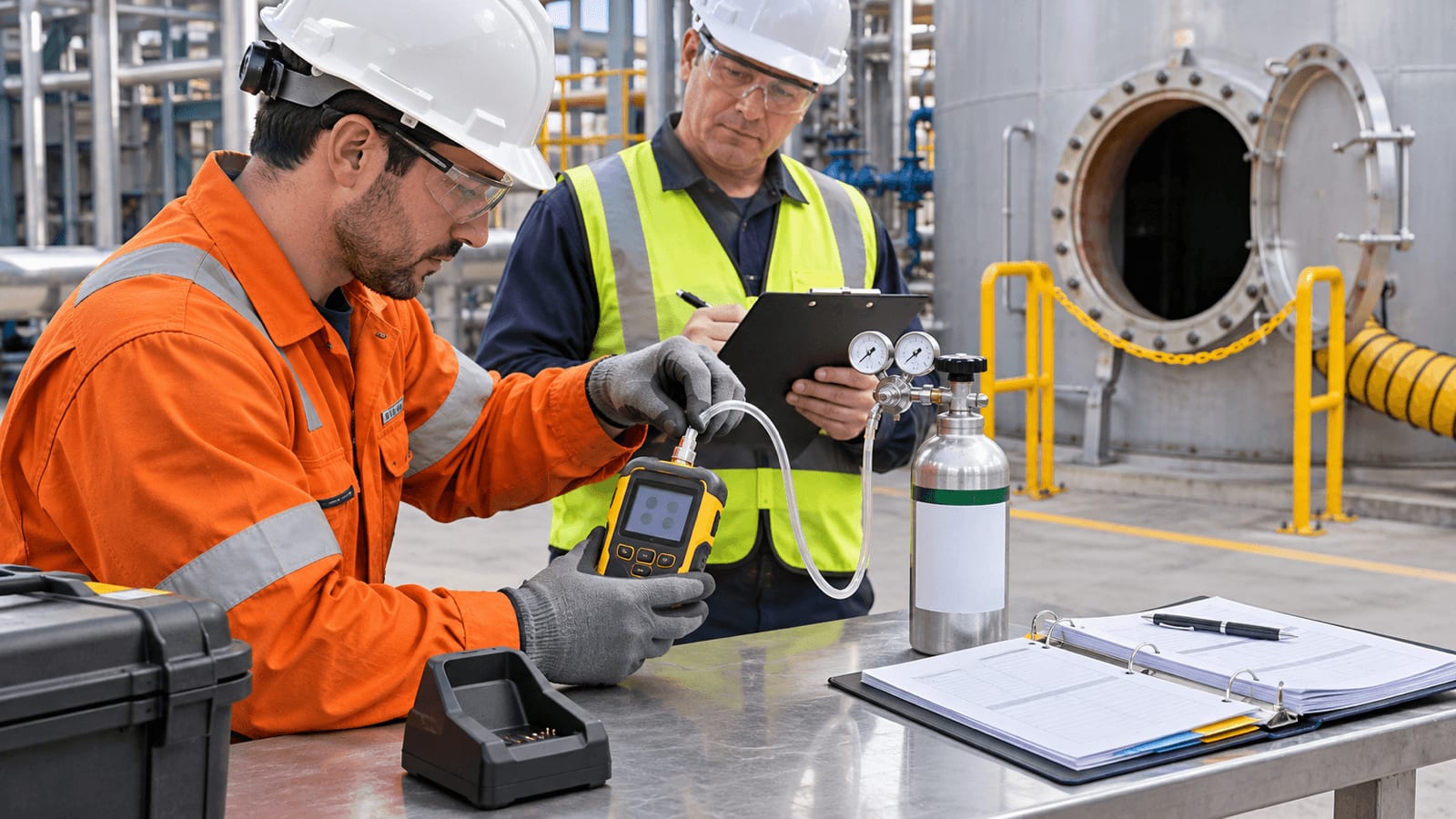
A gas monitor reading is useful only when the instrument is suitable, responsive, and supported by calibration records the entry team can trust.
Confined space programs often focus on the number displayed by a direct-reading monitor while giving less attention to the evidence behind that number. Calibration, bump testing, sensor selection, response time, maintenance, and record control determine whether the instrument can support an entry decision. A monitor that powers on is not automatically ready for the hazards, environment, and sampling method at a particular space.
Calibration records connect the equipment program to the permit process. They help employers verify that the monitor was maintained according to applicable procedures and manufacturer instructions, that overdue equipment is removed from service, and that workers understand the difference between a functional check and an accuracy adjustment. The record is not a substitute for atmospheric testing, but it supports confidence that the testing equipment is performing as expected.
Who This Affects
This issue affects employers with permit-required confined spaces, entry employers, host employers, entry supervisors, attendants, authorized entrants, safety managers, equipment coordinators, and contractors who bring their own monitors. It also affects rescue teams because rescue planning may depend on instruments that identify changing oxygen, combustible-gas, or toxic-gas conditions.
Facilities with tanks, pits, vaults, manholes, process vessels, sewers, utility spaces, and enclosed equipment frequently use portable multi-gas monitors. Some sites issue a device to each crew. Others maintain a shared pool. Both arrangements need clear ownership. Someone must know which unit was used, its sensor configuration, when calibration was due, what gas and regulator were used, and what happened after a failed check.
Multi-employer work makes the question more important. A host may know the atmospheric hazards associated with the space while a contractor supplies the equipment. Before entry, the parties should exchange enough information to confirm that the monitor detects the expected hazards and that its readiness records are available. A label saying "calibrated" without a unit identifier or date does not resolve that coordination problem.
The Confined Space Compliance Issue
OSHA's permit-required confined space standard requires employers to identify and evaluate permit-space hazards before employees enter and to provide testing and monitoring equipment needed for safe entry operations. Alternate entry provisions require a calibrated direct-reading instrument for pre-entry testing. OSHA guidance on direct-reading portable gas monitors recommends standard procedures for calibration and use, including documentation that verifies proper maintenance and calibration.
A bump test and a full calibration serve different purposes. A bump test exposes sensors to a known concentration of test gas to confirm that the sensor and alarm respond. Calibration compares the instrument's response with a known concentration and adjusts the reading when necessary. Employer procedures and manufacturer instructions should define frequency, method, acceptance criteria, and required action after a failure.
The record should not imply that calibration makes the monitor suitable for every hazard. Sensor configuration matters. A common four-gas unit may measure oxygen, combustible gas, carbon monoxide, and hydrogen sulfide, but a space may present a different toxic vapor. The hazard evaluation must drive instrument selection. Calibration of the wrong sensor package does not fix a gap in the hazard assessment.
Sampling method matters too. Remote sampling through tubing or a probe adds travel time before the sample reaches the sensor. OSHA's atmospheric testing guidance directs users to allow at least the instrument's minimum response time and to add time for hoses or probe extensions. A calibration record may show accuracy, while the entry procedure must still account for pump function, tubing condition, sample location, stratification, and response time.
Environmental limits can affect performance. Temperature, humidity, pressure, sensor poisons, low oxygen, cross-sensitivity, and damaged filters can change how an instrument behaves. Employers should use manufacturer information and qualified technical support when conditions exceed ordinary operating assumptions. The entry supervisor should not convert an unfamiliar warning, fault code, or failed check into permission to proceed.
What Employers Should Check
Begin with an equipment inventory that assigns a unique identifier to each monitor. Link that identifier to the model, serial number, installed sensors, firmware or configuration where relevant, service history, and calibration schedule. Shared spreadsheets can work, but the field label and the record must point to the same device without guesswork.
Check the most recent calibration result, not merely the scheduled date. The record should state when calibration occurred, who performed it, what procedure was used, the test-gas identity and concentration, cylinder expiration date, results, and any adjustment or repair. If the instrument failed and later passed, preserve the sequence so reviewers can see how it returned to service.
Verify that bump-test records follow the employer's procedure and manufacturer recommendations. A failed bump test should produce a defined response, such as removing the unit from service, checking the gas delivery setup, performing a full calibration, replacing a sensor, or obtaining qualified service. Repeating the test until it passes without investigating the failure weakens the record.
Confirm that the calibration gas matches the installed sensors and expected method. Check regulator flow, tubing, adapters, and cylinder condition. Users should know that an empty, expired, incorrectly connected, or mismatched gas cylinder can create a misleading result. Storage conditions for monitors and cylinders should also follow the applicable instructions.
At the entry point, connect the equipment record to the permit. Record the monitor identifier used for pre-entry and ongoing testing. Capture actual atmospheric concentrations as required by the permit process, rather than writing only "safe" or "normal." Document the tester, time, location, sampling levels, and any ventilation or work change that could affect conditions.
Finally, check whether the monitor's alarm settings and displayed units align with the entry procedure. Unauthorized changes, silent mode, disabled alarms, or unfamiliar units can undermine the plan even when calibration is current. Configuration control should be limited to designated people, with a method to review changes.
Include batteries, chargers, filters, pumps, and sampling accessories in the readiness check. A calibrated sensor cannot compensate for a blocked inlet, weak pump, damaged tube, depleted battery, or charger that never completed its cycle. Record defects against the same unit identifier and keep unavailable equipment clearly separated from ready equipment. Where crews exchange monitors between shifts, require a documented handoff that covers device status, alarms, unusual readings, remaining battery capacity, and any exposure to contaminants that could affect the sensors.
Which Training Fits This Situation
Awareness training is appropriate for employees who work near permit spaces but do not operate monitors or enter. They should recognize permit-space controls, respect barriers, and know that a monitor display does not authorize entry by itself.
Role-based permit-required confined space training is needed for entrants, attendants, and entry supervisors. It should connect atmospheric hazards, testing order, alarm response, ventilation, communication, evacuation, and permit documentation to each role. Entry supervisors need enough understanding to confirm that testing and monitoring match the identified hazards before authorizing entry.
Hands-on instrument training should cover the exact models employees use. Learners should power up the monitor in clean air, inspect filters and tubing, perform the required functional checks, recognize fault codes, calculate remote-sampling delay, read units, and respond to alarms. They should practice documenting a failed bump test and removing a unit from service.
Equipment coordinators need additional instruction on calibration methods, test-gas control, maintenance, record retention, configuration management, and manufacturer resources. Training should define what work they may perform and when the device must go to qualified service. An employer should verify skill in practice rather than relying only on course completion.
Common Mistakes to Avoid
Do not use a calibration sticker as the entire record. Stickers are helpful field cues, but they can become damaged, detached, or separated from the detailed result. Maintain traceable records that identify the unit and show what actually occurred.
Do not treat bump testing and calibration as interchangeable terms. If employees use the words loosely, they may perform the wrong check or misunderstand a failure. Define both terms in the written procedure and use the same language in forms and training.
Do not assume one monitor detects every atmospheric hazard. Review process chemicals, residues, decomposition, cleaning products, welding, coatings, inerting gases, nearby operations, and reasonably foreseeable releases. Choose sensors and methods from that evaluation.
Do not ignore sample-delivery time. Moving a probe rapidly through a vertical space can produce readings that do not represent each level. Allow the manufacturer's response time plus the additional time required for the tubing and pump setup.
Do not continue entry after an unexplained alarm, fault, failed check, or out-of-range reading. The entry procedure should require evacuation or prevent entry, preserve the information, and route the issue to a person with authority and technical competence.
Next Step
Select a small sample of recent permits and trace each listed monitor back to its calibration, bump-test, configuration, and service records. Then trace several monitors from the equipment inventory forward to the permits where they were used. Gaps in either direction can reveal devices with incomplete histories, permits with no equipment identifier, or records that cannot be tied to an actual entry.
Use the findings to revise one controlled procedure for monitor readiness. Assign ownership, define required fields, set failure actions, and train each role on the part it performs. The goal is not paperwork for its own sake. It is a reliable chain from hazard evaluation to a suitable instrument, a verified device, a correctly obtained reading, and a defensible entry decision.
Sources
Occupational Safety and Health Administration, Permit-Required Confined Spaces Standard: https://www.osha.gov/laws-regs/regulations/standardnumber/1910/1910.146
Occupational Safety and Health Administration, Procedures for Atmospheric Testing: https://www.osha.gov/laws-regs/regulations/standardnumber/1910/1910.146AppB
Occupational Safety and Health Administration, Calibrating and Testing Direct-Reading Portable Gas Monitors: https://www.osha.gov/publications/shib093013
Occupational Safety and Health Administration, Procedures for Atmospheric Testing in Confined Spaces: https://www.osha.gov/sites/default/files/publications/ATMOSPHERIC_TEST_CONFINED.pdf