
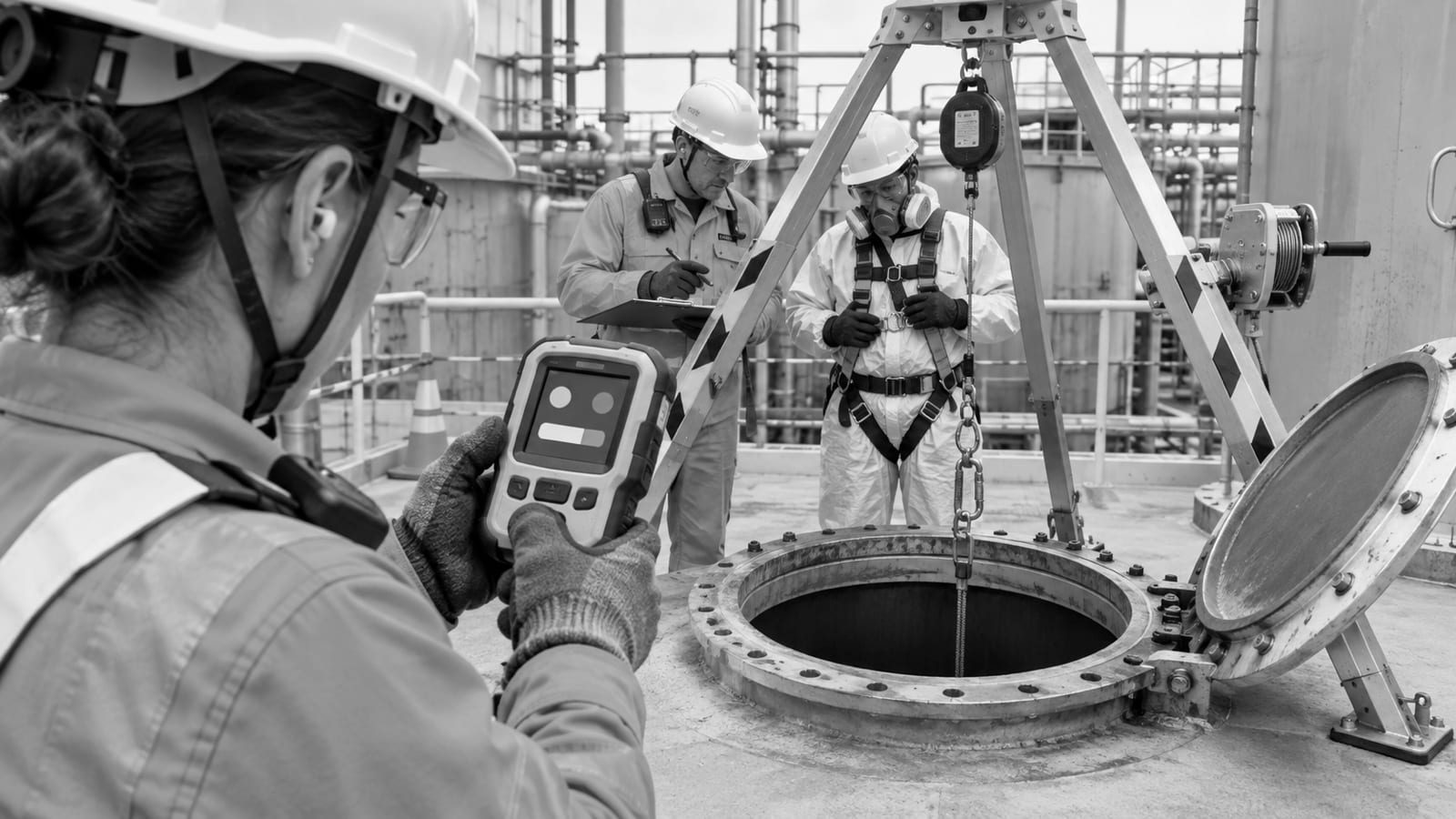
A gas monitor alarm is only useful when its sensors, setpoints, response plan, and expected hazards align with the confined space entry being performed.
Entry teams often focus on whether a portable gas monitor powers on and passes a bump test. Those checks matter, but they do not answer a different question: are the instrument's alarm settings appropriate for the hazards, entry procedure, applicable limits, and employer decisions for this specific job?
Alarm setpoints are not decorative preferences. They influence when entrants and attendants receive a warning that conditions need attention or require evacuation under the entry program. A setting that was suitable for one facility, sensor configuration, or task may be inappropriate after the instrument is moved, reconfigured, serviced, rented, or assigned to work that can introduce different contaminants.
Employers should review setpoints as part of a complete atmospheric testing and monitoring program. That program also includes hazard evaluation, sensor selection, calibration, bump testing, sampling methods, testing order, ventilation, communication, entry limits, evacuation criteria, and rescue planning. No single alarm number can replace those connected controls.
Who This Affects
This issue affects employers with permit-required confined spaces, entry supervisors, attendants, authorized entrants, safety managers, industrial hygienists, instrument program administrators, maintenance teams, and contractors. It is especially relevant when several departments share monitors or when rental units arrive with settings that differ from the facility's normal fleet.
Facilities with tanks, pits, vaults, vessels, manholes, silos, process equipment, wastewater structures, and utility spaces may use instruments with oxygen, combustible-gas, and toxic-gas sensors. The sensor combination varies. A standard four-gas monitor does not detect every chemical, and the presence of a screen reading does not prove the instrument is suitable for an unrepresented hazard.
Host employers and contractors should coordinate. The host may know the space history and process hazards, while the entry employer controls the crew and equipment. Both need a shared understanding of the hazards, acceptable entry conditions, testing approach, alarms, and actions. A contractor should not assume a facility-owned monitor has the contractor's usual settings, and a host should not assume the contractor's monitor covers the process chemicals.
The Confined Space Compliance Issue
The federal permit-required confined space standard requires employers to evaluate hazards, develop and implement the measures needed for safe entry, test or monitor conditions, and define acceptable entry conditions. Testing must be performed in the specified order for oxygen, combustible gases and vapors, and potential toxic contaminants. The results and entry conditions must connect to the permit and entry procedures.
The regulation does not provide one universal alarm-setpoint table for every monitor and every space. Employers must base decisions on the hazards, applicable occupational exposure limits, manufacturer instructions, sensor capabilities, process knowledge, and qualified technical judgment. State-plan rules, consensus standards, facility policies, or client specifications may add requirements that need review.
Setpoints also need context. A low oxygen alarm, high oxygen alarm, combustible-gas alarm, short-term toxic alarm, or time-weighted alarm can represent different decisions. The instrument may calculate or display more than one value. The team should know which alarm is sounding and what the entry procedure requires, rather than treating every signal as interchangeable.
An alarm is not permission to continue until the reading becomes more dramatic. The entry program should define when entrants must exit, who may investigate, whether ventilation may be adjusted, how conditions are verified, and who authorizes restart. If an instrument alarms unexpectedly, entrants should follow the planned response and not silence or reset the unit to keep working.
What Employers Should Check
Begin with the hazard assessment. List the atmospheric hazards that may be present before entry and those the work could introduce. Review prior permits, process chemicals, cleaning agents, residues, decomposition, inerting, welding or cutting, coatings, nearby operations, and the possibility of stratification. Identify which hazards the chosen sensors can detect and which require another method or instrument.
Confirm the monitor identity and configuration. Record the model, serial or asset number, installed sensors, sensor ranges, firmware or configuration version when relevant, calibration status, bump-test result, battery status, pump condition, tubing, filters, and accessories. An instrument label or fleet name alone is not enough if units with different sensors look similar.
Compare the active alarm settings with the employer's written criteria. Do not rely on memory or a display viewed in poor light. Use the manufacturer's approved method or fleet-management system, and restrict configuration changes to authorized personnel. Document any approved change so the next user does not inherit an unexplained setting.
Check whether latching, non-latching, audible, visible, and vibrating alarms work as the program expects. Workers may be in noisy areas, wear hearing protection, work in bright light, or move where the display is hard to see. The alarm presentation should be noticeable under actual conditions, and the attendant needs a communication plan that does not depend on hearing the entrant's monitor through a wall or hatch.
Review how setpoints relate to ventilation and entry decisions. Ventilation should be established and verified according to the entry procedure. It should not be used to justify ignoring a rising trend. A reading below an alarm may still show deterioration that warrants attention, especially when work generates contaminants or when the trend is moving toward an unacceptable condition.
Confirm the sampling method. Remote sampling through tubing introduces response time and can affect how quickly gas reaches the sensor. Vertical or complex spaces may require testing at multiple levels and locations. The employer should account for instrument response, tubing length, pump operation, and the time needed to obtain a representative reading before moving to the next point.
Verify that calibration gas, calibration procedures, and sensor compatibility follow manufacturer instructions. A bump test checks sensor and alarm response to gas, while calibration adjusts the instrument to a known concentration. Neither action proves that the monitor detects a different chemical or overcomes sensor interference, poisoning, cross-sensitivity, environmental limitations, or an expired sensor.
Define alarm actions on the permit or briefing. Entrants should know whether each alarm requires immediate exit, where to assemble, how the attendant accounts for people, who secures the space, and what information is reported. The entry supervisor should know what evidence is required before canceling, suspending, or reauthorizing entry.
Review access to configuration records. A simple fleet record can show the approved profile, last change, person authorizing the change, affected instruments, and verification date. This helps explain discrepancies and supports audits without turning the permit into an instrument manual.
Finally, test the procedure in the field. With no entry underway, activate a permitted test condition according to the manufacturer's process and confirm that entrants and attendants can recognize the alarm and carry out the expected response. Do not expose employees to hazardous conditions to test an alarm.
Which Training Fits This Situation
Authorized entrants need training on the hazards they may face, proper equipment use, communication, alarms, and exit requirements. They should recognize that a normal reading does not authorize work outside the permit and that an alarm must never be defeated, covered, or ignored.
Attendants need training on monitoring the entry, maintaining communication and accountability, ordering evacuation, summoning rescue, and preventing unauthorized entry. They do not need to become instrument technicians, but they should understand what the team's alarms mean and how an alarm changes their duties.
Entry supervisors need training that supports hazard review, permit verification, acceptable entry conditions, equipment checks, rescue availability, and authority to stop or cancel entry. Supervisors who approve monitor profiles need additional instrument-specific instruction and access to qualified industrial hygiene or technical support when setpoints involve unfamiliar contaminants or complex limits.
General confined space awareness may fit employees who identify spaces but do not enter them. Permit-required confined space entrant, attendant, and entry-supervisor training should match assigned roles. Instrument users also need hands-on instruction for the specific monitor, sensors, sampling accessories, alarms, bump testing, calibration policy, and limitations used by the employer.
Training completion does not replace an employer's confined space program, equipment procedures, hazard assessment, or verification of individual competence. Refresher or retraining may be needed when duties change, procedures change, a worker shows a knowledge gap, or the employer believes program use has deviated from requirements.
Common Mistakes to Avoid
One mistake is accepting factory defaults without comparing them with the employer's entry criteria. Defaults may be a starting configuration, but the employer still needs a defensible review. The opposite mistake is changing setpoints casually to stop nuisance alarms. An alarm that interferes with production may be identifying a real hazard, a poor work method, incorrect ventilation, contamination, or an instrument problem.
Another mistake is confusing a passing bump test with correct configuration. A bump test can show that sensors and alarms respond to test gas. It does not prove that the selected alarm thresholds, sensor set, sampling plan, or acceptable entry conditions fit the space.
Teams also make errors when they copy setpoints from another facility without understanding units, limits, sensor behavior, or local rules. Even familiar gas names can appear in different units or alarm types. Configuration should be reviewed by someone qualified to connect the technical value to the entry program.
A further mistake is relying only on alarms instead of watching trends and maintaining continuous monitoring when required by the procedure. An alarm is a threshold event. A trend can reveal changing conditions earlier and give the team information to leave before the space becomes unacceptable.
Finally, do not let the monitor become a substitute for rescue planning or ventilation controls. A loud alarm does not remove an entrant, isolate a line, stop a chemical reaction, or make a rescue service available. It is one part of the system.
Next Step
Select one monitor from the entry fleet and compare its installed sensors and active alarm profile with a recent permit, written acceptable entry conditions, manufacturer instructions, and the hazard assessment for that space. Record any mismatch and correct the program before the next entry.
Then run a short role-based briefing. Ask the entrant, attendant, and entry supervisor what each alarm requires, who orders evacuation, how accountability is maintained, and what evidence is needed before restart. If the answers differ, the procedure needs clarification.
Sources
Electronic Code of Federal Regulations, 29 CFR 1910.146 Permit-required confined spaces https://www.ecfr.gov/current/title-29/subtitle-B/chapter-XVII/part-1910/subpart-J/section-1910.146
Occupational Safety and Health Administration, Calibrating and Testing Direct-Reading Portable Gas Monitors https://www.osha.gov/publications/shib093013
Occupational Safety and Health Administration, Permit-Required Confined Spaces https://www.osha.gov/confined-spaces