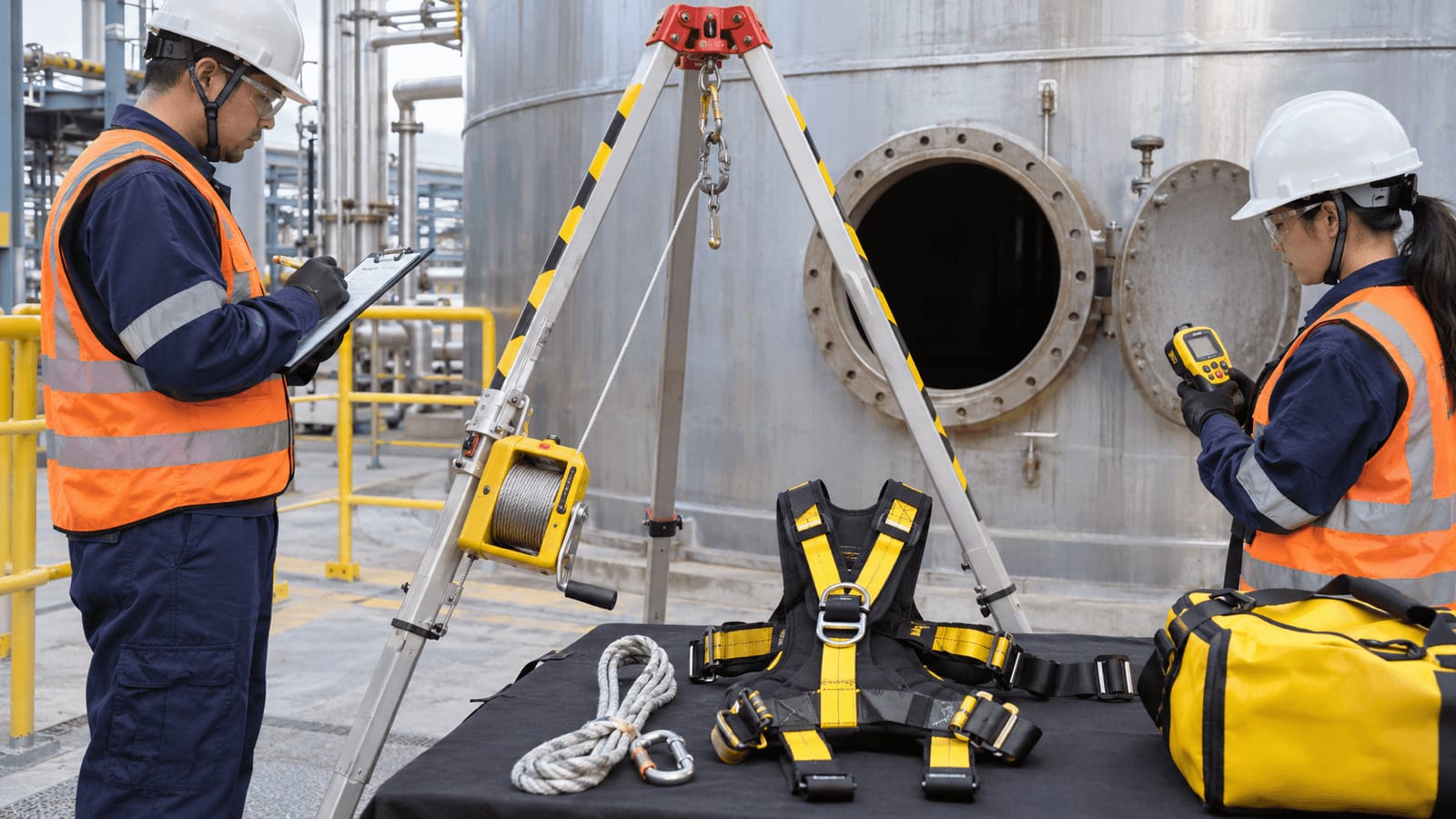
Rescue equipment must be selected, inspected, positioned, and understood before confined space entry begins, because an emergency leaves no time to improvise. A tripod beside the opening does not prove that the system fits the space, the entrant, the hazards, or the removal path.
Permit-required confined space planning often gives careful attention to atmospheric testing and permits while rescue hardware receives a quick visual glance. Yet harness attachment, line routing, anchorage, mechanical advantage, opening size, obstructions, and equipment condition can decide whether non-entry retrieval is possible.
Employers should connect equipment readiness to the written permit space program and the hazards of each space. OSHA's general industry permit-space standard requires rescue and emergency procedures, evaluation of rescue capability, and retrieval systems or methods for non-entry rescue when they can be used without increasing the overall risk or failing to contribute to rescue.
Who This Affects
This issue affects employers with tanks, vaults, pits, bins, silos, manholes, process vessels, sewers, wet wells, and other permit spaces. It matters to host employers, entry employers, controlling contractors, facility managers, safety professionals, entry supervisors, attendants, authorized entrants, maintenance teams, and rescue services.
The entry supervisor needs enough information to verify that rescue arrangements match the authorized entry. The attendant must understand how to summon rescue and what actions are permitted. Entrants need to wear and connect equipment correctly. The rescue service needs knowledge of the space, hazards, access, and equipment it may be expected to use.
Rental equipment does not transfer the employer's planning responsibilities. A vendor may provide inspection records or instructions, but the employer still needs to confirm compatibility, condition, configuration, training, and use at the actual entry point. The same is true when a facility owns equipment but an outside contractor conducts the entry.
The Confined Space Compliance Issue
OSHA requires employers to develop and implement the means, procedures, and practices necessary for safe permit-space entry. Required equipment includes rescue and emergency equipment needed to comply with the rescue provisions, except to the extent that it is provided by a rescue service.
For non-entry rescue, retrieval systems or methods must be used whenever an authorized entrant enters a permit space unless the retrieval equipment would increase the overall risk or would not contribute to rescue. The standard describes chest or full-body harness use, acceptable retrieval-line attachment points, connection of the other end to a mechanical device or fixed point outside the space, and availability of a mechanical device for vertical permit spaces more than five feet deep.
Those provisions do not make every tripod-and-winch arrangement suitable for every opening. The equipment may be blocked by piping, unable to clear a narrow hatch, exposed to a sharp edge, or positioned so the line drags across a flange. The entrant may wear tools or protective clothing that increases the removal profile. A vertical lift may transition to a horizontal movement that the setup does not address.
The employer should evaluate whether retrieval itself creates a greater hazard. A line can entangle an entrant in internal equipment, snag on ladders, cross moving machinery, or interfere with necessary work. If the employer concludes that conventional retrieval equipment would increase risk or would not contribute to rescue, that conclusion should be based on the actual space and supported by another rescue method, not used as a reason to leave rescue unplanned.
Equipment condition is part of readiness. Webbing, stitching, D-rings, connectors, wire rope, synthetic line, pulleys, winches, brakes, tripods, davit bases, anchor points, and mounting hardware can be damaged by wear, chemicals, corrosion, dirt, storage, impact, or misuse. Manufacturer instructions and applicable inspection criteria should guide the check and removal from service.
Rescue-team capability must also fit the equipment. OSHA requires employers to evaluate a prospective rescue service's ability to respond in a timely manner and its proficiency with rescue tasks and equipment for the relevant spaces. A team that has never used the site's device or practiced with a representative opening may not be ready simply because it owns rescue gear.
What Employers Should Check
Start with the space and the rescue path. Record the opening dimensions, orientation, depth, internal obstructions, ladders, changes in direction, elevation differences, surrounding work area, and route to a safe transfer point. Consider the entrant's likely position and the hazards that could cause incapacitation.
Match the equipment to that path. Verify rated capacity, line length, connector compatibility, anchorage or base requirements, required clearances, and the way the system will raise, lower, or redirect a person. Do not combine components merely because the connectors can be clipped together. Use the manufacturer's instructions and approved configurations.
Inspect the harness before use. Check labels and identification, webbing, stitching, buckles, D-rings, adjustment, contamination, cuts, burns, abrasion, deformation, and evidence of loading. Confirm that it fits the entrant and the selected attachment point supports the planned retrieval profile. A loose or incorrectly adjusted harness can complicate removal and injure an incapacitated worker.
Inspect the retrieval line and connectors along their full usable length. Look for broken wires, kinks, crushing, glazing, cuts, chemical damage, corrosion, knots, worn terminations, bent gates, missing locks, and incompatible connector loading. Keep the line away from sharp edges, hot surfaces, energized equipment, traffic, and moving parts.
Check the mechanical device through the manufacturer-specified pre-use process. Confirm attachment, direction of operation, brake or holding function, handle condition, line payout, retrieval action, and any indicators or limits. A test should be controlled and should not expose a worker to a suspended-load hazard.
Verify the tripod, davit, fixed point, or anchorage. Legs or bases should stand on a surface that supports the expected load without sliding, sinking, or interfering with the opening. Pins, feet, fasteners, cables, and mounts should be complete and correctly positioned. A guardrail, pipe, handrail, or convenient structural member should not be assumed to be an approved anchor.
Examine the opening and edge. A line passing over an unprotected edge can be cut or abraded and can increase the force required for retrieval. Hatch covers, guardrails, curbs, ladders, and piping may reduce clearance. The setup should protect employees from falls and falling objects while preserving the rescue path.
Position equipment before authorization. The line should be connected as planned, the operating area controlled, and the attendant able to reach the device without abandoning required duties or entering the space. If another person operates the winch, that role and location should be explicit.
Confirm communication and activation. The attendant should know the rescue service contact method, site location, space identifier, access instructions, and information to communicate. Test radios, phones, alarms, or other systems under entry conditions. A contact number printed on a permit is not enough if the device has no signal or the responder cannot find the opening.
Review rescue-service coordination. Provide hazard information and access to the relevant spaces so the service can plan and practice. Confirm response assumptions for the shift, facility access, locked gates, escorts, and any change in hazards. If the service cannot meet the entry's needs, entry should not proceed until suitable arrangements exist.
Keep usable records. A pre-use checklist can identify the equipment, inspector, condition, setup, compatible components, removal from service, corrective action, and verification. It should not replace the manufacturer's required periodic inspections or the employer's broader rescue evaluation.
Which Training Fits This Situation
Authorized entrants need role-based training on harness fit, connection, line management, communication, prohibited actions, evacuation, and the limitations of non-entry retrieval. They should be able to identify a damaged or incorrectly configured component and stop before entry.
Attendant training should cover continuous monitoring of entry conditions, communication, ordering evacuation, summoning rescue, controlling unauthorized entry, and operating rescue equipment only when the employer assigns and trains the attendant for that action without compromising other duties.
Entry supervisors need training that connects the permit, hazards, equipment, rescue service, and site configuration. They should verify that required tests have been conducted, procedures and equipment are in place, rescue services are available, and entry conditions remain acceptable before authorizing entry.
Employees designated for rescue need the PPE, task training, entrant proficiency, first-aid and CPR provisions, and practice required by the standard. Practice should use actual or representative spaces that simulate opening size, configuration, and accessibility. A classroom discussion alone does not demonstrate proficiency with the equipment.
Confined space awareness training may fit employees who identify spaces and avoid unauthorized entry. Permit-required confined space training fits entrants, attendants, and supervisors who perform assigned entry roles. Rescue training must go further for employees expected to perform rescue tasks.
Common Mistakes to Avoid
Do not treat a recent purchase as proof of readiness. New equipment can be incompatible, incorrectly assembled, damaged in transport, or unsuitable for the opening. Inspect and configure it before the permit is authorized.
Do not rely on a generic rescue plan copied from another space. A top-entry tank, side-entry vessel, sewer, and narrow vault can require different systems, staffing, and removal paths. The plan should reflect the actual hazards and geometry.
Do not place the tripod or davit after the entrant is inside. Installation can expose workers to the opening and delay rescue. Stage the system, protect the area, and verify operation before entry.
Do not allow retrieval lines to create new hazards. Keep them clear of agitators, ladders, internal piping, sharp edges, vehicles, and hot work. Reevaluate the routing when the entrant changes position or the work changes.
Do not assume the fire department or another outside service is automatically capable, available, and timely for the identified hazards. Evaluate and coordinate the service as the standard requires, and provide access for planning and practice.
Do not keep questionable equipment in the ready kit. Clearly remove damaged, loaded, contaminated, overdue, or unverifiable components from service under the employer's process so they cannot be selected by mistake.
Next Step
Before the next permit entry, conduct a dry setup at the actual opening. Identify every component, inspect it, connect it in the approved configuration, route the line, test communication, walk the rescue path, and confirm the outside service or in-house team assumptions. Correct gaps before signing the permit.
Use the exercise to update the space record, equipment inventory, inspection schedule, training matrix, and rescue plan. The goal is not to make the equipment look ready. It is to demonstrate that trained people can use suitable equipment to start an appropriate rescue without adding another victim.
Sources
Occupational Safety and Health Administration, 29 CFR 1910.146 Permit-Required Confined Spaces - https://www.osha.gov/laws-regs/regulations/standardnumber/1910/1910.146
Occupational Safety and Health Administration, Non-Mandatory Appendix F Rescue Team or Rescue Service Evaluation Criteria - https://www.osha.gov/laws-regs/regulations/standardnumber/1910/1910.146AppF
Occupational Safety and Health Administration, Permit-Required Confined Spaces Guide - https://www.osha.gov/sites/default/files/publications/OSHA3138.pdf
Occupational Safety and Health Administration, Confined Spaces in Construction - https://www.osha.gov/confined-spaces-construction