Atmospheric sampling must follow the worker's path through a vertical confined space because one opening-level reading can miss layered hazards below.
A gas monitor can display precise numbers and still provide an incomplete picture if the sample is taken from the wrong place, for too little time, or with a probe that has not reached the area the entrant will occupy. Tanks, vaults, pits, vessels, and similar spaces can contain different conditions at the top, middle, bottom, around obstructions, or farther from the entry. Entry teams need a sampling plan that matches the space, the work, and the instrument.
This article focuses on general-industry permit-required confined space operations under 29 CFR 1910.146. Construction work may be covered by 29 CFR 1926 Subpart AA, and other standards may apply to particular industries or hazards. Employers should determine the rules that apply to the actual task and should use technically qualified assistance when the atmosphere, process, or instrument requires it.
Who This Affects
Employers, entry supervisors, authorized entrants, attendants, safety professionals, industrial hygienists, maintenance teams, contractors, and rescue services all depend on atmospheric information. The person performing the test may hold one role, but the results affect the entry permit, ventilation, personal protective equipment, work method, emergency planning, and the decision to authorize or stop entry.
Vertical spaces deserve special attention because the entrant moves through several elevations. A reading taken while a probe hangs just inside a hatch does not describe the atmosphere four, eight, or twelve feet below. Vapors may settle, lighter gases may rise, oxygen can vary, and work can create contaminants after the initial test. Baffles, platforms, sumps, connected pipes, residues, and limited air movement can create local conditions.
Facility owners and host employers are affected when contractors enter their spaces. They should communicate known hazards, process history, previous test results, isolation conditions, and changes that could affect the atmosphere. Contractors still need to evaluate the space and operate their own entry program as required. A prior permit or a host's old reading should not be treated as a current clearance.
The Confined Space Compliance Issue
OSHA requires employers to evaluate permit-space conditions before entry and to test or monitor as needed to determine whether acceptable conditions are maintained during entry. When atmospheric hazards are tested, the order is oxygen, then combustible gases and vapors, then toxic gases and vapors. The sequence matters because some combustible-gas readings depend on oxygen and because fire or explosion hazards demand immediate attention.
Appendix B to 29 CFR 1910.146 distinguishes evaluation testing from verification testing. Evaluation testing helps identify hazards and develop the entry procedure. Verification testing checks that residues of identified contaminants are within the permit's acceptable entry conditions. A routine four-gas monitor may be suitable for identified hazards in one space but insufficient for another process with a specific toxic contaminant.
The instrument must have adequate sensitivity and specificity for the substances that may be present. The sampling method must also honor the instrument's response time. A pump, hose, filter, or probe adds travel time before the sampled air reaches the sensor. If the tester lowers the probe several feet and records the display immediately, the screen may still reflect air from the previous location.
OSHA's Appendix B addresses stratified atmospheres during descent. The atmospheric envelope should be tested about four feet in the direction of travel and to each side, and an entrant using a sampling probe should move slowly enough for the sampling speed and detector response. The principle is practical: test the air before the entrant's breathing zone reaches it.
Pre-entry testing is only one part of the control system. Conditions can change when ventilation starts or stops, residues are disturbed, cleaning products are introduced, welding begins, a line leaks, weather changes, or another process connects to the space. The employer must decide the testing or monitoring needed during the operation, and the permit should reflect acceptable conditions and the equipment used.
What Employers Should Check
Match the instrument to the hazard assessment
Identify the gases, vapors, and oxygen conditions that could exist or arise. Review process chemicals, safety data, residues, cleaning agents, connected systems, prior entries, corrosion, biological activity, and the planned work. Confirm that the monitor has the correct sensors and ranges. Do not assume a standard sensor package detects every toxic or combustible substance.
Check calibration status, functional checks, battery condition, filters, pump flow, tubing, probe connections, and alarms according to the manufacturer's instructions and the employer's program. A successful bump test demonstrates a response to test gas, but it does not fix a damaged hose, blocked filter, incorrect sensor, or sampling plan that misses the hazard location.
Define the vertical sampling sequence
Map the entry route from outside the opening to the work area. Decide the intervals, side-to-side coverage, remote areas, sumps, platforms, and obstructions that need testing. The plan should state where the probe will pause and how long the tester will wait at each point. Include the hose volume, pump rate, and sensor response time when determining that wait.
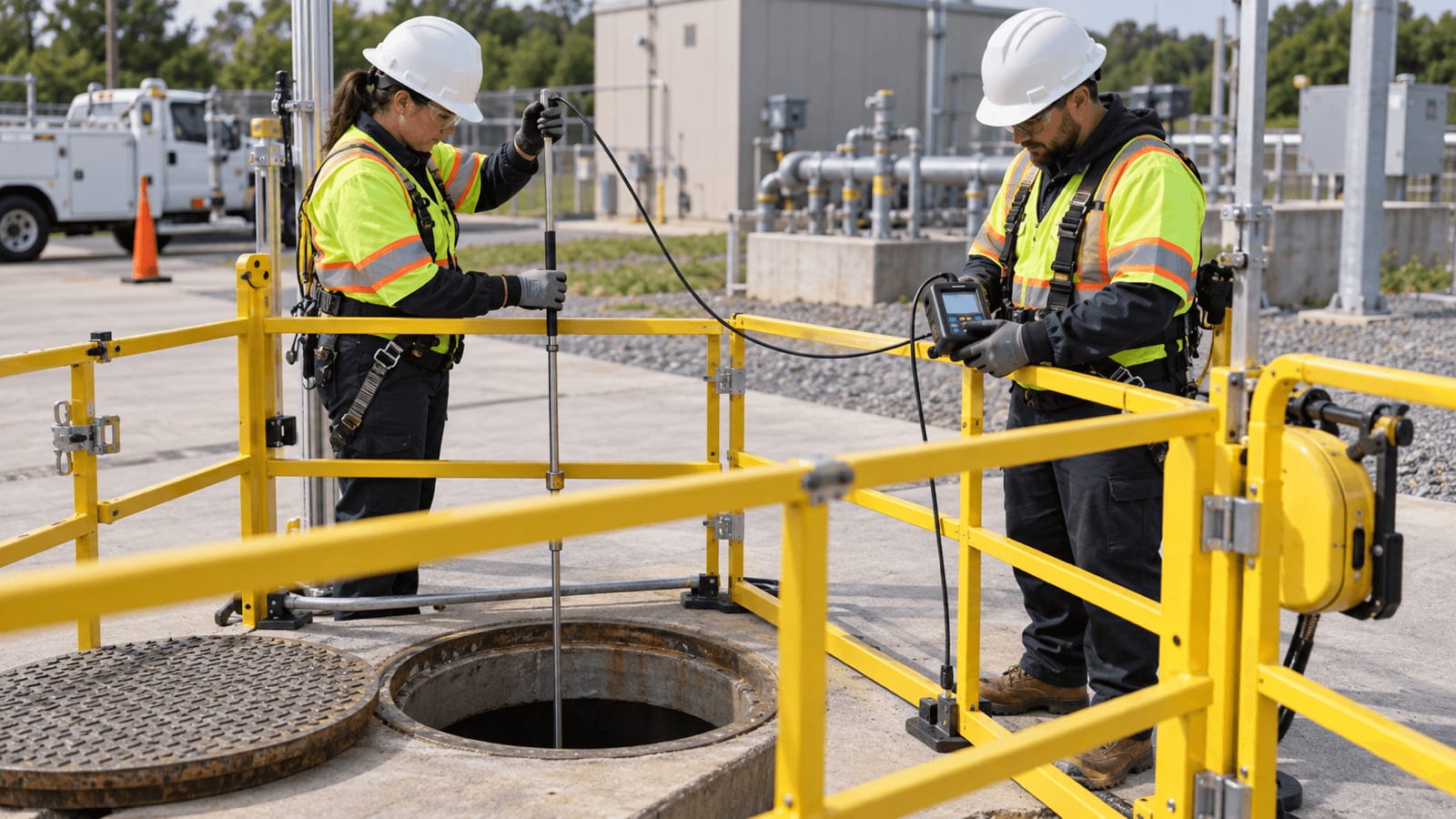
Test remotely before breaking the plane of the opening whenever the procedure and equipment allow. Keep the tester outside the space and protected from the opening's hazards. Guard the opening, control ignition sources, and use probe handling methods that do not create a fall exposure or pull the worker toward the hatch.
Record actual results and locations
Record numerical results, not only a check mark that says safe. Connect each result to the date, time, space, elevation or location, instrument identification, tester, and relevant ventilation or isolation condition. If the space is large or complex, a simple sketch can show the test points. The permit should make it possible for the entry supervisor and entrants to understand what was tested.
Provide entrants or their authorized representatives the opportunity to observe required testing and promptly provide results as required by the standard. Explain the alarm set points and acceptable entry conditions in terms the team can use. A worker should know what change requires evacuation, not merely that a supervisor looked at the monitor.
Plan monitoring during movement and work
Determine whether the monitor will remain with an entrant, be positioned in the work area, or be used by another trained team member. The choice should account for personal exposure, changing locations, sensor limitations, and alarm audibility. For a descent through potentially stratified air, monitoring should advance with the worker at a rate that allows the detector to sample ahead.
Ventilation should not be treated as proof that every area is safe. Verify that supplied air comes from a clean source and reaches the immediate areas where employees are or will be present. Check for short-circuiting, blocked ducts, dead zones, and changes caused by moving the hose or worker. Continue required testing or monitoring to confirm that acceptable conditions are maintained.
Establish a clear response to abnormal readings
The permit program should define evacuation criteria, communication, entry cancellation, investigation, and reauthorization. When a hazardous atmosphere or prohibited condition is detected, entrants should leave as required by the program. The team should not silence an alarm, move the monitor away, or rely on ventilation without identifying why the reading changed and whether the space can be safely reentered.
Preserve the reading and context. Record the location, task, ventilation state, connected processes, and actions taken. Inspect the instrument after the event if damage or contamination is possible. Reevaluate the hazard assessment and entry procedure before another attempt. A changed condition may require different sensors, isolation, ventilation, respiratory protection, or specialist review.
Which Training Fits This Situation
Authorized entrants need training on the hazards they may face, the proper use of equipment assigned to them, communication, and the signs or conditions that require exit. When they carry a monitor, they should understand sensor coverage, alarms, response time, sampling position, and the limit of what the instrument can tell them. They should never use a quiet display as permission to move ahead of the sampling zone.
Attendants need to understand how monitoring information affects the outside role. They should track entrants, maintain communication, recognize changing conditions, summon rescue, and order evacuation when required. If an attendant also observes a remote display, that added task must not interfere with the attendant's primary duties.
Entry supervisors need enough knowledge to verify that tests, procedures, and equipment match the hazards before authorizing entry. Training should include review of permits with multiple elevations, instrument documentation, sampling delay calculations, ventilation arrangements, and abnormal-reading scenarios. The supervisor should be able to identify when technically qualified support is necessary.
Role-based confined space training is more useful when it includes hands-on monitor practice with the actual or equivalent equipment. A drill can require the team to sample a vertical space, calculate hose delay, document several elevations, brief entrants, and respond to a changing reading. The exercise should test decisions and communication, not only button-pushing.
Common Mistakes to Avoid
Do not test only at the opening and call the entire space clear. The reading describes the sampled air at that time and location. It does not automatically represent lower levels, remote pockets, or conditions created after work begins.
Do not lower a long hose and read the screen immediately. Allow sampled air to travel through the hose and allow each sensor to respond. Use the manufacturer's information to establish a repeatable pause at every test point.
Do not assume that heavier gases are always at the bottom or lighter gases are always at the top. Temperature, ventilation, mixing, chemical properties, and space geometry affect distribution. Use the hazard evaluation and test the entrant's path and work areas.
Do not confuse a bump test with calibration or with atmospheric evaluation. Each serves a different purpose. Follow the employer's written program and the manufacturer's instructions for instrument checks, calibration, maintenance, and sensor replacement.
Do not let monitoring outrun rescue planning. A monitor can warn of a problem, but it does not remove the need for a suitable rescue service, communication, retrieval arrangements where applicable, and prompt evacuation procedures.
Do not treat a training certificate as site authorization. The employer must evaluate the space, designate roles, provide suitable equipment, implement the permit program, and verify that employees can perform their duties for the entry at hand.
Next Step
Select one representative vertical permit space and audit the sampling process from the hatch to the deepest work point. Compare the hazard assessment, sensors, hose length, pump rate, response time, pause intervals, recorded locations, ventilation, monitoring plan, and evacuation criteria. Correct any gap before the next entry.
Then run a short field exercise with the entry supervisor, attendant, and entrants. Have the team explain what each reading represents, when it becomes current for the sample location, how the monitor moves ahead of the entrant, and what everyone will do if an alarm or prohibited condition appears. The goal is a shared, observable method that keeps atmospheric information ahead of the worker.
Sources
- Occupational Safety and Health Administration, 29 CFR 1910.146 Permit-Required Confined Spaces
- Occupational Safety and Health Administration, 29 CFR 1910.146 Appendix B Procedures for Atmospheric Testing
- Occupational Safety and Health Administration, Testing Conditions in Spaces That May Have Layered Atmospheres