
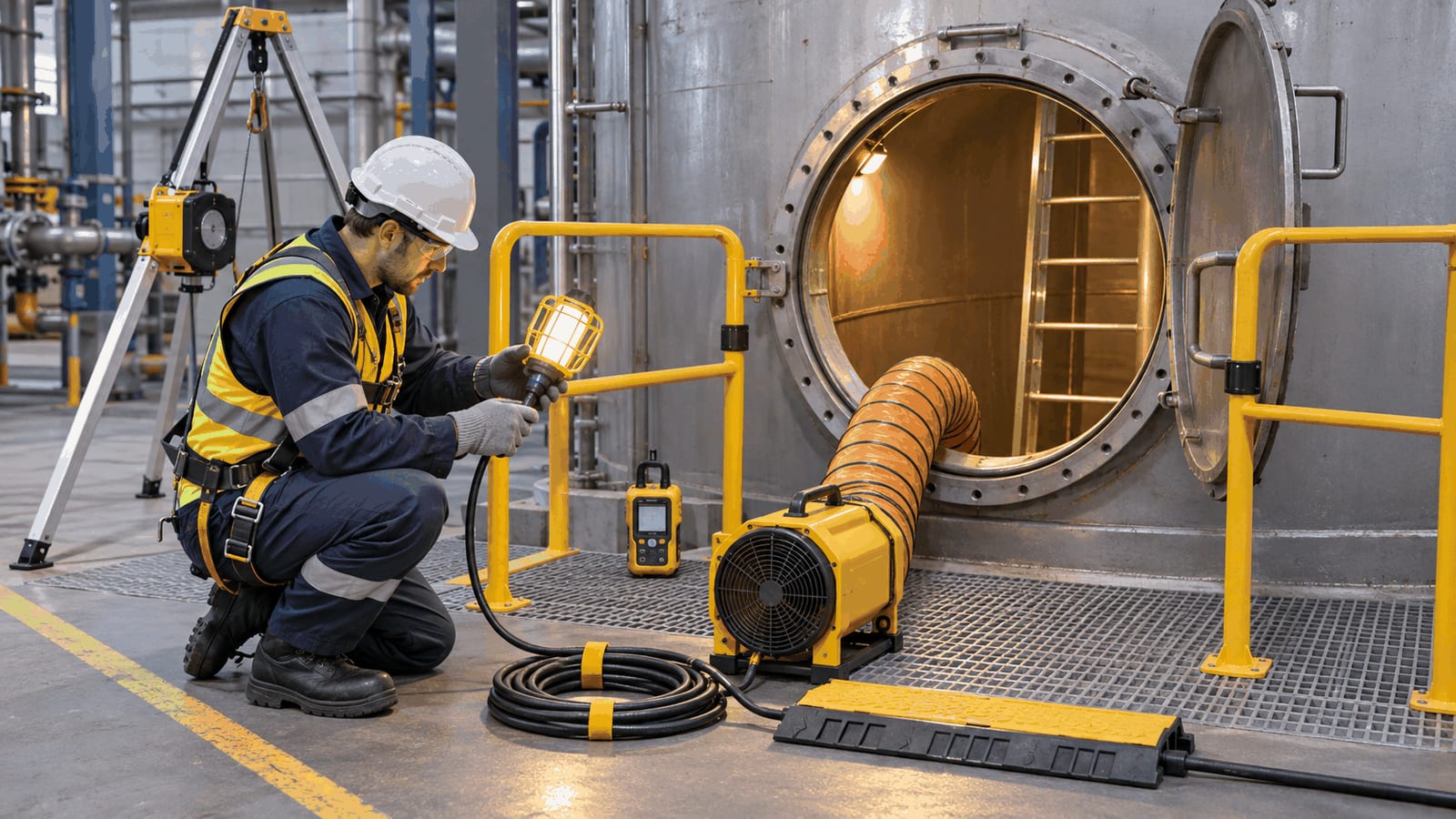
Temporary lighting can improve visibility inside a confined space when the entry plan addresses atmosphere, electrical hazards, placement, and failure.
A portable lamp may look like a simple accessory, yet it becomes part of the entry system as soon as workers depend on it to travel, inspect, clean, or repair inside a space. Poor illumination can conceal residue, changes in elevation, sharp edges, moving parts, damaged coatings, or a worker in distress. The lighting equipment can also introduce hazards through damaged cords, unsuitable equipment, heat, blocked access, or an ignition source in an atmosphere where flammable gas, vapor, or dust may be present. Employers should evaluate lighting as part of the permit-space hazard assessment rather than leaving the choice to whoever brings a lamp to the opening.
The permit-required confined space standard requires employers to identify and evaluate hazards before employees enter and to provide equipment needed for safe entry, including lighting equipment when it is needed for employees to see well enough to work safely and exit quickly during an emergency. Other electrical requirements address temporary wiring, portable lamps, flexible cords, protection from damage, grounding, and locations where electrical equipment may be exposed to physical damage or hazardous conditions. The correct equipment and controls depend on the space, atmosphere, work, and applicable electrical classification. A general-purpose work light is not automatically suitable for every entry.
Who This Affects
Temporary lighting planning affects employers whose crews enter tanks, vaults, pits, process vessels, sewers, silos, crawl spaces, and similar locations where permanent illumination is absent or inadequate. It also affects host employers, contractors, maintenance planners, electricians, safety staff, and rescue providers whose work touches the entry system. Each group may see only one part of the setup. The entry supervisor should bring those parts together before authorizing entry.
Entrants need enough light to recognize hazards, perform assigned work, read instruments when necessary, follow the route to the exit, and respond to an evacuation order. Attendants need to understand how a lighting failure could affect communication, entrant behavior, or the time required to exit. Equipment staff need accurate information about the environment rather than a vague request for a portable lamp. Rescue planners need to know whether cords, fixtures, shadows, or loss of power could complicate access. When contractors perform the entry, coordination should clarify who evaluates the equipment, who supplies power, and who controls changes.
The Confined Space Compliance Issue
Lighting begins with the hazard evaluation. The team should determine why existing light is insufficient, where workers must travel, what surfaces and obstructions are present, what tasks will occur, and whether the work itself can change the atmosphere. Cleaning chemicals, coatings, welding, cutting, grinding, residue disturbance, or process leakage may create conditions different from those observed when the space was opened. Atmospheric testing and monitoring requirements must be handled by the entry program, and the lighting selection should be compatible with the conditions the employer has identified.
Employers should not use vague labels such as safe light or explosion-proof as a substitute for equipment selection. Electrical suitability involves the recognized hazards, any classified location, the equipment's approvals and ratings, installation, cord and connector condition, voltage, grounding or double insulation where applicable, and protective devices required by the electrical rules and site procedures. A fixture that is appropriate in one tank may be inappropriate in another. If the employer lacks the expertise to make the selection, a qualified electrical or safety professional should be involved before the entry.
Cord routing is part of the entry configuration. A cord stretched across a ladder, hatch, retrieval line, or ventilation duct can create an entanglement or trip hazard and may interfere with emergency egress. Sharp edges can damage insulation. Water, conductive surfaces, vehicle traffic, doors, and moving equipment can expose cords and connections to damage. The plan should define how cords are supported, protected, inspected, and kept clear of entrants and rescue paths. Connections should not be placed where they are likely to be submerged, crushed, pulled apart, or contaminated.
Heat and placement matter even when the electrical equipment is otherwise suitable. A hot lamp can burn a worker, damage a coating, contact combustible material, or make an already hot space harder to tolerate. Glare can reduce visibility instead of improving it, while a single fixture can cast deep shadows behind internal structures. The team should consider distributed light, secure mounting, guards, aiming, and task-specific placement. Equipment should not narrow the opening or encourage an entrant to move beyond the planned work area merely to see.
Power loss is a foreseeable change that deserves a response. If normal lighting fails, workers may lose orientation, stop seeing the exit, or have difficulty reading a monitor. The entry procedure should state whether backup lighting is required, how entrants are notified, and whether loss of lighting is an automatic evacuation trigger. Any backup equipment must be evaluated for the same environment. A phone flashlight or an unreviewed battery lamp should not be treated as an automatic solution.
What Employers Should Check
Start with the permit-space evaluation and entry permit. The documents should identify illumination needs and related hazards clearly enough that the entry supervisor can verify controls. A useful field check covers the planned work zones, route, obstructions, atmosphere, electrical source, fixture type, cord path, connections, protective devices, backup arrangement, and evacuation response. The check should be completed under conditions that resemble the entry, because daylight at an open hatch can make the upper area look adequate while lower levels remain dark.
Inspect equipment before use. Look for damaged insulation, exposed conductors, bent or missing guards, cracked housings, loose strain relief, contaminated plugs, unauthorized repairs, and unreadable identifying information. Confirm that the fixture, cord, connector, transformer, battery, and other components match the planned setup. Equipment removed from service should be controlled so it cannot return to the entry by mistake. The inspection method and person responsible should be defined by the employer's electrical safety and confined-space procedures.
Verify the power arrangement rather than assuming an outlet is suitable. The source, overcurrent protection, grounding method, ground-fault protection where required, cord rating, and any reduced-voltage or isolation equipment should match applicable rules and site requirements. Temporary wiring should be installed and used for the permitted purpose and protected from physical damage. If the setup crosses areas controlled by another employer, coordinate access and protection. An entry supervisor should be able to point to the approved source and the person who evaluated it.
Test the actual visual result before entry. From the opening and other safe positions, check for shadowed ladders, unreadable gauges, dark corners, glare, and fixtures that could shift. Confirm that an entrant can reach the exit route without moving a lamp or stepping over cords. Where observation from outside cannot demonstrate adequate coverage, the employer should use a safe pre-entry method consistent with the program. Any adjustment after entry begins should be treated as a change and communicated through the established control process.
Confirm that lighting does not conflict with ventilation, atmospheric monitoring, communication, and retrieval. A lamp should not block airflow or heat a sampling line. Cords should not pull on a gas monitor or wrap around a retrieval system. Noise from generators or other equipment should not mask alarms or voice communication. The final arrangement needs to work as one system, not as separate pieces competing for the same opening and floor space.
Include lighting in the pre-entry briefing. Entrants should know which equipment they may move, what defects or changes to report, what to do if illumination drops, and whether they must exit immediately upon failure. Attendants should know the expected lamp locations and the escalation steps for flickering, damage, power loss, or an unexpected atmospheric reading. Entry supervisors should document that the required equipment and controls are in place before signing the permit.
Which Training Fits This Situation
Confined space awareness training helps employees recognize spaces, restrictions, and the need to avoid unauthorized entry, but workers who perform permit-required entries need role-specific instruction. Entrants, attendants, and entry supervisors should be trained for their assigned duties, the hazards of the space, equipment use, communication, and emergency actions. When lighting is part of the setup, training should include the limits of that equipment, inspection expectations, cord management, and the response to failure or damage.
Permit-required confined space entry training is the natural fit for authorized entrants and attendants who use or work around the lighting system. Entry supervisor training should emphasize verifying the hazard evaluation, equipment suitability, permit conditions, and coordination across electrical, operations, and rescue personnel. Employees who select, install, or repair electrical equipment may need separate qualifications under the employer's electrical safety program. Confined-space training does not make a person qualified for electrical work, and electrical expertise does not replace confined-space role training.
Practical exercises can expose problems that a lecture misses. Teams can stage a hatch, ventilation duct, retrieval line, monitor, lamp, and cords, then practice arranging them without blocking access. They can walk through a lamp failure, a damaged cord, an alarm, or a task change that introduces flammable material. The exercise should reinforce that entrants report and exit as required, attendants maintain their duties, and supervisors reevaluate the permit rather than improvising equipment changes.
Common Mistakes to Avoid
One mistake is selecting a light based only on brightness. More light does not resolve an unsuitable electrical rating, damaged cord, ignition concern, or blocked exit. Another is relying on a single fixture without checking shadows and failure consequences. A third is routing cords after every other system has been staged, leaving no protected path. Planning the lighting early makes it easier to integrate it with ventilation, retrieval, monitoring, and communication.
Employers also get into trouble when equipment labels are treated as universal permission. Ratings have context, and components used together must remain suitable for the identified conditions. Informal repairs, adapters, household extension cords, or mixed components can defeat the original evaluation. Finally, crews may continue after a light begins flickering because the task is almost finished. A defect or unexpected change should trigger the response defined in the entry program, not a production-based judgment inside the space.
Next Step
Before the next entry that requires portable lighting, walk the setup from the power source to the farthest work point. Confirm the hazard evaluation, electrical suitability, equipment condition, cord protection, light coverage, backup or failure response, and compatibility with every other entry system. Then brief entrants, attendants, and the entry supervisor on exactly what they should do if the lighting changes. That short review can turn a lamp from an afterthought into a controlled part of the permit-space plan.
Sources
Electronic Code of Federal Regulations, 29 CFR 1910.146, Permit-Required Confined Spaces - https://www.ecfr.gov/current/title-29/subtitle-B/chapter-XVII/part-1910/subpart-J/section-1910.146
Electronic Code of Federal Regulations, 29 CFR 1910.305, Wiring Methods, Components, and Equipment for General Use - https://www.ecfr.gov/current/title-29/subtitle-B/chapter-XVII/part-1910/subpart-S/section-1910.305