
Search Intent
Small employers, municipal departments, maintenance teams, and specialty contractors often ask whether one trained employee can fill more than one confined space role. The practical concern is not just headcount. A crew may have only three or four people available, yet the work still calls for hazard evaluation, entry authorization, continuous attendant coverage, atmospheric testing, communication, and a workable rescue plan.
The answer depends on the standard that applies, the duties assigned, the conditions at the space, and whether one person can perform every assigned duty without conflict. A job title alone does not settle the question. An experienced foreman may be capable of acting as the competent person during a construction-site evaluation, serving as entry supervisor for a permit entry, or working as an attendant at another time. That does not mean the foreman can perform all of those functions simultaneously during every entry.
Employers therefore need a role-based training matrix rather than a single course assigned to everyone. The matrix should connect each worker's actual duties to the knowledge, practice, authorization, and documentation needed for those duties. This article explains how to build that matrix without assuming that one certificate automatically qualifies a person for every confined space responsibility.
Who This Affects
This issue is common wherever staffing is lean or work changes from site to site. It affects utility and municipal crews entering vaults, manholes, wet wells, pits, and sewers. It also affects mechanical contractors, plumbers, tank cleaners, industrial maintenance teams, water and wastewater departments, telecom crews, construction supervisors, facility engineers, and general contractors coordinating several employers.
The decision usually involves several people:
- The employer or safety manager who establishes the confined space program and assigns duties.
- The competent person who evaluates construction work areas and identifies confined spaces and permit spaces.
- The entry supervisor who verifies that permit conditions are satisfied and authorizes the entry.
- The attendant who remains outside the permit space and monitors entrant status and conditions.
- The authorized entrant who enters the space and performs the assigned work.
- The person who tests or monitors the atmosphere.
- The rescue service or trained rescue personnel identified in the employer's plan.
- A controlling contractor or host employer that must exchange information and coordinate work with entry employers.
A small crew may place several of these labels on the same employee over the course of a day. That can be workable only when the employer separates the roles by time and task, trains for every assigned function, and prevents overlapping duties from interfering with critical responsibilities.
The Confined Space Compliance Issue
Confined space work is organized around duties, not informal seniority. For general industry permit-required confined spaces, 29 CFR 1910.146 requires an employer's permit space program to designate people with active roles, identify their duties, and provide the training needed for those duties. The standard describes responsibilities for authorized entrants, attendants, and entry supervisors. It also addresses people who test or monitor atmospheres and requires procedures for permits, coordination, rescue, and program review.
For construction, 29 CFR 1926 Subpart AA uses the same core entry roles while adding construction-specific responsibilities. Before work begins, the employer must ensure that a competent person identifies confined spaces in which its employees may work and determines which are permit spaces. Construction training must give each affected employee the understanding, knowledge, and skills needed for the duties assigned. Training is required before initial assignment, before a change in assigned duties, when a new hazard is introduced, and when performance indicates a problem with knowledge or procedure.
This is where small crews can get into trouble. A supervisor may have extensive experience but still lack training for the duties of an attendant. An entrant may know how to wear a harness but not know the employer's communication method or evacuation triggers. A person who can operate an atmospheric monitor may not have authority to classify the space or authorize entry. A course completion certificate may document education, but it does not create employer authorization, supply jobsite knowledge, verify hands-on skill with site equipment, or replace the written permit-space program.
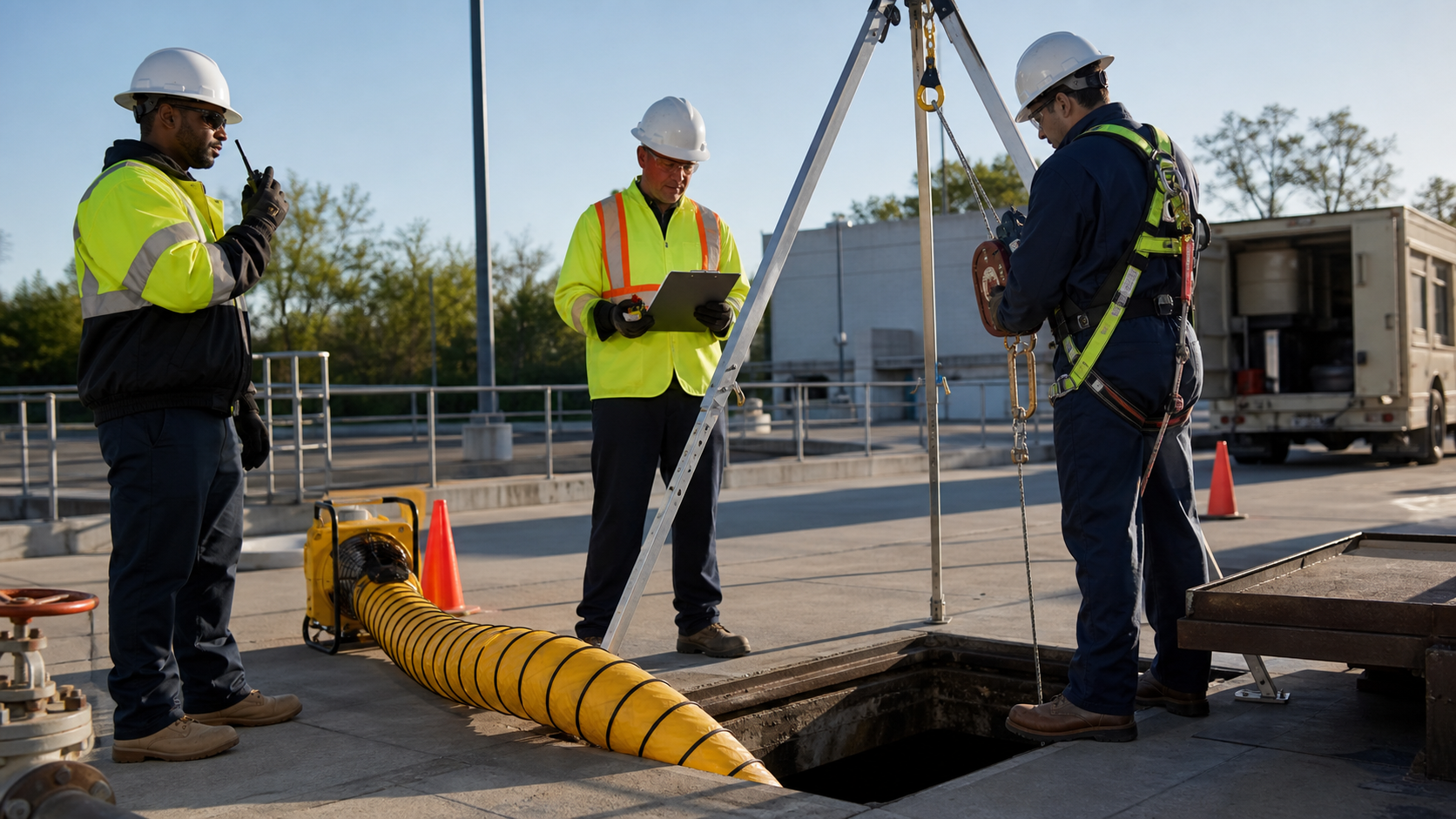
Multiple roles are not automatically prohibited. In construction, an entry supervisor may also serve as an attendant or authorized entrant when that person is trained and equipped for every role performed. The controlling question is whether all required duties can actually be performed. An attendant, for example, must remain outside until properly relieved and must not perform other duties that interfere with assessing and protecting entrants. A person cannot act as the active attendant from inside the space. An entry supervisor who intends to enter must ensure that someone else is providing uninterrupted attendant coverage when the program and conditions require it.
Timing matters as much as competence. The same employee might evaluate spaces as the competent person during preplanning, review the permit as entry supervisor before entry, then hand supervisory or attendant duties to another qualified person before becoming an entrant. That sequence may be possible if the employer's program defines it and every transfer is clear. By contrast, writing several roles beside one name on a permit without explaining when responsibilities transfer can leave no one accountable at the critical moment.
Rescue creates another boundary. The attendant is not an improvised rescue team. Non-entry retrieval should be planned and used when it is feasible and does not increase the entrant's risk. If entry rescue may be needed, the selected service must be capable of responding appropriately to the particular spaces and hazards. Workers who are not assigned and trained for entry rescue need to understand the danger of attempting it. A small crew cannot solve an incomplete rescue plan merely by adding “rescuer” to somebody's list of roles.
Language and comprehension also matter. Training must be delivered in language and vocabulary employees understand. For a bilingual crew, assigning the same video to everyone may not establish proficiency if workers cannot explain the permit, alarms, communications, evacuation commands, or equipment steps in the language used during the job. The employer's matrix should record the training language and the method used to evaluate understanding.
What Employers Should Check
Build the matrix from the work backward. Start with the spaces, hazards, and tasks, then identify the functions that must be covered during each phase of the entry.
- Identify the governing work context. Decide whether the operation falls under general industry requirements, construction requirements, or another applicable standard. Do not choose a course based only on the customer's industry name. Maintenance and construction activities can occur at the same facility, and the actual work can affect the analysis.
- Inventory the spaces. Record tanks, vaults, pits, manholes, crawl spaces, sewers, vessels, and other locations that may meet the confined space definition. For construction work, ensure a competent person has the knowledge and authority needed to identify confined spaces and permit spaces.
- Define the entry team for each job. Name the authorized entrants, attendant, entry supervisor, atmospheric tester, and rescue resource. If one employee will fill different roles, show the sequence and the handoff point. Avoid a general note such as “foreman covers all roles.”
- Test for duty conflicts. Ask where each person must physically be, what that person must observe, and what actions must remain available. If the attendant is completing paperwork, operating unrelated equipment, directing traffic, or supervising other production work, determine whether those tasks could interfere with entrant protection.
- Match training to each duty. Awareness-level education may help employees recognize confined spaces and respect access controls, but it is not the same as preparation for permit entry duties. Entrants, attendants, supervisors, competent persons, atmospheric testers, and rescue personnel require training appropriate to their assignments.
- Separate education from authorization. Record who completed a course, who was evaluated on site-specific procedures and equipment, and who the employer has formally authorized to perform each role. These are related controls, but they are not interchangeable.
- Verify equipment proficiency. Confirm that assigned workers can inspect and use monitors, ventilation, communications, barriers, harnesses, retrieval equipment, and other controls required by the entry. Include calibration or bump-test procedures where they apply to the selected instrument and manufacturer instructions.
- Plan relief coverage. Identify who takes over if an attendant needs a break, the entry supervisor leaves the area, conditions change, or the job extends beyond the planned shift. A role transfer should be explicit, communicated, and documented.
- Coordinate employers. On multi-employer construction sites, record which organization is the host employer, controlling contractor, and entry employer as applicable. Exchange known hazard and prior-entry information, coordinate simultaneous work, and communicate the results of the entry as required by the project arrangement and applicable rules.
- Confirm rescue before authorization. Identify the rescue method, equipment, communication route, response expectations, and access needs for the actual space. Verify that the plan fits the opening, depth, internal configuration, entrant PPE, and credible hazards.
- Document training and changes. Maintain records that connect employee names, training content, trainer information, dates, assigned duties, and proficiency checks. Update the matrix when assignments, hazards, equipment, procedures, or work locations change.
A useful matrix can be simple. Put employee names in rows and functions in columns. Mark awareness, competent person, entrant, attendant, entry supervisor, atmospheric testing, non-entry retrieval, and entry rescue as separate functions. Add columns for course completion date, site-specific briefing, hands-on evaluation, employer authorization, language, refresher trigger, and current status. The result should answer “Who can do this job today, with this equipment, under this procedure?” rather than merely “Who watched the training?”
Which Training Fits This Situation
Confined Space Awareness training fits employees who need to recognize confined spaces, understand basic hazards, follow signs and access controls, or support work near spaces without being assigned permit-entry duties. It can also help managers and buyers understand the vocabulary used in a program. Awareness training alone should not be treated as role qualification for an entrant, attendant, or entry supervisor.
Permit-Required Confined Space Entry training is the logical path for employees who will participate directly in permit entries. Buyers should confirm that the training addresses the role-specific knowledge relevant to authorized entrants and attendants, permit procedures, atmospheric hazards, communications, evacuation, equipment, and rescue awareness. The employer still needs to add its own spaces, hazards, program, permit, equipment, and hands-on practice.
Confined Space Supervisor training fits people expected to verify entry conditions, review permits, authorize entry, terminate entry, coordinate roles, and make operational decisions. It is especially useful for foremen and EHS leads who may supervise several entry teams. If a supervisor will also act as an attendant or entrant, the training plan should include those duties and the employer should evaluate proficiency for each assignment.
Confined Space Competent Person training fits construction personnel assigned to identify confined spaces and determine which are permit spaces. This responsibility is not simply another name for entry supervisor. One employee may be assigned both functions, but the employer should document the knowledge, capability, and authority associated with each one.
For a small crew with overlapping assignments, a multi-role plan is usually the clearest choice. A practical sequence may include Awareness for employees who only encounter or work near spaces, Permit-Required Entry training for entry-team members, Supervisor training for those authorizing operations, and Competent Person training for construction-site evaluators. Add site-specific instruction, equipment practice, rescue coordination, and documented employer authorization after the online or classroom portion.
Course selection should follow assigned duties, not the desire to minimize course count. Buying the broadest-sounding course for every employee can still leave role gaps if the employer never defines responsibilities or validates practical skill. Conversely, buying only Awareness because everyone has seen confined spaces before can leave workers unprepared for permit duties. The better question is which combination gives each employee the knowledge required for the work the employer will actually assign.
Common Mistakes to Avoid
- Using one generic “confined space trained” label for every employee without identifying entrant, attendant, entry supervisor, competent person, testing, or rescue duties.
- Assuming a management title automatically makes someone an entry supervisor or competent person.
- Assigning an attendant production, traffic-control, paperwork, or equipment duties that can interfere with continuous entrant protection.
- Allowing the active attendant to enter the space before another qualified attendant has formally relieved that person.
- Treating a certificate of completion as employer authorization or proof that the worker can use the site's monitor, ventilation, communications, harness, and retrieval system.
- Failing to retrain when duties change, a new hazard appears, procedures change, or performance shows a knowledge gap.
- Listing a local fire department or outside rescue provider without evaluating whether it can perform the required rescue for the actual space and conditions.
- Assuming a retrieval tripod automatically makes every rescue non-entry, without checking entanglement, internal obstructions, opening size, vertical distance, and whether retrieval could increase risk.
- Confusing the construction competent person evaluation with entry-supervisor authorization.
- Ignoring language, literacy, or communication needs when assigning workers to safety-critical roles.
- Failing to document role handoffs when one employee changes from supervisor or attendant to entrant.
- Reusing the same staffing plan for every vault, tank, pit, or manhole even when hazards, access, configuration, or contractor activity differ.
- Treating online training as a substitute for the employer's written program, site-specific instruction, equipment practice, rescue planning, and performance evaluation.
Next Step
Choose one representative confined space job and map it from pre-entry evaluation through permit cancellation. Write every required function beside the phase when it must be active, then place employee names against those functions. Any blank cell is a staffing or training gap. Any name appearing in simultaneous, conflicting functions needs a relief plan or an additional qualified worker.
Then review the confined-space.com course path by duty. Use Awareness for recognition-level needs, Permit-Required Entry for active entry-team responsibilities, Supervisor training for entry authorization and oversight, and Competent Person training for construction-site identification and classification duties. Complete the plan with employer-specific procedures, hands-on equipment practice, rescue arrangements, proficiency checks, and written authorizations. That combination creates a defensible training matrix and, more importantly, a crew structure that can perform every critical duty when the entry begins.
Ready to Get Your Crew Confined Space Certified?
Explore our OSHA-aligned online courses for Awareness, Permit-Required Entry, Supervisor, and Competent Person roles with instant certification.
Explore Courses & Pricing