Employees who enter, attend, supervise, test, and rescue often see confined space program weaknesses before those gaps appear during a formal audit. A sound review process gives affected employees and their authorized representatives a practical way to contribute to program development and implementation while preserving the employer's responsibility for safe entry operations.
Employee participation is not a suggestion box added after procedures are finished. Under OSHA's general industry permit-required confined space standard, employers must consult affected employees and their authorized representatives on the development and implementation of all aspects of the required permit space program. Required information must also be made available to them. Construction employers should separately evaluate the applicable requirements in 29 CFR 1926 Subpart AA and any other rules that cover their work.
Who This Affects
This issue affects employers with permit spaces such as tanks, vaults, pits, vessels, silos, process equipment, manholes, wet wells, and similar spaces. It is especially relevant where entries repeat, crews rotate, contractors participate, conditions change, or program reviews rely heavily on completed forms without structured worker input.
Authorized entrants can describe visibility, movement, heat, noise, tool use, obstructions, communication quality, and changes that occur after entry begins. Attendants can identify accountability problems, alarm confusion, interruptions, and competing duties. Entry supervisors see whether permits, isolation, testing, rescue readiness, and handoffs align at the point of authorization. Instrument users can report sampling limitations and equipment behavior. Rescue personnel can identify access, rigging, patient packaging, and response-time constraints.
Maintenance planners, safety staff, industrial hygiene personnel, operations staff, and host-employer representatives also contribute important information. Employees who do not enter may still be affected if they work near openings, isolate equipment, control process energy, issue work orders, or respond to alarms. Authorized representatives may help employees raise recurring concerns and understand how program information is used.
Participation needs to reflect the actual workforce. Night shift, weekend, temporary, multilingual, and contractor crews can experience different conditions from the team that attends daytime planning meetings. If only one group is heard, the review may miss problems in staffing, access, supervision, communication, or rescue coverage during other operating periods.
The Confined Space Compliance Issue
A permit space program is implemented through people. Written procedures may specify isolation, atmospheric testing, ventilation, communication, rescue, permits, and role duties, but employees can reveal whether those controls function under real conditions. Their input is particularly important when an unauthorized entry occurs, a prohibited condition is detected, a near miss happens, a space changes, or employees question the program's effectiveness.
OSHA's general industry standard requires employers to review entry operations when there is reason to believe program measures may not protect employees and to correct deficiencies before subsequent entries are authorized. It also requires an annual program review using canceled permits when entries occurred during the prior 12 months. Employee participation can improve both immediate event reviews and periodic program reviews by adding operational facts that forms alone may not capture.
Participation does not mean the employer delegates decisions or asks employees to approve unsafe conditions. The employer remains responsible for hazard evaluation, program design, training, equipment, supervision, rescue arrangements, and compliance. The purpose is to obtain and use informed input from people whose work is governed by the program.
Information access supports meaningful participation. Employees cannot evaluate a procedure they have not seen or discuss a hazard inventory that is unavailable. Employers should make required program information accessible in a usable form while protecting genuinely sensitive information through appropriate controls. Access methods should work for the location and shift, not only for staff at a central office.
A reliable process also separates participation from retaliation or production pressure. Workers need a clear way to report problems, ask for clarification, stop or exit when conditions require it, and participate in reviews without being discouraged. Supervisors should treat a concern as operational data to evaluate, not as disloyalty or delay.
What Employers Should Check
Start by mapping when employee input enters the program. Useful points include space evaluation, procedure development, pre-entry planning, permit briefings, post-entry closeout, incident review, rescue drills, equipment selection, training evaluation, and the annual program review. If participation occurs only after an incident, the process is too narrow.
Ask role-specific questions
Generic questions such as "Any concerns?" often produce silence. Ask entrants whether the work position affected monitor placement, whether ventilation reached the breathing zone, and whether lines or tools restricted movement. Ask attendants whether they could continuously track entrants and communicate without distraction. Ask supervisors which permit items were hard to verify. Ask rescue personnel whether access and retrieval arrangements matched the space.
Compare input with permits and field conditions
Review comments alongside canceled permits, test records, alarms, equipment logs, work orders, and corrective actions. A repeated note about poor radio reception may connect to permit entries that show communication checks but no details. A recurring complaint about heat may indicate a need to revisit work duration, ventilation, monitoring, or scheduling. The value comes from connecting observations to decisions.
Include changes and unusual events
Capture input after changes in space configuration, process materials, isolation points, ventilation, equipment, staffing, rescue services, or work scope. Review evacuations, prohibited conditions, unexpected readings, near misses, unauthorized entry, and equipment failures. The next entry should not proceed under an unchanged procedure if new information shows a gap.
Track responses and closure
Employees should be able to see that a concern was evaluated and understand the result. A simple log can identify the issue, source, date, affected space or procedure, interim control, owner, final action, and communication back to the workforce. If no change is made, record the factual basis and explain it clearly. An unanswered concern is likely to reappear.
Test whether access is practical
Check whether employees can obtain the current program, permits, hazard information, and relevant procedures on their shift and at the work location. Confirm that language, literacy, format, and technology do not create unnecessary barriers. Access should support questions and preparation before entry, not merely prove that a document exists.
Evaluate participation across employers
When a host employer and contractors are involved, clarify how hazard information, prior experience, entry procedures, and debrief findings move between organizations. Each employer retains its own duties. A shared meeting can improve coordination, but it should not blur who authorizes entry, supplies equipment, provides rescue arrangements, or closes corrective actions.
Which Training Fits This Situation
Training should match assigned duties and the program employees will use. Authorized entrants need to understand space hazards, controls, equipment, communication, warning signs, and exit requirements. Attendants need focused instruction on monitoring entrants, maintaining accountability, communicating, summoning rescue, controlling unauthorized entry, and avoiding conflicting duties. Entry supervisors need preparation to verify permit conditions, equipment, services, isolation, and role readiness before authorizing entry.
Awareness training can help employees who work near permit spaces recognize signs, restrictions, and reporting routes without preparing them to perform entry roles. Permit-required confined space courses can support knowledge for entrants, attendants, and supervisors, but course completion alone does not authorize entry. Employers must provide site-specific information, role assignments, practical instruction, equipment training, and evaluation appropriate to the hazards and procedures.
Training should also teach employees how to participate. Workers need to know where program information is located, how to raise a concern, what details make a report useful, when to exit or stop work, and how corrective actions are communicated. Supervisors need practice asking open, role-specific questions and responding without dismissing the person who identifies a problem.
Online confined space courses at confined-space.com can support the knowledge portion of an employer's training plan for awareness, entrant, attendant, or supervisor responsibilities. Employers should select the course that fits the actual role and applicable industry, then add site-specific instruction and hands-on evaluation. A certificate of completion documents training activity; it does not by itself demonstrate that an employee can safely perform every assigned duty.
Refresher or supplemental training may be appropriate when duties change, a new hazard is introduced, performance shows inadequacies, or the employer identifies a program gap. Employee participation can help identify these triggers. The response should target the deficiency instead of automatically repeating unrelated material.
Common Mistakes to Avoid
Treating a signature as participation
A sign-in sheet shows attendance, not consultation. Participation requires a real opportunity to offer information, ask questions, and influence how the program is developed or implemented.
Asking only supervisors
Supervisors have valuable information, but entrants and attendants experience different parts of the entry. Include each affected role and the shifts that perform the work.
Waiting for the annual review
Immediate concerns should be evaluated before the next entry when they suggest existing measures may not protect employees. Do not store urgent feedback for a year-end meeting.
Collecting input without closing actions
A recurring issue log that never shows resolution undermines trust and leaves risk in place. Assign owners, deadlines, interim measures, and verification.
Using employee input to transfer responsibility
Workers can inform the program, but the employer remains responsible for hazard evaluation, controls, training, equipment, supervision, and rescue arrangements.
Limiting access to one device or office
Program information that is technically available but inaccessible to field or night crews does not support useful participation. Choose practical access methods.
Treating complaints as a performance problem
Employee concerns may be evidence that the program needs review. Investigate the condition and the procedure before assuming the worker simply needs discipline or retraining.
Next Step
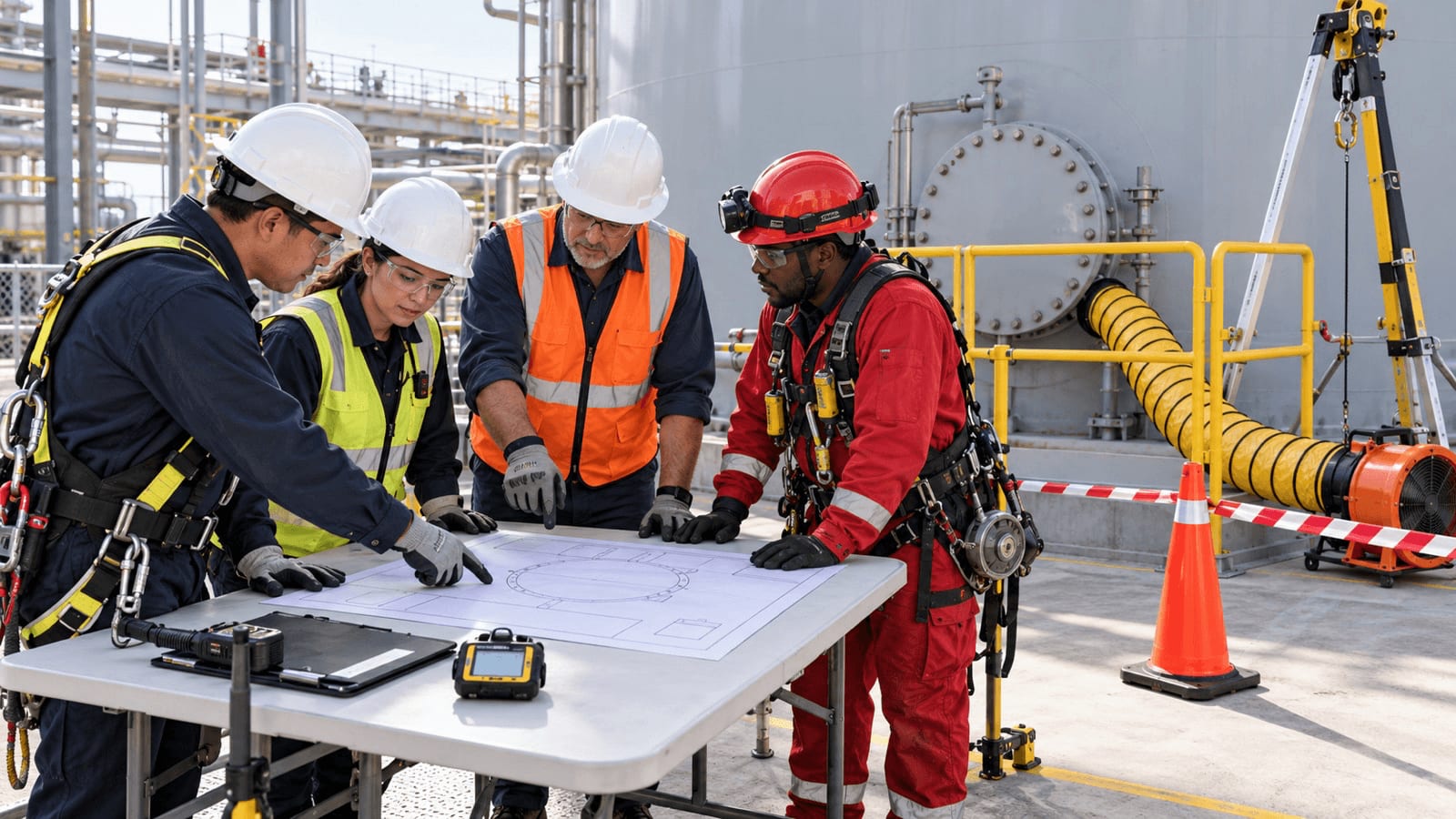
Choose one frequently entered permit space and review the last several canceled permits with a small group representing entrants, attendants, entry supervisors, testing personnel, and rescue support. Walk through the entry sequence and ask what was difficult, different, or unclear. Compare their observations with permits, alarms, work orders, and corrective actions.
Then update one concrete part of the program, such as a permit question, communication check, ventilation setup, briefing method, rescue coordination step, or reporting route. Assign an owner and verify the change during the next planned entry. Tell participating employees what was decided and why.
Employee participation works best as a normal operating practice rather than a once-a-year meeting. When employers combine field observations with permit records, incident information, and competent program review, they can identify weaknesses earlier and make training and procedures more relevant to the actual spaces and crews.