Unauthorized entry can disrupt a permit-space operation in seconds, so employers need physical controls, clear roles, and practiced responses at every portal. A curious employee, contractor, visitor, or would-be rescuer may not understand that crossing the opening is entry or that the space contains atmospheric, mechanical, engulfment, or configuration hazards.
This is more than a sign-placement issue. Effective control begins with identifying permit spaces, informing exposed employees, limiting access, and designing the entry setup so only authorized entrants can approach the portal. During the job, attendants and entry supervisors need workable procedures for warning people away, stopping an intrusion, protecting authorized entrants, and reviewing the permit-space program if an unauthorized entry occurs.
Who This Affects
Employers with tanks, vaults, pits, vessels, silos, bins, sewers, process equipment, and similar spaces may face unauthorized-entry risk. The concern is not limited to large industrial plants. Municipal facilities, utilities, food production sites, warehouses, maintenance shops, commercial buildings, water and wastewater operations, and manufacturing plants may all have spaces that attract attention during cleaning, inspection, repair, or shutdown work.
Authorized entrants, attendants, and entry supervisors are directly affected because an unauthorized person can interfere with monitoring and communication or create a new emergency. Maintenance planners and operations leaders are affected because normal traffic routes, deliveries, and production activity may pass near the portal. Security teams, host employers, contractors, and rescue providers need to understand how the boundary will be controlled without confusing access control with rescue capability.
Employees who are not assigned to the entry also need information appropriate to their exposure. They should know which spaces are permit-required, what signs and barriers mean, why they must not cross the boundary, and whom to contact if they see a problem. A person does not need entrant-level training to follow a facility rule, but the rule must be visible, understandable, and consistently enforced.
Visitors and subcontractors deserve deliberate planning. They may not recognize a permit-space sign, may follow a hose or cable toward an opening, or may assume a worker at the portal has invited them closer. Orientation, escorts, temporary route changes, and contractor coordination can prevent those assumptions from becoming an entry.
The Confined Space Compliance Issue
OSHA's general industry permit-required confined space standard requires employers to evaluate the workplace, identify permit spaces, and inform exposed employees of their existence, location, and danger. If employees will enter, the employer must develop and implement a written permit-space program. That program includes measures needed to prevent unauthorized entry and to control entry operations.
The definition of entry is important. Entry is considered to occur as soon as any part of a person's body breaks the plane of an opening. Someone does not have to climb fully into a tank or descend to the floor of a vault. Leaning through a hatch to look, reaching inside to retrieve an object, or placing the head and shoulders past a portal can meet the definition.
During an active entry, the attendant has specific duties when unauthorized persons approach or enter. The attendant must warn them to stay away, tell them to exit immediately if they have entered, and inform the authorized entrants and entry supervisor if an unauthorized person enters. The entry supervisor also has a duty to remove unauthorized individuals who enter or attempt to enter during entry operations.
An unauthorized entry is also a program-review trigger. OSHA identifies it as an example of a circumstance giving the employer reason to believe existing measures may not protect employees. The employer should review the operation and revise the program to correct deficiencies before subsequent entries are authorized. Treating the event only as an individual conduct problem can miss a weak barrier, poor route plan, unclear sign, inattentive assignment, or conflicting work activity.
Requirements can differ for construction work and other industries, and a site may be subject to additional owner, state, or local rules. Employers should determine which standard applies to the work and coordinate responsibilities among controlling contractors, host employers, and entry employers where construction provisions apply. Training should reflect the applicable program rather than mixing terms from different procedures.
What Employers Should Check
Start with the inventory. Confirm that each permit space is identified accurately and that signs or another equally effective means communicate the danger to exposed employees. The information should match the location that workers actually see. A facility map is useful, but it does not replace a clear indication at a remote hatch, roof access point, pit, or temporary opening.
Review normal access when no entry is underway. Hatches, doors, covers, gates, locks, railings, and controlled keys should prevent casual entry consistent with the space and operational needs. A cover that must remain open for ventilation or process work may require a guarded boundary. A fixed ladder beside a public route may require stronger administrative and physical controls than a locked vessel inside a restricted room.
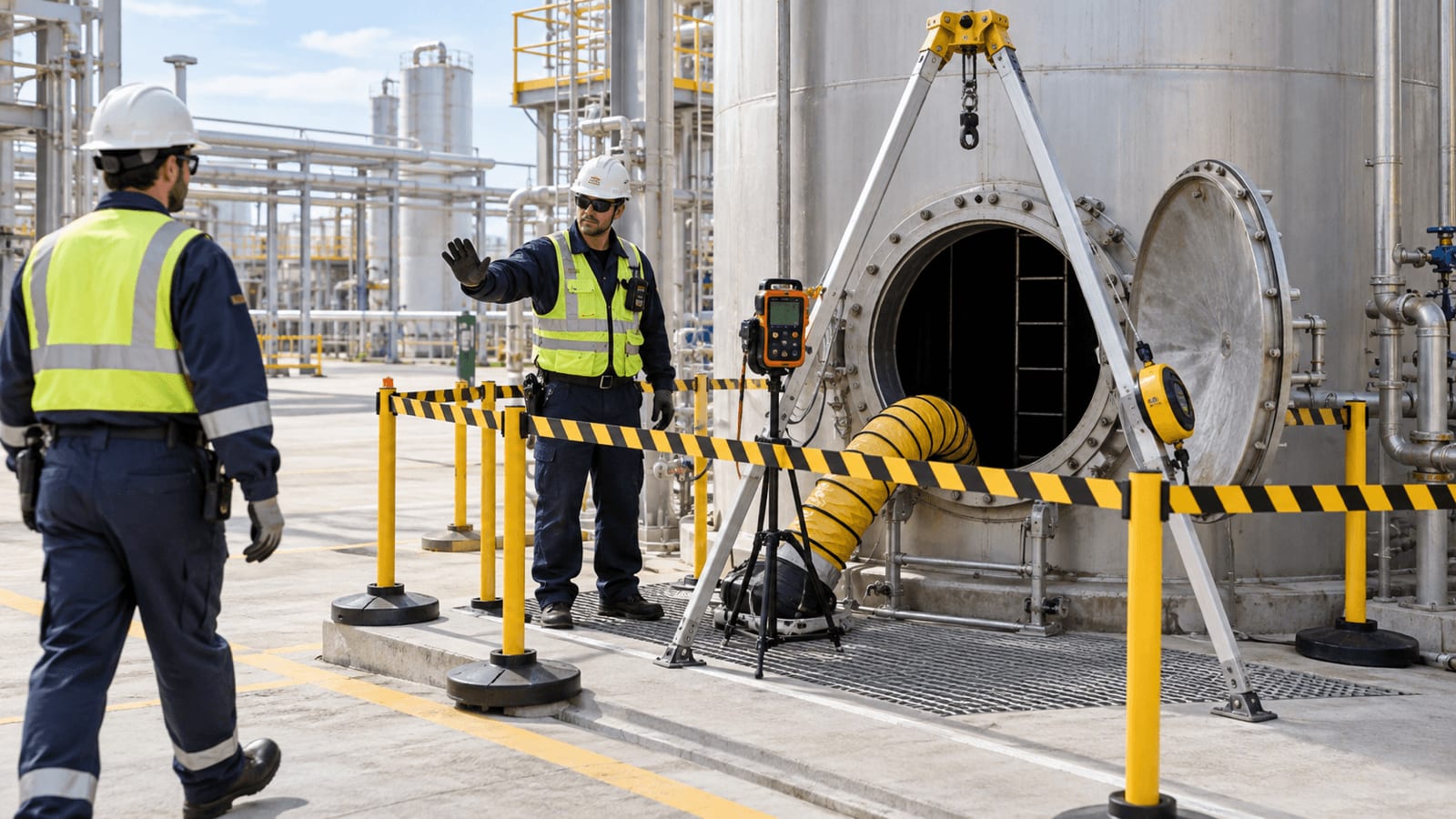
For each planned entry, draw the work zone around the portal. Include the attendant's position, retrieval equipment, ventilation duct, monitor lines, tools, staging area, and route for authorized entrants. Then map normal pedestrian, vehicle, and contractor traffic. The boundary should keep unrelated people from walking into cables, interrupting the attendant, or reaching the opening while still leaving rescue access usable.
Barrier choice should match the setting. Cones alone may be too easy to pass in a busy maintenance area. Tape can communicate a boundary but may not stop a person or protect an opening. Rigid rails, gates, portable panels, closed doors, or controlled access points may be appropriate depending on the hazard. A facility should not assume one setup works equally well for every tank, vault, and pit.
Check the attendant's workload. The attendant must remain outside the permit space and perform the required monitoring and protection duties. Duties that draw attention away from the portal, require leaving the position, or create a conflict should be reassigned. If one attendant monitors more than one space, the employer must ensure the arrangement allows all duties to be performed effectively and that the response plan addresses simultaneous demands.
Confirm communication methods. Authorized entrants need to know how the attendant will notify them if an unauthorized person enters or if the outside condition becomes unsafe. The entry supervisor needs a reliable way to respond promptly. Radios, wired communication, hand signals, alarms, and face-to-face methods should be tested under actual noise, distance, and personal protective equipment conditions.
Plan for predictable approach scenarios. A mechanic may need a tool stored beyond the boundary. A supervisor may arrive to observe. A delivery driver may follow the usual aisle. A coworker may try to help during an alarm. Decide in advance who stops the person, how authorized entrants are notified, when entry is terminated, and how security or management is summoned if the person does not comply.
Rescue controls deserve special attention because unplanned would-be rescue attempts can multiply casualties. The program should prevent unauthorized personnel from attempting rescue and should identify how trained rescue services are summoned. Barriers and messages should not obstruct the authorized rescue team's access. Employees should understand that calling for help and following the plan is active assistance, while impulsive entry can create another victim.
Which Training Fits This Situation
General awareness training fits employees who work near permit spaces but are not assigned to enter. It should cover recognition, posted warnings, the meaning of the controlled boundary, the definition of entry, prohibited actions, and reporting. Short site examples help people understand that reaching through an opening can count as entry.
Permit-required confined space training fits authorized entrants, attendants, and entry supervisors. It should address the hazards of the specific spaces, permit system, testing, ventilation, isolation, communication, entry conditions, exit triggers, rescue arrangements, and role duties. Attendants should practice the exact response to an approaching or entering unauthorized person without abandoning their primary duty to protect entrants.
Entry supervisors need practice evaluating the entire setup, not just signing the permit. A useful exercise asks the supervisor to inspect barriers, traffic routes, attendant position, communications, rescue access, and visitor controls before authorizing entry. The supervisor should be able to explain what event would require cancellation and what conditions must be corrected before a new permit is issued.
Contractor coordination training fits sites where multiple employers share the area. Host and entry employers should exchange hazard and procedure information, coordinate simultaneous work, and debrief the entry as required by the applicable standard. Site orientation should tell non-entry contractors how the permit-space boundary affects their route and whom to contact for access.
Training should include an unauthorized-entry drill. Use a controlled scenario in which a worker approaches the boundary, ignores the first warning, or crosses the portal plane. Evaluate whether the attendant gives the required warnings, alerts entrants and the supervisor, preserves communication, and initiates site procedures. Follow with a review of the physical and administrative controls, not just the individual's words.
Confined-space courses can support awareness, entrant, attendant, supervisor, and competent-person knowledge, depending on the work. The employer must still provide site-specific instruction, assign qualified people, maintain the written program, and verify that employees can perform their duties. A certificate of completion does not replace authorization for a particular entry.
Common Mistakes to Avoid
The first mistake is relying on a sign alone. A sign communicates danger, but an active entry beside a busy aisle may need physical separation, traffic control, and an attentive attendant. The setup should account for how people really move through the area.
Another mistake is placing the barrier so close to the portal that a person has already entered the hazard zone before encountering it. The boundary should provide time and space for warning and redirection. It should also prevent people from tripping over hoses, cables, and retrieval lines.
Employers sometimes give the attendant extra duties such as issuing tools, completing unrelated paperwork, directing deliveries, or monitoring production. Those tasks can make an approaching person easy to miss. If a duty could interfere with monitoring and protecting entrants, it should be assigned elsewhere.
A fourth mistake is treating every unexpected person as a security issue but not an entry-safety issue. Even if the person leaves immediately, crossing the opening should prompt notification, permit decisions, documentation, and a program review. The event may reveal a control weakness that will recur on the next shift.
Another mistake is allowing supervisors, managers, or inspectors to cross the boundary without being added to the permit process. Job title does not create entry authorization. Anyone who enters must meet the program requirements, be accounted for, understand the hazards, and use the required equipment and procedures.
Finally, do not confuse access restrictions with a rescue plan. Locking a hatch or surrounding a portal with barricades may reduce unauthorized approach, but the employer still needs appropriate rescue procedures, available services, operable summons, and retrieval systems where required. One control cannot stand in for the whole program.
Next Step
Select one frequently used permit space and observe the area during a realistic entry setup. Track how employees, contractors, tools, vehicles, and supervisors approach the portal. Check whether the warning and physical controls stop a person before the entry plane, whether the attendant can maintain full attention, and whether rescue access remains clear.
Use the findings to update the pre-entry checklist and site-specific training. Assign who installs the boundary, who verifies it, how traffic is redirected, what the attendant says, and what happens after an intrusion. If an unauthorized entry has already occurred, review the permit-space program and correct the deficiency before authorizing the next entry.
Sources
Occupational Safety and Health Administration, 29 CFR 1910.146 Permit-Required Confined Spaces, https://www.osha.gov/laws-regs/regulations/standardnumber/1910/1910.146
Occupational Safety and Health Administration, Permit-Required Confined Spaces QuickCard, https://www.osha.gov/sites/default/files/publications/CONFINED_SPACE_PERMIT.pdf
Occupational Safety and Health Administration, 29 CFR 1926 Subpart AA Confined Spaces in Construction, https://www.osha.gov/laws-regs/regulations/standardnumber/1926/1926SubpartAA