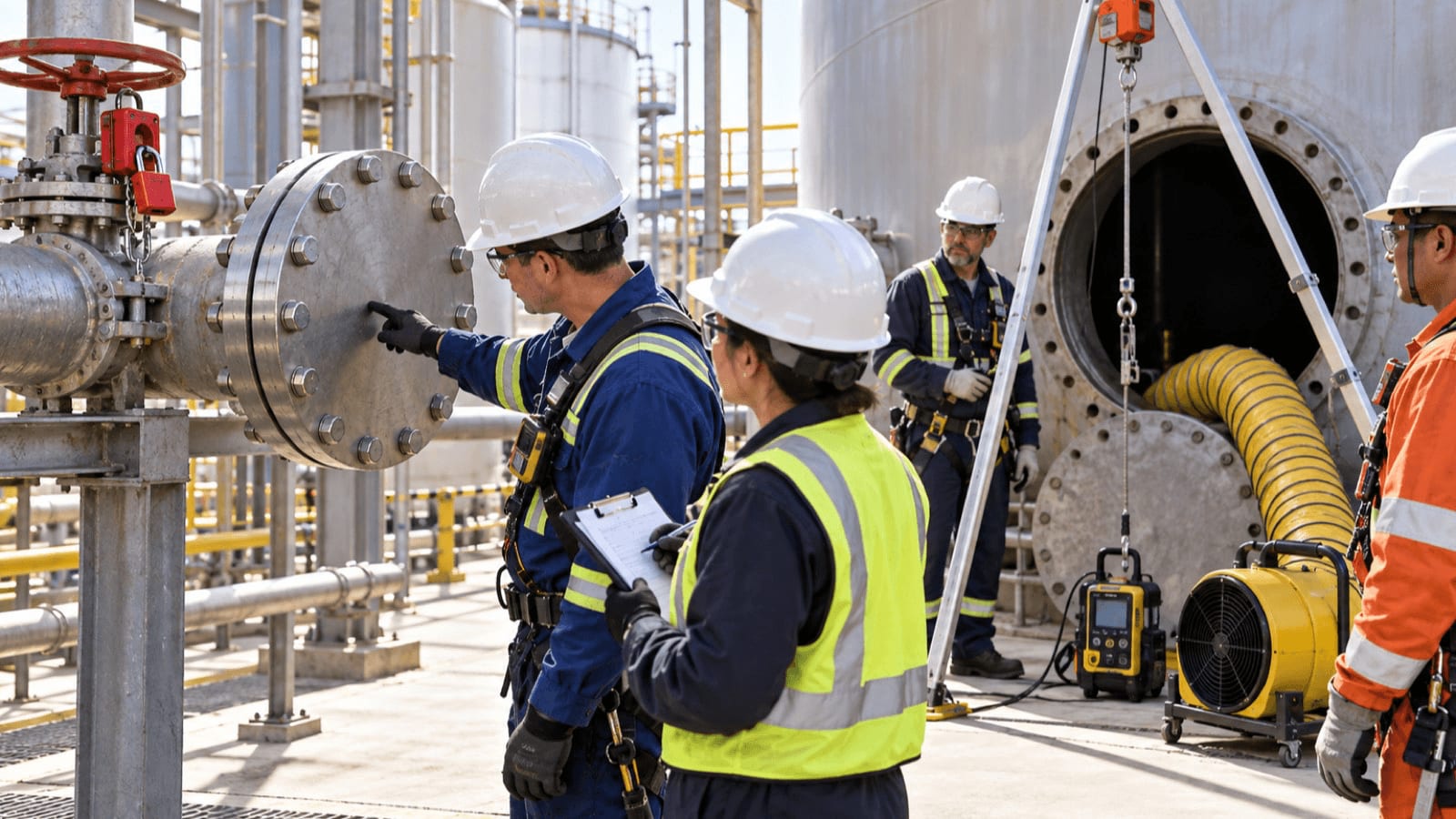
Before a worker crosses a permit-space opening, the entry team must verify that connected lines cannot release energy or material into the space.
Tanks, vessels, pits, and process equipment often remain connected to piping after production stops. Closing a valve may look like isolation, but valve position alone does not always establish that the space is protected from pressure, flow, heat, chemicals, steam, inert gas, or product. The entry plan must identify each connection, select an appropriate isolation method, apply the method correctly, and verify it before entry begins.
Line breaking adds another layer of risk because the work intentionally opens a pipe, line, or duct that has carried material capable of causing injury. The hazards can include residual pressure, trapped liquid, corrosive chemicals, flammable vapor, toxic material, hot product, or an oxygen-displacing gas. A permit and an atmospheric reading do not neutralize those sources. Isolation has to be addressed as a physical control and documented in the entry process.
Who This Affects
This issue affects facility owners, host employers, maintenance departments, operations teams, contractors, entry employers, entry supervisors, attendants, authorized entrants, and rescue services. It is especially relevant during shutdowns, tank cleaning, internal inspection, agitator maintenance, exchanger work, sewer or process-vessel access, and jobs that involve disconnecting piping before or during entry.
The applicable requirements depend on the industry and work. OSHA's general-industry permit-space rule is 29 CFR 1910.146. Construction work in confined spaces is generally addressed under 29 CFR 1926 Subpart AA. Employers should determine which standard applies to the task, coordinate information among employers at multi-employer sites, and follow any additional state-plan, permit, process-safety, lockout, or facility requirements.
Operations personnel also play a critical role even when they do not enter. They often know the process flow, valve lineup, cleaning history, and possible cross-connections. Their information should be combined with current drawings and a field walk. The entry supervisor still has to verify that permit conditions are satisfied rather than relying only on a control-room status or verbal assurance.
The Confined Space Compliance Issue
OSHA defines isolation for general-industry permit spaces as the process of removing the space from service and completely protecting it against the release of energy and material. Listed methods include blanking or blinding; misaligning or removing sections of lines, pipes, or ducts; a double-block-and-bleed system; lockout or tagout of all energy sources; and blocking or disconnecting mechanical linkages.
Those methods are not interchangeable labels. A blank or blind is a solid plate fastened to close the bore and withstand the maximum pressure without leakage beyond the plate. Double block and bleed uses two closed and locked or tagged inline valves with an open and locked or tagged drain or vent between them. Removing a spool or misaligning a line creates a visible physical separation. The employer must choose a method suited to the source and the applicable rule.
Line breaking is defined separately because intentionally opening a system can expose workers before entry even starts. The line may contain material remaining between valves, in low points, behind deposits, or in connected branches. Draining, venting, purging, flushing, depressurizing, and testing may be necessary parts of preparation, but they should not be confused with the final isolation barrier.
Atmospheric testing does not replace isolation
Pre-entry testing answers what is in the atmosphere at the time and location tested. It does not prove that a connected process line cannot introduce a hazard later. A space can test within acceptable conditions and then change quickly if a valve leaks, a pump starts, a line is opened elsewhere, or product drains from an overlooked branch. The entry program should treat testing and isolation as complementary controls.
Permit language must describe the actual condition
A permit entry labeled "locked out" is incomplete if it does not show which sources were addressed, where isolating devices are located, and how their status was verified. Clear entries help the supervisor, attendant, entrant, and rescue planners understand the configuration. They also make shift changes and permit closeout more reliable.
What Employers Should Check
Start with the space and every possible path into it. Compare process drawings, piping and instrumentation diagrams, equipment records, and field conditions. Walk down nozzles, drains, vents, jackets, bypasses, sample lines, recirculation lines, overflow paths, and temporary hoses. Mark connections that are inactive, abandoned, or difficult to trace so the team does not assume that an old line is harmless.
Confirm the isolation method for each source
Document whether each source will be blanked, blinded, disconnected, misaligned, controlled by double block and bleed, locked or tagged, or otherwise isolated under the applicable procedure. Check ratings, materials, pressure and temperature capability, valve arrangement, drain or vent routing, and the possibility of backflow. When the method depends on site-specific engineering or process knowledge, involve qualified personnel.
Control stored and residual energy
Before line breaking, reduce pressure and temperature using an established procedure. Drain or recover liquids to an appropriate system, vent to a safe location, and verify that trapped pressure is relieved. Consider plugged drains, crystallized product, sludge, scale, frozen material, and low points. Workers performing the break may need task-specific PPE and positioning because the absence of gauge pressure does not guarantee that the line is empty.
Verify devices in the field
The entry supervisor should not approve the permit from paperwork alone. Confirm lock and tag placement, blank or blind installation, removed spool gaps, open bleed points, blocked linkages, and the identity of each controlled source. Use a documented independent check where the consequence of error is high. The verifier should understand what correct installation looks like and should be able to trace it back to the permit.
Test and monitor the space
After isolation and preparation, evaluate the space under the applicable standard. Test for atmospheric hazards in the required order and at representative locations. Continue monitoring as necessary to confirm acceptable entry conditions. If isolation is infeasible in a large or continuous system, the general-industry rule includes specific provisions for testing to the extent feasible and continuous monitoring where entrants work. That exception should not become a casual substitute for feasible isolation.
Coordinate operations during entry
Protect the isolation boundary from unauthorized changes. Communicate with control-room staff, contractors, and adjacent crews. Address shift changes, emergency operations, lineups for nearby equipment, and the possibility that someone will remove a lock or close a bleed. The attendant should know which external activities could affect entrants and how to initiate evacuation.
Plan restoration and closeout
Restoring equipment can be hazardous if blinds, disconnected lines, tools, or entrants remain in place. The permit closeout and energy-control procedure should verify personnel accountability, space clearance, removal authorization, line restoration sequence, and communication to operations. Do not let the pressure to restart a process compress these steps.
Which Training Fits This Situation
Authorized entrants need training on the hazards they may face, the equipment they use, communication expectations, warning signs, and evacuation requirements. Attendants need training on entrant accountability, outside conditions, communication, evacuation, and prohibited duties. Entry supervisors need deeper preparation on hazard evaluation, permit verification, isolation status, testing, rescue availability, and termination of entry.
Permit-required confined space entry training is a strong fit for teams that will enter spaces with serious hazards or use a permit program. Confined space supervisor training fits people who approve entries and verify that required precautions are in place. Awareness training may help workers recognize spaces and avoid unauthorized entry, but it does not prepare a person to perform an entrant, attendant, or supervisor role.
Courses at confined-space.com can support the knowledge component for those roles. Employers must still provide site-specific instruction on their spaces, chemicals, isolation hardware, energy-control procedures, permits, monitors, communications, rescue arrangements, and contractor coordination. Course completion by itself does not authorize an employee to perform a role.
Practical exercises should include tracing a line, matching an isolating device to a permit, recognizing a hidden bypass, verifying a double-block-and-bleed arrangement, responding to an unexpected pressure indication, and stopping entry when the configuration cannot be confirmed. Supervisors should demonstrate that they can challenge incomplete information rather than simply sign a prepared permit.
Common Mistakes to Avoid
Treating a closed valve as complete isolation
A single closed valve may not meet the selected isolation method, and it can leak, be misidentified, or be moved. Follow the applicable rule and site procedure instead of relying on appearance.
Assuming a zero gauge reading means the line is empty
Gauges can be isolated, damaged, plugged, or located away from trapped material. Verification should consider vents, drains, low points, temperature, and the actual break location.
Leaving small connections off the walkdown
Sample tubing, flush lines, instrument connections, jackets, drains, and temporary hoses can introduce hazardous material or energy. Include every connection in the boundary review.
Using atmospheric testing as proof of mechanical isolation
Testing describes the atmosphere during sampling. It does not prevent a later release. Maintain both atmospheric controls and physical isolation.
Copying the previous permit
Equipment lineups and maintenance scopes change. A copied isolation list can preserve yesterday's error or omit today's connection. Build and verify the permit for the current entry.
Failing to coordinate restoration
Removing locks, blinds, or blocks before confirming that entry is terminated can expose workers. Use a controlled closeout and restart sequence with clear responsibility.
Next Step
Choose one upcoming tank, vessel, pit, or process-space entry and perform a joint field walk before the permit is issued. Trace every connection, identify the isolation method, decide how each condition will be verified, and compare the result with the current permit form. Correct gaps in drawings, labels, procedures, and training before the crew mobilizes.
Then evaluate whether each assigned person is prepared for the actual role. A reliable entry plan combines physical isolation, atmospheric evaluation, competent supervision, trained entrants and attendants, workable rescue arrangements, and disciplined coordination. If the team cannot verify the boundary, entry should wait until the uncertainty is resolved.