
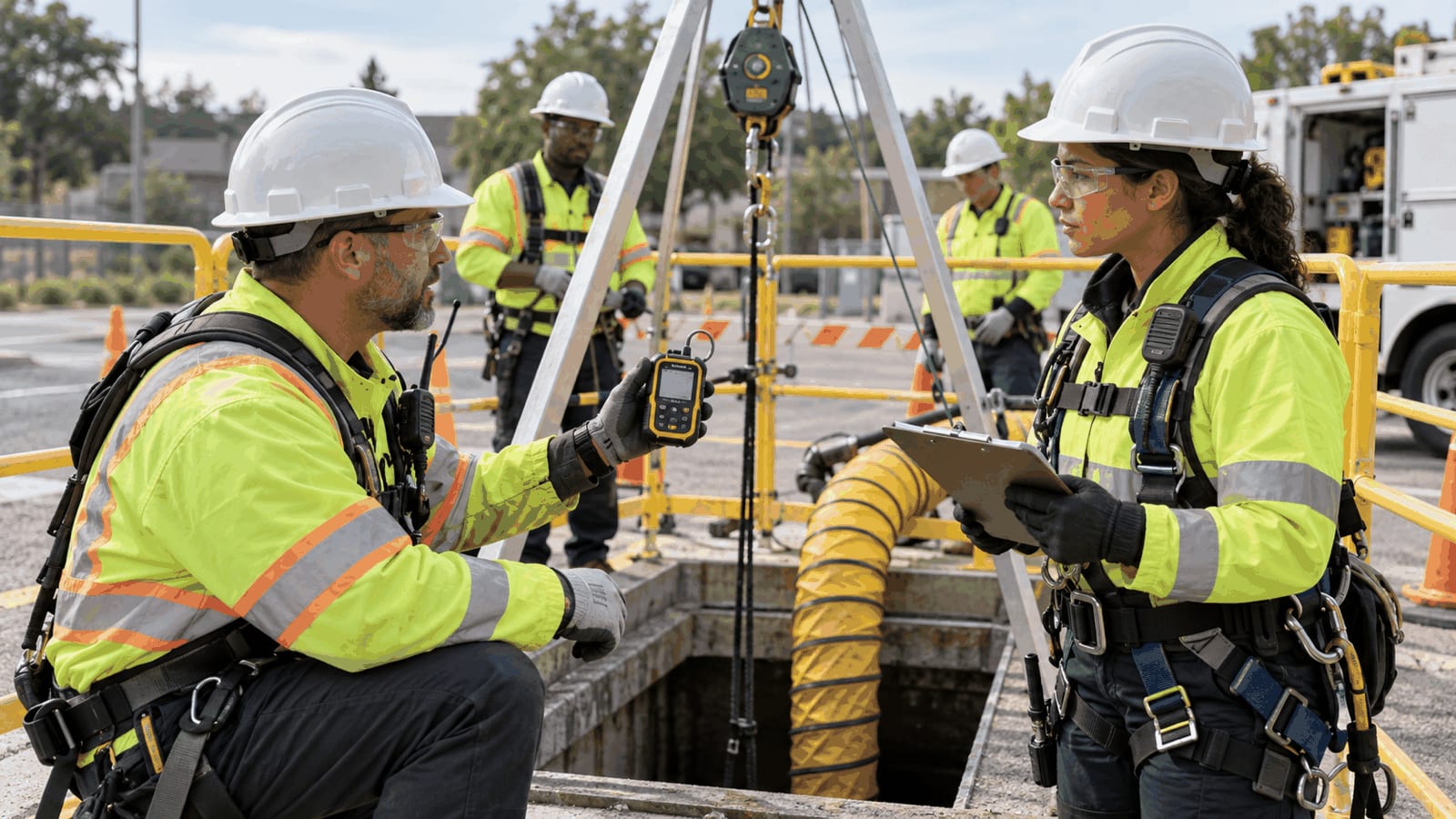
Before confined space work starts, employers should test whether every role can exchange critical information when conditions or responsibilities change. The test should happen before the permit is signed.
A confined space entry plan can contain the right names and equipment while still failing at the handoff between people. A contractor may arrive with a permit, a facility team may control isolation, and an attendant may be assigned minutes before entry. If no one confirms who owns the decision, what the monitor means, how the entrant will communicate, or when the job must stop, the paperwork can create false confidence. Training should prepare each role to transfer information clearly before the first person crosses the opening.
This issue appears in construction, utilities, municipalities, manufacturing, maintenance, tanks, vaults, manholes, pits, and crawl spaces. It is especially important when work crosses employers or shifts. OSHA rules differ by setting, and construction work may implicate 29 CFR 1926 Subpart AA while general industry work may implicate 29 CFR 1910.146. Employers should identify the applicable requirements and use their written program, site evaluation, and qualified technical resources to make the final determination.
Who This Affects
Authorized entrants need a concise explanation of the space, hazards, controls, communication method, and exit triggers. They should know what the atmospheric instrument is measuring, what alarm behavior means, and how to report symptoms, changing conditions, or loss of communication. An entrant is not simply a person who has watched an online module. The entrant must understand the actual task and the limits of the entry plan.
Attendants need a different kind of readiness. They monitor the outside conditions and the entrants, maintain communication, control unauthorized access, summon help, and perform the duties assigned by the employer's program. An attendant who is also expected to perform unrelated work may miss a change or delay an alarm. The handoff should make clear whether the attendant can leave, who relieves the role, and how the relief person receives current information.
Entry supervisors accept responsibility for verifying that acceptable entry conditions exist, authorizing entry, coordinating work, and terminating or suspending entry when required. A competent person may have additional construction duties, such as evaluating hazards and changing conditions. In a multi-employer job, the facility representative, host employer, controlling contractor, entry employer, and rescue service may all need a defined communication path.
Rescue teams and emergency contacts are part of the handoff even when no rescue is expected. The plan should identify who calls, what information is sent, how responders reach the space, and whether non-entry retrieval is feasible. Training should not imply that an untrained coworker should enter to help. A prompt, disciplined alarm and rescue response protects both the original entrant and the would-be rescuer.
The Confined Space Compliance Issue
The central issue is not the title printed on a form. It is whether the employer has evaluated the space and built practices that match the hazards and work. A space can have limited entry and exit, be large enough for a person to enter, and not be designed for continuous occupancy. A permit-required space may also contain or have the potential to contain a hazardous atmosphere, engulfment, an internal configuration that could trap or asphyxiate a person, or another recognized serious hazard.
Atmospheric testing is a process, not a single number captured at the opening. The employer should specify the instruments, calibration and bump-test practices, sampling locations, order of testing, frequency, continuous monitoring needs, alarm response, and recordkeeping. Ventilation can change a condition, but it must be positioned and maintained so it does not introduce a new hazard or give people a reason to ignore an alarm. The entrant, attendant, and supervisor need to understand what the readings mean for the work in progress.
The handoff also includes energy control. Isolation, blanking, blocking, draining, purging, lockout, and verification may be controlled by different people. A person entering should not rely on a verbal statement that a line is closed. The written procedure should show what was isolated, how it was verified, who may change it, and what happens if the condition cannot be maintained.
Construction entries can introduce additional coordination challenges. The space may be changing as excavation proceeds, temporary ventilation is moved, welding or coatings begin, or water enters. The plan should address the construction-specific requirements, the competent person's role, and how a change is communicated to every employer. A permit can be suspended while controls are corrected, rather than carried forward simply because the shift has not ended.
What Employers Should Check
Use a short readiness conversation before the permit is signed and repeat it when roles or conditions change:
- Who is the entry supervisor, attendant, authorized entrant, competent person, and rescue contact for this shift?
- What hazards were identified, and which controls are verified rather than assumed?
- Where will the instrument sample, and who will see the readings?
- What alarm, symptom, communication loss, weather event, equipment failure, or outside activity stops the entry?
- How will the entrant request help, and how will the attendant summon it?
- Who controls isolation and how was zero energy or safe condition verified?
- What equipment is present, inspected, compatible, and ready for use?
- Who relieves the attendant or supervisor, and what information is handed over?
- How will the permit, readings, changes, and closeout be recorded?
The checklist should produce a decision, not merely a signature. If the radio does not work inside the vault, the handoff should identify the replacement communication method before entry. If the rescue team cannot arrive within the time assumed by the plan, the employer should reassess the entry. If ventilation moves or the task introduces a new chemical, the permit and hazard controls should be reviewed.
Post-entry review is another handoff. The supervisor should capture alarms, delays, near misses, changes, equipment issues, and lessons that can improve the next entry. A permit that closes without documenting what changed leaves the next crew to rediscover the same problem. Training records are useful, but the employer should also retain evidence that the program was used and evaluated.
Shift changes deserve the same discipline as the initial briefing. The outgoing attendant should explain current readings, ventilation position, isolation status, entrant location, unusual sounds or odors, equipment condition, and open concerns. The incoming person should repeat the information back and verify the communication method. If the handoff cannot be completed clearly, the entry should pause until the supervisor resolves the gap. This is a simple field practice that makes role training visible in the work.
Which Training Fits This Situation
Awareness training fits workers who need to recognize confined space hazards, stay out of unauthorized spaces, and report concerns. Permit-Required Entry training is more appropriate for entrants and attendants who will work under a written entry procedure. Supervisor training should cover authorization, coordination, permit decisions, atmospheric controls, isolation verification, and termination. Competent Person training may be needed where the construction role includes evaluating hazards and changing conditions.
Many employers need a multi-role plan. The same person may move from entrant to attendant on another job, while a foreman may serve as entry supervisor only occasionally. Map the roles by task rather than by job title, then assign training, practice, equipment familiarity, and authorization to each role. An online course can provide a consistent knowledge base and a certificate of completion, while site-specific drills, equipment practice, rescue coordination, and employer evaluation make the training usable.
Confined-space.com can support role-based awareness, permit-required, supervisor, and competent-person training decisions. The right course depends on the work, the applicable standard, and the employer's written program. Training supports compliance planning, but it does not authorize entry by itself or replace the employer's hazard evaluation and rescue arrangements.
Common Mistakes to Avoid
One common mistake is treating the permit as a substitute for communication. Another is assigning an attendant who is distracted by production work. Employers also overlook relief coverage, assume a rescue service understands the space without a briefing, or use a monitor without defining alarm actions. A course certificate may be filed while no one verifies whether the employee can use the instrument or explain the exit trigger.
Avoid copying yesterday's permit into today's entry. Confirm the space, task, crew, isolation, weather, ventilation, readings, equipment, and rescue path again. Do not allow a worker to improvise a rescue entry. Do not promise that ventilation alone makes every space safe. When the plan and the conditions disagree, suspend entry until the difference is resolved.
Next Step
List the confined-space roles your next project actually uses, then check whether each person has the right training, equipment practice, authority, and handoff responsibilities. A short role-based review before work starts can reveal gaps that a generic training record cannot. Build the course choice around the decision each person must make, and connect it to a written program, site evaluation, and practical drill.