
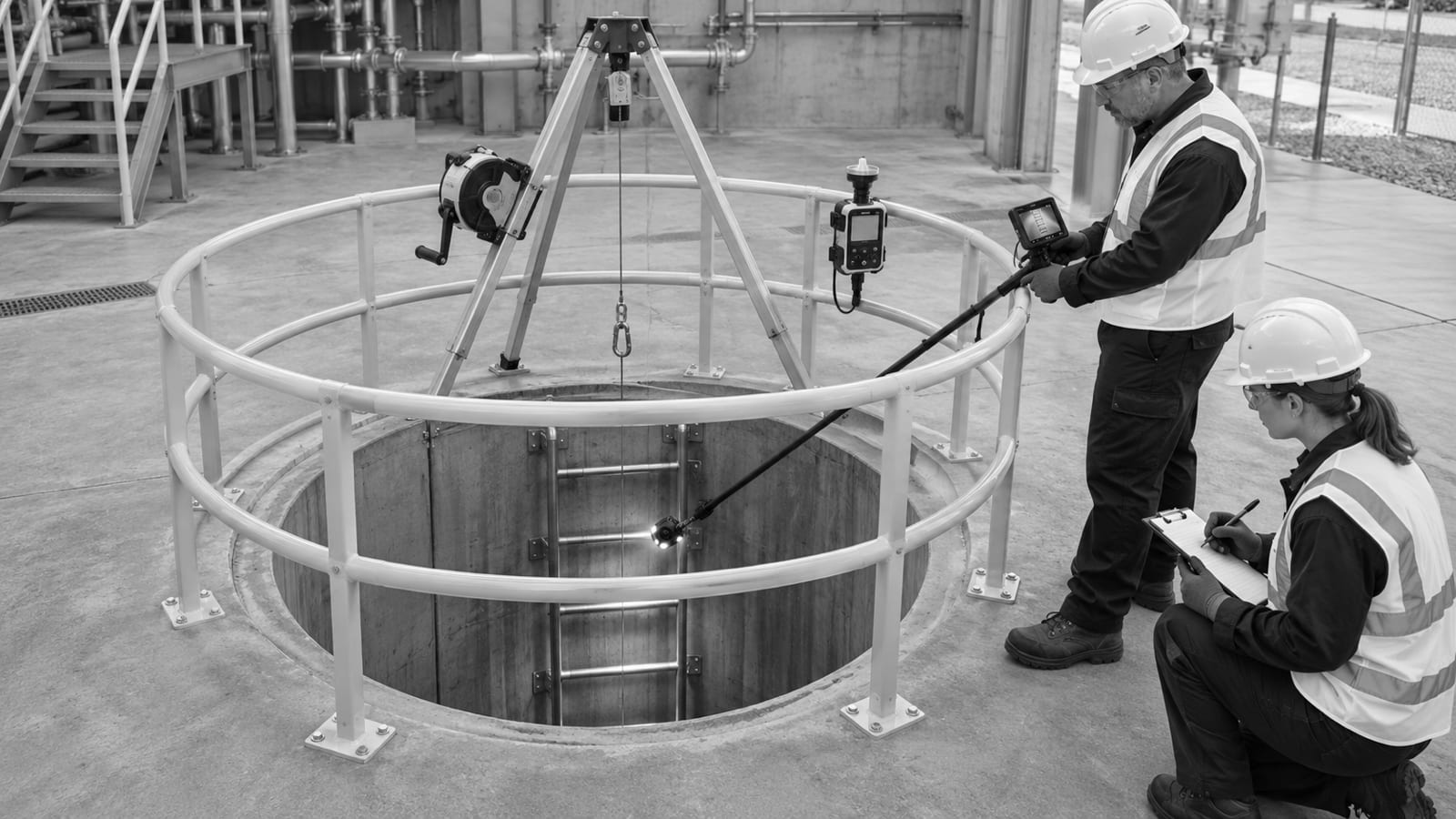
A fixed ladder can look serviceable from the surface while corrosion, damaged rungs, poor clearance, or an obstructed landing make descent unsafe.
Confined-space entry planning often concentrates on atmosphere, isolation, attendants, and rescue. Those controls are essential, but every authorized entrant still has to cross the opening, transfer body weight to the ladder, carry or lower equipment, pass through the portal, and reach a stable landing. A defect or conflict in that short path can cause a fall, delay escape, or obstruct retrieval even when atmospheric readings are acceptable.
The ladder check should be part of the employer's complete permit-space program and applicable walking-working-surface requirements. It does not replace atmospheric testing, hazard isolation, retrieval planning, or rescue evaluation. It asks a separate question: can entrants move into and out of this specific space using the intended access system without being exposed to an unaddressed hazard?
Who This Affects
Fixed-ladder readiness affects employees entering vaults, tanks, pits, manholes, wet wells, process vessels, and other vertical spaces. It also affects attendants and entry supervisors who must keep the opening controlled, verify equipment, and terminate entry when conditions no longer match the permit. Rescue services need accurate information about portal size, ladder position, obstructions, elevation, and the path for removing an incapacitated entrant.
Facility owners and host employers may know the ladder's age, inspection history, prior repairs, coatings, or exposure to corrosive materials. Contractors may bring retrieval equipment, monitors, tools, or temporary access devices that change the opening geometry. Both sides should exchange information before the entry team arrives rather than discovering conflicts during descent.
Maintenance planners, safety professionals, and engineering personnel may need to evaluate structural deterioration or access redesign. Entry personnel should not be expected to determine the remaining capacity of a severely corroded ladder from appearance alone. Training should help them recognize when to stop and request qualified evaluation.
The Confined Space Compliance Issue
OSHA's general industry permit-required confined space standard requires employers to identify and evaluate hazards, develop safe entry procedures, provide necessary equipment, and verify acceptable entry conditions. The equipment list includes ladders needed for safe ingress and egress. The employer must maintain equipment properly and ensure employees use it properly.
OSHA's general industry ladder standard contains requirements for ladder condition, rung spacing, clear width, loading, surfaces, and use. The exact requirements that apply depend on the ladder, workplace, industry, and circumstances. A confined-space permit should not be used to declare a defective fixed ladder acceptable. The entry plan must address both the space hazards and the access equipment used to reach it.
Restricted entry or exit is part of what can make an area a confined space. A vertical ladder can hinder rapid escape even when it is in good condition, especially when an entrant wears a harness, carries equipment, or must pass through a small opening. The hazard evaluation should consider the real movement required, not merely note that a ladder exists.
Retrieval creates another relationship. When non-entry retrieval is required and appropriate, the line, mechanical device, anchor, tripod, or davit must be arranged so rescue can begin promptly. A fixed ladder can compete with the retrieval path, catch the line, or reduce the profile available to remove a worker. OSHA's nonmandatory rescue-evaluation appendix identifies portal size, obstructions, elevation, and access orientation as factors in rescue capability.
What Employers Should Check
Inspect the ladder before authorizing descent. Look for missing, bent, loose, cracked, heavily corroded, or contaminated rungs and side members. Check attachment points, welds, anchors, coatings, and the surrounding structure. Surface rust is not the same as structural failure, but entry personnel should not guess about capacity when section loss, movement, cracking, or unknown repairs are present.
Check each rung's walking surface. Oil, grease, process residue, ice, algae, or standing water can make a sound ladder slippery. Cleaning must follow the site's hazard controls so workers are not exposed to unknown material. If residue cannot be removed safely from the surface, the ladder should remain out of service until the employer provides a suitable solution.
Evaluate the transition at the opening. An entrant needs a secure handhold and enough clearance to move from the surface onto the ladder while wearing required PPE. Guardrails, curbs, hatches, pipes, cables, and retrieval equipment should not force twisting, overreaching, or stepping onto a narrow lip. If a cover is removed, the opening also needs protection against accidental falls and falling objects under the applicable procedure.
Look down the entire climbing path using safe observation methods. Verify that pipes, valves, braces, temporary hoses, ventilation ducts, and stored equipment do not narrow the route. Confirm that the entrant can maintain the required contact and that clothing or harness components will not snag. Do not ask an employee to descend simply to finish an inspection of a questionable ladder.
Check the bottom transition and landing. The last rung should not end above deep water, loose debris, an unstable surface, or an active mechanical hazard. Entrants need room to step off while remaining within the evaluated work area. If the ladder terminates behind piping or equipment, the permit should account for the body movement and any effect on emergency egress.
Coordinate tools and materials. Employees should not climb while carrying objects that can cause loss of balance. Define how monitors, tools, cleaning supplies, and replacement parts will be lowered or transferred. Keep hoisting lines and equipment paths separate from the entrant when practical, and control falling-object exposure at the opening.
Test the retrieval path before entry using a representative setup. Confirm that the line runs without wrapping around the ladder or crossing a sharp edge. Consider the entrant's body profile, portal dimensions, and where the ladder occupies space. A successful unloaded line pull does not prove an incapacitated person can pass the opening, so the rescue service should evaluate realistic access and packaging needs.
Document the result in a way that identifies the actual ladder and space. Useful records include the location, date, observed condition, access conflicts, corrective action, and person completing the check. If the facility has a formal ladder inspection program, link the entry review to that record rather than creating an isolated note that never reaches maintenance.
Which Training Fits This Situation
Awareness training fits employees who work near permit spaces but are not assigned entry duties. They should know that a fixed ladder and an open cover do not authorize entry. They also should recognize signs such as a missing rung, loose anchor, or damaged hatch and know how to report them without crossing the barrier.
Authorized entrant training should include the access method, required PPE, tool-transfer procedure, communication, exit triggers, and the physical technique expected by the employer. Entrants should know they can stop before descent when the ladder feels unstable, the opening is obstructed, or their equipment cannot pass safely. Training should never pressure a worker to prove a defect by climbing farther.
Attendant training should cover opening protection, falling-object control, retrieval-line observation, and the rule against entering to help with a ladder problem. The attendant needs a clear method to summon the entry supervisor, maintenance, or rescue service while keeping unauthorized people away.
Entry supervisor training should connect the ladder check with the permit, equipment inspection, rescue evaluation, and termination authority. Scenario practice can include a rung that moves during the pre-entry check, a tripod leg that blocks the ladder transition, a ventilation duct across the landing, or corrosion discovered below the opening. The correct response is to pause and revise the plan, not to write around the condition.
Employers should also train the personnel who perform formal ladder inspections or repairs. A confined-space course does not qualify someone to assess structural damage or alter a fixed ladder. The company should define who may remove a ladder from service, who may approve temporary access, and who may release repaired equipment.
Common Mistakes to Avoid
One mistake is checking only the first few rungs visible from above. Corrosion, residue, or damage may be worse near the bottom, at water lines, or behind a pipe. Use records, safe visual tools, remote cameras, or qualified inspection methods when the full ladder cannot be safely observed.
Another mistake is assuming the retrieval tripod automatically improves access. Tripod legs, winches, and lines can obstruct the climber or narrow the portal. Set the system up and check the movement path before entry.
A third mistake is letting a portable ladder rest on an unstable floor or against a fixed ladder as an improvised repair. Any alternative access must meet applicable requirements, be compatible with the space, and be included in the hazard and rescue evaluation.
A fourth mistake is allowing entrants to carry monitors or tools in their hands while climbing. Use an approved method that preserves balance and contact without dropping objects on workers below.
A fifth mistake is treating cleaning as repair. Removing residue can restore traction, but it does not correct a loose anchor, thinned rung, cracked weld, or damaged support. Record both housekeeping and structural issues separately.
A final mistake is reopening the space after maintenance without rechecking the full entry configuration. A repaired ladder can still conflict with the hatch, barrier, retrieval line, ventilation duct, or landing. The entry supervisor should verify the assembled system, not just the maintenance ticket.
Next Step
Select one frequently entered vertical space and perform a no-entry access rehearsal. Install the barrier, open the cover using the normal procedure, place the retrieval equipment, route monitoring and ventilation equipment, and trace the entrant's movement from the surface to the landing. Record every point where hands, feet, harness, tools, or retrieval line compete for space.
Then update the pre-entry checklist with a short fixed-ladder section and assign ownership for defects. The most useful outcome is not a longer form. It is a reliable decision path that keeps employees out until the ladder, opening, landing, and rescue arrangement work together for safe descent and escape.
Sources
Occupational Safety and Health Administration, 29 CFR 1910.146 Permit-Required Confined Spaces - https://www.osha.gov/laws-regs/regulations/standardnumber/1910/1910.146
Occupational Safety and Health Administration, 29 CFR 1910.23 Ladders - https://www.osha.gov/laws-regs/regulations/standardnumber/1910/1910.23
Occupational Safety and Health Administration, Appendix F to 29 CFR 1910.146 Rescue Team or Rescue Service Evaluation Criteria - https://www.osha.gov/laws-regs/regulations/standardnumber/1910/1910.146appf