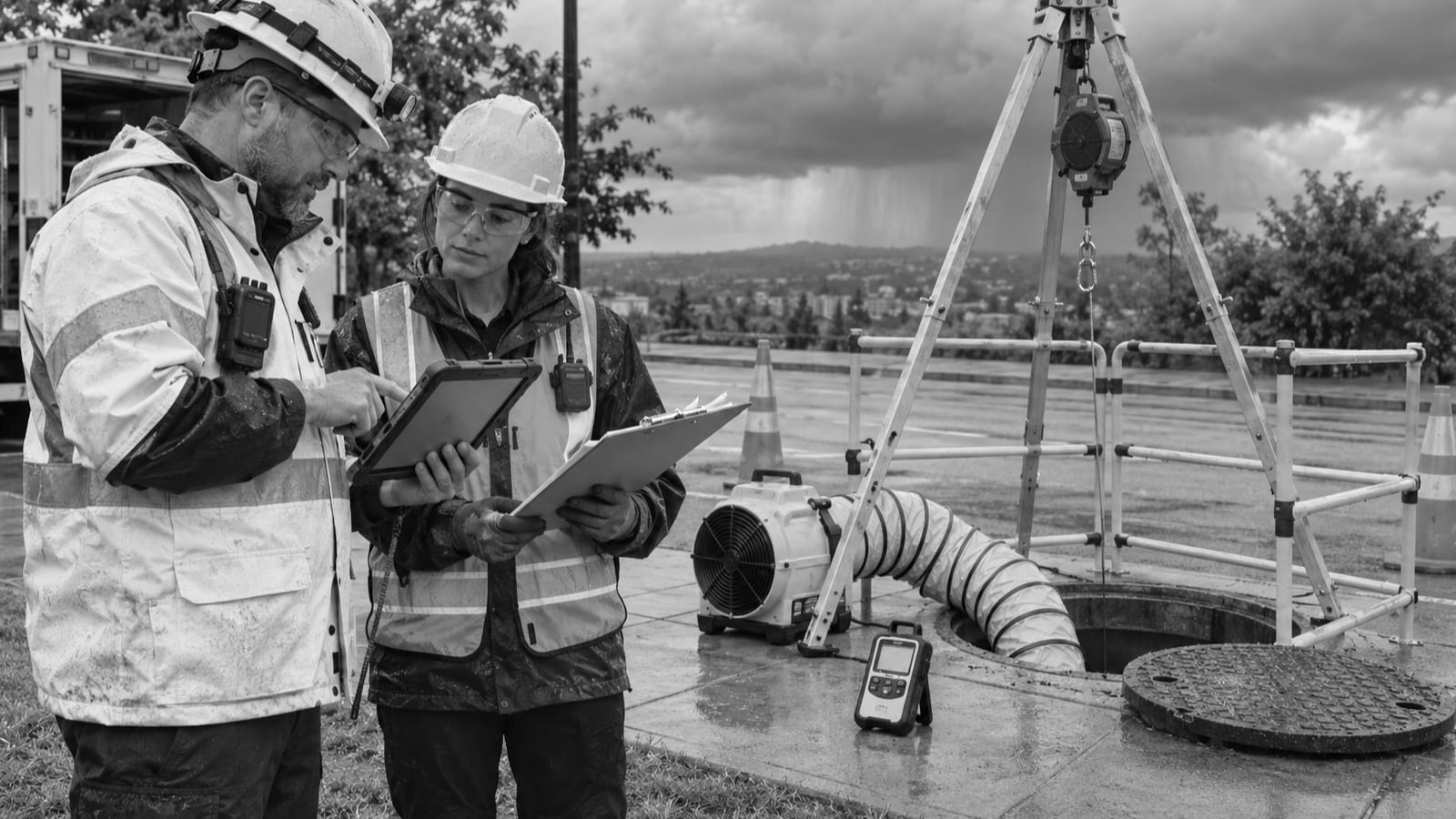
Rain can change a vault, pit, sewer, or storm drain from a planned entry into an engulfment, electrical, access, and atmospheric emergency within minutes. Weather should therefore be part of the entry evaluation, permit discussion, monitoring plan, and stop-work criteria whenever precipitation or upstream runoff can affect the space.
A dry opening at the crew's location does not prove that conditions will remain stable. Rain several miles away can move through a drainage network, surface runoff can enter low points, pumps can lose capacity, and wet ground can alter electrical and walking conditions around the opening. Employers need a process that links weather information to field observations and gives the entry team authority to delay, suspend, or terminate work.
Who This Affects
This issue affects employees and contractors entering storm drains, sanitary and combined sewers, utility vaults, lift-station wet wells, valve pits, pump pits, meter vaults, underground chambers, and other low or connected spaces. It also affects host employers, controlling contractors, entry employers, public works departments, facility owners, dispatchers, safety managers, attendants, entry supervisors, rescue services, and anyone responsible for upstream operations.
The exposure is not limited to outdoor construction. A building sump, underground mechanical room, or utility tunnel can receive water through drains, penetrations, failed pumps, or connected structures. A facility may have a dry local forecast while upstream areas receive heavy rain. The employer's evaluation should follow the actual water pathways rather than the nearest window.
Entry roles experience the change differently. Entrants may face rising water, contaminated flow, unstable footing, energized equipment, or a changing atmosphere. Attendants need to monitor both the entrants and relevant conditions outside the space. Entry supervisors must decide whether acceptable entry conditions continue to exist. Rescue services need to understand how water or weather could change access, retrieval, and response time.
The Confined Space Compliance Issue
OSHA's permit-space rules require employers to identify and evaluate hazards, develop and implement procedures needed for safe entry, and specify acceptable entry conditions. Construction employers must ensure a competent person identifies confined spaces and permit spaces through evaluation and testing as necessary. General industry employers must evaluate permit-space hazards and implement a written program when employees enter.
Weather is not a separate checkbox that replaces those duties. It is information that can reveal or increase hazards already addressed by the program, including engulfment, hazardous atmosphere, electrical exposure, falls, struck-by hazards, and restricted access. OSHA's construction confined-space guidance specifically notes that a storm upstream from workers in a storm sewer can cause flash flooding.
Rain can create multiple hazards at once
Incoming water can rise quickly or carry debris that strikes, traps, or blocks an entrant. It can cover steps and obscure openings. It may contact energized equipment or temporary cords. Runoff can introduce fuel, chemicals, sewage, organic matter, or other contaminants. Changes in flow can disturb deposits and affect atmospheric conditions. Ventilation equipment and air intakes can be exposed to water or contaminated surface air.
The ground-level work zone can also deteriorate. Wet pavement, soft shoulders, traffic spray, lightning, wind, and reduced visibility can affect barriers, tripods, ventilation, communication, and emergency access. A safe-entry decision must consider both the space and the area needed to support the entry.
Acceptable entry conditions need weather-based limits
A permit that says only "no rain" is usually too vague for a connected system. The team needs to know which forecast area, upstream watershed, alarm, gauge, pump condition, water level, or field observation matters. Limits should reflect the space and system. A small isolated vault may require different controls than a storm sewer serving a large drainage area.
The employer should define who checks weather, when it is checked, how the information is communicated, and what happens when conditions approach a limit. If the program depends on pumps, gates, bypass systems, or upstream controls, the team should confirm who monitors those systems and how a failure reaches the attendant and entry supervisor.
What Employers Should Check
Start with the drainage and connection picture. Identify every path by which water, sewage, process material, or runoff could reach the space. Review storm and sanitary maps, laterals, overflows, sumps, pumps, gates, valves, roof drains, surface grades, nearby inlets, upstream basins, and any temporary bypass arrangement. Field conditions should be compared with drawings because old or undocumented connections may change the route.
Check weather beyond the immediate work area
Choose reliable weather information appropriate to the drainage area. For a sewer or stormwater system, that may mean monitoring radar and alerts upstream, not only the point forecast at the entry opening. Establish a check before dispatch, before opening the space, before permit authorization, and at defined intervals during the entry. Assign a backup person when the entry team cannot reasonably monitor changing weather and perform its other duties.
Weather tools support judgment but do not replace field observations. Darkening skies, rising water, flow sound, debris movement, pump cycling, water marks, or reports from upstream crews can require action even if an app has not issued an alert. Conversely, a forecast that improves does not prove that upstream flow has already passed.
Verify isolation and flow controls
Determine whether connected lines, laterals, gates, pumps, or process flows must be isolated. Isolation methods should match the employer's program and the applicable standard. Administrative promises that no one will operate a valve are not equivalent to an isolation method required by the entry procedure.
Where flow cannot be fully isolated, the employer should evaluate whether entry can be conducted safely at all and what monitoring, early-warning, or evacuation provisions are necessary. OSHA's example sewer program notes that affected laterals may need blocking where there is a reasonable potential for contamination or engulfment. Site-specific conditions control the decision.
Inspect pumps, power, and electrical conditions
If safe conditions depend on a pump or bypass, confirm its capacity, power source, alarms, discharge path, backup provisions, and response to failure. Do not let the pump itself create a new atmosphere or discharge hazard. Keep generators and engine exhaust away from openings and ventilation air intakes.
Review electrical equipment for wet-location suitability and physical protection. Position cords, connections, monitors, blowers, and retrieval equipment where runoff will not collect around them. Weather can also affect communication equipment and lighting, so test both under the conditions expected for the entry.
Recheck atmosphere and ventilation
Pre-entry atmospheric testing remains necessary as required by the entry procedure. Rain or increased flow can alter contaminants and distribution within a sewer, wet well, or vault. Continue monitoring at the frequency and locations needed to ensure acceptable conditions. An alarm, unexpected reading, ventilation failure, or relevant change requires the actions defined by the program and permit.
Ventilation must use a clean air source and reach the areas where employees are or will be present. Rain can move vehicle exhaust toward an intake, flood a blower location, collapse flexible ducting, or shift barriers around equipment. Protect the system without blocking emergency access.
Define evacuation and permit suspension triggers
Triggers should be specific enough that an attendant does not have to debate them while entrants are exposed. Examples can include a weather alert for the defined drainage area, observed lightning within the employer's established limit, rising flow or water level, debris movement, loss of a pump, loss of communication, ventilation interruption, atmospheric alarm, water entering the work zone, or instructions from an upstream system operator.
OSHA requires entrants to exit when ordered by the attendant or entry supervisor, when they recognize a warning sign or symptom, when they detect a prohibited condition, or when an evacuation alarm is activated. Training should make weather-related prohibited conditions recognizable before the entry begins.
Which Training Fits This Situation
Awareness training fits employees who may encounter vaults, pits, sewers, or storm drains but are not authorized to enter. They should recognize permit-space signs, understand why an apparently routine opening can become hazardous in rain, and know not to enter to retrieve tools or assist a coworker.
Authorized entrant and attendant training should cover the employer's weather checks, water pathways, alarms, communication methods, evacuation signals, and prohibited conditions. Entrants need practice exiting promptly with tools and hoses arranged to avoid entanglement. Attendants need practice monitoring upstream information without losing focus on entrant accountability and external hazards.
Entry supervisor training should emphasize permit decisions when information is incomplete or conditions are changing. Supervisors should be able to connect the forecast and system status to acceptable entry conditions, verify rescue availability, suspend or cancel a permit, and require a new evaluation before reentry.
Rescue planning and drills should account for the conditions that weather can create. A plan based on clear pavement and a dry opening may not work when access roads flood, lightning limits outdoor operations, or water changes the space. Employers should coordinate these factors with the selected rescue service before entry, not during an emergency.
Training supports the employer's program; it does not make a generic weather rule suitable for every space. The employer must evaluate the actual location, work, connections, and applicable OSHA provisions.
Common Mistakes to Avoid
One common mistake is checking only the local forecast. Connected sewers and storm drains can respond to rainfall outside the immediate work area. Another is using a single pre-entry check for a job that lasts several hours. Weather and system status need ongoing attention when they can change entry conditions.
Do not rely on the attendant to improvise thresholds. Write clear triggers into the permit or supporting procedure and brief the entire team. Do not assume that a pump eliminates engulfment risk without verifying capacity, power, alarms, and backup. Do not treat atmospheric monitoring as a substitute for water-level and flow monitoring when both hazards exist.
Avoid placing blowers, electrical connections, tripods, or permits in drainage paths. Do not let vehicle exhaust contaminate ventilation air. Do not resume entry immediately after rain ends without confirming that upstream flow, the atmosphere, access, isolation, and rescue arrangements are again acceptable.
Finally, do not send an untrained employee into a space to check conditions. Evaluate from outside when feasible using the employer's approved methods and equipment. If the permit is terminated, document the reason and use what happened to improve future planning.
Next Step
Select one recurring vault, pit, or sewer entry and map how rain could affect it from dispatch through permit closeout. Identify the relevant drainage area, water pathways, isolation points, pumps, weather source, monitoring locations, evacuation triggers, communication method, and rescue access. Then compare that map with the current permit and training.
If any trigger depends on someone "watching the weather," name the person, source, interval, threshold, and communication route. That small change turns a general caution into an operational control the entry team can understand and use.
Sources
Electronic Code of Federal Regulations, 29 CFR 1910.146 Permit-Required Confined Spaces: https://www.ecfr.gov/current/title-29/subtitle-B/chapter-XVII/part-1910/subpart-J/section-1910.146
Electronic Code of Federal Regulations, 29 CFR 1926.1203 General Requirements for Confined Spaces in Construction: https://www.ecfr.gov/current/title-29/subtitle-B/chapter-XVII/part-1926/subpart-AA/section-1926.1203