
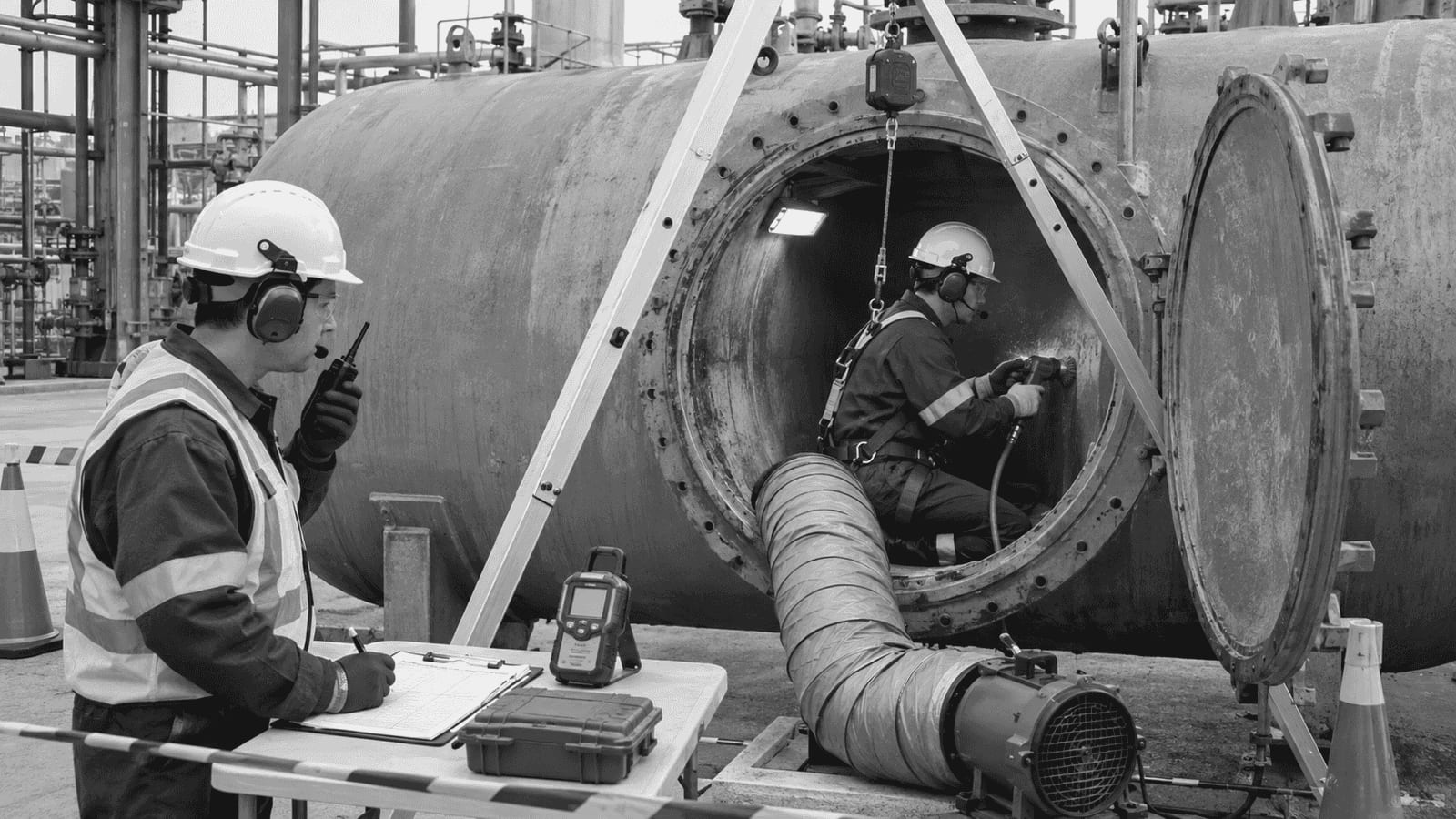
Noise inside tanks, vaults, and vessels can damage hearing while masking alarms, instructions, and the evacuation signals an entry team depends on. Fans, grinders, impact tools, pumps, product flow, compressed air, and reverberant metal surfaces can turn a routine task into a high-noise entry. Employers need to evaluate the exposure and confirm that every required communication still works under actual operating conditions.
Noise is not only a hearing-conservation issue. In a permit-required confined space, it can interfere with the attendant's ability to monitor entrant status, an entrant's ability to hear an order to evacuate, and the team's ability to summon rescue services. Hearing protection can reduce exposure, but poorly selected protection can also make speech, alarms, and equipment changes harder to detect. The entry plan must treat these needs as one system.
This article provides planning and training guidance, not a noise survey, medical opinion, or site-specific entry procedure. Employers should apply the full confined-space and occupational-noise requirements that cover their operation, account for state-plan rules, and use qualified assistance when exposure assessment or control selection exceeds internal capability.
Who This Affects
Authorized entrants face the direct exposure. Tasks such as abrasive cleaning, scaling, grinding, chipping, bolting, vacuuming, and pressure washing can place the noise source inside a reflective enclosure. Even a tool that is manageable outdoors may be much louder to the worker when sound reflects from steel, concrete, or masonry. The entrant may also wear a hood, respirator, face shield, or other equipment that changes how speech and alarms are heard.
Attendants are affected even when they remain outside. They must communicate with entrants as necessary to monitor status and alert them to the need to evacuate. A blower, generator, traffic, nearby production, or the work itself may overwhelm voice communication at the opening. The attendant may hear tool noise but not recognize whether the tool stopped because a task ended, a hose failed, or the entrant became unable to respond.
Entry supervisors, safety managers, industrial hygienists, maintenance planners, and rescue coordinators also have a role. They may need to estimate or measure exposure, select controls, approve the permit, verify communications, coordinate work pauses, and decide whether the rescue arrangement remains effective. Host and contractor employers should exchange information when one controls the space and another supplies tools or personnel, because either party can introduce a noise source that changes the entry conditions.
Spaces That Can Amplify the Problem
Metal tanks and vessels can create strong reverberation. Concrete wet wells, vaults, and pits may reflect equipment noise and limit the distance available between a worker and the source. Boilers, ducts, sewers, tunnels, and process equipment can transmit sound from connected machinery even after the immediate work area appears isolated. A narrow entry can also limit options for barriers, remote tooling, or bulky earmuffs.
Noise may vary across the space. The opening can seem acceptable while the far end, a curved shell, or the area beside an operating tool is much louder. A pre-entry conversation test at the hatch does not establish the entrant's exposure or prove that communication will work at the task location. The evaluation should follow the worker, tool, and work sequence.
The Confined Space Compliance Issue
The general-industry permit-space standard requires the employer to evaluate hazards, develop and implement the means and procedures needed for safe entry, and provide communication equipment as necessary. Authorized entrants must communicate with the attendant as necessary so the attendant can monitor status and alert entrants of a need to evacuate. Attendants must maintain communication and order evacuation when prohibited conditions, behavioral effects of exposure, outside conditions, or inability to perform duties make withdrawal necessary.
The occupational-noise standard addresses exposure assessment, feasible engineering or administrative controls, hearing conservation, hearing protectors, training, and records under its applicable conditions. For general-industry workers, the standard identifies an 85 dBA eight-hour time-weighted average action level for a hearing conservation program and uses exposure tables and dose calculations for compliance decisions. Short, intense, or variable tasks still require evaluation rather than an assumption that a brief entry is harmless.
One Control Must Not Defeat Another
The entry team cannot solve high noise by simply handing the entrant earplugs and proceeding. The employer must first understand the exposure and consider controls at the source or along the path. If hearing protection is needed, it must provide suitable attenuation, fit the worker, work with the rest of the PPE, and allow the planned communication and emergency cues to remain perceivable through an appropriate method.
The opposite shortcut is equally unsafe. Removing hearing protection so an entrant can understand the attendant exposes the worker to the noise the protection was selected to control. If routine instructions require workers to lift an earmuff or pull out a plug, the communication method is not compatible with the noise plan. The entry supervisor should stop and correct the system rather than normalize the workaround.
Noise also belongs on the permit when it is a hazard or affects the controls needed for entry. The record should identify the source, task, expected duration, evaluation method, selected controls, hearing protection where required, communication method, backup method, and conditions that require withdrawal. A generic check box labeled PPE or communication does not show that these elements were tested together.
What Employers Should Check
Start with the work description. List each tool, machine, blower, pump, nozzle, and connected process that may create or transmit noise. Identify when it operates, where it will be relative to the entrant, and how long the task is expected to last. Account for start-up, testing, cleanup, and troubleshooting, not only the steady production phase. A stuck fastener or unexpected coating can extend exposure far beyond the estimate.
Evaluate Exposure at the Worker Position
Use an appropriate sound-level or dosimetry approach when information indicates exposure may reach relevant limits. Measurements should represent the entrant's actual position, tool, duty cycle, and other equipment operating at the same time. Reverberation and movement through the space can make a reading at the opening misleading. If the task or equipment changes, the employer should determine whether earlier results still represent the exposure.
Review controls before relying on personal protection alone. Quieter tools, maintained bearings, sharp cutting surfaces, reduced air pressure when technically appropriate, remote operation, isolation of a noisy source, acoustic treatment designed for the environment, and moving a compressor or generator away from the opening may reduce exposure. Administrative controls can limit duration or schedule noisy work separately, but they should not transfer the exposure to another worker or create a new entry hazard.
Ventilation should be included in the review because blowers can be major noise sources. The solution is not to reduce required ventilation without evaluating atmospheric consequences. The team can consider quieter equipment, greater separation, duct routing, vibration isolation, maintenance, or other engineering options while preserving the airflow required by the entry procedure. Atmospheric monitoring and ventilation controls must remain effective.
Test Communication With Everything Running
Test the primary system at the farthest and noisiest planned work location while the actual fan and tools operate. The entrant should send and receive routine check-ins, the stop-work message, and the evacuation signal. The attendant should confirm the worker's identity and response rather than accepting an indistinct sound. If radios or wired headsets are used, verify coverage, battery condition, connector security, cable routing, intrinsic-safety requirements where applicable, and compatibility with hearing protectors.
Provide a backup method that is meaningful in the space. Depending on the configuration, that could include a redundant radio, hard-wired system, visual signal, vibrating device, line signal, or planned tool shutdown followed by voice contact. A backup is not effective merely because equipment is available. The crew should practice it and know when loss of the primary method requires evacuation rather than troubleshooting while the entrant remains exposed.
Alarms need the same practical test. Gas-monitor alarms, evacuation signals, facility alarms, and rescue notifications may use sound, light, vibration, or combinations. Confirm that entrants can perceive and distinguish the relevant signal through their PPE and against background noise. The attendant should not depend on hearing an entrant's personal monitor from outside a tank or around a corner.
Check Hearing Protection as Part of the PPE Ensemble
Select hearing protection from options that provide the needed attenuation and can be fitted correctly. More attenuation is not automatically better if it causes overprotection, poor communication, or inconsistent use. Flat-attenuation, level-dependent, or communication-enabled protectors may be useful for some tasks when properly selected and evaluated. Fit testing can help verify that an individual worker receives the intended protection.
Compatibility matters in confined spaces. Earmuffs may interfere with hard-hat attachments, respirator straps, face shields, welding hoods, or the limited clearance needed to pass through an opening. Earplugs may be difficult to insert with contaminated hands. Communication headsets can add cables or components that snag or complicate retrieval. The employer should test the full ensemble without blocking egress or compromising another protective device.
Finally, confirm rescue communication. The attendant must be able to summon the designated service without leaving the post in a way that abandons required duties. The rescue team needs a clear report of the space, entrant count, task, hazards, noise controls, and last known communication. If high noise would prevent rescuers from coordinating inside the space, that condition belongs in rescue planning and practice.
Which Training Fits This Situation
Confined Space Awareness training fits employees who work around tanks, pits, vessels, and vaults but are not assigned an entry role. They should understand why a noisy task does not authorize entry, why barriers and permits matter, and how new tools or production changes can alter a previously evaluated space.
Permit-Required Confined Space Entry Training fits authorized entrants and attendants. Entrants need to recognize noise as a hazard, use hearing and communication equipment, respond to alarms, report changes, and exit when communication fails or an evacuation order is given. Attendants need to conduct meaningful check-ins, recognize abnormal behavior, maintain accountability, control the area, and initiate the emergency process without entering.
Confined Space Supervisor Training fits the person who authorizes and terminates entry. That role should understand how the noise evaluation connects with the permit, control hierarchy, PPE, communication test, rescue plan, and conditions for cancellation. Competent Person for Confined Spaces Training can support safety managers and EHS personnel who evaluate programs, inventories, equipment, contractor coordination, and recurring hazards across multiple spaces.
Course completion is a foundation. The employer must add site-specific instruction on the actual tools, measured or expected exposures, hearing protectors, radios, alarms, permits, work practices, and rescue arrangements. Workers should demonstrate the primary and backup communication methods while wearing the complete PPE ensemble before entry begins.
Common Mistakes to Avoid
Do not use the noise level at the opening as a substitute for the entrant's exposure. Do not assume a short job is below applicable limits without considering intensity and duration. Do not treat hearing protection as the first and only control. Do not lower required ventilation merely because a blower is loud. Do not accept an untested radio, a weak signal, or an attendant shouting into the opening as a complete communication plan.
Avoid using one hearing protector for every worker without considering fit, attenuation, comfort, cleanliness, and compatibility. Avoid overprotection that isolates the entrant from important cues. Avoid communication equipment that defeats the seal of an earmuff or respirator. Avoid cable and duct layouts that narrow the opening, create entanglement, or interfere with retrieval.
Do not let the permit remain static after the task changes. A different tool, longer duration, added worker, relocated blower, production restart, or failed headset can change the exposure and the effectiveness of controls. The entry supervisor should know which changes require a pause, reevaluation, permit update, or cancellation.
Next Step
Choose one upcoming noisy entry and run a full-condition test before the permit is signed. Operate the ventilation and tools, place the entrant at the real task location in the complete PPE ensemble, verify exposure controls, exchange routine and emergency messages, test the backup, and practice the evacuation signal. Record what fails and correct it before entry.
Use the result to improve the written program rather than treating it as a one-time equipment check. Update tool lists, noise data, approved hearing-protection options, communication procedures, alarm methods, contractor questions, and rescue briefings. Role-based training should then reinforce the revised process so the next crew inherits a tested system rather than an informal workaround.
Sources
Electronic Code of Federal Regulations, 29 CFR 1910.146 Permit-Required Confined Spaces | https://www.ecfr.gov/current/title-29/subtitle-B/chapter-XVII/part-1910/subpart-J/section-1910.146
Electronic Code of Federal Regulations, 29 CFR 1910.95 Occupational Noise Exposure | https://www.ecfr.gov/current/title-29/subtitle-B/chapter-XVII/part-1910/subpart-G/section-1910.95
CDC National Institute for Occupational Safety and Health, Provide Hearing Protection | https://www.cdc.gov/niosh/noise/prevent/ppe.html
CDC National Institute for Occupational Safety and Health, Use Administrative Controls | https://www.cdc.gov/niosh/noise/prevent/admin.html