Biological hazards can change a routine confined-space entry into a serious exposure event unless employers evaluate contact, aerosols, and hygiene before work.
Sewers, wet wells, lift stations, tanks, manure systems, waste pits, and some utility vaults may contain sewage, wastewater, sludge, animal waste, decaying material, contaminated sediment, or residues that support microorganisms. Entry teams often focus first on oxygen, flammable gases, and toxic contaminants because those hazards can be immediately fatal. That focus is essential, but it should not erase the need to evaluate biological exposure and the work practices that can spread contamination beyond the space.
Biological hazards do not create one universal entry rule. The employer must evaluate the actual space, material, work activity, exposure route, and potential severity. A permit-required confined space program remains centered on identifying and controlling all relevant hazards, assigning trained roles, specifying acceptable conditions, monitoring the entry, and preparing rescue. Biological exposure should be integrated into that program rather than handled as an unrelated housekeeping issue.
Who This Affects
This issue affects authorized entrants who inspect, clean, repair, sample, pump, scrape, pressure wash, or remove material inside spaces connected to sewage or waste systems. It also affects attendants and entry supervisors because contamination can change PPE, communication, evacuation, decontamination, and rescue decisions. Maintenance planners, industrial hygiene staff, operations teams, and occupational health professionals may need to support the hazard assessment.
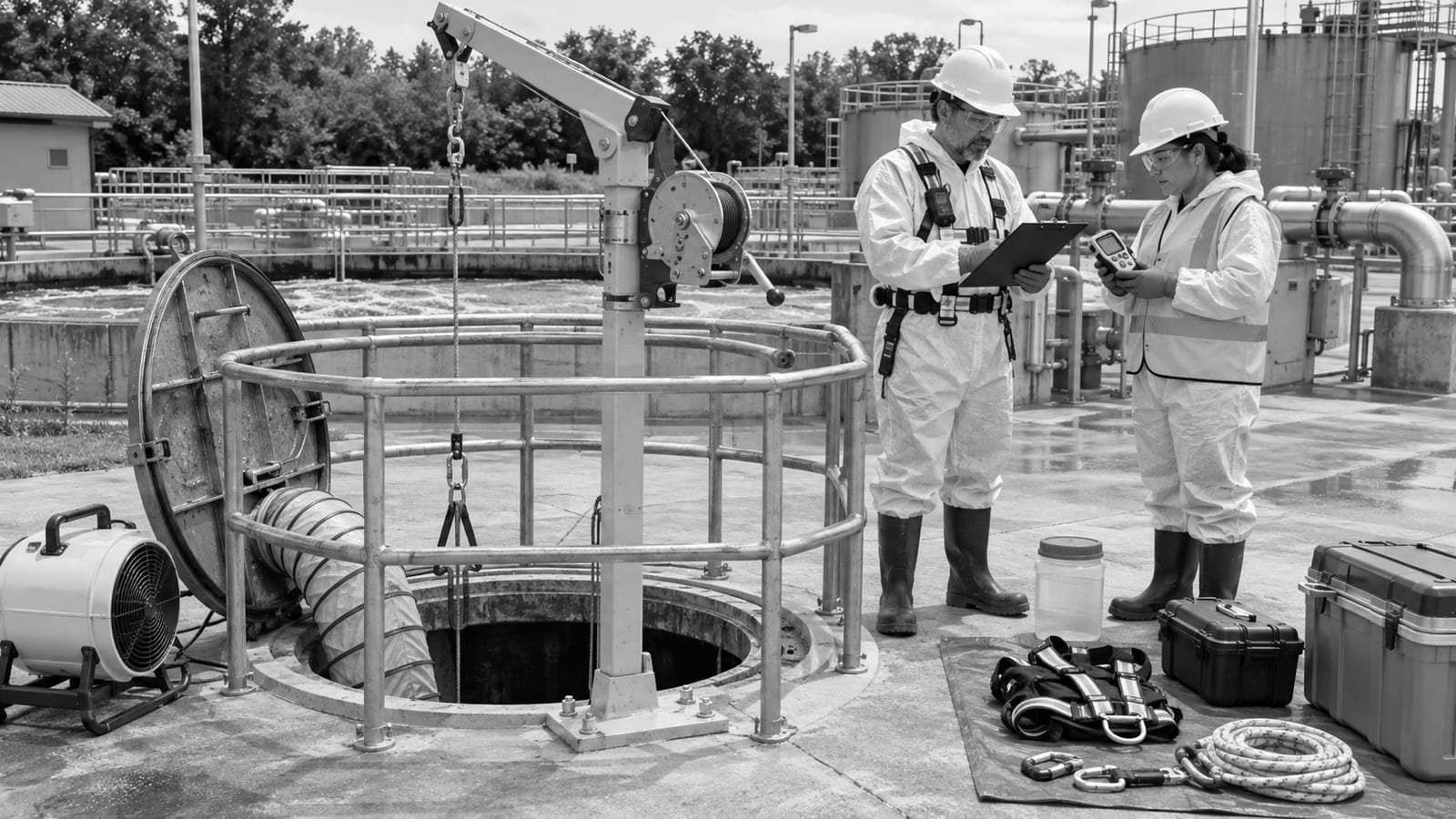
Employees outside the opening can also be exposed. Tools, hoses, boots, gloves, monitors, retrieval lines, and removed components can carry contaminated material to the attendant's area, service vehicle, break room, or home. A splash during line opening or pumping can reach workers who never cross the plane of the space. The plan should therefore define clean and dirty zones and responsibilities for everyone who handles equipment or waste.
Contractor coordination matters when a host facility controls the system and another employer supplies the entry team. The host may know the space's contents, process changes, recent backups, chemical additions, or unusual waste streams. The contractor may control the permit, PPE, monitoring, and decontamination procedures. Both sides need enough information to prevent a gap in which each assumes the other evaluated biological exposure.
The Confined Space Compliance Issue
OSHA's permit-required confined-space rules require employers to identify and evaluate hazards before employees enter. A permit space can be triggered by a hazardous atmosphere, engulfment, a trapping configuration, or another recognized serious safety or health hazard. Biological agents are not automatically identical in every space, so the employer should evaluate whether the specific hazard can cause serious harm or impair an entrant's ability to self-rescue.
The analysis must remain broader than infection risk. Sewage and decaying material may also be associated with oxygen deficiency, hydrogen sulfide, methane, carbon dioxide, engulfment, slips, and unexpected inflow. Cleaning or pressure washing can aerosolize material. Chemical disinfectants can add irritation, toxic vapor, or incompatible-reaction hazards. A strong permit connects these hazards rather than treating each as a separate checklist.
General-industry entries may fall under 29 CFR 1910.146, while construction work may fall under 29 CFR 1926 Subpart AA. The applicable standard depends on the work and setting, not simply on the label attached to the space. Employers should use the rule that applies to the activity and also address other relevant requirements for personal protective equipment, respiratory protection, sanitation, hazard communication, and bloodborne pathogens when those standards apply to the exposure.
The entry permit should describe the identified hazards, measures used to isolate and control them, acceptable entry conditions, testing or monitoring results, equipment, communication, rescue, and authorized personnel. If biological contamination requires special PPE, hygiene, waste handling, or medical coordination, those items should appear in the work plan or linked procedure. A generic notation such as "biohazard" does not tell an entrant what contact is expected or what to do after a splash.
What Employers Should Check
Start with the space history and current process. Identify what normally enters the space, what entered recently, and whether a backup, flood, spill, dead animal, medical waste, industrial discharge, or unusual production condition changed the material. Review available process information, sampling data, safety data sheets, and facility reports. Ask whether the system contains domestic sewage, animal waste, food residue, stagnant water, sludge, or other organic material.
Define the work that will disturb the material. Visual inspection from a platform can present a different exposure than pressure washing, jetting, vacuuming, scraping, pumping, cutting, or manually removing solids. Work that creates splashes, droplets, aerosols, sharp-object contact, or high-pressure injection hazards needs a more detailed control plan. Consider how the entrant will move, where hands and knees contact surfaces, and how tools return through the opening.
Map the likely exposure routes. Contaminated material can contact broken skin, eyes, nose, mouth, or other mucous membranes. Workers can transfer material from gloves to radios, phones, food, tobacco, or their face. Aerosols may require evaluation by a qualified safety or health professional, especially when the task is energetic or the material is unusual. The absence of a noticeable odor does not establish that biological or atmospheric conditions are acceptable.
Control inflow and energy before entry. Isolate pumps, valves, lines, gates, augers, mixers, electrical sources, and other equipment under the applicable procedure. Prevent sewage, stormwater, manure, product, cleaning chemicals, or process material from entering while employees are inside. Verify isolation rather than relying on a control-room statement. If isolation cannot be maintained, the employer must reassess whether entry can proceed and what permit-space controls are necessary.
Select PPE from the assessment. Depending on the task, controls may include waterproof gloves, protective clothing, boots, eye protection, and face protection for splash. Respiratory protection decisions require a compliant program, suitable equipment, medical evaluation, fit testing for tight-fitting respirators, training, and correct use. PPE should not introduce a greater hazard by limiting movement, communication, heat tolerance, or retrieval through the opening.
Plan hygiene and decontamination before the crew begins. Provide a way to wash hands with soap and clean water after handling sewage or waste and before eating, drinking, smoking, or touching the face. Define how contaminated clothing, disposable items, tools, monitors, harnesses, lines, and vehicle surfaces will be handled. Keep food and drinks outside the contaminated work zone. Establish a process for cleaning, bagging, transporting, or disposing of materials without spreading contamination.
Workers should know how to report cuts, punctures, splashes to the eyes or mouth, symptoms, and damaged PPE. The employer's response procedure should identify first aid, exposure reporting, and access to appropriate medical evaluation. Occupational health professionals can advise on job-specific immunization or medical considerations, but a general article or training certificate cannot make an individual medical determination.
Atmospheric testing and ventilation remain essential. Test in the order and locations required by the program, account for stratification, and continue monitoring as conditions warrant. Ventilation should use clean make-up air and should not spread contaminated exhaust to workers or occupied areas. A blower does not remove the need for biological contact controls, and disinfecting a surface does not prove that the atmosphere is safe.
Rescue planning must account for contamination. The designated rescue service needs to understand the material, PPE, decontamination concerns, portal, access path, and equipment. Non-entry retrieval may reduce rescuer exposure when it is feasible and does not create a greater hazard, but the retrieval line and harness can become contaminated. Attendants should not enter to perform rescue unless they are authorized, trained, equipped, and relieved according to the employer's rescue plan.
Which Training Fits This Situation
Awareness training is appropriate for employees who may encounter sewer manholes, waste tanks, wet wells, or similar spaces but are not assigned to enter. They should recognize space markings, biological and atmospheric warning signs, unauthorized-entry controls, contamination boundaries, and the person to contact. Awareness alone does not prepare someone to serve as an entrant, attendant, entry supervisor, or rescuer.
Permit-Required Confined Space Entry Training fits workers assigned to entry roles. Entrants need to understand the hazards, PPE, hygiene rules, monitoring, communication, exit triggers, and equipment they will use. Attendants need training on continuous monitoring of entrants and external conditions, contamination control at the opening, emergency actions, and the prohibition against duties that interfere with their role. Entry supervisors need enough knowledge to verify the permit, isolation, controls, equipment, rescue, and cancellation conditions.
Construction crews may need training aligned with 29 CFR 1926 Subpart AA and the competent-person responsibilities that apply to the worksite. General-industry teams may need training aligned with the employer's 29 CFR 1910.146 program. Contractors should not rely on a broad orientation if the assigned work involves specific sewage, animal-waste, industrial-discharge, or decontamination hazards.
Online training can build a consistent foundation and document course completion, but the employer must add site-specific instruction, equipment practice, PPE use, permit review, and hands-on procedures where needed. Training should use realistic scenarios, such as a torn glove, a splash to the face, a blocked wash station, an unexpected industrial discharge, or contaminated retrieval equipment. Workers need to know exactly when to exit, report, isolate an item, and seek evaluation.
Common Mistakes to Avoid
Do not treat a normal oxygen reading as proof that the space is free of biological hazards. A gas monitor measures only the sensors installed and functioning on that instrument. It does not measure every microorganism or contact hazard. Atmospheric results and biological controls answer different questions.
Do not assume all sewage entries are identical. Domestic wastewater, industrial discharge, floodwater, animal waste, medical waste, and stagnant process material can present different conditions. The task also matters. Opening a hatch, sampling, jetting, scraping, and full entry can create different exposure pathways.
Do not let contaminated PPE become the control problem. Gloves are ineffective when workers touch radios, phones, vehicle controls, food, or their face and then keep using the same gloves. Protective clothing that cannot be removed without touching contaminated surfaces needs a better doffing plan. The employer should teach the sequence and provide the supplies needed to follow it.
Do not add disinfectants without evaluating new hazards. Mixing products, using an incompatible chemical, or applying a product in a poorly ventilated space can create toxic vapor, oxygen displacement, skin injury, or other danger. Cleaning chemicals should be reviewed through the same hazard-assessment and permit process as the original contamination.
Do not separate rescue from exposure control. A rescue service that expects an atmospheric emergency may still be unprepared for contaminated sludge, sharps, splash, or decontamination. Share the actual hazard information and verify that the service can perform the rescue in the expected conditions.
Next Step
Select one frequently entered sewer, wet well, waste tank, or similar space and review the permit from opening to equipment cleanup. Identify the material, task, contact routes, inflow sources, atmospheric hazards, PPE, wash facilities, contaminated-equipment path, exposure reporting, and rescue arrangement. Then compare the written plan with what the crew can actually do at the site.
Use the review to assign the right training by role. Awareness training supports employees who recognize and avoid unauthorized entry. Permit-required entrant, attendant, and entry-supervisor training supports the people who plan and perform controlled entry. Add site-specific instruction on the biological material and decontamination process, and direct medical questions to an appropriate occupational health professional.
Sources
Electronic Code of Federal Regulations, 29 CFR 1910.146 Permit-Required Confined Spaces - https://www.ecfr.gov/current/title-29/subtitle-B/chapter-XVII/part-1910/subpart-J/section-1910.146
Electronic Code of Federal Regulations, 29 CFR 1926.1204 Permit-Required Confined Space Program - https://www.ecfr.gov/current/title-29/subtitle-B/chapter-XVII/part-1926/subpart-AA/section-1926.1204
OSHA, Confined Spaces in Construction: Sewer Systems - https://www.osha.gov/sites/default/files/publications/OSHA3789.pdf
CDC and NIOSH, Protecting Workers Handling Human Waste - https://www.cdc.gov/global-water-sanitation-hygiene/about/workers_handlingwaste.html