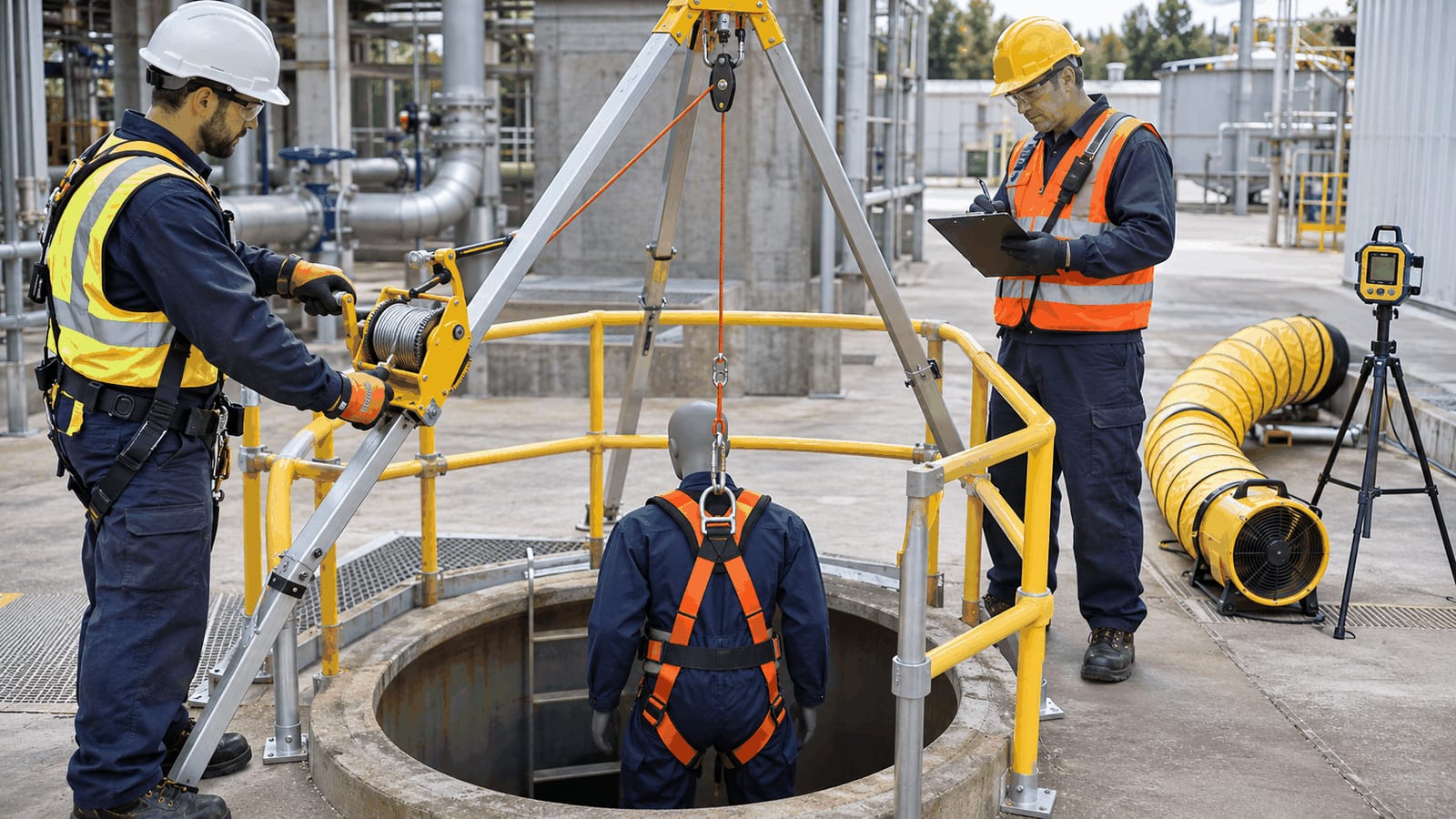
A retrieval line can support fast non-entry rescue only when its attachment, path, anchor, and mechanical device match the entrant and the space configuration. A line that is merely clipped on may snag, pull across a sharp edge, interfere with work, or fail to move the entrant through the opening when seconds matter.
Retrieval equipment is one part of a complete permit-space program. It does not replace atmospheric testing, isolation, ventilation, an attendant, an evaluated rescue service, or procedures for summoning help. The employer should decide before entry whether retrieval will contribute to rescue, then configure and test the system for the actual space rather than assuming a tripod and winch solve every problem.
Who This Affects
This issue affects employers whose workers enter tanks, vaults, pits, vessels, silos, manholes, and other permit-required confined spaces where non-entry rescue may be used. Entry supervisors, attendants, authorized entrants, rescue coordinators, safety professionals, equipment inspectors, and contractors all influence whether the retrieval path is workable.
The entry supervisor needs enough information to determine that the required equipment is present and the permit conditions are satisfied. The attendant must understand how the retrieval system fits the rescue procedure without abandoning attendant duties or entering the space. The entrant must wear and connect the equipment correctly and avoid routing choices that add entanglement or trip hazards.
Facility owners and host employers also have a role. Drawings, prior permits, access dimensions, fixed obstructions, and known hazards can help an entry employer assess whether a straight retrieval path exists. When several employers participate, they should coordinate equipment placement and emergency actions so the line is not blocked by ventilation ducting, tools, vehicles, or another contractor's work.
The Confined Space Compliance Issue
Under 29 CFR 1910.146, retrieval systems or methods must be used to facilitate non-entry rescue whenever an authorized entrant enters a permit space, unless the retrieval equipment would increase the overall entry risk or would not contribute to rescue. That exception requires a real evaluation of the conditions. It is not a reason to omit retrieval merely because routing is inconvenient.
The standard generally calls for a chest or full-body harness, with the retrieval line attached at the center of the entrant's back near shoulder level, above the head, or at another point the employer can establish will present a profile small enough for successful removal. Wristlets may be used only under the stated conditions, including when a harness is infeasible or creates a greater hazard and wristlets are the safest and most effective alternative.
The other end of the retrieval line must connect to a mechanical device or fixed point outside the permit space so rescue can begin as soon as the need is recognized. A mechanical device must be available for personnel retrieval from vertical-type permit spaces more than five feet deep. These requirements address connection and availability, but the employer still has to make the arrangement function through the real opening and travel path.
The line path can determine whether retrieval contributes to rescue. An entrant may pass beneath piping, around a ladder, through a narrow manway, or behind internal baffles. A line can wrap around an obstruction or pull the entrant toward a surface that prevents removal. The equipment may also create an additional hazard if it catches moving machinery, conflicts with fall-protection equipment, or introduces a trip line into the work area.
When retrieval would increase risk or would not contribute, the employer should document the basis for the chosen rescue method in the program and permit planning. The alternative rescue capability still must meet the program requirements. An exception from using a retrieval line is not an exception from planning for timely rescue.
What Employers Should Check
Begin with the access opening and route. Measure the opening, note its shape and edge condition, and identify ladders, guardrails, curbs, flanges, piping, platforms, changes in direction, and internal obstructions. Consider the entrant's body position during removal, not just during normal entry. The route has to accommodate a person who may be unconscious and unable to assist.
Evaluate the harness connection point and fit. The connection should support a removal profile suited to the space, and the harness should be adjusted for the individual using it. Loose straps, an incorrect dorsal connection, or an attachment to a tool loop can defeat the planned body position. The entrant should understand which connection is for retrieval and should not change it during the job without authorization.
Trace the retrieval line from the entrant to the external point. The path should avoid sharp or abrasive edges, hot surfaces, chemical contact, rotating equipment, pinch points, and locations where the line could be buried or trapped. If an edge-protection component or approved guide is needed, it should be installed before entry and should not create a new failure point.
Check the anchor or mechanical device for compatibility with the intended direction and load. A fixed point should be selected for the retrieval function, not chosen because it is nearby. Tripods, davit systems, winches, pulleys, connectors, and anchors should be assembled and used within manufacturer instructions. The setup should remain stable when the line is tensioned in the expected direction.
Keep the opening usable. Ventilation ducting should deliver air where needed without blocking the extraction path. Atmospheric monitor tubing, lighting cables, communication lines, tools, hoses, and temporary barriers need assigned routes. The attendant should not have to dismantle the work area before retrieval can begin.
Confirm that the line length and device travel are sufficient. The system should reach the entrant's work location and still allow retrieval through the opening to a safe landing area. A winch that reaches the entrant but stops before the person clears the opening is not a complete arrangement. The team should also know how the entrant will be moved away from the edge after extraction.
Inspect the equipment before use according to the employer's program and manufacturer information. Look for cuts, abrasion, chemical damage, heat damage, broken stitching, distorted hooks, missing keepers, corrosion, damaged cables, device problems, or overdue inspections. Remove questionable equipment from service through the established process rather than improvising a repair at the opening.
Test the arrangement without exposing a worker. A representative load, mannequin, or controlled dry run can reveal line friction, instability, insufficient clearance, or an awkward body angle. The test should reflect the real route as closely as practical. It should not be a casual tug on the line after the entrant is already inside.
Coordinate the retrieval plan with the rescue service. Provide access details, internal configuration, hazards, equipment information, and the expected line path. If the rescue service is external, confirm how it will be summoned and how quickly it can reach the site. The attendant and entry supervisor should know which actions begin immediately and which actions belong to trained rescuers.
Which Training Fits This Situation
Authorized entrant training should cover correct harness use, the purpose of the retrieval connection, line management, and the hazards of rerouting or disconnecting the system. Entrants need to recognize when the line interferes with assigned work and report the problem rather than tying it off, moving it to an unsuitable point, or continuing with a snagged line.
Attendant training should connect line observation with the attendant's broader duties. The attendant should recognize loss of slack control, an unexpected change in line direction, a blocked opening, or a condition that could delay rescue. Training should make clear that the attendant may not enter the permit space unless the employer's rescue procedure authorizes it and all conditions for that role are met.
Entry supervisor training should focus on verifying that the rescue plan is matched to the space and that the permit reflects the selected equipment and method. The supervisor should know how to challenge a generic setup, require a dry run, and stop entry when the line path or equipment changes.
Employees assigned to in-house rescue need the training and practice required for their responsibilities, including personal protective equipment and simulated rescues from actual or representative spaces. The representative space should reproduce opening size, configuration, and accessibility closely enough to expose the same routing problems. A drill in an open training area does not necessarily validate rescue through a baffled tank or crowded vault.
Role-based confined space training can support these skills by teaching how permits, entrants, attendants, supervisors, monitoring, ventilation, and rescue work together. The most useful course is the one aligned with the employee's assigned duties and followed by hands-on practice with the employer's spaces and equipment.
Common Mistakes to Avoid
One mistake is treating any overhead object as an anchor. Convenience does not establish capacity, compatibility, or suitable load direction. The employer should identify and approve the external connection as part of the rescue system.
Another mistake is routing the retrieval line over a raw manway edge. Even if the line moves freely during entry, a loaded line can press against the edge during extraction. The setup should address the edge before the permit is authorized.
Teams also place the ventilation blower, duct, monitor, and tool staging directly in the removal path. The equipment may work during normal operations but block the opening during an emergency. A pre-entry layout should reserve a clear extraction corridor.
Some employers assume the line must always be used without evaluating whether it adds risk or can contribute to rescue. Others use the exception too broadly and omit retrieval without a space-specific analysis. The proper approach is a documented evaluation that leads to a workable retrieval system or a justified alternative rescue method.
A further mistake is testing only the winch. Cranking the device does not prove the entrant can pass through the space. The body profile, line route, obstructions, edge, anchor, device, opening, and landing area must operate as one system.
Finally, do not confuse non-entry retrieval with the entire rescue plan. A snagged entrant, medical emergency, entanglement, or internal obstruction may require trained entry rescue. The employer still needs procedures, an evaluated rescue service, communications, and the required access to relevant hazard information.
Next Step
Choose one upcoming permit-space entry and walk the retrieval path from the entrant's expected work position to the final safe landing area. Record every change in direction, obstruction, edge, connection, and piece of equipment that shares the opening. Then conduct a controlled dry run and correct any condition that prevents prompt movement.
Use the results to update the permit preparation checklist, equipment layout, rescue coordination notes, and role-based training. A retrieval line becomes useful when the whole entry team understands where it runs, why it is connected there, and what must remain clear throughout the job.
Sources
Electronic Code of Federal Regulations, 29 CFR 1910.146, Permit-Required Confined Spaces: https://www.ecfr.gov/current/title-29/subtitle-B/chapter-XVII/part-1910/subpart-J/section-1910.146
Occupational Safety and Health Administration, Permit-Required Confined Spaces: https://www.osha.gov/confined-spaces