
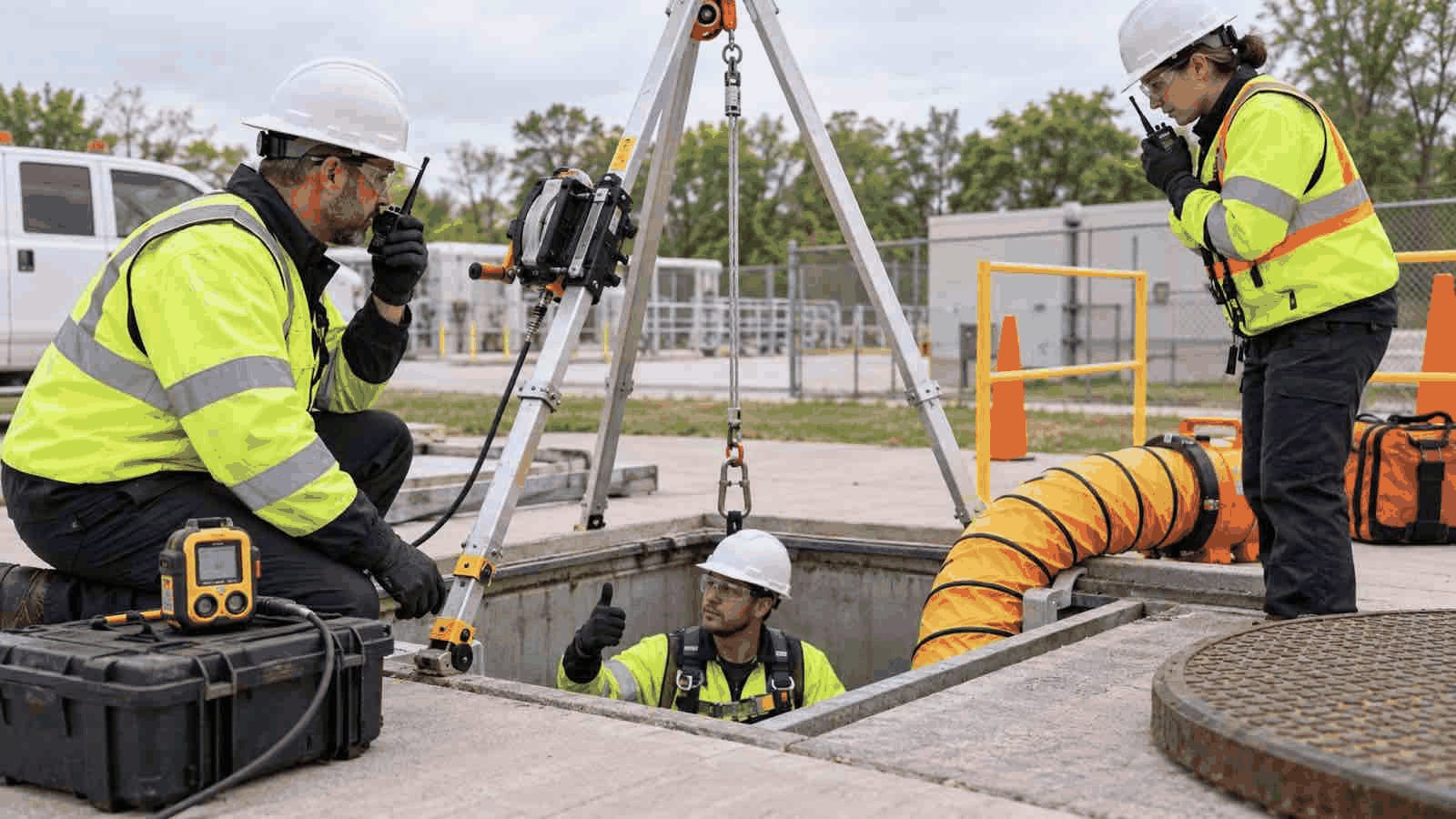
A tested communication plan helps confined-space crews exchange clear messages before entry, during work, and when a hazard or alarm changes conditions. The plan is not complete because a radio was issued or a phone number appears on a permit. Employers need to verify that the selected method works from the actual entry point, remains available during the task, and supports a prompt response when conditions or worker status changes.
This issue is easy to underestimate during planned maintenance. The crew may know each other, the entry may be short, and the space may appear close to the attendant. Yet fans, pumps, traffic, steel walls, depth, personal protective equipment, and equipment noise can make ordinary speech unreliable. A missed message can delay an evacuation, hide a monitor alarm, or prevent an attendant from recognizing that an entrant has stopped responding.
Who This Affects
Communication planning affects every employer that permits or directs work in a confined space. Construction employers working under 29 CFR 1926 Subpart AA may need coordination among the controlling contractor, host employer, entry employer, and specialty rescue provider. General industry employers working under 29 CFR 1910.146 may need a program that covers tanks, vessels, pits, vaults, manholes, sewers, crawl spaces, and other permit spaces.
Entrants need a way to report symptoms, hazards, tool problems, changes in the atmosphere, and the need to leave. Attendants need a way to maintain contact, recognize distress, order evacuation, summon rescue, and keep unauthorized people away. Entry supervisors need reliable information to confirm acceptable conditions, authorize entry, terminate the permit, and respond to changes. Rescue teams need access to the facts that shape the response, including the space configuration, hazards, entry point, equipment, and number of workers.
Contractors and facility managers are also affected when work occurs in an active plant, utility system, municipal asset, or occupied building. One party may control the space while another controls the workers or rescue service. Communication failures often happen at the boundaries, where everyone assumes someone else is monitoring the status.
The Confined Space Compliance Issue
OSHA’s permit-required confined-space rules require employers to evaluate hazards, establish procedures, provide equipment, and coordinate responsibilities. The standard does not treat communication as a decorative addition to the permit. It is part of the system used to monitor entrants, identify unsafe conditions, summon help, and carry out the entry plan.
The right method depends on the space and the work. A direct voice may work for a shallow vault with limited noise, but it can fail when a worker moves behind a baffle or into a deeper section. A radio may work until the entrant’s body position, the wall material, or the fan noise blocks it. A lifeline can provide a physical connection, but pulling on it may not communicate a detailed instruction and may create a hazard if the line is routed across equipment or edges.
Employers should define what information must be exchanged, not just which device will be used. The plan may need a routine check-in schedule, an immediate alarm phrase, a signal for evacuation, a signal for loss of communication, and a method for reporting a monitor alarm. It should state who has authority to order an evacuation and how the order is acknowledged. A worker should not have to guess whether a warning means pause, exit, or emergency rescue.
Communication also supports atmospheric control. The attendant may see a monitor display, hear an alarm, or receive a reading from a remote sensor before the entrant understands what has changed. The attendant needs to relay the action required, and the entrant needs to confirm that the message was received. If communication is lost while the atmosphere is being monitored, the employer should have a predefined response rather than relying on optimism.
Rescue communication has its own demands. A rescue service may need a site address, access route, space diagram, current permit, hazard information, monitor readings, and the last known location of entrants. A generic instruction to call 911 may not provide the information needed for a timely and appropriate response. The employer should evaluate whether the selected rescuers can respond to the particular space and hazards, and communications should be included in that evaluation.
What Employers Should Check
Before the first shift, the entry supervisor and crew should conduct a practical communications check from the work positions. Useful questions include:
- Can the entrant hear and understand the attendant over fans, pumps, tools, traffic, or respiratory equipment?
- Can the attendant distinguish a routine status message from an emergency instruction?
- Does the radio or phone work at the bottom, far end, or most obstructed part of the space?
- What happens if the primary device fails, loses power, or becomes contaminated?
- How will a worker report a symptom or atmospheric alarm without waiting for the next scheduled check-in?
- Who contacts rescue, and what information is transmitted first?
- How will the crew communicate with a host employer or control room?
- How is an evacuation instruction acknowledged and recorded?
The test should match the planned work. If the entry requires hands-on cleaning, welding, coating, pumping, or inspection, the test should account for gloves, face protection, hearing protection, tools, and body position. If the entrant will move through a manhole, tunnel, or interconnected system, the team should test at the farthest planned location. If the attendant cannot maintain reliable contact, the employer should change the method, change the task, add equipment, or decide that entry should not proceed.
A simple check-in protocol can reduce ambiguity. The entrant gives a status call at a defined interval or at a meaningful task milestone. The attendant repeats the entrant’s name and status, then records the check when the entry program requires documentation. A missed check-in has a known escalation path. The path may begin with a repeat call, move to an order to exit, and proceed to rescue actions if the entrant cannot respond or a hazard is present. The exact timing should reflect the space hazards and the employer’s program.
The employer should inspect communication equipment like other entry equipment. Batteries need to be charged. Spare units should be available when the work duration or hazard warrants them. Cords and headsets need to be compatible with the worker’s PPE. Devices may need intrinsically safe or otherwise suitable designs when flammable atmospheres are possible. Equipment should be protected from water, dust, corrosive materials, and the task’s other conditions.
Communication is not a substitute for continuous or periodic atmospheric monitoring, ventilation, isolation, retrieval, or rescue planning. It is one layer in the entry system. A clear radio call does not make an unsafe atmosphere acceptable, and a working lifeline does not eliminate the need for a trained attendant and a suitable rescue plan.
Which Training Fits This Situation
Confined Space Awareness Training is useful for workers who need to recognize confined-space hazards, understand why entry is restricted, and follow the employer’s communication and evacuation instructions without serving in a designated entry role. It can be a practical baseline for maintenance, construction, utility, and municipal workers who may encounter spaces during normal duties.
Permit-Required Entry Training should cover the full entry system, including hazard evaluation, permits, isolation, atmospheric testing, ventilation, monitoring, communication, PPE, retrieval, rescue, and termination. Entrants and attendants need role-specific practice. An entrant should know how to report conditions and respond to an evacuation order. An attendant should know how to maintain contact, monitor status, prevent unauthorized entry, and summon help without entering.
Supervisor training is important when the person authorizes entry, verifies acceptable conditions, confirms procedures, or terminates the permit. Supervisors should practice deciding whether a communication method is adequate for the actual space. Competent Person training may be relevant on construction projects when a designated person evaluates hazards and controls the entry process under the employer’s program.
For mixed crews, a role matrix can show who needs awareness, who may enter, who serves as attendant, who signs permits, who manages contractors, and who contacts rescue. Online training can support consistent foundational knowledge and certificates of completion can help organize records, but employers still need site-specific briefings, equipment checks, drills, and hands-on or in-person practice where the job demands it.
Common Mistakes to Avoid
One common mistake is treating a device assignment as a communication plan. The plan should specify the message, the response, and the backup when the device fails. Another is testing only at the opening. The crew should test where the entrant will actually work, including the location with the most interference.
Employers should also avoid using vague signals. “Come out” may be understood differently from “evacuate now,” and a repeated alarm may not tell the entrant whether to leave because of gas, fire, loss of ventilation, or another emergency. Plain language and consistent signals help reduce hesitation.
Do not assume the attendant can leave the opening to find a better signal. The attendant’s duties continue while entrants are inside. If the method fails, the program should provide a safe response that protects the attendant and keeps the space controlled. Do not send an unplanned worker into the space to check on a silent entrant.
Finally, do not rely on a certificate alone. Training records are useful evidence of preparation, but they do not prove that a particular radio works in a particular vault or that a rescue team has practiced the route. Employers should connect training to the site, the equipment, the roles, and the hazards.
Next Step
Before the next confined-space entry, conduct a communication test from the entrant’s work position and write the result into the entry preparation process. If the test exposes gaps, select the training and equipment that match the assigned roles, then validate the complete system with a site-specific briefing. Confined Space Training from confined-space.com can support awareness, permit-entry, supervisor, and Competent Person preparation, while the employer remains responsible for the actual entry program and worksite controls.