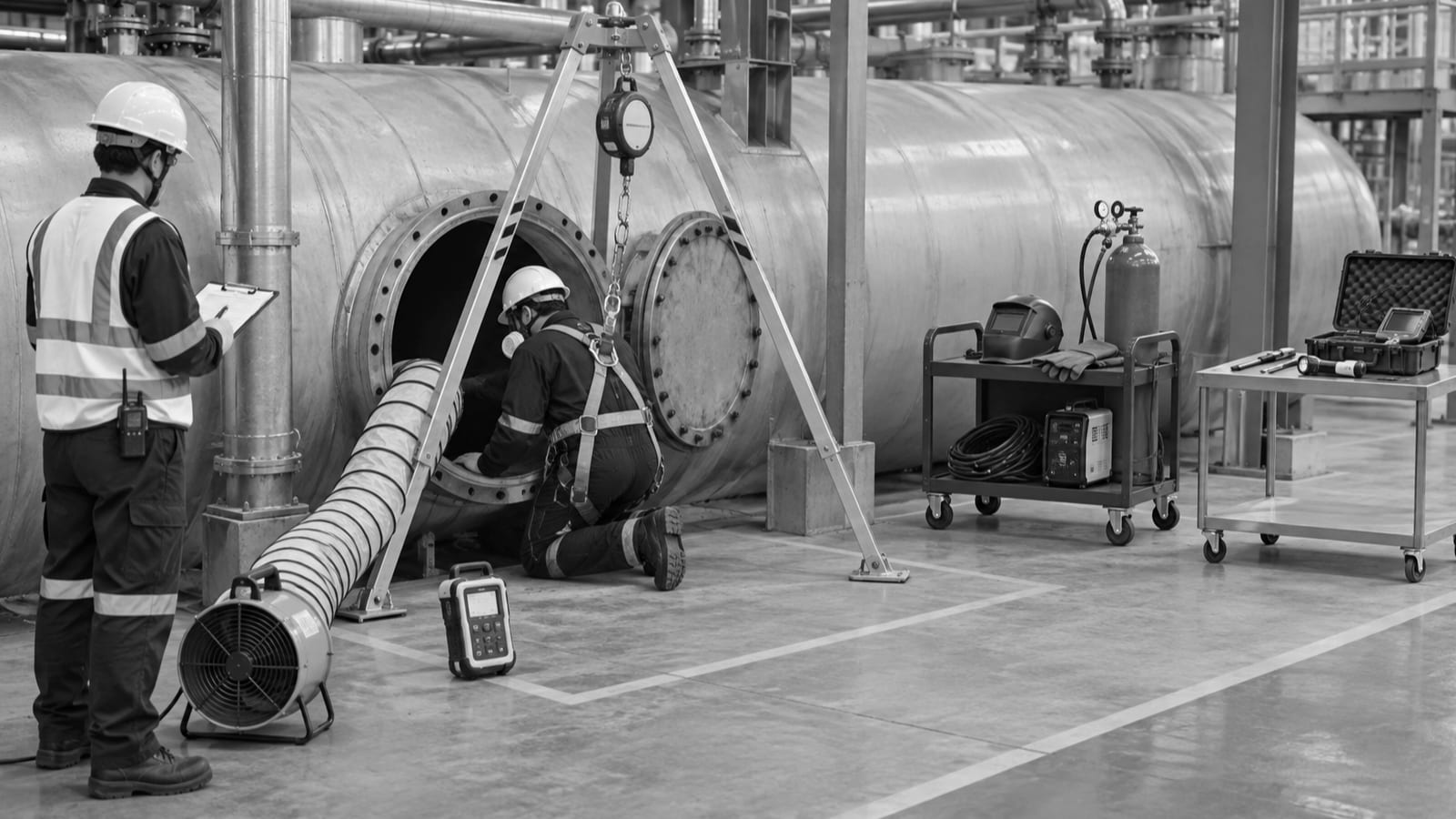
When several tasks occur inside one confined space, each tool, chemical, energy source, and crew action can change the hazards covered by the entry permit. A tank inspection may overlap with cleaning, a repair may introduce hot work, or one contractor may start a coating task while another adjusts ventilation. The entry supervisor needs to evaluate the combined operation, not approve separate work packets that only look safe when viewed alone.
This article focuses on permit-required confined spaces under general industry. Construction work may involve additional or different requirements, and every employer must evaluate the standard, space, tasks, and roles that apply to its operation. The discussion supports planning and training, but it does not replace a site-specific permit-space program or professional safety advice.
Who This Affects
The issue affects employers that send more than one craft, contractor, or work group into tanks, vaults, pits, vessels, silos, process equipment, and other permit spaces. Maintenance planners, operations personnel, entry supervisors, attendants, authorized entrants, industrial hygienists, safety staff, and rescue services all depend on an accurate picture of what will happen inside and near the space.
Host employers and contractors are especially affected when their work overlaps. One employer may control the process equipment while another supplies welders, inspectors, cleaners, electricians, or specialty technicians. Federal permit-space requirements call for coordination when employees of more than one employer work simultaneously as authorized entrants so that one employer's employees do not endanger another's. That coordination needs to reach the field permit and pre-entry briefing, not remain in contract language.
Small crews are also affected. A single employer may assign one entrant to inspect, another to clean, and a third to repair. Even without multiple companies, the activities can interact. A cleaner can change the atmosphere, a grinder can create sparks and noise, a pump can affect ventilation, and a hose can obstruct retrieval. The permit should describe the combined entry accurately enough for entrants and attendants to understand the whole operation.
The Confined Space Compliance Issue
The permit-space program must identify and evaluate hazards before employees enter, define acceptable entry conditions, isolate the space, and establish the procedures and equipment needed for safe entry. The entry permit identifies the purpose of entry, hazards, controls, acceptable conditions, test results, communication, rescue arrangements, equipment, and any additional permits such as hot-work authorization. When tasks are added or changed, the original permit may no longer describe the entry that is actually occurring.
Simultaneous work can create additive hazards. Two products that are acceptable when used separately may create an unexpected vapor concern when combined. Welding can consume oxygen, create fumes, introduce ignition sources, and affect protective coatings. Cleaning can disturb residues. Powered tools can add heat, noise, vibration, and electrical leads. Material movement can block the portal. An operation outside the space can change energy, flow, or atmospheric conditions inside it.
The interaction can also defeat a control. A ventilation duct placed for one work position may be moved to make room for scaffolding. A temporary partition may create a poorly ventilated zone. A welding screen may obstruct the attendant's view or communication. One entrant may disconnect an isolation point that another crew believed was secured. A retrieval line may become entangled with hoses or cables introduced for a second task.
The entry supervisor is responsible for determining that acceptable conditions are present, authorizing and overseeing entry, and terminating entry as required. If a condition arises that is not allowed under the permit, the entry must be terminated and the permit canceled. Adding an unreviewed activity should never be treated as a minor production adjustment when it changes the purpose, hazards, equipment, or controls described by the permit.
What Employers Should Check
Define every task and sequence
List the work steps in the order they will occur. Identify which steps are simultaneous, which require the space to be clear, and which can begin only after another task is complete. The description should include inspection, cleaning, testing, cutting, welding, coating, abrasive work, line breaking, equipment removal, material transfer, and any operation near the portal that could affect entrants.
Build one combined hazard review
Compare the hazards created by the space with those created by each task. Review atmospheric contaminants, oxygen effects, flammable materials, engulfment, mechanical and electrical energy, temperature, noise, visibility, falling objects, slips, access, ergonomics, and rescue configuration. Safety data, process knowledge, prior permits, monitoring history, and contractor information should feed the same review.
Confirm isolation boundaries
Each crew needs the same understanding of valves, blinds, disconnects, lockout or tagout points, stored energy, and operations that remain live. The employer should identify who controls each boundary and how a change will be communicated. A worker should not assume that another craft's lock or work order covers the energy that affects the entry.
Reevaluate ventilation and monitoring
The ventilation and testing plan should match the combined contaminants and work locations. Determine where air enters and leaves, whether one task can push contaminants toward another entrant, and whether ducting will remain effective as people and equipment move. Monitoring locations, instruments, alarm settings, and frequency should reflect the evaluated hazards and acceptable entry conditions.
Protect communication and accountability
The attendant must maintain an accurate count of entrants, communicate as necessary, monitor activities inside and outside the space, and order evacuation when required. Multiple tasks can increase radio traffic, noise, visual obstruction, and confusion about who is directing whom. Use clear call signs, stop signals, and a rule for reporting task changes before they begin.
Preserve rescue capability
Compare the rescue plan with the final layout, entrant count, PPE, work platforms, partitions, hoses, and equipment. The rescue service needs information about hazards that entrants may face, including hazards created by the work. A rescue path that worked for an empty tank may not work after scaffolding, tools, welding leads, or process components occupy the route.
Which Training Fits This Situation
Authorized entrant training should prepare workers to recognize the hazards of their own task and the ways another task can affect them. Entrants need to understand alarms, symptoms, communication, evacuation triggers, and the prohibition against making an unapproved change simply because the tool or material is already available. The briefing should identify who can authorize a task change and what happens while the change is reviewed.
Attendant training should address divided attention. The attendant must not take on duties that interfere with monitoring and protecting entrants. When several tasks occur, the attendant may need to track work positions, atmospheric information, changing noise, outside operations, and entrant status at the same time. A realistic drill can show whether the communication plan is usable under that workload.
Entry supervisor training should emphasize combined hazard evaluation, permit accuracy, contractor coordination, and termination decisions. A supervisor should be able to compare the actual work with the authorized purpose and recognize when the permit needs to stop. Training should use scenarios in which a repair expands, a contractor changes a product, a hot-work task is added, monitoring changes, or an outside process affects the space.
Permit-required confined space training fits entrants, attendants, and supervisors who perform defined permit-space duties. Awareness training fits employees who need to recognize spaces and avoid unauthorized entry but do not serve entry roles. Supervisor or competent-person focused training may be appropriate for people who evaluate conditions, coordinate programs, or direct complex work, depending on the employer's industry and assigned duties. Course completion supports knowledge, but the employer must still provide site-specific procedures, equipment instruction, and practical verification.
Common Mistakes to Avoid
One mistake is attaching several permits without reconciling them. A confined-space permit, hot-work permit, lockout record, and contractor work package can each be complete on its own while conflicting with the others. The entry supervisor should compare purposes, times, hazards, isolations, names, monitoring, and stop conditions before authorization.
Another mistake is describing the entry as inspection and then allowing repair work to begin automatically. The permit duration cannot exceed the time required to complete the assigned task identified on the permit, and the authorized purpose matters. If findings lead to a new task, pause and evaluate whether the existing permit covers it accurately.
Employers also make mistakes when they rely on one atmospheric reading for a changing operation. Work can generate contaminants or alter oxygen and flammability conditions after entry begins. Testing or monitoring should determine whether acceptable conditions are being maintained during entry. The plan should account for the work locations and substances involved, not merely the opening.
A fourth mistake is assuming contractors will coordinate among themselves. The host employer and entry employers have information and coordination duties. A brief exchange of permits is not enough if one crew does not know what another will introduce into the space or when process operations outside the space may change.
Another mistake is letting production pressure redefine the permit. A worker may say that a second task will take only a minute or that the tool creates no new hazard. The correct question is whether the task changes the authorized purpose, hazards, controls, acceptable conditions, equipment, communication, or rescue plan. If it does, the entry supervisor should stop and follow the employer's change process.
Finally, teams sometimes overlook the exit and portal. Tools, debris, cords, hoses, cylinders, and ventilation ducting can accumulate as work expands. The route must remain usable for normal exit and emergency response, and the attendant's position must remain effective. Good housekeeping inside a permit space is part of entry control, not cosmetic cleanup.
Next Step
Select one planned entry that involves two crafts or two work activities and conduct a combined permit review before the work date. Put the task sequence, hazards, isolation, ventilation, monitoring, communication, rescue, and stop conditions on one page. Ask each employer and entry role to explain how a change will be reported and authorized.
If the answers differ, resolve the conflict before entry. A permit is useful only when it describes the operation people will actually perform. Clear coordination gives the entry supervisor a defensible basis for authorization and gives entrants a shared understanding of what is allowed, what is prohibited, and when everyone must exit.
Sources
Electronic Code of Federal Regulations, 29 CFR 1910.146 Permit-Required Confined Spaces: https://www.ecfr.gov/current/title-29/subtitle-B/chapter-XVII/part-1910/subpart-J/section-1910.146
Occupational Safety and Health Administration, Permit-Required Confined Spaces: https://www.osha.gov/confined-spaces
Occupational Safety and Health Administration, Confined Spaces Advisor: https://www.osha.gov/etools/confined-spaces