Supplied-air respirators can protect confined-space entrants only when air quality, hose routing, entry controls, and rescue planning work as one system. Selecting a respirator is not a substitute for evaluating the space, controlling hazards, testing the atmosphere, ventilating when appropriate, or following the employer's permit-required confined-space program.
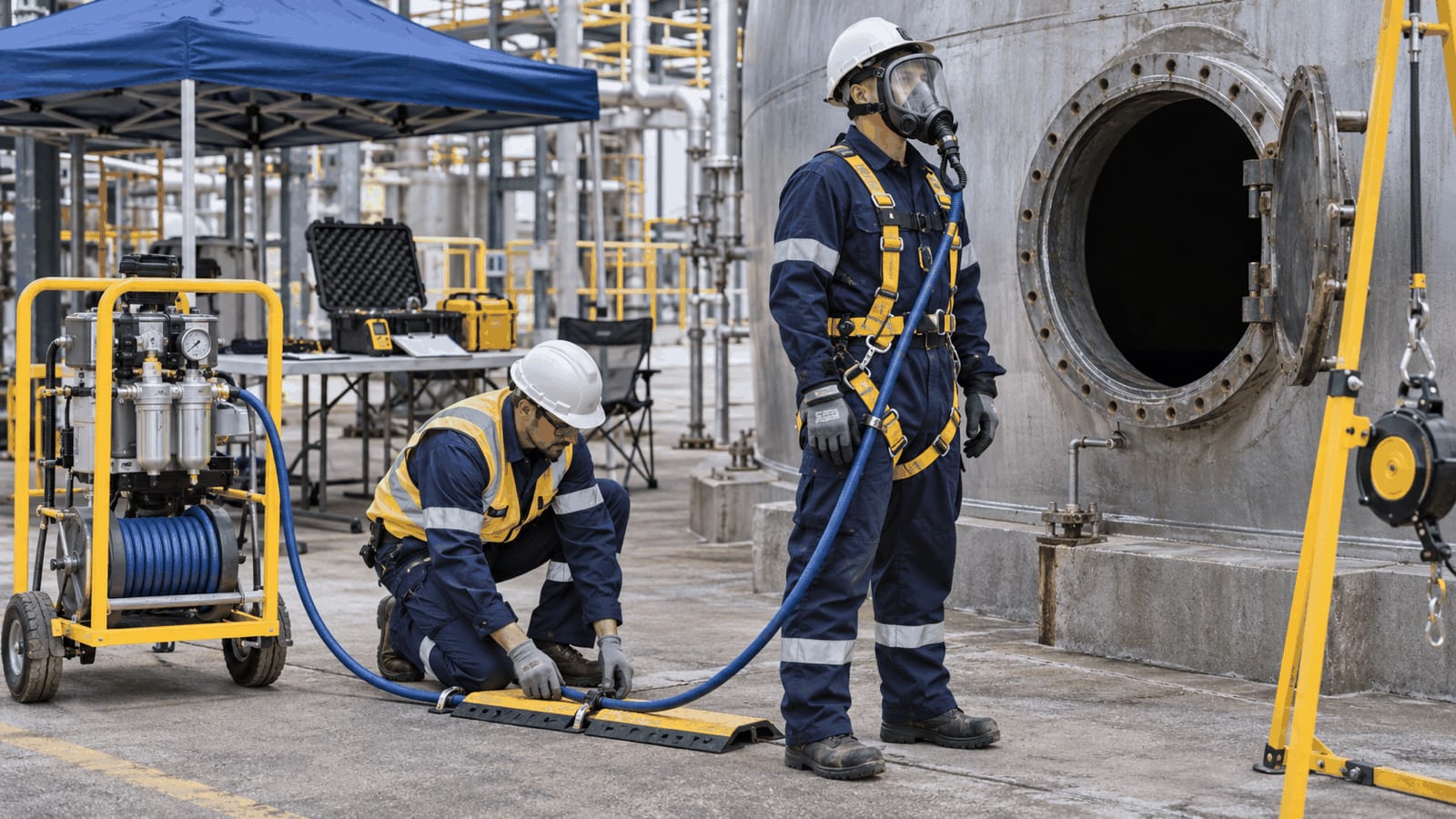
A supplied-air respirator, often called an airline respirator, delivers breathing air through a hose connected to a source outside the contaminated area. That arrangement can support longer work than a conventional self-contained breathing apparatus, but it also creates dependencies. The entrant relies on the air source, regulator, fittings, hose, facepiece, and procedures that keep the supply available. The hose can also affect movement through ladders, narrow openings, internal obstructions, and work areas.
Employers should coordinate respiratory protection and confined-space entry before the permit is authorized. The program administrator, entry supervisor, attendant, entrants, rescue planners, and equipment personnel need a shared understanding of the atmosphere, respirator limitations, work sequence, alarm response, and exit plan.
Who This Affects
This issue affects employers whose employees enter tanks, vessels, pits, vaults, process equipment, sewers, boilers, and other spaces where respiratory hazards may be present. It is especially relevant when the work can release vapors, gases, dusts, fumes, or mists, or when the atmosphere may become oxygen deficient. Cleaning, coating, welding, cutting, chemical transfer, sludge removal, and process maintenance can introduce or increase hazards after entry begins.
Respiratory protection program administrators need to connect hazard evaluation and respirator selection with the specific geometry and tasks inside the space. Entry supervisors need enough information to verify that required controls are in place before authorizing entry. Attendants must understand respiratory alarms and hose problems well enough to order evacuation without attempting an unauthorized entry.
Authorized entrants need training and practice with the exact equipment and route they will use. Rescue services need to know whether an entrant will wear an airline, an auxiliary escape supply, a harness, and a retrieval line. Maintenance and operations personnel who provide compressed air, power, ventilation, or isolation also affect whether the system can remain reliable through the full entry.
Contractor and host-employer coordination matters when one company controls the space and another supplies the entry crew or respiratory equipment. Assumptions about who verified breathing air, who inspected hoses, or who will respond to an alarm can create dangerous gaps. Responsibilities should be resolved before the entry permit is signed.
The Confined Space Compliance Issue
OSHA's respiratory protection standard requires employers to evaluate respiratory hazards, identify relevant workplace and user factors, and select an appropriate respirator. If the employer cannot identify or reasonably estimate the exposure, the atmosphere must be considered immediately dangerous to life or health. Oxygen-deficient atmospheres are also treated as IDLH, subject to the limited altitude-related exception in the standard.
Respirator selection must match the hazard classification. A supplied-air respirator without an auxiliary self-contained air supply is not one of the respirator configurations listed for entry into an IDLH atmosphere. For IDLH conditions, the standard identifies a full-facepiece pressure-demand SCBA with a minimum service life of 30 minutes or a combination full-facepiece pressure-demand supplied-air respirator with an auxiliary self-contained air supply. Escape-only respirators must be certified for escape from the atmosphere in which they will be used.
The permit-space program adds another layer. Employers must identify and evaluate hazards before employees enter, develop procedures and practices for safe entry, provide necessary equipment, evaluate conditions during entry, and provide for rescue and emergency services. Atmospheric testing and monitoring must follow the applicable entry procedure. A respirator reduces inhalation exposure when properly selected and used, but it does not control fire, engulfment, mechanical movement, heat stress, or the physical limitations of the space.
The air supply is part of the protective system. OSHA requires atmosphere-supplying respirators to receive breathing gas of the specified purity. Compressed breathing air must meet at least Grade D requirements described in the respiratory protection standard. Employers must also address compressors, couplings, cylinders, moisture, carbon monoxide, and other conditions covered by the standard. Plant compressed air should never be assumed to be breathing air merely because a fitting can be connected.
Hose length and configuration matter because the respirator is approved as a complete assembly under specified conditions. Employers should use the respirator in compliance with its certification and manufacturer instructions. Improvised fittings, unauthorized hose combinations, or repairs by unqualified personnel can change performance and may violate the conditions under which the equipment was approved.
What Employers Should Check
Define the atmosphere and the work
Start with the identified or reasonably estimated contaminants, oxygen concentration, potential concentrations, chemical state, and physical form. Consider what the job will add to the space. A tank may initially test within acceptable limits, yet coating removal, solvent use, welding, or residue disturbance can change the atmosphere. The assessment should cover routine work and reasonably foreseeable emergencies.
Document whether the atmosphere is IDLH, potentially IDLH, or non-IDLH and identify the basis for that conclusion. The entry team should know what information would cause the classification or respirator selection to change. If the hazard cannot be adequately characterized, the employer should not downgrade the uncertainty through assumption.
Verify the complete respirator configuration
Check the facepiece, regulator, breathing tube, belt or harness components, approved air-supply hose, couplings, air source, and any required auxiliary cylinder. Confirm that the complete configuration is permitted by the equipment's approval and instructions. Inspect components before use and remove defective equipment from service under the program's procedures.
Tight-fitting facepieces require the medical evaluation, fit testing, and user seal checks addressed by the respiratory protection standard. Facial hair or other conditions that interfere with the sealing surface can compromise the fit. Prescription eyewear, communication equipment, protective clothing, and head protection should be arranged so they do not disrupt the seal or breathing-air connections.
If an auxiliary escape supply is required, entrants should know its service duration, activation method, gauge or alarm features, and limitations. It is an escape resource, not extra working time. The travel route and expected exit time should be compatible with the available emergency supply.
Protect the breathing-air source
Locate the air source where it will not draw in exhaust, process emissions, solvent vapors, or other contamination. Protect cylinders and compressors from damage and unauthorized adjustment. Verify that breathing-air quality, compressor safeguards, alarms, and maintenance meet the requirements that apply to the selected system.
Someone should be assigned to monitor the source when the entry plan depends on continuous air delivery. The plan should state what happens if pressure drops, a compressor alarm activates, electrical power is lost, or another crew needs to move the source. A verbal assumption that someone nearby will notice is not a reliable control.
Plan hose routing through the whole space
Walk the route from the source to the entrant's work position. Account for the opening, ladder, platform edges, sharp surfaces, hot work, vehicle traffic, doors, rotating equipment, and places where the hose could be crushed or pinched. Use compatible hose protection and routing methods that do not create a new trip hazard or prevent rapid exit.
Inside the space, consider bends, columns, piping, baffles, and elevation changes. The entrant should not have to disconnect the air line to pass an obstruction. Hose length should remain within the approved configuration, and excess hose should be managed so it does not tangle with retrieval equipment or another entrant.
Multiple entrants require deliberate routing. Color coding or other identification can help the attendant and entrants distinguish lines, but markings should not obscure inspection or approval information. The team should know how a line will be traced if an alarm, snag, or loss of flow occurs.
Connect alarms to entry actions
The permit and briefing should identify alarms associated with the respirator, air source, auxiliary supply, atmospheric monitor, and ventilation equipment. Each alarm needs a defined response. Entrants should not remain inside while the team debates whether a low-pressure signal is serious.
The attendant should maintain communication with entrants and order evacuation when a prohibited condition is detected, when behavioral effects of hazard exposure are noticed, when a situation outside the space could endanger entrants, or when the attendant cannot effectively perform required duties. A breathing-air failure or damaged airline should be incorporated into those procedures.
Align rescue with respiratory equipment
Rescue planning must reflect the actual entry system. A retrieval line can conflict with an airline, especially at a small opening or around internal equipment. Rescue personnel should evaluate how the lines will move together and whether non-entry retrieval is feasible without increasing injury or entanglement.
The rescue service should understand the atmospheric hazards, entry route, respirators in use, auxiliary supply, and time needed to reach and remove an entrant. Rescue practice should use representative openings, equipment, and line routing. A general rescue capability that has never been tested with the supplied-air arrangement may not reveal practical problems before an emergency.
Which Training Fits This Situation
Authorized entrant training should cover the hazards of the space, signs and consequences of exposure, proper use and limitations of the assigned respirator, communications, alarm response, and evacuation. Entrants should practice donning, connection checks, user seal checks for tight-fitting facepieces, controlled movement with the hose, transition to auxiliary air when applicable, and exit without disconnecting the supply.
Attendant training should focus on accountability, communication, line observation, external hazards, alarm recognition, and evacuation authority. The attendant should know the difference between managing a hose from outside and performing equipment maintenance or repair that requires specialized qualification. Attendants must remain outside unless relieved and should not take on duties that interfere with monitoring and protecting entrants.
Entry supervisors need role-based training that connects respirator readiness to permit authorization. They should be able to verify that hazard evaluation, air testing, air supply, hose routing, medical clearance, fit testing, equipment inspection, communications, and rescue arrangements are complete. They should also know when a changed condition requires permit suspension, cancellation, or a new evaluation.
The respiratory protection program administrator needs training or experience appropriate to the program's complexity. Equipment technicians need the manufacturer-specific qualifications required for adjustments and repairs. Rescue personnel need practice with the exact space and equipment configuration. A general confined-space awareness course alone is not enough preparation for employees assigned these operational roles.
Training can be organized around the employee's assignment: confined-space awareness for workers who need to recognize and avoid unauthorized entry, permit-required confined-space entrant and attendant training for entry team members, entry supervisor training for those who authorize and terminate entry, and rescue training for the designated rescue function. Respirator training, fit testing, and medical evaluation obligations remain part of the respiratory protection program and should be coordinated with, not replaced by, confined-space training.
Common Mistakes to Avoid
One mistake is choosing an airline respirator because it appears convenient without first classifying the atmosphere. Equipment suitable for a non-IDLH atmosphere may not be suitable for IDLH entry. Another mistake is treating an auxiliary cylinder as a normal work supply rather than an emergency resource for escape.
Employers may verify breathing-air pressure at the start but fail to protect the source for the duration of entry. A moved compressor, contaminated intake, disconnected cylinder bank, or power interruption can affect entrants immediately. Continuous dependencies need continuous ownership.
Poor hose routing is another recurring weakness. A line may look clear at the opening but catch on an internal ladder, pipe support, or sharp edge as the entrant moves. Routing should be evaluated at the actual work location, not only from outside the space.
Some teams add respiratory protection to an existing permit without revisiting rescue. The extra hose, auxiliary cylinder, and facepiece can affect retrieval and communication. Rescue compatibility should be confirmed before entry, not discovered during an emergency.
Finally, documentation can be mistaken for readiness. A current fit-test record does not show that the day's airline is intact, that the breathing-air source is protected, or that the entrant can navigate the space. Field verification and practice are needed alongside records.
Next Step
Before the next entry that uses supplied air, bring the respiratory protection program administrator, entry supervisor, attendant, entrants, and rescue representative together for a route-based review. Trace the breathing-air system from source to facepiece, verify the atmosphere classification and respirator configuration, walk the hose path, test communications and alarms, and confirm the evacuation and rescue sequence.
Use the findings to update the permit procedure, equipment checklist, and role-based training. If the space, task, contaminant, air source, or equipment configuration changes, reassess the plan before entry continues. Coordinated preparation helps ensure that the respirator, permit program, and rescue plan support the same safe-entry decision.
Sources
Occupational Safety and Health Administration, 29 CFR 1910.134 Respiratory protection: https://www.osha.gov/laws-regs/regulations/standardnumber/1910/1910.134
Occupational Safety and Health Administration, 29 CFR 1910.146 Permit-required confined spaces: https://www.osha.gov/laws-regs/regulations/standardnumber/1910/1910.146
Occupational Safety and Health Administration, Small Entity Compliance Guide for the Respiratory Protection Standard: https://www.osha.gov/sites/default/files/publications/3384small-entity-for-respiratory-protection-standard-rev.pdf
Occupational Safety and Health Administration, Permit-Required Confined Spaces publication: https://www.osha.gov/sites/default/files/publications/osha3138.pdf