
Search Intent: Which confined space course should employers choose for utility vault and manhole crews, and why does the answer depend on each worker's assigned duty before dispatch?
Who This Affects
This article is for employers who send workers near or into utility vaults, manholes, lift stations, sewer structures, stormwater structures, meter pits, valve vaults, communications spaces, crawl areas, and similar confined spaces. It is written for municipal leaders, public works supervisors, utility contractors, safety and EHS managers, construction foremen, general contractors, facility managers, compliance coordinators, and buyers responsible for selecting OSHA-aligned confined space training.
The audience also includes teams that do not always think of themselves as confined space crews. A water department may inspect valve boxes and pump stations. A telecom contractor may open underground utility structures. A paving contractor may coordinate work around a manhole. A maintenance team may support a vendor entering a pit. A general contractor may have multiple subcontractors working around the same underground opening. In each case, workers may need different levels of training depending on whether they recognize the hazard, control the area, test the atmosphere, enter the space, attend the entry, supervise the permit, or evaluate changing jobsite conditions.
Course selection matters because one generic label, such as "confined space trained," does not tell an employer whether a person is prepared for the task assigned that day. A worker who only needs to recognize and avoid unauthorized entry may need awareness-level training. A worker assigned as an authorized entrant or attendant for a permit-required space needs deeper instruction. A foreman who authorizes entry and cancels permits needs supervisor-level understanding. A construction employer may also need a competent person who can identify existing and predictable hazards and take corrective measures within the employer's program.
The practical problem is dispatch pressure. Utility and municipal work often moves quickly. Crews respond to service calls, blocked lines, storm damage, inspection schedules, repair tickets, and contractor coordination needs. If training decisions are made only after the truck is loaded, the employer may discover too late that the available workers do not match the role mix needed for the space. A better approach is to define the space types, identify the tasks, assign roles, and select training before dispatch.
The Confined Space Compliance Issue
Utility vaults and manholes can look routine because crews see them often. Familiarity can hide the compliance issue. A structure may have limited entry or exit, may not be designed for continuous occupancy, and may contain actual or potential hazards that make it a permit-required confined space. Atmospheric hazards, engulfment, water intrusion, traffic exposure, electrical hazards, poor ventilation, chemical residue, biological hazards, configuration hazards, and energy sources may all affect the decision.
The training issue is not simply whether a space has a lid or an access hatch. It is whether the employer has matched training to the way workers interact with the space. Some employees only work near the opening. Some remove covers and set up barricades. Some test the atmosphere. Some enter briefly for inspection. Some perform repair work that changes the hazard profile. Some supervise contractors. Some decide whether permit-required entry procedures are needed. These are different duties, and they call for different levels of preparation.
For general industry employers, permit-required confined space work is commonly evaluated under 29 CFR 1910.146. For construction work, 29 CFR 1926 Subpart AA applies. Employers should avoid treating those references as abstract legal citations. They affect real decisions about identifying confined spaces, communicating hazards, assigning entry roles, using permits, testing atmospheres, coordinating with contractors, and planning rescue. The employer does not need to turn every crew member into a regulatory specialist, but the employer does need to make sure each assigned role is supported by appropriate training and site-specific instruction.
One common gap appears when a utility crew has several experienced workers but no clear entry supervisor. Another appears when a contractor assumes the municipal host has classified the space and arranged rescue, while the host assumes the contractor's training covers the job. A third appears when workers complete an online course but have never been briefed on the employer's gas monitor, ventilation setup, retrieval equipment, communication method, or permit form. These gaps do not mean online training is ineffective. They mean online training must be connected to the employer's spaces, equipment, and responsibilities.
Confined-space.com course selection should therefore begin with the job duties. Awareness, Permit-Required Entry, Supervisor, and Competent Person training each solve a different problem. Selecting the right one helps the employer build a practical training matrix instead of relying on vague assumptions. The result should be a crew that understands who may enter, who must remain outside, who can authorize the work, who evaluates hazards, and what extra field instruction is required before entry begins.
What Employers Should Check
Before selecting courses for vault and manhole work, employers should map the work in plain language. The goal is not to create paperwork for its own sake. The goal is to prevent a mismatch between the workers dispatched and the responsibilities the job actually requires.
- List the spaces workers may encounter. Include sewer manholes, storm structures, water valve vaults, meter pits, lift stations, telecom vaults, electrical vaults, tanks, pits, and any contractor-controlled spaces that crews may support.
- Identify which spaces may be permit-required. Review known or potential atmospheric hazards, engulfment, inwardly converging walls, sloped floors, mechanical hazards, electrical hazards, water intrusion, chemicals, biological hazards, and other serious hazards.
- Separate nearby work from entry work. A person setting cones near a manhole does not have the same duty as a person climbing inside. Training should reflect the difference.
- Identify who removes covers and controls access. Workers who open a space may need to recognize hazards, prevent unauthorized entry, communicate with supervisors, and understand when the job must stop.
- Decide who may perform atmospheric testing. Testing requires more than owning a meter. The employer should define who tests, when testing happens, what gases are measured, how the monitor is checked, and how results are communicated.
- Decide who may enter. Authorized entrants need to understand hazards, communication, monitoring, PPE, evacuation triggers, permit conditions, and the limits of their role.
- Decide who may serve as attendant. Attendants need to understand continuous monitoring duties, communication, entrant tracking, emergency steps, and why they must not abandon their assigned position.
- Decide who may act as entry supervisor. Supervisors need enough training to verify controls, review permits, confirm rescue arrangements, authorize entry, and terminate the entry when conditions require it.
- Decide whether a competent person is needed. Construction crews and contractors should identify who is responsible for recognizing existing and predictable hazards and taking prompt corrective measures within the employer's authority.
- Review contractor coordination. Clarify whether the host employer or contractor classifies the space, provides hazard information, supplies equipment, controls the permit, assigns rescue, and keeps records.
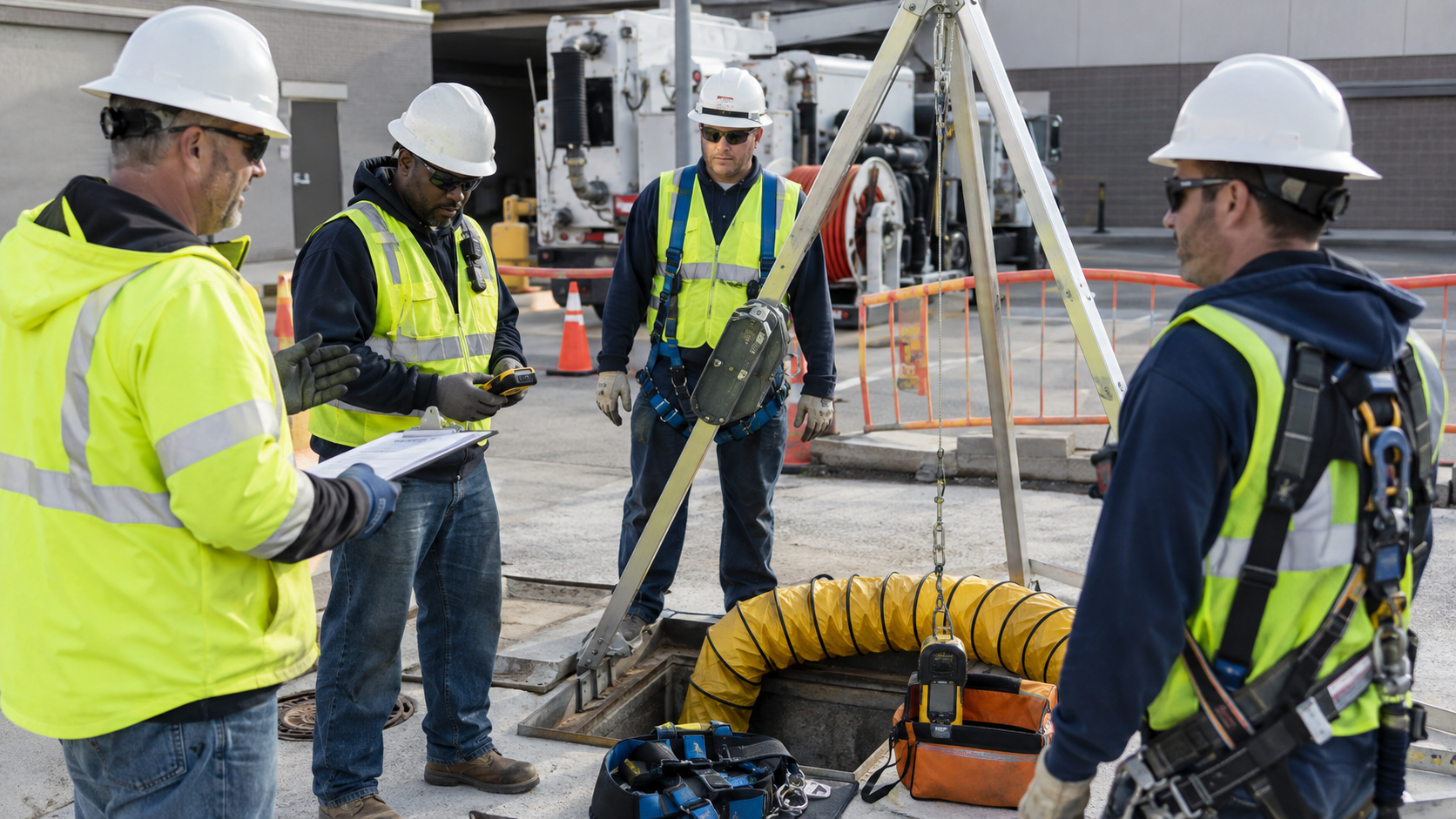
- Check equipment training. Gas monitors, ventilation blowers, ducts, harnesses, tripods, davit arms, winches, radios, barricades, and lighting all require employer-specific instruction.
- Confirm rescue planning before dispatch. Do not wait until the crew is at the opening to decide whether non-entry retrieval is feasible or whether an outside rescue service has been coordinated.
- Match records to roles. Keep certificates of completion, field briefings, authorizations, permit records, and refresher needs organized by worker and duty.
This checklist gives the buyer or safety manager a practical way to choose courses. If a worker's only assigned duty is recognition and avoidance, awareness training may fit. If the worker may enter or attend permit-required work, a permit-required entry course is the better match. If the worker authorizes entries or manages the permit process, supervisor training should be considered. If the worker evaluates construction jobsite hazards and directs corrective action, competent person training may be needed.
Which Training Fits This Situation
Awareness training fits employees who need to identify confined spaces, understand why unauthorized entry is dangerous, recognize when a job may require additional controls, and know when to stop and contact a supervisor. For vault and manhole operations, this may include laborers, inspectors who do not enter, equipment operators, traffic control personnel, dispatchers who route work, project managers, and facility staff who coordinate vendors. Awareness training is useful because it helps prevent informal entry and helps non-entry personnel recognize when the work has moved beyond their role.
Permit-Required Confined Space Entry training fits workers who may be assigned as authorized entrants or attendants for permit-required spaces. This is often the core training path for utility and municipal crews that enter manholes, valve vaults, lift stations, meter pits, and process-related utility spaces. It should cover entry roles, permits, hazard controls, atmospheric testing concepts, ventilation, communication, evacuation, and emergency procedures. Employers should add site-specific instruction on their own permit forms, monitoring instruments, PPE, retrieval equipment, and communication methods.
Supervisor training fits foremen, lead workers, public works supervisors, safety coordinators, facility leaders, and contractor supervisors who authorize or oversee entries. A supervisor needs more than general awareness. The supervisor should understand how to verify that testing has occurred, controls are in place, the permit is complete, workers are assigned properly, rescue arrangements are addressed, and entry should be canceled or stopped when conditions change. For organizations with multiple crews, supervisor training helps create consistent decisions across shifts and jobsites.
Competent Person training is often relevant for construction-related confined space work, excavation-adjacent operations, utility installation, repair projects, and contractor activities where jobsite conditions change. The competent person role is not just a title. It is tied to the ability to identify hazards and take prompt corrective measures within the employer's scope. A competent person may help evaluate whether a space is permit-required, recognize when construction activity creates new hazards, coordinate with entry supervisors, and stop work when the plan no longer fits the conditions.
Many employers need a layered plan. A municipal water department might assign awareness training to employees who work around vaults but do not enter, permit-required entry training to entrants and attendants, supervisor training to foremen who authorize entries, and competent person training to designated leaders involved in construction or utility repair projects. A utility contractor might use the same structure but add stronger contractor coordination procedures because crews frequently work under host employer control. A manufacturing facility with utility pits may train maintenance workers for entry and train shift leaders for permit review.
The course decision should lead naturally to a duty decision. After training, the employer should document who is authorized for which role. A certificate of completion supports the record, but employer authorization should still account for site-specific procedures, equipment familiarity, language needs, physical ability, refresher timing, and observed performance. This is particularly important for small crews, night shifts, and emergency response work where the available workers may change quickly.
For buyers comparing confined-space.com options, the simplest question is: What will this worker be expected to do when the truck arrives? If the answer is recognize and avoid, choose Awareness. If the answer is enter or attend a permit-required space, choose Permit-Required Entry. If the answer is approve, coordinate, or stop the entry, choose Supervisor. If the answer is evaluate changing construction or utility jobsite hazards and direct corrective action, choose Competent Person. If the worker does more than one of those things, select a multi-role training path and document when each role may be performed.
Common Mistakes to Avoid
Avoid buying one course for everyone simply because it is easier to administer. Convenience can create undertraining for critical roles and confusion for workers who do not need entry-level detail. A better training plan assigns the right level to each duty and keeps the role boundaries clear.
Avoid assuming experienced utility workers automatically understand permit-required confined space responsibilities. Experience is valuable, but it may not cover the employer's current permit system, atmospheric monitoring procedure, ventilation setup, rescue plan, contractor coordination process, or documentation expectations. Training gives experienced workers a common framework and helps supervisors verify that expectations are consistent.
Avoid confusing awareness with authorization. A worker who can recognize a confined space is not automatically approved to enter it. Authorization should be tied to training, employer procedures, equipment instruction, site-specific briefing, and the conditions of the job.
Avoid assigning an attendant who also has conflicting duties. An attendant cannot effectively monitor entrants, maintain communication, track conditions, and summon rescue if that person is also expected to leave the opening, run equipment elsewhere, direct traffic far from the space, or perform paperwork that distracts from the entry. If the role cannot be performed continuously, the staffing plan needs to change.
Avoid treating atmospheric testing as a casual task. Gas monitors must be selected, maintained, checked, and used according to the employer's procedure and manufacturer instructions. Workers need to know what the readings mean, when testing should occur, how ventilation affects readings, and when conditions require evacuation or cancellation.
Avoid weak rescue assumptions. A tripod or davit system does not guarantee non-entry rescue will work for every manhole or vault. The employer should consider opening size, obstructions, edge geometry, worker position, lifeline routing, retrieval angle, traffic exposure, and whether rescue equipment can be positioned safely. If an outside rescue service is part of the plan, coordination should occur before the entry.
Avoid ignoring host and contractor communication. Utility work often involves a mix of owners, municipalities, prime contractors, subcontractors, and specialty vendors. Each party may hold different information about the space and the work. Before entry, clarify hazards, permits, training expectations, equipment responsibility, rescue arrangements, and post-entry information sharing.
Avoid letting records become disconnected from dispatch. If supervisors cannot quickly see who has Awareness, Permit-Required Entry, Supervisor, or Competent Person training, they may send a crew that lacks a required role. Training records should be easy to review by worker, course, date, language, refresher need, and authorized duty.
Next Step
Before the next utility vault or manhole assignment, list the duties each worker may perform and match those duties to the right confined-space.com training path. Use Awareness for recognition and avoidance, Permit-Required Entry for entrant and attendant duties, Supervisor for permit authorization and entry oversight, Competent Person for designated construction or jobsite hazard evaluation responsibilities, and a multi-role plan when one worker may be assigned different duties on different jobs.
Ready to Get Your Crew Confined Space Certified?
Explore our OSHA-aligned online courses for Awareness, Permit-Required Entry, Supervisor, and Competent Person roles with instant certification.
Explore Courses & Pricing